This site uses cookies as defined in our Cookie Policy, by continuing to use this site you agree to their use.
Continue

| Arrive | Depart | ||||||
| 17th17 | SepSep | 202828 | Amsterdam, Netherlands, embark on the Crystal Serenity | 12:00 | 19:00 | ||
Amsterdam combines the unrivaled beauty of the 17th-century Golden Age city center with plenty of museums and art of the highest order, not to mention a remarkably laid-back atmosphere. It all comes together to make this one of the world's most appealing and offbeat metropolises in the world. Built on a latticework of concentric canals like an aquatic rainbow, Amsterdam is known as the City of Canals—but it's no Venice, content to live on moonlight serenades and former glory. Quite the contrary: on nearly every street here you'll find old and new side by side—quiet corners where time seems to be holding its breath next to streets like neon-lit Kalverstraat, and Red Light ladies strutting by the city's oldest church. Indeed, Amsterdam has as many lovely facets as a 40-carat diamond polished by one of the city's gem cutters. It's certainly a metropolis, but a rather small and very accessible one. Locals tend to refer to it as a big village, albeit one that happens to pack the cultural wallop of a major world destination. There are scores of concerts every day, numerous museums, summertime festivals, and, of course, a legendary year-round party scene. It's pretty much impossible to resist Amsterdam's charms. With 7,000 registered monuments, most of which began as the residences and warehouses of humble merchants, set on 160 man-made canals, and traversed by 1,500 or so bridges, Amsterdam has the largest historical inner city in Europe. Its famous circle of waterways, the grachtengordel, was a 17th-century urban expansion plan for the rich and is a lasting testament to the city’s Golden Age. This town is endearing because of its kinder, gentler nature—but a reputation for championing sex, drugs, and rock ’n’ roll does not alone account for Amsterdam's being one of the most popular destinations in Europe: consider that within a single square mile the city harbors some of the greatest achievements in Western art, from Rembrandt to Van Gogh. Not to mention that this is one of Europe's great walking cities, with so many of its treasures in the untouted details: tiny alleyways barely visible on the map, hidden garden courtyards, shop windows, floating houseboats, hidden hofjes(courtyards with almshouses), sudden vistas of church spires, and gabled roofs that look like so many unframed paintings. And don’t forget that the joy lies in details: elaborate gables and witty gable stones denoting the trade of a previous owner. Keep in mind that those XXX symbols you see all over town are not a mark of the city's triple-X reputation. They're part of Amsterdam's official coat of arms—three St. Andrew's crosses, believed to represent the three dangers that have traditionally plagued the city: flood, fire, and pestilence. The coat's motto ("Valiant, determined, compassionate") was introduced in 1947 by Queen Wilhelmina in remembrance of the 1941 February Strike in Amsterdam—the first time in Europe that non-Jewish people protested against the persecution of Jews by the Nazi regime. | |||||||
| 18th18 | SepSep | 202828 | Antwerp, Belgium | 09:00 | 23:59 | ||
Explore Antwerp, Belgium's second city. Known for its diamond cutting industry, fashion and the many great artists that lived in its vicinity, Antwerp is a city focused on art and culture. | |||||||
| 19th19 | SepSep | 202828 | Antwerp, Belgium | 16:00 | |||
Explore Antwerp, Belgium's second city. Known for its diamond cutting industry, fashion and the many great artists that lived in its vicinity, Antwerp is a city focused on art and culture. | |||||||
| 20th20 | SepSep | 202828 | London (Greenwich), England | 07:00 | 20:00 | ||
About 8 miles downstream—which means seaward, to the east—from central London, Greenwich is a small borough that looms large across the world. Once the seat of British naval power, it is not only home to the Old Royal Observatory, which measures time for our entire planet, but also the Greenwich Meridian, which divides the world into two—you can stand astride it with one foot in either hemisphere. Bear in mind that the journey to Greenwich is an event in itself. In a rush, you can take the driverless DLR train—but many opt for arriving by boat along the Thames. This way, you glide past famous sights on the London skyline (there’s a guaranteed spine chill on passing the Tower) and ever-changing docklands, and there’s usually a chirpy Cock-er-ney navigator enlivening the journey with his fun commentary. A visit to Greenwich feels like a trip to a rather elegant seaside town—albeit one with more than its fair share of historic sites. The grandiose Old Royal Naval Hospital, designed by Christopher Wren, was originally a home for veteran sailors. Today it’s a popular visitor attraction, with a more glamorous second life as one of the most widely used movie locations in Britain. Greenwich was originally home to one of England's finest Tudor palaces, and the birthplace of Henry VIII, Elizabeth I, and Mary I. Inigo Jones built what is considered the first "classical" building in England in 1616—the Queen's House, which now houses a collection of fine art. Britain was the world’s preeminent naval power for over 500 years, and the excellent National Maritime Museum> details that history in an engaging way. Its prize exhibits include the coat worn by Admiral Lord Nelson (1758–1805) in his final battle—bullet hole and all. The 19th-century tea clipper Cutty Sark was nearly destroyed by fire in 2007, but reopened in 2012 after a painstaking restoration. Now it’s more pristine than ever, complete with an impressive new visitor center. Greenwich Park, London's oldest royal park, is still home to fallow red deer, just as it has been since they were first introduced here for hunting by Henry VIII. The Ranger's House now houses a private art collection, next door to a beautifully manicured rose garden. Above it all is the Royal Observatory, where you can be in two hemispheres at once by standing along the Greenwich Meridian Line, before seeing a high-tech planetarium show. Toward north Greenwich, the hopelessly ambitious Millennium Dome has been successfully reborn as the O2 and now hosts major concerts and stand-up comedy gigs. More adventurous visitors can also go Up the O2 on a climbing expedition across the massive domed surface. Meanwhile, those who prefer excursions of a gentler kind may prefer to journey a couple of miles south of the borough, farther out into London’s southern suburbs, to the shamefully underappreciated Eltham Palace. Once a favorite of Henry VIII, parts of the mansion were transformed into an art deco masterpiece during the 1930s. | |||||||
| 21st21 | SepSep | 202828 | At Sea | ||||
| 22nd22 | SepSep | 202828 | La Rochelle, France | 09:00 | 20:00 | ||
| 23rd23 | SepSep | 202828 | Bordeaux, France | 10:00 | 23:59 | ||
Bordeaux as a whole, rather than any particular points within it, is what you'll want to visit in order to understand why Victor Hugo described it as Versailles plus Antwerp, and why the painter Francisco de Goya, when exiled from his native Spain, chose it as his last home (he died here in 1828). The capital of southwest France and the region's largest city, Bordeaux remains synonymous with the wine trade: wine shippers have long maintained their headquarters along the banks of the Garonne, while buyers from around the world arrive for the huge biennial Vinexpo show (held in odd-number years).Bordeaux is, admittedly, a less exuberant city than many others in France, but lively and stylish elements are making a dent in its conservative veneer. The cleaned-up riverfront is said by some, after a bottle or two, to exude an elegance reminiscent of St. Petersburg, and that aura of 18th-century élan also permeates the historic downtown sector—“le vieux Bordeaux"—where fine shops invite exploration. To the south of the city center are old docklands undergoing renewal—one train station has now been transformed into a big multiplex movie theater—but the area is still a bit shady. To get a feel for the historic port of Bordeaux, take the 90-minute boat trip that leaves Quai Louis-XVIII every weekday afternoon, or the regular passenger ferry that plies the Garonne between Quai Richelieu and the Pont d'Aquitaine in summer. A nice time to stroll around the city center is the first Sunday of the month, when it's pedestrian-only and vehicles are banned. | |||||||
| 24th24 | SepSep | 202828 | Bordeaux, France | 18:00 | |||
Bordeaux as a whole, rather than any particular points within it, is what you'll want to visit in order to understand why Victor Hugo described it as Versailles plus Antwerp, and why the painter Francisco de Goya, when exiled from his native Spain, chose it as his last home (he died here in 1828). The capital of southwest France and the region's largest city, Bordeaux remains synonymous with the wine trade: wine shippers have long maintained their headquarters along the banks of the Garonne, while buyers from around the world arrive for the huge biennial Vinexpo show (held in odd-number years).Bordeaux is, admittedly, a less exuberant city than many others in France, but lively and stylish elements are making a dent in its conservative veneer. The cleaned-up riverfront is said by some, after a bottle or two, to exude an elegance reminiscent of St. Petersburg, and that aura of 18th-century élan also permeates the historic downtown sector—“le vieux Bordeaux"—where fine shops invite exploration. To the south of the city center are old docklands undergoing renewal—one train station has now been transformed into a big multiplex movie theater—but the area is still a bit shady. To get a feel for the historic port of Bordeaux, take the 90-minute boat trip that leaves Quai Louis-XVIII every weekday afternoon, or the regular passenger ferry that plies the Garonne between Quai Richelieu and the Pont d'Aquitaine in summer. A nice time to stroll around the city center is the first Sunday of the month, when it's pedestrian-only and vehicles are banned. | |||||||
| 25th25 | SepSep | 202828 | Saint-Jean-de-Luz, France | 08:00 | 18:00 | ||
| 26th26 | SepSep | 202828 | Bilbao, Spain | 08:00 | 19:00 | ||
Time in Bilbao (Bilbo, in Euskera) may be recorded as BG or AG (Before Guggenheim or After Guggenheim). Never has a single monument of art and architecture so radically changed a city. Frank Gehry's stunning museum, Norman Foster's sleek subway system, the Santiago Calatrava glass footbridge and airport, the leafy César Pelli Abandoibarra park and commercial complex next to the Guggenheim, and the Philippe Starck AlhóndigaBilbao cultural center have contributed to an unprecedented cultural revolution in what was once the industry capital of the Basque Country.Greater Bilbao contains almost 1 million inhabitants, nearly half the total population of the Basque Country. Founded in 1300 by Vizcayan noble Diego López de Haro, Bilbao became an industrial center in the mid-19th century, largely because of the abundance of minerals in the surrounding hills. An affluent industrial class grew up here, as did the working class in suburbs that line the Margen Izquierda (Left Bank) of the Nervión estuary.Bilbao's new attractions get more press, but the city's old treasures still quietly line the banks of the rust-color Nervión River. The Casco Viejo (Old Quarter)—also known as Siete Calles (Seven Streets)—is a charming jumble of shops, bars, and restaurants on the river's Right Bank, near the Puente del Arenal bridge. This elegant proto-Bilbao nucleus was carefully restored after devastating floods in 1983. Throughout the Casco Viejo are ancient mansions emblazoned with family coats of arms, wooden doors, and fine ironwork balconies. The most interesting square is the 64-arch Plaza Nueva, where an outdoor market is pitched every Sunday morning.Walking the banks of the Nervión is a satisfying jaunt. After all, this was how—while out on a morning jog—Guggenheim director Thomas Krens first discovered the perfect spot for his project, nearly opposite the right bank's Deusto University. From the Palacio de Euskalduna upstream to the colossal Mercado de la Ribera, parks and green zones line the river. César Pelli's Abandoibarra project fills in the half mile between the Guggenheim and the Euskalduna bridge with a series of parks, the Deusto University library, the Meliá Bilbao Hotel, and a major shopping center.On the left bank, the wide, late-19th-century boulevards of the Ensanche neighborhood, such as Gran Vía (the main shopping artery) and Alameda de Mazarredo, are the city's more formal face. Bilbao's cultural institutions include, along with the Guggenheim, a major museum of fine arts (the Museo de Bellas Artes) and an opera society (Asociación Bilbaína de Amigos de la Ópera, or ABAO) with 7,000 members from Spain and southern France. In addition, epicureans have long ranked Bilbao's culinary offerings among the best in Spain. Don't miss a chance to ride the trolley line, the Euskotram, for a trip along the river from Atxuri Station to Basurto's San Mamés soccer stadium, reverently dubbed "la Catedral del Fútbol" (the Cathedral of Football). | |||||||
| 27th27 | SepSep | 202828 | At Sea | ||||
| 28th28 | SepSep | 202828 | Porto, Portugal | 07:00 | 17:00 | ||
Lively, commercial Oporto is the second largest city in Portugal after Lisbon. Also called Porto for short, the word easily brings to mind the city's most famous product - port wine. Oporto's strategic location on the north bank of the Douro River has accounted for the town's importance since ancient times. The Romans built a fort here where their trading route crossed the Douro, and the Moors brought their own culture to the area. Oporto profited from provisioning crusaders en route to the Holy Land and enjoyed the riches from Portuguese maritime discoveries during the 15th and 16th centuries. Later, port wine trade with Britain compensated for the loss of the spice trade and the end of gold and gem shipments from Brazil. In the 19th century, the city went through a period of new prosperity with the rise of industries. In its wake followed the building of workers' quarters and opulent residences. Since the declaration of Oporto as a World Heritage Site by UNESCO, the city aims to build up a cultural reference that will provide it with a new image, based on deep historical roots. Among the attractions that make Oporto such an interesting place are its graceful bridges spanning the Douro River, a picturesque riverfront quarter and, most notable, its world-famous port wine lodges. Although Oporto is a bustling centre and home to many different businesses, the source of its greatest fame is the rich, sweet fortified red wine we know as port. | |||||||
| 29th29 | SepSep | 202828 | Lisbon, Portugal, disembark the Crystal Serenity | ||||
Set on seven hills on the banks of the River Tagus, Lisbon has been the capital of Portugal since the 13th century. It is a city famous for its majestic architecture, old wooden trams, Moorish features and more than twenty centuries of history. Following disastrous earthquakes in the 18th century, Lisbon was rebuilt by the Marques de Pombal who created an elegant city with wide boulevards and a great riverfront and square, Praça do Comércio. Today there are distinct modern and ancient sections, combining great shopping with culture and sightseeing in the Old Town, built on the city's terraced hillsides. The distance between the ship and your tour vehicle may vary. This distance is not included in the excursion grades. | |||||||
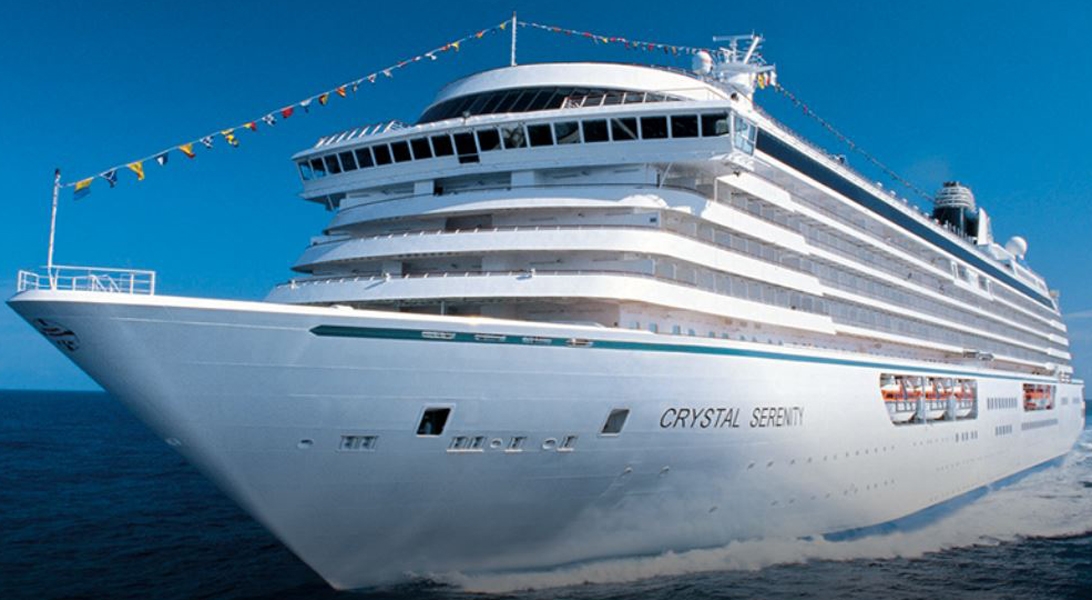
The images shown are for illustration purposes only and may not be an exact representation of what you find on the ship.
The images shown are for illustration purposes only and may not be an exact representation of what you find on the ship.

A nod to the mythic bars and bistros of Paris. Celebrate the classics in this spacious and airy café that serves light bites from dawn to dusk.
The Bistro is a delightful daytime relaxing cafe that offers delicious light meals, with panoramic views of the sparkling sea.
The images shown are for illustration purposes only and may not be an exact representation of what you find on the ship.

The ship's sleek cinema for recent-released movies, live sport events, guest lectures and religious services.

An ideal refreshment stop any time of the day, and the perfect place to meet friends for a pre-dinner cocktail. Enjoy a variety of musical styles as the day turns into night.

An elegant space to indulge in the finest cigars and cognacs.

Signature piano bar with an intimate ambience. The perfect setting for a cocktail before and after dinner.

Featuring large sky lights, floor-to-ceiling windows and a fabulous 270-degree forward view, this venue is perfect for afternoon tea, social gatherings and dancing.
The images shown are for illustration purposes only and may not be an exact representation of what you find on the ship.
The images shown are for illustration purposes only and may not be an exact representation of what you find on the ship.


Our Fusion packages are all ABTA & ATOL protected ensuring that your booking is safe with us
| 12 nights aboard the Crystal Serenity | |||
| Gratuities included | |||
| Complimentary drinks including wines, champagne, spirits throughout the ship | |||
| Award winning Broadway style entertainment | |||
| Complimentary speciality dining (one visit per restaurant) | |||
| Choice of shore excursions in every port | |||
| Butler Service | |||
| Enrichment programs & lectures | |||
| Complimentary shuttle buses in selected ports | |||
| Complimentary Wi-fi throughout the ship | |||
| Port Taxes and Fees | |||
 | ABTA and ATOL Protection* | ||
Date 17th Sep 2028 |
Nts 12 |
Oceanview £6,190pp |
Balcony £7,270pp |
Suite £7,360pp |
Date 17th Sep 2028 |
Nts 12 |
Oceanview £6,190pp |
Balcony £7,270pp |
Suite £7,360pp |
| Oceanview staterooms from | £6,190pp | ||
| GOW1 | Premium Ocean View | £6,190pp | |
| GOWS | Single Ocean View | £8,080pp | |
| Balcony staterooms from | £7,270pp | ||
| GVR2 | Deluxe Veranda | £7,270pp | |
| GVR1 | Premium Veranda | £7,540pp | |
| Suite staterooms from | £7,360pp | ||
| AVR3 | Aquamarine Suite | £7,360pp | |
| AVR2 | Aquamarine Deluxe Suite | £8,170pp | |
| SVR3 | Sapphire Suite | £9,340pp | |
| SVR2 | Sapphire Deluxe Suite | £9,610pp | |
| SVR1 | Sapphire Premium Suite | £10,060pp | |
| PJFW | Junior Penthouse Deluxe Suite | £17,440pp | |
| PJVS | Junior Penthouse Premium Suite | £19,870pp | |
| PHVS | Penthouse Suite | £21,850pp | |
| POWN | Crystal Owner's Suite | £29,770pp | |
Fusion Holidays when selling travel arrangements is a trading name of Co-op Travel Services Limited, registration 08903986. Fusion Cruises is an Accredited Body Member of Co-op Travel Services Limited ATOL 12904.
Book with Confidence. We are a Member of ABTA which means you have the benefit of ABTA’s assistance and Code of Conduct.
Some of the flights and flight-inclusive holidays on this website are financially protected by the ATOL scheme but ATOL protection does not apply to all holiday and travel services offered on this website. This website will provide you with information on the protection that applies in the case of each holiday and travel service offered before you make your booking. If you do not receive an ATOL Certificate then the booking will not be ATOL protected. If you do receive an ATOL Certificate but all parts of your trip are not listed on it, those parts will not be ATOL protected. Please see our booking conditions for information, or for more information about financial protection and the ATOL Certificate go to: www.caa.co.uk