| | | | | Arrive | Depart |
| 5th05 | OctOct | 202828 | Nuuk (Godthaab), Greenland, embark on the MS Roald Amundsen | | 22:00 |
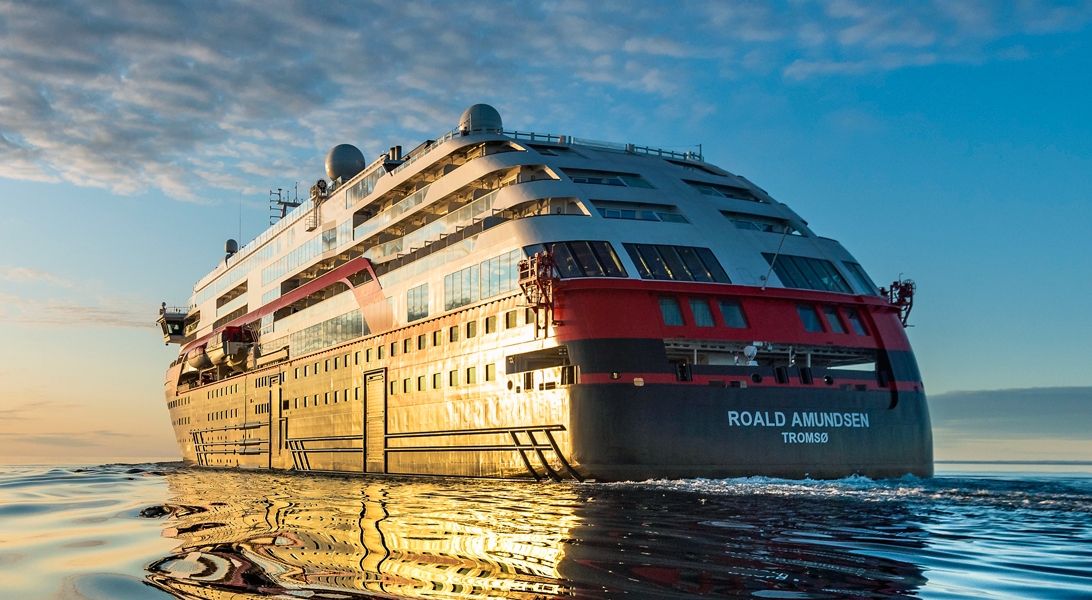
Nuuk, meaning “the cape”, was Greenland’s first town (1728). Started as a fort and later mission and trading post some 240 kilometers south of the Arctic Circle, it is the current capital. Almost 30% of Greenland’s population lives in the town. Not only does Nuuk have great natural beauty in its vicinity, but there are Inuit ruins, Hans Egede’s home, the parliament, and the Church of our Saviour as well. The Greenlandic National Museum has an outstanding collection of Greenlandic traditional dresses, as well as the famous Qilakitsoq mummies. The Katuaq Cultural Center’s building was inspired by the undulating Northern Lights and can house 10% of Nuuk’s inhabitants. Gateway to the Greenlandic Arctic Flight from Reykjavik to Nuuk. Greenland’s compact capital is set along a deep fjord system framed by rugged mountains. Despite its small scale, the city is a vibrant centre of modern Greenlandic life. If time allows, you can explore the harbour, museums, and historic districts before embarkation. Nuuk is also where you start to feel the essence of the Arctic: ice, sea, and the mountainous peaks of Quassussuaq and Ukkusissat. Once on board, meet the Expedition Team, settle into your cabin, and we’ll begin the voyage north and west towards Baffin Island. |
| 6th06 | OctOct | 202828 | Kvanefjord, Greenland | 12:00 | 18:00 |
Where Norse stories meet Inuit shorelines Sailing toward South Greenland, you’ll ease into expedition life as the coast starts to reveal its true scale: steep mountains, glacial valleys, and fjords that seem to reach endlessly inland. On board, your Expedition Team will introduce AECO guidelines, helping you understand how we travel responsibly in this fragile environment. Conditions permitting, we may cruise into spectacular Kuannersooq (Kvanefjord), where still waters mirror cliffs and drifting ice. This region is a fascinating blend of cultural layers: Norse settlement history, enduring Inuit traditions, and landscapes shaped by ice. It’s our first taste of Greenland’s wild south. |
| 7th07 | OctOct | 202828 | Qassiarsuk, Greenland | 10:00 | 20:00 |
Qassiarsuk is the newer, Greenlandic name for this small village. Brattahlid is the older, Norse name. Here we tour the foundation remains of the manor house of Erik the Red, who found Greenland after being banished from Iceland and Norway for murder. We will also visit the site of the first Christian church ever built in North America (physiographically speaking), see a recently unearthed Norse graveyard that contains remains of 144 Norse colonists, and have a chance to admire Hans Lynge’s remarkable bronze sculpture of Erik the Red. |
| 8th08 | OctOct | 202828 | At Sea | | |
| 9th09 | OctOct | 202828 | At Sea | | |
| 10th10 | OctOct | 202828 | Saglek Fjord, Newfoundland and Labrador, Canada | 07:00 | 19:00 |
Witness the immense Torngat Mountains Welcome to Canada, and to one of the most dramatic coastlines in the North Atlantic. After clearing customs, Park Rangers join us as we explore Torngat Mountains National Park, a place whose Inuktitut name is often translated as 'place of spirits’. Over several days, we’ll navigate into powerful fjords and bays where sheer cliffs rise from dark water, and glaciers cling to the rock. The lands are a rich habitat for wildlife, and shaped by Inuit traditions of travel and hunting. Our route may take us into Saglek Bay, backed by the Torngat Mountains, and Nachvak, one of the longest fjords in Labrador. We may also reach Ramah, a remote and windswept stretch of coast, before visiting Nain, the northernmost permanent settlement in Labrador, and Hebron, a former Inuit community with a poignant history. |
| 11th11 | OctOct | 202828 | Nachvak Fiord, Newfoundland and Labrador, Canada | 07:00 | 19:00 |
| 12th12 | OctOct | 202828 | Ramah Bay, Newfoundland and Labrador, Canada | 07:00 | 19:00 |
| 13th13 | OctOct | 202828 | Hebron, Newfoundland and Labrador, Canada | 07:00 | 19:00 |
| 14th14 | OctOct | 202828 | Nain, Newfoundland and Labrador, Canada | 09:00 | 19:00 |
| 15th15 | OctOct | 202828 | At Sea | | |
| 16th16 | OctOct | 202828 | Saint-Anthony, Newfoundland and Labrador, Canada | 07:00 | 18:00 |
Relive the tales of Vikings, pioneers, and early explorers Newfoundland welcomes you with a powerful sense of place, shaped by ocean, weather, and an enduring maritime spirit. Along this rugged island, towering headlands give way to sheltered bays and lively communities, where history feels close to the surface. As we explore, you can trace stories that span centuries, from early explorers and pioneering missionaries to echoes of Viking voyages that once crossed these waters. Expect dramatic coastal scenery, fresh Atlantic air, and the chance to connect with a culture that’s proudly distinct. Whether you’re drawn by heritage, landscapes, or the warmth of local character, Newfoundland has a way of staying with you long after you sail on. |
| 17th17 | OctOct | 202828 | At Sea | | |
| 18th18 | OctOct | 202828 | Cap-aux-Meules, Magdalen Islands, Québec, Canada | 14:00 | 21:00 |
Birds, beaches, and a gentler Atlantic mood Our stop in the Gulf of Saint Lawrence brings a refreshing change of pace, where open skies, accessible shorelines, and strong birdlife create ideal conditions for exploration. Depending on the landing site and conditions, you can expect inviting coastal scenery and an easy rhythm ashore, perfect for walking, photography, and wildlife watching. This region encourages a more personal connection with the North Atlantic: less about extremes, more about detail, light, and life along the water’s edge. Keep your eyes open for seabirds and shifting weather patterns that can paint the landscape in minutes. It’s a rewarding interlude that highlights the voyage’s range, from Arctic fjords to Atlantic island charm. |
| 19th19 | OctOct | 202828 | Chéticamp, Nova Scotia, Canada | 07:00 | 18:00 |
Coastal heritage with a salt-air heartbeat In Nova Scotia, the voyage takes on a distinctly maritime character, where fishing harbours, coastal trails, and warm community spirit create an immediate sense of belonging. Over these days, you’ll connect more closely with Atlantic Canada’s cultural heritage, shaped by seafaring traditions, resilient coastal living, and landscapes that invite you outdoors. Explore ashore at your own pace, whether that means scenic viewpoints, local history, or simply soaking up the atmosphere of a place that feels both storied and lived-in. It’s an easy, relatable contrast to the Far North, and a satisfying way to round out the expedition. By now, you’ll feel how the journey’s carried you across worlds. |
| 20th20 | OctOct | 202828 | Sydney, New South Wales, Australia | 07:00 | 18:00 |
Sydney, capital of New South Wales and one of Australia's largest cities, is best known for its harbourfront Sydney Opera House, with a distinctive sail-like design. Massive Darling Harbour and the smaller Circular Quay port are hubs of waterside life, with the arched Harbour Bridge and esteemed Royal Botanic Garden nearby. Sydney Tower’s outdoor platform, the Skywalk, offers 360-degree views of the city and suburbs. |
| 21st21 | OctOct | 202828 | At Sea | | |
| 22nd22 | OctOct | 202828 | Halifax, Nova Scotia, Canada, disembark the MS Roald Amundsen | 07:00 | |
Surrounded by natural treasures and glorious seascapes, Halifax is an attractive and vibrant hub with noteworthy historic and modern architecture, great dining and shopping, and a lively nightlife and festival scene. The old city manages to feel both hip and historic. Previous generations had the foresight to preserve the cultural and architectural integrity of the city, yet students from five local universities keep it lively and current. It's a perfect starting point to any tour of the Atlantic provinces, but even if you don't venture beyond its boundaries, you will get a real taste of the region.It was Halifax’s natural harbor—the second largest in the world after Sydney, Australia’s—that first drew the British here in 1749, and today most major sites are conveniently located either along it or on the Citadel-crowned hill overlooking it. That’s good news for visitors because this city actually covers quite a bit of ground.Since amalgamating with Dartmouth (directly across the harbor) and several suburbs in 1996, Halifax has been absorbed into the Halifax Regional Municipality, and the HRM, as it is known, has around 415,000 residents. That may not sound like a lot by U.S. standards, but it makes Nova Scotia’s capital the most significant Canadian urban center east of Montréal.There's easy access to the water, and despite being the focal point of a busy commercial port, Halifax Harbour doubles as a playground, with one of the world's longest downtown boardwalks. It's a place where container ships, commuter ferries, cruise ships, and tour boats compete for space, and where workaday tugs and fishing vessels tie up beside glitzy yachts. Like Halifax as a whole, the harbor represents a blend of the traditional and the contemporary. Disembarkation day Arriving in Halifax feels like a gentle return to the everyday, but you’ll bring something different with you now: a deeper relationship with the North Atlantic and the high latitudes that shaped this journey. After breakfast, it’s time to say goodbye to the ship and the Expedition Team, and to disembark in this historic maritime city. If your schedule allows, Halifax rewards exploration, from its lively waterfront to layers of naval and immigration history, and the easy charm of cafés and harbour views. Most of all, it’s a place to pause and realise how far you’ve travelled, not just in distance, but in perspective. The expedition ends, but the stories keep going. |