| | | | | Arrive | Depart |
| 17th17 | SepSep | 202828 | Nuuk (Godthaab), Greenland, embark on the MS Roald Amundsen | | 22:00 |
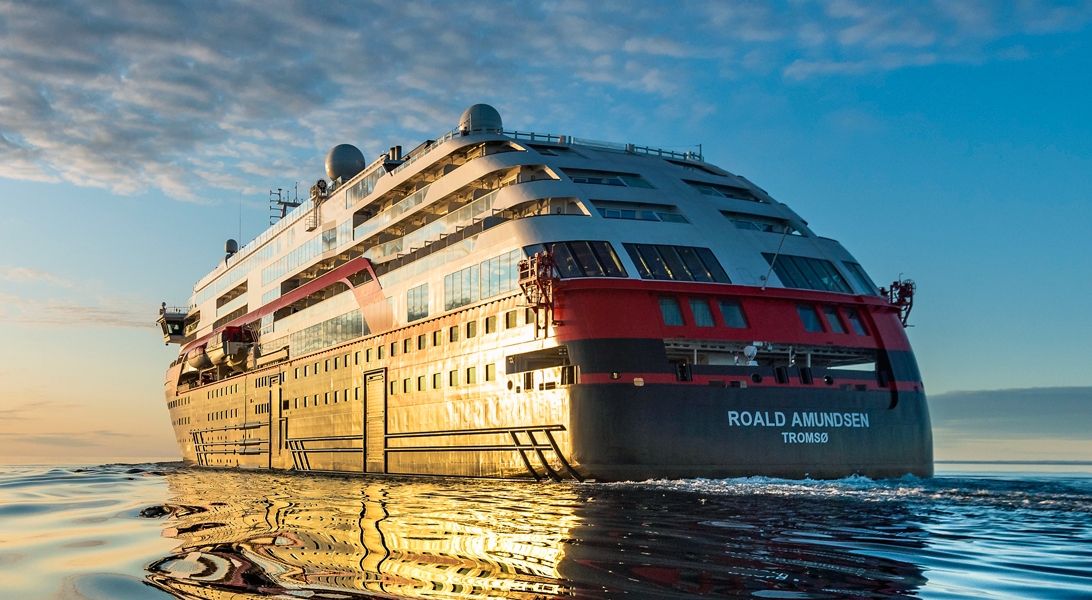
Nuuk, meaning “the cape”, was Greenland’s first town (1728). Started as a fort and later mission and trading post some 240 kilometers south of the Arctic Circle, it is the current capital. Almost 30% of Greenland’s population lives in the town. Not only does Nuuk have great natural beauty in its vicinity, but there are Inuit ruins, Hans Egede’s home, the parliament, and the Church of our Saviour as well. The Greenlandic National Museum has an outstanding collection of Greenlandic traditional dresses, as well as the famous Qilakitsoq mummies. The Katuaq Cultural Center’s building was inspired by the undulating Northern Lights and can house 10% of Nuuk’s inhabitants. Gateway to the Greenlandic Arctic Flight from Reykjavik to Nuuk. Greenland’s compact capital is set along a deep fjord system framed by rugged mountains. Despite its small scale, the city is a vibrant centre of modern Greenlandic life. If time allows, you can explore the harbour, museums, and historic districts before embarkation. Nuuk is also where you start to feel the essence of the Arctic: ice, sea, and the mountainous peaks of Quassussuaq and Ukkusissat. Once on board, meet the Expedition Team, settle into your cabin, and we’ll begin the voyage north and west towards Baffin Island. |
| 18th18 | SepSep | 202828 | At Sea | | |
| 19th19 | SepSep | 202828 | Qikiqtarjuaq, Nunavut, Canada | 10:00 | 20:00 |
Ice-carved coasts and living Arctic communities The eastern edge of Baffin Island reveals some of the most dramatic scenery in the Arctic: steep mountains, deep fjords, and glaciers descending directly into the sea. Sea ice often lingers here, shaping access and movement throughout the region. In settlements such as Qikiqtarjuaq, life is in close connection with land and sea, where hunting, fishing, and travel remain guided by environmental conditions. Zodiac cruising and shore landings, where possible, offer encounters with this immense coastal landscape and its wildlife-rich waters. |
| 20th20 | SepSep | 202828 | Kangok Fjord, Canada | 09:00 | 16:00 |
| 21st21 | SepSep | 202828 | Baffin Island, Nunavut, Canada | | |
| 22nd22 | SepSep | 202828 | At Sea | 07:00 | 16:00 |
| 23rd23 | SepSep | 202828 | Baffin Island, Nunavut, Canada | | |
Science at sea Time at sea allows the scale of the region to settle in. Baffin Island’s vast coastline stretches behind while new regions approach ahead. Sea conditions can shift rapidly, from open water to scattered ice, requiring constant observation and adaptation. Onboard life continues with lectures and sessions that bring the Arctic environment into focus: how ice forms, how ecosystems function, and how navigation in these waters is shaped by nature rather than fixed routes. |
| 24th24 | SepSep | 202828 | Dundas Harbour, Devon Island, Nunavut, Canada | 07:00 | 12:00 |
Dundas Harbour is located in the southeast of Devon Island, Canada’s 6th largest island. It is a forlorn but starkly beautiful spot. The island was first sighted by Europeans in 1616 by the English explorers Robert Bylot and William Baffin. But it did not appear on maps until after explorer William Edward Parry’s exploration in the 1820’s. Parry named it after Devon, England. In the local Inuktitut language, the place is called Talluruti, which translates as “a woman’s chin with tattoos on it.” This refers to the deep crevasses and streaks on Devon Island, which from a distance resemble traditional facial tattoos. On land there are remains of a Thule settlement dating back to 1000 A.D., including tent rings, middens and a gravesite. There are also much more recent remains a Royal Canadian Mounted Police outpost. The first post was established in 1924 to monitor and control illegal activities, such as foreign whaling, in the eastern entrance to the Northwest Passage. But conditions were so isolated and severe that the post was abandoned in 1933. It was reopened in 1945, but again closed, this time permanently, in 1951. Today, Devon Island is the largest uninhabited island in the world. Gateway to the Northwest Passage Lancaster Sound is one of the most important waterways in the Arctic. It’s a historic entry point into the Northwest Passage. We’ll pass towering cliffs and deep channels along the coast of Devon Island, which is the largest uninhabited island on Earth. Conditions permitting, we may visit Beechey Island, an important historical site associated with early Arctic exploration, including Sir John Franklin’s 1845 expedition. |
| 24th24 | SepSep | 202828 | Croker Bay, Nunavut, Canada | 15:00 | 20:00 |
Gateway to the Northwest Passage Lancaster Sound is one of the most important waterways in the Arctic. It’s a historic entry point into the Northwest Passage. We’ll pass towering cliffs and deep channels along the coast of Devon Island, which is the largest uninhabited island on Earth. Conditions permitting, we may visit Beechey Island, an important historical site associated with early Arctic exploration, including Sir John Franklin’s 1845 expedition. |
| 25th25 | SepSep | 202828 | Elwin Bay, Prince Regent Inlet, Nunavut, Canada | 14:00 | 20:00 |
| 26th26 | SepSep | 202828 | At Sea | | |
| 27th27 | SepSep | 202828 | At Sea | | |
| 28th28 | SepSep | 202828 | Igloolik, Nunavut, Canada | 10:00 | 20:00 |
Wide seas and Inuit homelands Foxe Basin opens into a vast, shallow sea bordered by low tundra and distant, broken coastline. It feels open and exposed: water and sky blending at the horizon, with few landmarks to hold onto. Over these few days, you move through a landscape shaped by long Thule and Inuit presence. Over 100 stone cairns called ‘inuksuit’ line the tundra at Enukso Point, some dating back 2,000 years. In Igloolik, a small hamlet literally translating as 'there is a house here', it’s easy to see how life remains closely tied to sea ice, hunting, and the seasonal rhythm of the land. |
| 29th29 | SepSep | 202828 | At Sea | | |
| 30th30 | SepSep | 202828 | Harkin Bay, Canada | 08:00 | 12:00 |
| 30th30 | SepSep | 202828 | Inuksuk Point, Canada | 14:00 | 20:00 |
| 1st01 | OctOct | 202828 | Cape Dorset, Nunavut, Canada | 10:00 | 20:00 |
Cape Dorset is a small Inuit hamlet located on Dorset Island, off the southern shore of Baffin Island. The traditional name for Cape Dorset is Kinngait (meaning "high mountain"), describing the ‘Cape’, which is actually a 800 foot mountain. This is a nature-lovers paradise with breath-taking landscapes and an amazing abundance of arctic wildlife, such as migratory caribou, seabirds, whales, seals and walruses. Ancient native Thule (Dorset Culture) peoples lived in this area for three thousand years, and it is here where the first archaeological remains were found. Captain Luke Foxe, during his attempt to find the Northwest Passage in 1631, was the first European to land here. He named the Cape in honour of his sponsor Edward Sackville, the Earl of Dorset. In 1913, the Hudson's Bay Company started a trading post, exchanging furs and skins for supplies like tobacco, ammunition, flour, gas, tea and sugar. In 1949, the market for white fox collapsed but the art industry boomed. Since the 1950s, Cape Dorset, the "Capital of Inuit Art", has become an economic mainstay of the community, with more than 20% of it residents employed in the arts. Where Arctic meets Atlantic influence At the gateway between the Canadian Arctic and North Atlantic, Hudson Strait separates Baffin Island from northern Quebec. It’s known for strong tides, powerful currents, and fast-changing weather as wind funnels through the channel. September and October are when the Arctic starts to shift; you begin to see drifting fragments of sea ice reappearing: sometimes remnants of older ice carried in on currents and in sheltered areas, the first thin new ice forming at the surface. It’s not winter yet, but you’re watching it arrive in real time. We aim to call at Kinngait (Cape Dorset), one of Nunavut’s most important cultural communities, internationally known for Inuit printmaking and sculpture. Zodiac cruising and shore visits bring you close to a working Arctic coastline. |
| 2nd02 | OctOct | 202828 | At Sea | | |
| 3rd03 | OctOct | 202828 | Hantzsch Island, Canada | 07:00 | 13:00 |
| 4th04 | OctOct | 202828 | At Sea | | |
| 5th05 | OctOct | 202828 | Nuuk (Godthaab), Greenland, disembark the MS Roald Amundsen | 06:00 | |
Nuuk, meaning “the cape”, was Greenland’s first town (1728). Started as a fort and later mission and trading post some 240 kilometers south of the Arctic Circle, it is the current capital. Almost 30% of Greenland’s population lives in the town. Not only does Nuuk have great natural beauty in its vicinity, but there are Inuit ruins, Hans Egede’s home, the parliament, and the Church of our Saviour as well. The Greenlandic National Museum has an outstanding collection of Greenlandic traditional dresses, as well as the famous Qilakitsoq mummies. The Katuaq Cultural Center’s building was inspired by the undulating Northern Lights and can house 10% of Nuuk’s inhabitants. Return to Greenland’s capital Our voyage concludes in Nuuk, marking the completion of our circumnavigation around Baffin Island. Say a fond farewell to the ship, Expedition Team, crew, and fellow travellers as you step ashore for the final time. Nuuk feels like a metropolis after the remote Arctic communities you’ve visited, yet it remains closely tied to its fjord setting. Colourful houses line the water’s edge, where fishing boats, modern infrastructure, and cultural institutions sit side by side, reflecting a city balancing tradition with contemporary Greenlandic life. Take time to explore the harbour, museums, or nearby historic areas before you fly to Reykjavik, which brings your full Arctic journey to a close. |