| | | | | Arrive | Depart |
| 24th24 | AugAug | 202828 | Vancouver, British Columbia, Canada, embark on the MS Roald Amundsen | | |
Vancouver is a delicious juxtaposition of urban sophistication and on-your-doorstep wilderness adventure. The mountains and seascape make the city an outdoor playground for hiking, skiing, kayaking, cycling, and sailing—and so much more—while the cuisine and arts scenes are equally diverse, reflecting the makeup of Vancouver's ethnic (predominantly Asian) mosaic. Vancouver is consistently ranked as one of the world's most livable cities, and it's easy for visitors to see why. It's beautiful, it's outdoorsy, and there's a laidback West Coast vibe. On the one hand, there's easy access to a variety of outdoor activities, a fabulous variety of beaches, and amazing parks. At the same time, the city has a multicultural vitality and cosmopolitan flair. The attraction is as much in the range of food choices—the fresh seafood and local produce are some of North America's best—as it is in the museums, shopping, and nightlife.Vancouver's landscaping also adds to the city's walking appeal. In spring, flowerbeds spill over with tulips and daffodils while sea breezes scatter scented cherry blossoms throughout Downtown; in summer office workers take to the beaches, parks, and urban courtyards for picnic lunches and laptop meetings. More than 8 million visitors each year come to Vancouver, Canada's third-largest metropolitan area. Because of its peninsula location, traffic flow is a contentious issue. Thankfully, Vancouver is wonderfully walkable, especially in the downtown core. The North Shore is a scoot across the harbor, and the rapid-transit system to Richmond and the airport means that staying in the more affordable ’burbs doesn't have to be synonymous with sacrificing convenience. The mild climate, exquisite natural scenery, and relaxed outdoor lifestyle keep attracting residents, and the number of visitors is increasing for the same reasons. People often get their first glimpse of Vancouver when catching an Alaskan cruise, and many return at some point to spend more time here. Gateway to the Pacific and the Arctic Your adventure begins in Vancouver, the bustling Pacific seaport framed by steep mountains and lush forests. Wander the Victorian streets of Gastown, explore the seawall and towering cedar groves of Stanley Park, and, if you’re looking for somewhere to eat, some of the best food in North America is right here. The seafood and farm-to-table cooking is exceptional. You’ll spend the night here, before an early flight north to Alaska the following morning. This is the calm before the Arctic… |
| 25th25 | AugAug | 202828 | Nome, Alaska, United States | | 22:00 |
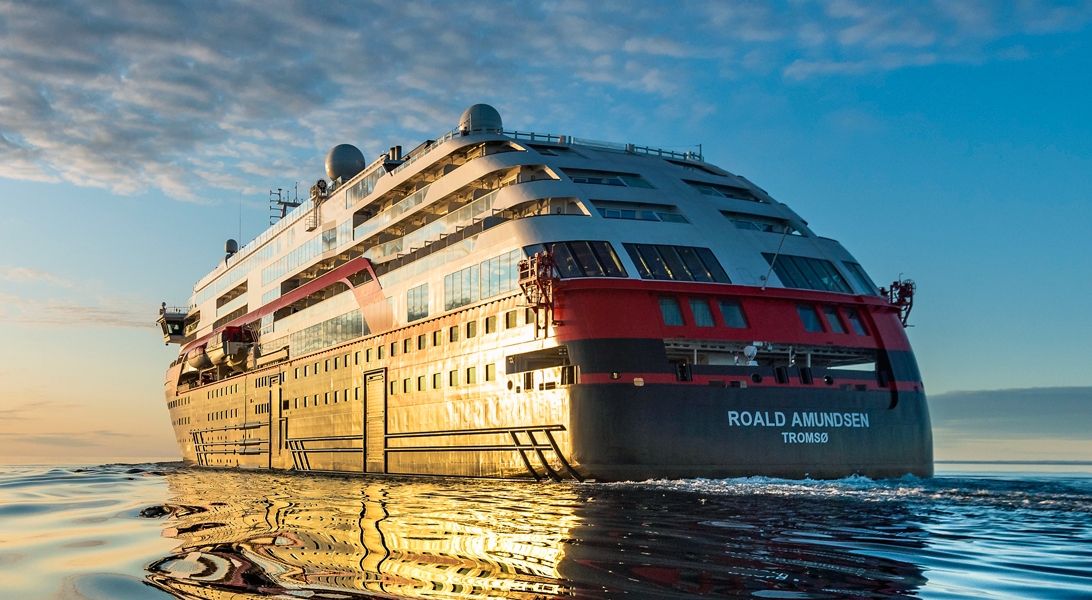
Nome is located on the edge of the Bering Sea, on the southwest side of the Seward Peninsula. Unlike other towns which are named for explorers, heroes or politicians, Nome was named as a result of a 50 year-old spelling error. In the 1850's an officer on a British ship off the coast of Alaska noted on a manuscript map that a nearby prominent point was not identified. He wrote "? Name" next to the point. When the map was recopied, another draftsman thought that the “?” was a C and that the “a” in "Name" was an o, and thus a map-maker in the British Admiralty christened "Cape Nome." The area has an amazing history dating back 10,000 years of Inupiaq Eskimo use for subsistence living. Modern history started in 1898 when "Three Lucky Swedes”, Jafet Lindberg, Erik Lindblom and John Brynteson, discovered gold in Anvil Creek…the rush was on! In 1899 the population of Nome swelled from a handful to 28,000. Today the population is just over 3,500. Much of Nome's gold rush architecture remains. A frontier town at the edge of the Arctic Today you’ll take an early flight from Vancouver to Nome, Alaska, where your ship awaits for an adventure through the famed Northwest Passage and beyond. Nome is a small coastal town on the edge of the Bering Sea. Once a boomtown of the 1898 Gold Rush, it still carries traces of its frontier past in rusting dredges, old steam engines, and railway remnants. The town also drew big names, including Wyatt Earp, who opened a saloon here, and it later became the endpoint for three of Roald Amundsen’s polar expeditions. That legacy of ambition and exploration sets the stage for what’s to come… Once on board, collect your expedition jacket, settle into your cabin, meet the Expedition Team, and get ready for the adventure. |
| 26th26 | AugAug | 202828 | At Sea | | |
| 27th27 | AugAug | 202828 | At Sea | | |
| 28th28 | AugAug | 202828 | At Sea | | |
| 29th29 | AugAug | 202828 | At Sea | | |
| 30th30 | AugAug | 202828 | Herschel Island, Yukon, Canada | 09:00 | 16:00 |
Living coastlines across the Western Canadian Arctic This stretch of the Western Canadian Arctic feels elemental: rugged coastlines, tundra plateaus, and communities along the fjords that live in close harmony with the land. Over these few days we’ll sail along the Inuvialuit Settlement Region, and where conditions allow, explore shorelines up close on Zodiacs, landing for guided hikes, and visiting places like Ulukhaktok on Victoria Island: a small but culturally rich settlement known for its printmaking and strong artistic traditions. |
| 31st31 | AugAug | 202828 | Smoking Hills, Northwest Territories, Canada | 18:00 | 21:00 |
| 1st01 | SepSep | 202828 | Ulukhaktok, Northwest Territories, Canada | 14:00 | 20:00 |
| 2nd02 | SepSep | 202828 | At Sea | | |
| 3rd03 | SepSep | 202828 | Cambridge Bay, Nunavut, Canada | 10:00 | 20:00 |
Historic waters of the central Canadian Arctic This stretch moves through some of the most historically significant waters of the Northwest Passage. Small communities such as Cambridge Bay and Gjoa Haven lie in vast landscapes marked by ancient travel routes and thousands of years of Inuit life. Gjoa Haven on King William Island is closely tied to the story of Franklin’s lost expedition in 1845, which ended nearby, and to the Inuit oral histories that later helped piece together what happened. The name ‘Gjoa’ also carries Amundsen’s legacy. He navigated this passage aboard the vessel Gjøa and sheltered in this harbour during his historic transit of the Northwest Passage, marking a defining moment in polar exploration history. |
| 4th04 | SepSep | 202828 | Jenny Lind Island, Nunavut, Canada | 07:00 | 18:00 |
| 5th05 | SepSep | 202828 | Gjoa Haven, Nunavut, Canada | 10:00 | 20:00 |
Through the Central Arctic Straits Today we navigate the narrow waterways at the heart of the Northwest Passage. As we move between islands and shifting floes, the landscape reveals a stark beauty: low tundra shores, scattered icebergs, and vast horizons under an ever-changing Arctic sky. Wildlife may make an appearance, such as seals resting on the ice, or seabirds tracing our route overhead. This is a place where you really feel a powerful sense of isolation and discovery. |
| 6th06 | SepSep | 202828 | At Sea | | |
| 7th07 | SepSep | 202828 | Prince of Wales Island, Alaska, United States | 10:00 | 20:00 |
Into the ice edge This part of the voyage offers a real sense of Arctic exploration, surrounded by thick sea ice. We approach Prince of Wales Island, one of the larger islands in the Canadian Arctic Archipelago passage, set between Somerset and Victoria Islands. Navigating these high-latitude waters in northern Nunavut, we keep watch for the ice edge: the shifting boundary between open water and sea ice, and adjust our route according to conditions. If ice and weather allow, we may launch the Zodiacs to explore sheltered bays, gaining a closer perspective on the low-lying tundra, and if we’re lucky, encountering the local wildlife in its natural environment. |
| 8th08 | SepSep | 202828 | At Sea | 07:00 | 14:00 |
| 9th09 | SepSep | 202828 | Beechey Island, Nunavut, Canada | 07:00 | 14:00 |
Beechey Island is a small island off the southwest coast of Devon Island, separated by a narrow waterway called the Barrow Strait. Captain William Edward Parry was the first European to visit the island in 1819. His lieutenant, Frederick William Beechey, named the island after his father, the artist William Beechey (1753–1839). Beechey Island played a significant role in the history of Arctic Exploration. During the winter of 1845-46, Sir John Franklin and his men camped on the island as part of their ill-fated quest to find the Northwest Passage. Mummified remains of three of Franklin’s crew were discovered, giving a better understanding of what happened before the disappearance of the expedition. In 1850 Edward Belcher used the island as a base while surveying the area. Later, in 1903, Norwegian explorer Roald Amundsen stopped at the island at the beginning of his successful voyage in search for the Northwest Passage. Subsequently, Beechey Island has been declared a "Territorial Historic Site" since 1975 by the Northwest Territories government The High Arctic Highway Entering Lancaster Sound, we reach one of the Arctic’s key marine corridors, between Baffin and Devon Islands. It’s a stunning region of towering cliffs and glacially carved coastlines, where you might even spot narwhals, seals, and seabirds. This area also played a major role in early searches for the Northwest Passage, when explorers attempted to navigate through the Arctic Archipelago. Today, it remains an active migration route for wildlife, as well as a historic exploration corridor. |
| 9th09 | SepSep | 202828 | Radstock Bay, Devon Island, Canada | 16:00 | 22:00 |
Devon Island is Canada’s sixth largest island and was first seen by Europeans in the early 17th century. The Thule culture had already settled there many centuries before, and left behind qarmat homes, made of rocks, whale bones, rock and sod walls, and skins for roofs that tell a story of over 800 years of human habitation. Other striking finds in this area are the many fossils of corals, crinoids and nautiloids that can be seen. Just across Lancaster Sound is Prince Leopold Island, a Canadian Important Bird Area, a federally listed migratory bird sanctuary, and a Key Migratory Bird Terrestrial Habitat site with large numbers of Thick-billed Murres, Northern Fulmars and Black-legged Kittiwakes that breed there. The High Arctic Highway Entering Lancaster Sound, we reach one of the Arctic’s key marine corridors, between Baffin and Devon Islands. It’s a stunning region of towering cliffs and glacially carved coastlines, where you might even spot narwhals, seals, and seabirds. This area also played a major role in early searches for the Northwest Passage, when explorers attempted to navigate through the Arctic Archipelago. Today, it remains an active migration route for wildlife, as well as a historic exploration corridor. |
| 10th10 | SepSep | 202828 | Maxwell Bay, Antarctica | 07:00 | 16:00 |
| 11th11 | SepSep | 202828 | Dundas Harbour, Devon Island, Nunavut, Canada | 07:00 | 15:00 |
Dundas Harbour is located in the southeast of Devon Island, Canada’s 6th largest island. It is a forlorn but starkly beautiful spot. The island was first sighted by Europeans in 1616 by the English explorers Robert Bylot and William Baffin. But it did not appear on maps until after explorer William Edward Parry’s exploration in the 1820’s. Parry named it after Devon, England. In the local Inuktitut language, the place is called Talluruti, which translates as “a woman’s chin with tattoos on it.” This refers to the deep crevasses and streaks on Devon Island, which from a distance resemble traditional facial tattoos. On land there are remains of a Thule settlement dating back to 1000 A.D., including tent rings, middens and a gravesite. There are also much more recent remains a Royal Canadian Mounted Police outpost. The first post was established in 1924 to monitor and control illegal activities, such as foreign whaling, in the eastern entrance to the Northwest Passage. But conditions were so isolated and severe that the post was abandoned in 1933. It was reopened in 1945, but again closed, this time permanently, in 1951. Today, Devon Island is the largest uninhabited island in the world. |
| 12th12 | SepSep | 202828 | Pond Inlet, Nunavut, Canada | 12:00 | 20:00 |
Located in northern Baffin Island, Pond Inlet is a small, predo¬minantly Inuit community, with a population of roughly 1,500 inhabitants. In 1818, the British explorer John Ross named a bay in the vicinity after the English astronomer John Pond. Today Pond Inlet is considered one of Canada's "jewels of the North" thanks to several picturesque glaciers and mountain ranges nearby. Many archaeological sites of ancient Dorset and Thule peoples can be found near Pond Inlet. The Inuit hunted caribou, ringed and harp seals, fish, polar bears, walrus, narwhals, geese, ptarmigans and Arctic hares, long before European and American whalers came here to harvest bowhead whales. Pond Inlet is also known as a major center of Inuit art, especially the printmaking and stone carving that are featured in the town’s art galleries. Fjords and Inuit frontiers Eastern Baffin Island reveals some of the most dramatic scenery of the voyage. Towering fjords cut deep into the coastline, while glaciers descend towards the sea in vast, sculptural forms. The sense of scale is truly immense. We explore this landscape by Zodiac, navigating through ice-fringed waters and along sheer cliff faces that rise straight from the sea, particularly in the waters of Sirmilik National Park. These journeys bring us into close contact with the region’s raw geography and shifting ice. We also call at Pond Inlet, a welcoming Inuit community at the gateway to the park. Here, you’ll gain insight into daily life in the High Arctic. |
| 13th13 | SepSep | 202828 | At Sea | 07:00 | 14:00 |
| 14th14 | SepSep | 202828 | At Sea | | 14:00 |
| 15th15 | SepSep | 202828 | Baffin Bay, Nunavut, Canada | | |
Watch for wildlife and get involved in Citizen Science Leaving Canada’s Nunavut region behind, we cross Baffin Bay towards Greenland. The adventure continues through science and storytelling, with onboard lectures and Citizen Science activities such as NASA cloud observation supporting global climate research. Our Cultural Ambassadors continue to share perspectives on Inuit life across the Arctic, linking communities separated by water but connected by history and culture. It’s a reflective passage: quiet, expansive, and atmospheric. |
| 16th16 | SepSep | 202828 | Baffin Bay, Nunavut, Canada | | |
| 17th17 | SepSep | 202828 | Nuuk (Godthaab), Greenland, disembark the MS Roald Amundsen | 06:00 | |
Nuuk, meaning “the cape”, was Greenland’s first town (1728). Started as a fort and later mission and trading post some 240 kilometers south of the Arctic Circle, it is the current capital. Almost 30% of Greenland’s population lives in the town. Not only does Nuuk have great natural beauty in its vicinity, but there are Inuit ruins, Hans Egede’s home, the parliament, and the Church of our Saviour as well. The Greenlandic National Museum has an outstanding collection of Greenlandic traditional dresses, as well as the famous Qilakitsoq mummies. The Katuaq Cultural Center’s building was inspired by the undulating Northern Lights and can house 10% of Nuuk’s inhabitants. The trip concludes in colourful Nuuk Your trip ends in Nuuk, Greenland’s compact capital. Striking contrasts define this city: traditional wooden houses sit alongside contemporary architecture, including the Greenland Parliament Building. Explore Nuuk Cathedral and Hans Egede House, or walk the harbour where fishing vessels and modern maritime activity share the same waters. From here, you fly to Reykjavik, carrying memories of a journey shaped by ice, culture, and the vast scale of the Arctic world. |