This site uses cookies as defined in our Cookie Policy, by continuing to use this site you agree to their use.
Continue

| Arrive | Depart | ||||||
| 18th18 | JunJun | 202828 | Broome, Western Australia, Australia, embark on the Scenic Eclipse II | ||||
Broome, a coastal town in Western Australia, is famous for its stunning beaches, rich history, and vibrant culture. Located on the Indian Ocean, it boasts Cable Beach, known for its white sand, turquoise waters, and iconic camel rides at sunset. Once a pearling hub, Broome retains its multicultural heritage, reflected in its cuisine and architecture. The town is also the gateway to the Kimberley region, offering breathtaking landscapes and unique natural attractions like the Staircase to the Moon. With warm weather year-round and a laid-back atmosphere, Broome is a perfect destination for adventure, relaxation, and cultural experiences. Your Expedition Voyage begins in Broome, a characterful coastal town where red pindan soils meet the turquoise Indian Ocean and long sweeps of white sand. Tropical light, tidal flats and a laid-back atmosphere together create a distinctive gateway to the Kimberley. Please book your flight to arrive into Broome prior to 02:00 PM. | |||||||
| 19th19 | JunJun | 202828 | Lacepede Islands, Western Australia, Australia | ||||
The Lacepedes are a group of four islands, perfectly nestled off the Kimberley coast. The islands are imperative to Australia’s rich wildlife as they are key breeding habitats for Green Turtles and are home to a wealth of birds such as Masked Boobies, Australian Pelicans, Lesser Frigatebirds and the largest colony of Brown Bobbies in the world. Join your expedition team for a guided zodiac tour to view the prolific wildlife. Due to the sensitive nature of the environment, landings are prohibited on the Lacepede Islands. After a relaxing morning on board Scenic Eclipse II, arrive in the afternoon at the remote Lacepede Islands, located approximately 120 kilometres north of Broome. Designated an A-class reserve, this protected archipelago is renowned for its prolific seabird colonies and rich marine life. It is also Western Australia’s most significant breeding ground for green turtles and, in season, a notable location to observe migrating humpback whales. | |||||||
| 20th20 | JunJun | 202828 | Talbot Bay, Western Australia, Australia | ||||
Sir David Attenborough named the Horizontal Falls± at Talbot Bay “one of the greatest natural wonders of the world.” Created by a unique combination of geology and massive tidal surges squeezed through two narrow cliff passages, this is the only place in the world where horizontal falls exist. After a full day exploring this fascinating region, relax in the Vitality pool and gaze out across the breathtaking panoramic views. Scenic Discovery: ±Please note, guests will have the opportunity to view this natural phenomena however will not cruise through the Horizontal Falls. | |||||||
| 21st21 | JunJun | 202828 | At Sea | ||||
| 22nd22 | JunJun | 202828 | Careening Bay, Western Australia, Australia | ||||
Careening Bay was named by Lieutenant Phillip Parker King when he careened his ship, HMC Mermaid during a voyage of discovery in 1820. After a series of leaks onboard the Mermaid, King set out for a shallow sandy bay which to careen and carry out repairs. For ten days the Mermaid crew worked hard before refloating the vessel. The ship’s carpenter carved the name of the vessel and the year into a conspicuous boab tree. The famous boab tree is now 3 metres wide and National Heritage listed. Careening Bay, within Port Nelson, is closely linked to early coastal exploration. In 1820, British surveyor Phillip Parker King careened his vessel HMC Mermaid here for repairs, commemorating the event by having its name carved into the trunk of a vast boab tree that still bears the inscription today. Scenic Discovery: | |||||||
| 23rd23 | JunJun | 202828 | Hunter River & Mitchell Falls, Western Australia, Australia | ||||
Today, Scenic Eclipse II will cruise through York Sound to the mouth of the Hunter River. A true wilderness with jaw-dropping panoramas of wild escarpments, monsoon rainforests and the four-tiered Mitchell Falls, carved out over millennia. | |||||||
| 24th24 | JunJun | 202828 | Swift Bay, Western Australia, Australia | ||||
The Bonaparte Archipelago is a rugged maze of islands that stretch almost 150km along Western Australia’s remote Kimberley coast. Remaining relatively unspoilt and remarkably pristine, Swift Bay is landscaped by heavily fractured sandstone providing an abundance of rock shelters. On the walls of these shelters are examples of both Wandjina and Gwion Gwion style rock art. Join your expedition team ashore for a guided walk to a number of rock art galleries depicting these unique rock art styles. Swift Bay offers a rare concentration of Kimberley rock art styles in one area, with Gwion Gwion and Wandjina galleries located within reach of your Scenic Discovery Yacht by a short Zodiac transfer. Towering sandstone escarpments and sheltered rock overhangs frame a landscape where culture and country are closely intertwined. Scenic Discovery: | |||||||
| 25th25 | JunJun | 202828 | At Sea | ||||
| 26th26 | JunJun | 202828 | Vansittart Bay, Western Australia, Australia | ||||
Vansittart Bay is a beautifully protected large bay with several islands and coves. Jar Island contains ancient rock art galleries depicting the Gwion Gwion style unique to the Kimberley region. Mainly neglected by, or unknown to, the early European researchers of Aboriginal culture in the Kimberley in favour of the dominant & more dramatic Wandjina art, Gwion Gwion art has in recent years gained world prominence. Join your Expedition Team ashore for a short walk, past some fascinating rock formations, to the site of the Gwion Gwion art galleries. Vansittart Bay, a sheltered inlet along the Kimberley coast, is known for its quiet beaches, rust-red headlands and deep cultural significance for Traditional Owners. Here, traces of more recent history appear alongside ancient stories, including the remarkably well-preserved skeleton of a World War II Douglas C-53 aircraft resting in the landscape. Scenic Discovery: | |||||||
| 27th27 | JunJun | 202828 | At Sea | ||||
| 28th28 | JunJun | 202828 | Darwin, Northern Territory, Australia | ||||
Darwin is Australia's most colorful, and exotic, capital city. Surrounded on three sides by the turquoise waters of the Timor Sea, the streets are lined with tropical flowers and trees. Warm and dry in winter, hot and steamy in summer, it's a relaxed and casual place, as well as a beguiling blend of tropical frontier outpost and Outback hardiness. Thanks to its close proximity to Southeast Asia and its multicultural population it also seems more like Asia than the rest of Australia. Darwin is a city that has always had to fight for its survival. The seductiveness of contemporary Darwin lifestyles belies a history of failed attempts that date from 1824 when Europeans attempted to establish an enclave in this harsh, unyielding climate. The original 1869 settlement, called Palmerston, was built on a parcel of mangrove wetlands and scrub forest that had changed little in 15 million years. It was not until 1911, after it had already weathered the disastrous cyclones of 1878, 1882, and 1897, that the town was named after the scientist who had visited Australia's shores aboard the Beagle in 1839. During World War II it was bombed more than 60 times, as the harbor full of warships was a prime target for the Japanese war planes. Then, on the night of Christmas Eve 1974, the city was almost completely destroyed by Cyclone Tracy, Australia’s greatest natural disaster. It's a tribute to those who stayed and to those who have come to live here after Tracy that the rebuilt city now thrives as an administrative and commercial center for northern Australia. Old Darwin has been replaced by something of an edifice complex—such buildings as Parliament House and the Supreme Court all seem very grand for such a small city, especially one that prides itself on its casual, outdoor-centric lifestyle. Today Darwin is the best place from which to explore Australia's Top End, with its wonders of Kakadu and the Kimberley region. Your Kimberley voyage concludes in Darwin, where the tropical north offers a striking contrast to the remote coastlines and tidal landscapes explored along the way. After a final morning on board, farewell the Captain and crew of Scenic Eclipse II, carrying with you memories of an extraordinary journey through one of Australia’s most remarkable regions. | |||||||
| 29th29 | JunJun | 202828 | Darwin, Northern Territory, Australia | ||||
Darwin is Australia's most colorful, and exotic, capital city. Surrounded on three sides by the turquoise waters of the Timor Sea, the streets are lined with tropical flowers and trees. Warm and dry in winter, hot and steamy in summer, it's a relaxed and casual place, as well as a beguiling blend of tropical frontier outpost and Outback hardiness. Thanks to its close proximity to Southeast Asia and its multicultural population it also seems more like Asia than the rest of Australia. Darwin is a city that has always had to fight for its survival. The seductiveness of contemporary Darwin lifestyles belies a history of failed attempts that date from 1824 when Europeans attempted to establish an enclave in this harsh, unyielding climate. The original 1869 settlement, called Palmerston, was built on a parcel of mangrove wetlands and scrub forest that had changed little in 15 million years. It was not until 1911, after it had already weathered the disastrous cyclones of 1878, 1882, and 1897, that the town was named after the scientist who had visited Australia's shores aboard the Beagle in 1839. During World War II it was bombed more than 60 times, as the harbor full of warships was a prime target for the Japanese war planes. Then, on the night of Christmas Eve 1974, the city was almost completely destroyed by Cyclone Tracy, Australia’s greatest natural disaster. It's a tribute to those who stayed and to those who have come to live here after Tracy that the rebuilt city now thrives as an administrative and commercial center for northern Australia. Old Darwin has been replaced by something of an edifice complex—such buildings as Parliament House and the Supreme Court all seem very grand for such a small city, especially one that prides itself on its casual, outdoor-centric lifestyle. Today Darwin is the best place from which to explore Australia's Top End, with its wonders of Kakadu and the Kimberley region. Scenic Freechoice: | |||||||
| 30th30 | JunJun | 202828 | Darwin, Northern Territory, Australia | ||||
Darwin is Australia's most colorful, and exotic, capital city. Surrounded on three sides by the turquoise waters of the Timor Sea, the streets are lined with tropical flowers and trees. Warm and dry in winter, hot and steamy in summer, it's a relaxed and casual place, as well as a beguiling blend of tropical frontier outpost and Outback hardiness. Thanks to its close proximity to Southeast Asia and its multicultural population it also seems more like Asia than the rest of Australia. Darwin is a city that has always had to fight for its survival. The seductiveness of contemporary Darwin lifestyles belies a history of failed attempts that date from 1824 when Europeans attempted to establish an enclave in this harsh, unyielding climate. The original 1869 settlement, called Palmerston, was built on a parcel of mangrove wetlands and scrub forest that had changed little in 15 million years. It was not until 1911, after it had already weathered the disastrous cyclones of 1878, 1882, and 1897, that the town was named after the scientist who had visited Australia's shores aboard the Beagle in 1839. During World War II it was bombed more than 60 times, as the harbor full of warships was a prime target for the Japanese war planes. Then, on the night of Christmas Eve 1974, the city was almost completely destroyed by Cyclone Tracy, Australia’s greatest natural disaster. It's a tribute to those who stayed and to those who have come to live here after Tracy that the rebuilt city now thrives as an administrative and commercial center for northern Australia. Old Darwin has been replaced by something of an edifice complex—such buildings as Parliament House and the Supreme Court all seem very grand for such a small city, especially one that prides itself on its casual, outdoor-centric lifestyle. Today Darwin is the best place from which to explore Australia's Top End, with its wonders of Kakadu and the Kimberley region. Your journey begins with a morning departure from Darwin on board the famous Ghan (Gold Service) for your Scenic Special Stay. The train, which runs between Darwin and Adelaide, provides one of the world’s greatest rail journeys as it cuts across remote desert landscapes in impeccable luxury. Settle into your private cabin before a delightful regionally-inspired lunch accompanied by a selection of all-inclusive wines and beverages. Arrive early afternoon at the Top End township of Katherine, the “Crossroads of the North”. The third-largest town in the Northern Territory, Katherine is a gateway between outback desert and the tropical climate of the Top End. Here, you’re free to choose between experiences that will enhance your visit. Take a guided cruise through Nitmiluk (Katherine) Gorge, where you’ll marvel at the famed towering red ochre sandstone walls and hear stories of the local Jawoyn people. Or take a glimpse into the lives of those who call the outback home with a fascinating day of discovery on a huge cattle station. Enjoy a sumptuous dinner in the Queen Adelaide Restaurant as the sun sets over the outback, then head back to your cabin to find your bed turned down. Fall asleep as the train rolls soothingly onwards across the vast outback. | |||||||
| 1st01 | JulJul | 202828 | At Sea | ||||
| 2nd02 | JulJul | 202828 | At Sea | ||||
| 3rd03 | JulJul | 202828 | At Sea | ||||
| 3rd03 | JulJul | 202828 | Adelaide, South Australia, Australia, disembark the Scenic Eclipse II | ||||
Australians think of Adelaide as a city of churches, but Adelaide has outgrown its reputation as a sleepy country town dotted with cathedrals and spires. The Adelaide of this millennium is infinitely more complex, with a large, multiethnic population and thriving urban art and music scenes supported by a "space activation program" that encourages pop-up shops, markets, performances, street food, mini festivals, art exhibitions, and other "off-the-cuff" experiences in the cities underutilized streets and public spaces.Bright and clean, leafy and beautiful Adelaide is a breeze to explore, with a grid pattern of streets encircled by parkland. The heart of the greenbelt is divided by the meandering River Torrens, which passes the Festival Centre in its prettiest stretch. | |||||||
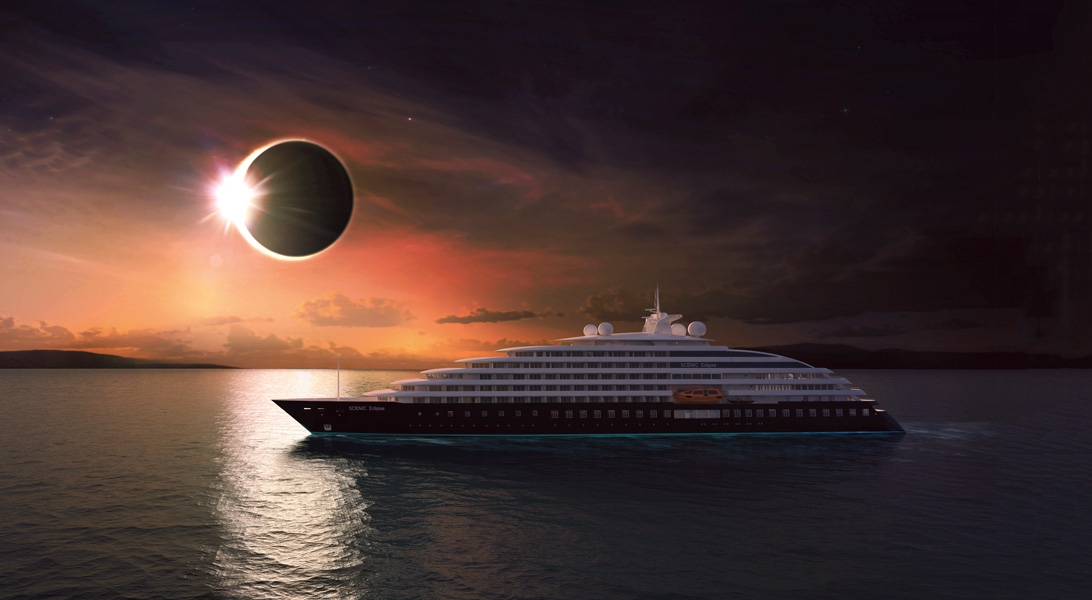
The images shown are for illustration purposes only and may not be an exact representation of what you find on the ship.
The images shown are for illustration purposes only and may not be an exact representation of what you find on the ship.
The images shown are for illustration purposes only and may not be an exact representation of what you find on the ship.
The images shown are for illustration purposes only and may not be an exact representation of what you find on the ship.
The images shown are for illustration purposes only and may not be an exact representation of what you find on the ship.

Our Fusion packages are all ABTA & ATOL protected ensuring that your booking is safe with us
| Return flights including luggage allowance | |||
| Overseas Transfers | |||
| 15 nights aboard the Scenic Eclipse II | |||
| Return Flights (including regional) | |||
| All Verandah Suites | |||
| Butler service for every guest | |||
| Nine Dining Venues | |||
| Gratuities Included | |||
| Complimentary drinks on-board | |||
| Free use of electric bikes | |||
| Comprehensive choice of shore excursions | |||
| Complimentary Wi-Fi | |||
| Explore under the sea in our submarine (additional charge) | |||
| Soar above and beyond by helicopter (additional charge) | |||
| Port Taxes and Fees | |||
 | ABTA and ATOL Protection* | ||
Fly/cruise package |
Date 18th Jun 2028 |
Nts 15 |
Interior  |
Oceanview |
Balcony |
Suite £18,391pp |
Interior |
Oceanview |
Balcony |
Suite £36,782pp |
Date 18th Jun 2028 |
Nts 15 |
Interior |
Oceanview |
Balcony |
Suite £18,391pp |
Interior |
Oceanview |
Balcony |
Suite £36,782pp |
| Suite | |
| (All prices are £GBP per person) | |
| Mon 29th May 202829 May 28 | 17,615 |
| Mon 29th May 202829 May 28 | 35,230 |
| Sat 8th Jul 202808 Jul 28 | 17,130 |
| Sat 8th Jul 202808 Jul 28 | 34,260 |
| Fri 28th Jul 202828 Jul 28 | 18,100 |
| Fri 28th Jul 202828 Jul 28 | 36,200 |
Fusion Holidays when selling travel arrangements is a trading name of Co-op Travel Services Limited, registration 08903986. Fusion Cruises is an Accredited Body Member of Co-op Travel Services Limited ATOL 12904.
Book with Confidence. We are a Member of ABTA which means you have the benefit of ABTA’s assistance and Code of Conduct.
Some of the flights and flight-inclusive holidays on this website are financially protected by the ATOL scheme but ATOL protection does not apply to all holiday and travel services offered on this website. This website will provide you with information on the protection that applies in the case of each holiday and travel service offered before you make your booking. If you do not receive an ATOL Certificate then the booking will not be ATOL protected. If you do receive an ATOL Certificate but all parts of your trip are not listed on it, those parts will not be ATOL protected. Please see our booking conditions for information, or for more information about financial protection and the ATOL Certificate go to: www.caa.co.uk