This site uses cookies as defined in our Cookie Policy, by continuing to use this site you agree to their use.
Continue

| Arrive | Depart | ||||||
| 20th20 | MarMar | 202929 | Osaka, Japan, embark on the Scenic Eclipse II | ||||
From Minami's neon-lighted Dotombori and historic Tenno-ji to the high-rise class and underground shopping labyrinths of Kita, Osaka is a city that pulses with its own unique rhythm. Though Osaka has no shortage of tourist sites, it is the city itself that is the greatest attraction. Home to some of Japan's best food, most unique fashions, and warmest locals, Osaka does not beg to be explored—it demands it. More than anywhere else in Japan, it rewards the impulsive turn down an interesting side street or the chat with a random stranger. People do not come here to see the city, they come to experience it.Excluded from the formal circles of power and aristocratic culture in 16th-century Edo (Tokyo), Osaka took advantage of its position as Japan's trading center, developing its own art forms such as Bunraku puppet theater and Rakugo comic storytelling. It was in Osaka that feudal Japan's famed Floating World—the dining, theater, and pleasure district—was at its strongest and most inventive. Wealthy merchants and common laborers alike squandered fortunes on culinary delights, turning Osaka into "Japan's Kitchen," a moniker the city still has today. Though the city suffered a blow when the Meiji government canceled all of the samurai class's outstanding debts to the merchants, it was quick to recover. At the turn of the 20th century, it had become Japan's largest and most prosperous city, a center of commerce and manufacturing.Today Osaka remains Japan's iconoclastic metropolis, refusing to fit Tokyo's norms and expectations. Unlike the hordes of Tokyo, Osakans are fiercely independent. As a contrast to the neon and concrete surroundings, the people of Osaka are known as Japan's friendliest and most outgoing. Ask someone on the street for directions in Tokyo and you are lucky to get so much as a glance. Ask someone in Osaka and you get a conversation.The main areas of the city, Kita (north) and Minami (south), are divided by two rivers: the Dojima-gawa and the Tosabori-gawa. Between Kita and Minami is Naka-no-shima, an island and the municipal center of Osaka. Kita (north of Chuo Dori) is Osaka's economic hub and contains Osaka's largest stations: JR Osaka and Hankyu Umeda. The area is crammed with shops, department stores, and restaurants. Nearby are a nightlife district, Kita-shinchi; Naka-no-shima and the Museum of Oriental Ceramics; Osaka-jo (Osaka Castle); and Osaka Koen (Osaka Park). Restaurants, bars, department stores, and boutiques attract Osaka's youth to Minami (south Chuo Dori); theatergoers head to the National Bunraku Theatre and electronics-lovers to Den Den Town. For a glimpse of old Osaka, visit Tenno-ji Temple and Shin Sekai. The main stations are Namba, Shin-sai-bashi, Namba Nankai, and Tenno-ji. There's easy access to the Municipal Museum of Fine Art and Sumiyoshi Taisha (Sumiyoshi Grand Shrine).The bay area, to the west of the city center, is home to the Osaka Aquarium and Universal Studios Japan. The Shinkansen stops at Shin-Osaka, three stops (about five minutes) north of Osaka Station on the Mido-suji subway line. To the north of Shin-Osaka is Senri Expo Park. Welcome to Osaka, Japan's vibrant culinary capital and gateway to the treasures of the Kansai region. A city of contrasts, Osaka seamlessly blends the grandeur of its 16th-century castle with a dynamic street food scene that pulses through neighbourhoods like Dotonbori and Shinsekai. Nearby, the ancient capitals of Kyoto and Nara beckon with serene temples, sacred deer parks and centuries of imperial history. Please book your flight to arrive into Osaka prior to 02:00 PM. | |||||||
| 21st21 | MarMar | 202929 | Imabari, Japan | ||||
Discover Imabari, a maritime city on the island of Shikoku and the eastern gateway to the Shimanami Kaido, one of the world's most celebrated cycling and walking routes, linking a chain of small islands across the Seto Inland Sea via a series of graceful bridges. The city itself is steeped in heritage, home to a reconstructed castle with sweeping moat views, a distinguished shipbuilding tradition and a thriving towel-making industry renowned for its exceptional craftsmanship. | |||||||
| 22nd22 | MarMar | 202929 | Itsukushima, Japan | ||||
The small island of Miyajima (“The Shrine Island”) is known for the Floating Torii Gate, which is one of “The Three Most Beautiful Views” of Japan. Built in the water, the Torii Gate leads to the Itsukushima Shrine and at high tide it seems to float. The Torii Gate is one of the most photographed sites in all of Japan. There are many more shrines and paths on Miyajima that are inviting to walk. Mount Misen has a cable car leading partly up to the top with nice views and wild monkeys and deer roaming the trails. Begin the morning at Miyajima, one of Japan's most revered and photographed islands. The World Heritage-listed Itsukushima Shrine, with its iconic vermillion torii gate appearing to float upon the water at high tide, has drawn pilgrims and travellers for centuries. Beyond the shrine, forested hillsides rise steeply, home to friendly wild deer that wander freely among visitors, whilst traditional streets offer local specialities including momiji manju, the island's signature maple-leaf-shaped cakes. | |||||||
| 22nd22 | MarMar | 202929 | Hiroshima, Japan | ||||
History buffs will want to write home Hiroshima. Despite being devastated in 1945, this Japanese city is known to all for its commitment peace – its ruin on the 6th August 1945 led to the end of the war and today, the Peace Memorial (a UNESCO World Heritage Site) , is a constant reminder of the destruction that war brings. A walk in the leafy boulevards of Peace Memorial Park brings quiet contemplation. The Flames of Peace – set in the park’s central feature pond – burn brightly and will continue to do so until all the nuclear bombs I the world have been destroyed. There are many other inspiring messages of hope around the city too; the Children’s’ Peace Monument just north of the park is a homage to little Sadako Sasaki, who was just two in 1945. When she developed leukemia in 1956, she believed that if she folded 1,000 paper cranes – a symbol of longevity and happiness in Japan – she would recover. Sadly she died before she finished her task but her classmates finished the rest. It is impossible to ignore the events of 1945 in Hiroshima, but this is far from a depressing place. The great efforts that have been made in rebuilding of the city over the years have given Hiroshima a vibrant, eclectic edge, with the downtown shopping area and street food stalls being well worth a visit. The proximity to Miyajima and its iconic, impressive, Torii gate should not be overlooked either. If you are lucky enough to visit during the unpredictable and short-lived Sakura (cherry blossom) season, then the extraordinary sight of the delicate pink blossom floating across the water to the red gate, means you can consider yourself one of the luckiest people on the planet. | |||||||
| 23rd23 | MarMar | 202929 | Shimonoseki, Japan | ||||
Located at the western tip of Honshu, Shimonoseki commands the narrow Kanmon Strait, where the waters of the Seto Inland Sea meet the Sea of Japan. This storied port city is famed throughout the country as the capital of fugu, the prized and carefully prepared pufferfish, with the bustling Karato Fish Market offering a vivid introduction to the region's seafood traditions. | |||||||
| 24th24 | MarMar | 202929 | Busan, South Korea | ||||
White-sand city beaches and hot-spring resorts may not be everyone's first image of Korea, but these are what Koreans flock to Busan for all year. And there are plenty of opportunities for rest, relaxation, retail therapy, and even a touch of glamour every October with the Busan International Film Festival. Busan's beaches are the big summertime draw but there is plenty to be seen year round. Quintessential experiences include taking some rest and relaxation at a local spa and exploring the Beomeosa temple complex. Cross the Korea Strait to discover Busan, South Korea's dynamic coastal metropolis. Stretched along a dramatic shoreline of beaches, cliffs and wooded hillsides, the city reveals a distinctive character quite unlike any Japanese port on this voyage. The bustling Jagalchi Fish Market, one of the largest in Asia, hums with energy as vendors display the morning's catch, whilst nearby Gamcheon Culture Village cascades down a hillside in a mosaic of pastel-coloured houses and street art. | |||||||
| 25th25 | MarMar | 202929 | Sakaiminato, Japan | ||||
Sakaiminato is a small city almost totally surrounded by water: the Sea of Japan to the east, the Sakai Channel to the north and Lake Nakaumi to the west. Across the lake the towns of Matsue and Yasugi offer interesting experiences. Matsue is known as the “Town of Water” next to scenic Lake Shinji and Lake Nakaumi. It has one of the very few wooden castles that still remain in Japan. Touring the castle and boat rides on the Horikawa River and the castle’s moat are popular. Yasugi has the Adachi Museum of Art, a private museum that houses one of the finest collections of contemporary Japanese paintings, but also has a 165,000 square metres garden –with plants and rocks collected by the museum’s founder. Six different gardens show different scenarios depending on the season. These gardens have been selected as “Japan’s best garden” for several years. After a morning at sea, arrive at Sakaiminato on the coast of western Honshu, a charming fishing port that serves as the gateway to a region of quiet beauty and cultural depth. Nearby | |||||||
| 26th26 | MarMar | 202929 | Kanazawa, Japan | ||||
The capital of the Ishikawa Prefecture, Kanazawa once rivalled Kyoto and Edo (Tokyo) as a town rich in cultural achievements. Kanazawa escaped destruction during World War II and accordingly has been able to preserve many of the old districts in good shape. The city is famous because of Kenrokuen. Located next to Kanazawa Castle, Kenrokuen is classified as “One of the Three Gardens of Japan”. The garden has an artificial pond, and hills and houses are dotted within the 11.4 hectares. It has Japan’s oldest fountain using natural water pressure and a tea-house dating back to 1774. Close by is the Higashi Chaya Gai Geisha District, designated a National Cultural Asset and the biggest of the Geisha districts of Kanazawa. Some of the houses not only retain the original structure, but still are used as Geisha houses. Some of the streets have traditional shops creating a nostalgic atmosphere. Kanazawa is also known for its lacquer ware, Kutani-style pottery, gold-leaf workmanship and delicately painted silk kimonos. Kanazawa is one of Japan's most beautifully preserved castle towns, a city that escaped wartime destruction and retains an extraordinary concentration of Edo-era heritage. At its heart lies Kenrokuen, ranked among the country's three finest landscape gardens, where meticulously pruned pines, winding streams and seasonal blooms create a composition of timeless elegance. | |||||||
| 27th27 | MarMar | 202929 | Sado, Japan | ||||
Sado is Japan’s sixth-largest island and depends mainly on fishing and agriculture. The island’s Tori Forest Park had been selected for the successful reintroduction of Crested Ibises into Japan –a bird that was down to what was believed to be a total world population of 12 birds in 1981. At that time the last five wild ibises found in Japan were taken into captivity on Sado and both Japan and China cooperated in a breeding programme for these birds. Fortunately the work has paid off and released Crested Ibises successfully nested in the wild again in 2012. Another attraction is the Sado Gold Mine. The adventurous can descend into the deep tunnels to see the conditions under which gold was extracted for almost 400 years. Venture to Sado Island, a rugged and richly storied island set in the Sea of Japan off the coast of Niigata. Once a place of exile for disgraced aristocrats and a centre of gold mining that fuelled the Tokugawa shogunate, Sado carries layers of history that few Japanese destinations can match. The island's gold and silver mines, which operated for nearly four centuries, have been recognised for their historical significance and remain among Sado's most compelling landmarks. | |||||||
| 28th28 | MarMar | 202929 | Niigata, Japan | ||||
Niigata city is the capital of Niigata prefecture and faces the Japan Sea on the island of Honshu, the largest of the four islands that comprise Japan. With a population of 810,000, Niigata is the largest Honshu city along the Japan Sea coast. The city is located at 300 km northwest of Tokyo and the bullet train would take you there in only two hours. Niigata offers four distinct seasons throughout the year, and people may find the winter season to be the best time to visit as many people would come for winter sports such as skiing or snowboarding. However, you will find the place abundantly beautiful throughout the year as well. Niigata is famous for growing rice as well as fresh seafood. If you try white rice without any seasonings, you would be able to taste the difference and appreciate its flavour. Thanks to the quality of the rice, they produce great Sake in the area. If you have time, why don’t you extend your journey to one of the famous Sake Brewery? Discover Niigata, a prosperous port city on Honshu's Sea of Japan coast, renowned for producing some of the country's finest rice and, by extension, its most celebrated saké. The Niigata region is home to an extraordinary concentration of saké breweries, many with histories stretching back generations, where master brewers draw on pure mountain water and locally grown Koshihikari rice to craft beverages of exceptional quality. | |||||||
| 29th29 | MarMar | 202929 | At Sea | ||||
| 30th30 | MarMar | 202929 | Aomori, Japan | ||||
Aomori's main event is its Nebuta Matsuri Festival,held August 2 to 7. People come to see illuminated floats of gigantic samurai figures paraded through the streets at night. Aomori's festival is one of Japan's largest, and is said to celebrate the euphoria of post-battle victory, and is thus encouraged to be noisier and livelier than you may have been exposed to in other Japanese festivals. Dancers, called heneto, run alongside the floats, dancing crazily, and you're encouraged to join in. Throughout the year you can enjoy delicious seafood from Aomori Bay, including Oma no Maguro (tuna of Oma), as well as delicious fruits and vegetables (particularly garlic). And come every summer, the town cuts loose to throw the decidedly wild Nebuta Matsuri festival, a frenzied, utterly unaccountable period when normal gets thrown to the wind. Arrive in Aomori, the northernmost city on Honshu, where the landscapes take on a wilder, more dramatic character. This is a region of deep cultural heritage, celebrated for the spectacular Nebuta Festival and its towering illuminated floats, and for apple orchards that produce some of Japan's most prized fruit. While the festival takes place in August, the city's waterfront Nebuta Museum brings the festival to life year-round, with full-scale floats on display in a striking contemporary building. | |||||||
| 31st31 | MarMar | 202929 | Hakodate, Japan | ||||
Facing out on two bays, Hakodate is a 19th-century port town, with clapboard buildings on sloping streets, a dockside tourist zone, streetcars, and fresh fish on every menu. In the downtown historic quarter, a mountain rises 1,100 feet above the city on the southern point of the narrow peninsula. Russians, Americans, Chinese, and Europeans have all left their mark; this was one of the first three Japanese ports the Meiji government opened up to international trade in 1859. The main sights around the foot of Mt. Hakodate can be done in a day, but the city is best appreciated with an overnight stay for the illumination in the historic area, the night views from either the mountain or the fort tower, and the fish market at dawn. City transport is easy to navigate and English information is readily available. Evening departure trains from Tokyo arrive here at dawn—perfect for fish-market breakfasts. Cross the Tsugaru Strait to Hakodate, a port city at the southern tip of Hokkaido with a distinctive cosmopolitan heritage. Among the first Japanese cities to open to international trade in the mid-19th century, Hakodate retains a fascinating blend of Western and Japanese architectural influences, particularly in the Motomachi district, where European-style churches, former consulates and elegant merchant houses line hillside streets overlooking the harbour. | |||||||
| 1st01 | AprApr | 202929 | Miyako, Iwate, Japan | ||||
Turning south along the Pacific coast, arrive at Miyako, gateway to the dramatic Sanriku coastline. This stretch of northeastern Japan is defined by its raw, untamed beauty, where rugged cliffs plunge into the ocean and forested headlands frame sheltered bays of remarkable clarity. Jodogahama Beach, with its striking white rock formations and emerald waters, has been admired for centuries and remains one of the Tohoku region's most captivating coastal landscapes. | |||||||
| 2nd02 | AprApr | 202929 | Oarai, Japan | ||||
Discover Oarai, a seaside town on the Ibaraki coast where spiritual tradition meets natural splendour. The Oarai Isosaki Shrine, perched dramatically on rocky outcrops above the Pacific, features a torii gate that rises directly from the sea, creating a striking tableau at sunrise as waves crash around its base. This sacred site has drawn visitors for centuries, its ocean setting imbuing it with a sense of elemental power. | |||||||
| 3rd03 | AprApr | 202929 | Shimizu, Japan | ||||
The salt and pepper cone of Japan's most famous natural landmark won’t fail to take your breath away, as it soars into the sky in a vision of spectacular symmetry. Make sure your camera is fully prepared before you dock in Shimizu’s port, where unparalleled views of the extraordinary Mount Fuji’s dramatic peak await. Take your time to soak up one of Japan's most iconic views, before dipping your toes into the rest of what this destination of tranquil temples has to offer. While there’s a bustling fish market, and a charming amusement park waiting close to the port, most new arrivals immediately set off in pursuit of the best views of Mount Fuji, or to see the stunning panorama on offer from the heights of the Kunozan Toshogu Shrine. Take the cable car up to the top, to experience the tranquillity around the forested shrine, and to enjoy its stunning architecture of deep scarlets and gleaming golds. You can also enjoy heart-stopping views out over the Bay of Suruga, and the tea plantations below. Shimizu offers one of the most celebrated vistas in all of Japan: the commanding presence of Mount Fuji, its symmetrical snow-capped cone rising above Suruga Bay in a scene that has inspired artists and poets for centuries. On clear days, the sacred mountain dominates the horizon with a majesty that transcends every photograph. | |||||||
| 4th04 | AprApr | 202929 | Toba, Japan | ||||
Arrive in Toba, a quiet port city on the Shima Peninsula that holds an outsized place in Japanese cultural history. It was here, in the sheltered waters of Ago Bay, that Mikimoto Kokichi pioneered the technique of cultivating pearls in the late 19th century, transforming a local fishing tradition into a global industry. The legacy of pearl cultivation remains woven into the fabric of the city, and the traditions of the ama, the free-diving women who have harvested shellfish and seaweed along these shores for over two thousand years, endure as a living connection to the region's maritime past. | |||||||
| 5th05 | AprApr | 202929 | Osaka, Japan, disembark the Scenic Eclipse II | ||||
From Minami's neon-lighted Dotombori and historic Tenno-ji to the high-rise class and underground shopping labyrinths of Kita, Osaka is a city that pulses with its own unique rhythm. Though Osaka has no shortage of tourist sites, it is the city itself that is the greatest attraction. Home to some of Japan's best food, most unique fashions, and warmest locals, Osaka does not beg to be explored—it demands it. More than anywhere else in Japan, it rewards the impulsive turn down an interesting side street or the chat with a random stranger. People do not come here to see the city, they come to experience it.Excluded from the formal circles of power and aristocratic culture in 16th-century Edo (Tokyo), Osaka took advantage of its position as Japan's trading center, developing its own art forms such as Bunraku puppet theater and Rakugo comic storytelling. It was in Osaka that feudal Japan's famed Floating World—the dining, theater, and pleasure district—was at its strongest and most inventive. Wealthy merchants and common laborers alike squandered fortunes on culinary delights, turning Osaka into "Japan's Kitchen," a moniker the city still has today. Though the city suffered a blow when the Meiji government canceled all of the samurai class's outstanding debts to the merchants, it was quick to recover. At the turn of the 20th century, it had become Japan's largest and most prosperous city, a center of commerce and manufacturing.Today Osaka remains Japan's iconoclastic metropolis, refusing to fit Tokyo's norms and expectations. Unlike the hordes of Tokyo, Osakans are fiercely independent. As a contrast to the neon and concrete surroundings, the people of Osaka are known as Japan's friendliest and most outgoing. Ask someone on the street for directions in Tokyo and you are lucky to get so much as a glance. Ask someone in Osaka and you get a conversation.The main areas of the city, Kita (north) and Minami (south), are divided by two rivers: the Dojima-gawa and the Tosabori-gawa. Between Kita and Minami is Naka-no-shima, an island and the municipal center of Osaka. Kita (north of Chuo Dori) is Osaka's economic hub and contains Osaka's largest stations: JR Osaka and Hankyu Umeda. The area is crammed with shops, department stores, and restaurants. Nearby are a nightlife district, Kita-shinchi; Naka-no-shima and the Museum of Oriental Ceramics; Osaka-jo (Osaka Castle); and Osaka Koen (Osaka Park). Restaurants, bars, department stores, and boutiques attract Osaka's youth to Minami (south Chuo Dori); theatergoers head to the National Bunraku Theatre and electronics-lovers to Den Den Town. For a glimpse of old Osaka, visit Tenno-ji Temple and Shin Sekai. The main stations are Namba, Shin-sai-bashi, Namba Nankai, and Tenno-ji. There's easy access to the Municipal Museum of Fine Art and Sumiyoshi Taisha (Sumiyoshi Grand Shrine).The bay area, to the west of the city center, is home to the Osaka Aquarium and Universal Studios Japan. The Shinkansen stops at Shin-Osaka, three stops (about five minutes) north of Osaka Station on the Mido-suji subway line. To the north of Shin-Osaka is Senri Expo Park. Today, it is time to farewell Scenic Eclipse II after 17 remarkable days on board. Be sure to fit in one last indulgent breakfast at the Yacht Club or ask your butler to deliver coffee to your suite so you can take your time packing. Then disembark in Osaka, carrying with you memories of an unforgettable Discovery Voyage around Japan during its most magical season. Please book your flight to depart out of Osaka after 12:00 PM. #Spa treatments and services at additional cost. Daily activities may be subject to change; please consult your Daily Wonder for updates. Helicopter and submersible not in operation in Japan. The itinerary is a guide only and may be amended for operational reasons. As such, Scenic cannot guarantee the voyage will operate unaltered from the itinerary stated above. Please refer to our terms and conditions for further information. Hotels are indicative and subject to change. | |||||||
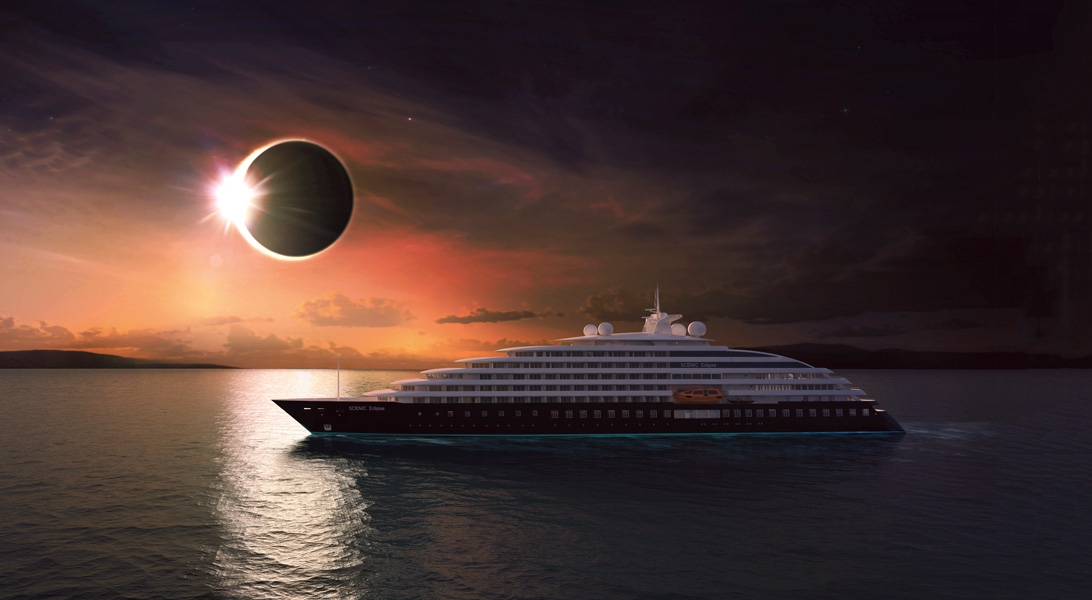
The images shown are for illustration purposes only and may not be an exact representation of what you find on the ship.
The images shown are for illustration purposes only and may not be an exact representation of what you find on the ship.
The images shown are for illustration purposes only and may not be an exact representation of what you find on the ship.
The images shown are for illustration purposes only and may not be an exact representation of what you find on the ship.
The images shown are for illustration purposes only and may not be an exact representation of what you find on the ship.


Our Fusion packages are all ABTA & ATOL protected ensuring that your booking is safe with us
| Return flights including luggage allowance | |||
| Overseas Transfers | |||
| 16 nights aboard the Scenic Eclipse II | |||
| Return Flights (including regional) | |||
| All Verandah Suites | |||
| Butler service for every guest | |||
| Nine Dining Venues | |||
| Gratuities Included | |||
| Complimentary drinks on-board | |||
| Free use of electric bikes | |||
| Comprehensive choice of shore excursions | |||
| Complimentary Wi-Fi | |||
| Explore under the sea in our submarine (additional charge) | |||
| Soar above and beyond by helicopter (additional charge) | |||
| Port Taxes and Fees | |||
 | ABTA and ATOL Protection* | ||
Fly/cruise package |
Date 20th Mar 2029 |
Nts 16 |
Interior  |
Oceanview |
Balcony |
Suite £23,273pp |
Interior |
Oceanview |
Balcony |
Suite £46,546pp |
Date 20th Mar 2029 |
Nts 16 |
Interior |
Oceanview |
Balcony |
Suite £23,273pp |
Interior |
Oceanview |
Balcony |
Suite £46,546pp |
Fusion Holidays when selling travel arrangements is a trading name of Co-op Travel Services Limited, registration 08903986. Fusion Cruises is an Accredited Body Member of Co-op Travel Services Limited ATOL 12904.
Book with Confidence. We are a Member of ABTA which means you have the benefit of ABTA’s assistance and Code of Conduct.
Some of the flights and flight-inclusive holidays on this website are financially protected by the ATOL scheme but ATOL protection does not apply to all holiday and travel services offered on this website. This website will provide you with information on the protection that applies in the case of each holiday and travel service offered before you make your booking. If you do not receive an ATOL Certificate then the booking will not be ATOL protected. If you do receive an ATOL Certificate but all parts of your trip are not listed on it, those parts will not be ATOL protected. Please see our booking conditions for information, or for more information about financial protection and the ATOL Certificate go to: www.caa.co.uk