This site uses cookies as defined in our Cookie Policy, by continuing to use this site you agree to their use.
Continue

| Arrive | Depart | ||||||
| 28th28 | JanJan | 202929 | Timaru, New Zealand, embark on the Scenic Eclipse II | ||||
Situated almost equidistant between Christchurch and Dunedin, Timaru has oft been overlooked by those just needing to get from one city to another but more fool them! The town’s name comes from the Māori name Te Maru, meaning ‘place of shelter’ and the pretty town reveals not only stunning Middle Earth landscape and views to write home about, but an intact Victorian / Edwardian shopping precinct with many of the building being built in local volcanic bluestone. Understandably, beach life is very important here and the long ribbons of white sandy beaches and clean seas are perfect for a swimming, sunning and spoiling yourself! Voted one of New Zealand’s top 10 most loved beaches, Caroline Bay is simply a treasure. Built on the rolling hills created from the lava flows of the extinct Mt Horrible volcano, Timaru is a melting pot of culture, history, adventure and dramatic scenery. Art lovers too will not be left wanting as the city’s art gallery holds the third largest public art collection in the South Island. Walking enthusiasts will not want to miss one of the many walks along the coast or rivers that vary from short paved paths – ideal for pushchairs and wheelchairs to longer, more strenuous hikes. Well signposted and maintained, these tracks are especially beautiful in the autumn when the leaves are turning colour. And do not forget to be on the lookout for penguins, which will happily waddle alongside you some of the way! Upon arrival in Christchurch, you will be transferred by coach to Timaru, where your ultra-luxury Scenic Discovery Yacht awaits. Nestled along New Zealand's dramatic South Island coast, Timaru welcomes you with its blend of natural beauty and rich heritage. The Captain and crew will warmly greet you as you board Scenic Eclipse II. Please book your flight to arrive into Christchurch prior to 10:30 AM. | |||||||
| 29th29 | JanJan | 202929 | Akaroa, New Zealand | ||||
Arrive this morning in Akaroa, site of New Zealand’s only successful French settlement. Established by French settlers in 1840, it still carries its heritage lightly, with French street names, characterful cottages and a Gallic note in some of its cafés and cuisine. Akaroa also looks over a sheltered harbour frequented by rare Hector’s dolphins, and is framed by an historic lighthouse and rolling green hillsides. | |||||||
| 30th30 | JanJan | 202929 | Picton, New Zealand | ||||
The maritime township of Picton (population 4,000) lies at the head of Queen Charlotte Sound and is the arrival point for ferries from the North Island, as well as a growing number of international cruise ships. It plays a major role in providing services and transport by water taxi to a multitude of remote communities in the vast area of islands, peninsulas, and waterways that make up the Marlborough Sounds Maritime Park. There's plenty to do in town, with crafts markets in summer, historical sights to see, and walking tracks to scenic lookouts over the sounds. The main foreshore is lined by London Quay, which looks up Queen Charlotte Sound to the bays beyond. High Street runs down to London Quay from the hills, and between them these two streets make up the center of town. Wake early this morning to experience the Marlborough Sounds as you sail into Picton. Ask your butler to deliver coffee to your suite so you can soak it in from your private verandah. | |||||||
| 31st31 | JanJan | 202929 | Napier, New Zealand | ||||
The earthquake that struck Napier at 10:46 am on February 3, 1931, was—at 7.8 on the Richter scale—the largest quake ever recorded in New Zealand. The coastline was wrenched upward several feet. Almost all the town's brick buildings collapsed; many people were killed on the footpaths as they rushed outside. The quake triggered fires throughout town, and with water mains shattered, little could be done to stop the blazes that devoured the remaining wooden structures. Only a few buildings survived (the Public Service Building with its neoclassical pillars is one), and the death toll was well over 100.The surviving townspeople set up tents and cookhouses in Nelson Park, and then tackled the city's reconstruction at a remarkable pace. In the rush to rebuild, Napier went mad for art deco, the bold, geometric style that had burst on the global design scene in 1925. Now a walk through the art deco district, concentrated between Emerson, Herschell, Dalton, and Browning streets, is a stylistic immersion. The decorative elements are often above the ground floors, so keep your eyes up. Arriving in Napier, it can feel as though the clock has paused in the 1930s. After a devastating earthquake in 1931, the city centre was almost entirely rebuilt in the Art Deco style of the era, with clean lines, pastel facades and geometric detailing. Today, its palm-lined streets, sunlit promenades and carefully preserved buildings create one of the world’s finest concentrations of authentic Art Deco architecture, complemented by a relaxed café culture and easy access to Hawke’s Bay’s acclaimed vineyards. | |||||||
| 1st01 | FebFeb | 202929 | Gisborne, New Zealand | ||||
With a population of around 35,000 and located on the north island, Gisborne exudes history at every turn. Maori for “Great standing place of Kiwa”, Kiwa was a leading figure aboard the Maori ancestral canoe, Takitimu, which ran aground in Gisborne around 1450 AD. After landing, Kiwa became a coastal guardian, eventually marrying Parawhenuamea, the keeper of the streams. The union point of three rivers and the first place to see the sun, the city is filled with light and laugher and gracefully squeezes surfer’s beaches with the district’s colonial past. Captain Cook made his first landfall here, John Harris set up his first trading station in the then village and today, Gisborn is the major centre of Maori cultural life.Suffice to say then that the city is a watery wonderland. With its picture perfect beaches, what savvy traveller does not want to add being among the first people in the world to say they have watched the sky change colour as the sun bursts from out of the sea. A place of nature, spectacular beach cliff views are all just part and parcel of everyday life here, and easy walks from the centre of town to the Titirangi Reserve will award you with yet more unbelievable 180˚ vistas from Poverty Bay to Gisborne City; stretch your eyes with the panorama, while stretching your legs on one of the many enjoyable walks.A perfect place to stroll, amble and wander, like much of New Zealand Gisborne keeps a healthy respect for history and nature and enjoys a very laid back feel. Gisborne, known affectionately as “Gizzy”, is celebrated as one of the first cities in the world to greet the new day. Its relaxed coastal atmosphere is complemented by a strong food and wine culture, with vineyards in the surrounding Tairawhiti region particularly noted for expressive whites and rich Chardonnay. Long, surf-washed beaches, a compact town centre and a growing focus on local producers give Gisborne a quietly confident, distinctly East Coast character. | |||||||
| 2nd02 | FebFeb | 202929 | Tauranga, New Zealand | ||||
The population center of the Bay of Plenty, Tauranga is one of New Zealand's fastest-growing cities. Along with its neighbor, Whakatane, this seaside city claims to be one of the country's sunniest towns. Unlike most local towns, Tauranga doesn't grind to a halt in the off-season, because it has one of the busiest ports in the country, and the excellent waves at the neighboring beach resort of Mount Maunganui—just across Tauranga's harbor bridge—always draw surfers and holiday folk. Today Scenic Eclipse II docks at Mount Maunganui, a relaxed beachside town just across the harbour from Tauranga. A graceful volcanic cone rises above a long, curving surf beach and sheltered inner bay, with coastal paths leading to wide views over the Bay of Plenty. Nearby Tauranga, New Zealand’s busiest port, offers a revitalised waterfront lined with cafés, restaurants and bars, adding an urban gloss to the region’s otherwise easygoing, holiday atmosphere. | |||||||
| 3rd03 | FebFeb | 202929 | Auckland, New Zealand | ||||
Auckland, the ‘City of Sails’, set between two harbours and ringed by dormant volcanic cones, is New Zealand’s largest and most cosmopolitan city. Here, waterside promenades, galleries and green spaces sit within easy reach of the central districts. You might spend time along the redeveloped waterfront, pause at a neighbourhood café or sample local seafood and New Zealand wines. Across the city, Maori and wider Pacific influences are reflected in its museums, art and everyday culture, giving Auckland a relaxed yet quietly sophisticated character. | |||||||
| 4th04 | FebFeb | 202929 | Bay of Islands, New Zealand | ||||
The Tasman Sea on the west and the Pacific Ocean on the east meet at thetop of North Island at Cape Reinga. No matter what route you take, you'll passfarms and forests, marvellous beaches, and great open spaces. The East Coast,up to the Bay of Islands, is Northland's most densely populated, often withrefugees from bigger cities—looking for a more relaxed life—clustered aroundbreathtaking beaches. The first decision on the drive north comes at the footof the Brynderwyn Hills. Turning left will take you up the West Coast throughareas once covered with forests and now used for either agricultural orhorticulture. Driving over "the Brynderwyns," as they are known,takes you to Whangarei, the only city in Northland. If you're in the mood for adiversion, you can slip to the beautiful coastline and take in Waipu Cove, anarea settled by Scots, and Laings Beach, where million-dollar homes sit next tosmall Kiwi beach houses.An hour's drive farther north is the Bay of Islands, known all over theworld for its beauty. There you will find lush forests, splendid beaches, andshimmering harbors. The Treaty of Waitangi was signed here in 1840 betweenMāoriand the British Crown, establishing the basis for the modern New Zealandstate. Every year on February 6, the extremely beautiful Waitangi Treaty Ground(the name means weeping waters) is the sight of a celebration of the treaty andprotests by Māori unhappy with it. Continuing north on the East Coast, theagricultural backbone of the region is even more evident and a series ofwinding loop roads off the main highway will take you to beaches that are bothbeautiful and isolated where you can swim, dive, picnic, or just laze. .The West Coast is even less populated, and the coastline is rugged andwindswept. In the Waipoua Forest, you will find some of New Zealand's oldestand largest kauri trees; the winding road will also take you past mangroveswamps. Crowning the region is the spiritually significant Cape Reinga, theheadland at the top of the vast stretch of 90 Mile Beach, where it's believedMāori souls depart after death. Today Māori make up roughly a quarter of thearea's population (compared with the national average of about 15%). The legendaryMāori navigator Kupe was said to have landed on the shores of Hokianga Harbour,where the first arrivals made their home. Many different wi (tribes) livedthroughout Northland, including Ngapuhi (the largest), Te Roroa, Ngati Wai,Ngati Kuri, Te Aupouri, Ngaitakoto, Ngati Kahu, and Te Rarawa. Many Māoriherecan trace their ancestry to the earliest inhabitants The Bay of Islands is one of the world’s most spectacular sailing destinations, so make sure you’re on your verandah or the Observation Terrace as you arrive early this morning. With its unique sub-tropical climate, around 150 islands and thousands of postcard-perfect coves, this is a little slice of paradise in northern New Zealand. | |||||||
| 5th05 | FebFeb | 202929 | At Sea | ||||
| 6th06 | FebFeb | 202929 | Norfolk Island, Norfolk Island | ||||
Roughly halfway between New Zealand and Australia, this tiny island is an outlying self-governing Australian territory with a tumultuous past. Claimed by Captain James Cook for the British in 1774, it was settled as a convict colony in 1788 and became known as Hell in the Pacific. In 1855, Queen Victoria gave the island to the descendants of the Bounty mutineers, who had outgrown their home on Pitcairn Island. | |||||||
| 7th07 | FebFeb | 202929 | At Sea | ||||
| 8th08 | FebFeb | 202929 | At Sea | ||||
| 9th09 | FebFeb | 202929 | Pacific Harbour, Fiji | ||||
Pacific Harbour sits on Viti Levu’s southern coast, where lush hills meet a wide stretch of lagoon. Often referred to as Fiji’s adventure capital, it also offers a relaxed introduction to local life, with village visits, handicraft markets and coastal walks. You may have the opportunity to witness traditional ceremonies, learn about fire-walking customs or sample Fijian dishes influenced by both Indigenous and Indo-Fijian heritage. The area's sheltered waters and surrounding reefs provide a haven for diverse marine life, whilst nearby rainforest trails reveal waterfalls and birdlife unique to this part of the Pacific. | |||||||
| 10th10 | FebFeb | 202929 | Sawa-I-Lau, Fiji | ||||
The Yasawa archipelago comprises approximately 20 volcanic islands that boast a captivating landscape. These picturesque islands served as the backdrop for the iconic Blue Lagoon films, including both the 1949 and 1980 versions. Interestingly, until 1987, the Yasawas remained inaccessible for land-based tourism, allowing them to be admired exclusively from boats, shrouding them in an air of mystique and remote beauty. | |||||||
| 11th11 | FebFeb | 202929 | Lautoka, Fiji, disembark the Scenic Eclipse II | ||||
North of Nadi through sugarcane plantations and past the Sabeto Mountains is Lautoka, nicknamed the Sugar City for the local agriculture and its big processing mill. With a population of around 50,000, it's the only city besides Suva and, like the capital, has a pleasant waterfront. It's the sailing point for Blue Lagoon and Beachcomber Cruises but is otherwise unremarkable for tourists, itself having few hotels and fewer good restaurants. Locals recommend the city as a less-expensive place to shop for clothing, but note that it can take as long as 45 minutes to drive here. Legend has it that Lautoka acquired its name when two chiefs engaged in combat and one hit the other with a spear. He proclaimed "lau toka" (spear hit) and thus the future town was named. Your Discovery Voyage concludes this morning in Lautoka, the second largest city in Fiji. Set on the western side of the island of Viti Levu, just north of Nadi, it’s the gateway to Fiji’s Sun Coast a pleasant mix of sugar-cane fields, grass-covered peaks, rural villages and market towns. Please book your flight to depart out of Nadi after 12:00 PM. #Spa treatments and services at additional cost. Daily activities may be subject to change; please consult your Daily Wonder for updates. Submersible not in operation in New Zealand. The itinerary is a guide only and may be amended for operational reasons. As such Scenic cannot guarantee the voyage will operate unaltered from the itinerary stated above. Please refer to our terms and conditions for further information. | |||||||
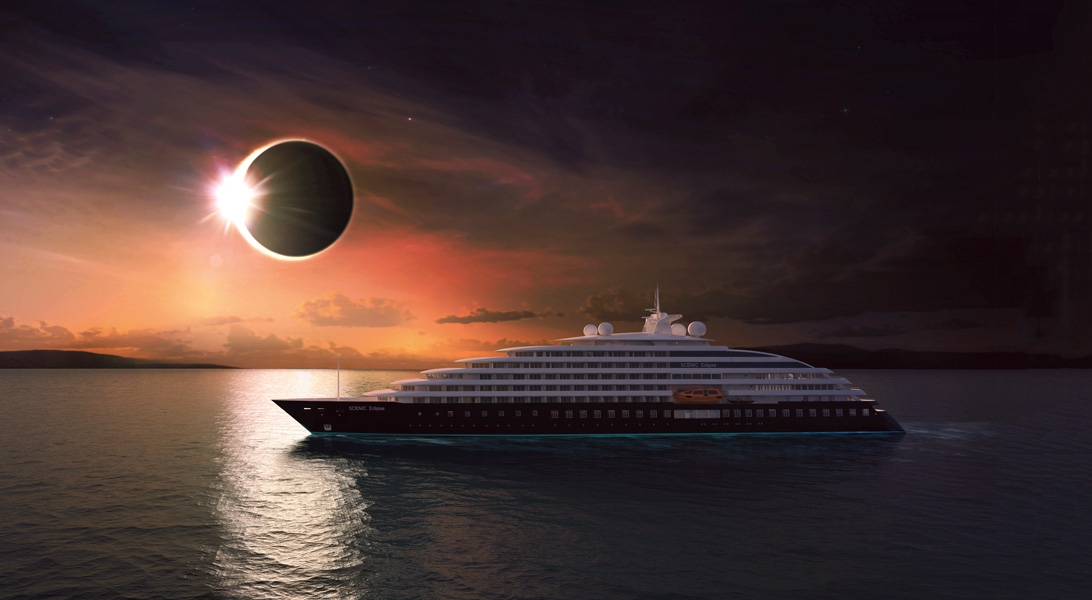
The images shown are for illustration purposes only and may not be an exact representation of what you find on the ship.
The images shown are for illustration purposes only and may not be an exact representation of what you find on the ship.
The images shown are for illustration purposes only and may not be an exact representation of what you find on the ship.
The images shown are for illustration purposes only and may not be an exact representation of what you find on the ship.
The images shown are for illustration purposes only and may not be an exact representation of what you find on the ship.

Our Fusion packages are all ABTA & ATOL protected ensuring that your booking is safe with us
| Return flights including luggage allowance | |||
| Overseas Transfers | |||
| 14 nights aboard the Scenic Eclipse II | |||
| Return Flights (including regional) | |||
| All Verandah Suites | |||
| Butler service for every guest | |||
| Nine Dining Venues | |||
| Gratuities Included | |||
| Complimentary drinks on-board | |||
| Free use of electric bikes | |||
| Comprehensive choice of shore excursions | |||
| Complimentary Wi-Fi | |||
| Explore under the sea in our submarine (additional charge) | |||
| Soar above and beyond by helicopter (additional charge) | |||
| Port Taxes and Fees | |||
 | ABTA and ATOL Protection* | ||
Fly/cruise package |
Date 28th Jan 2029 |
Nts 14 |
Interior  |
Oceanview |
Balcony |
Suite £13,440pp |
Interior |
Oceanview |
Balcony |
Suite £26,880pp |
Date 28th Jan 2029 |
Nts 14 |
Interior |
Oceanview |
Balcony |
Suite £13,440pp |
Interior |
Oceanview |
Balcony |
Suite £26,880pp |
Fusion Holidays when selling travel arrangements is a trading name of Co-op Travel Services Limited, registration 08903986. Fusion Cruises is an Accredited Body Member of Co-op Travel Services Limited ATOL 12904.
Book with Confidence. We are a Member of ABTA which means you have the benefit of ABTA’s assistance and Code of Conduct.
Some of the flights and flight-inclusive holidays on this website are financially protected by the ATOL scheme but ATOL protection does not apply to all holiday and travel services offered on this website. This website will provide you with information on the protection that applies in the case of each holiday and travel service offered before you make your booking. If you do not receive an ATOL Certificate then the booking will not be ATOL protected. If you do receive an ATOL Certificate but all parts of your trip are not listed on it, those parts will not be ATOL protected. Please see our booking conditions for information, or for more information about financial protection and the ATOL Certificate go to: www.caa.co.uk