This site uses cookies as defined in our Cookie Policy, by continuing to use this site you agree to their use.
Continue

| Arrive | Depart | ||||||
| 30th30 | NovNov | 202828 | Auckland, New Zealand, embark on the Scenic Eclipse II | ||||
Welcome to Auckland, New Zealand’s largest city. Home to around a third of the population, Auckland is a stylish, cosmopolitan centre set around two grand harbours. It’s packed with fascinating museums, world-class art galleries and stylish shops featuring local designers. Please book your flight to arrive into Auckland prior to 02:00 PM. | |||||||
| 1st01 | DecDec | 202828 | Waiheke Island, New Zealand | ||||
With its pale sandy beaches, vine-draped hills and clear Hauraki Gulf waters, Waiheke has long been regarded as one of the world’s most appealing island retreats. Popular with day trippers arriving by ferry from Auckland, it sees only a select number of smaller cruise vessels anchoring off its gently folded coastline, preserving a relaxed, village-like feel. You might follow a headland path shaded by crimson-flowering pohutukawa, paddle between sheltered bays by kayak, or linger over tastings at boutique estates to understand why Waiheke is often described as New Zealand’s “Island of Wine”. | |||||||
| 2nd02 | DecDec | 202828 | At Sea | ||||
| 3rd03 | DecDec | 202828 | Napier, New Zealand | ||||
The earthquake that struck Napier at 10:46 am on February 3, 1931, was—at 7.8 on the Richter scale—the largest quake ever recorded in New Zealand. The coastline was wrenched upward several feet. Almost all the town's brick buildings collapsed; many people were killed on the footpaths as they rushed outside. The quake triggered fires throughout town, and with water mains shattered, little could be done to stop the blazes that devoured the remaining wooden structures. Only a few buildings survived (the Public Service Building with its neoclassical pillars is one), and the death toll was well over 100.The surviving townspeople set up tents and cookhouses in Nelson Park, and then tackled the city's reconstruction at a remarkable pace. In the rush to rebuild, Napier went mad for art deco, the bold, geometric style that had burst on the global design scene in 1925. Now a walk through the art deco district, concentrated between Emerson, Herschell, Dalton, and Browning streets, is a stylistic immersion. The decorative elements are often above the ground floors, so keep your eyes up. Arriving in Napier, it can feel as though the clock has paused in the 1930s. After a devastating earthquake in 1931, the city centre was almost entirely rebuilt in the Art Deco style of the era, with clean lines, pastel facades and geometric detailing. Today, its palm-lined streets, sunlit promenades and carefully preserved buildings create one of the world’s finest concentrations of authentic Art Deco architecture, complemented by a relaxed café culture and easy access to Hawke’s Bay’s acclaimed vineyards. | |||||||
| 4th04 | DecDec | 202828 | Picton, New Zealand | ||||
The maritime township of Picton (population 4,000) lies at the head of Queen Charlotte Sound and is the arrival point for ferries from the North Island, as well as a growing number of international cruise ships. It plays a major role in providing services and transport by water taxi to a multitude of remote communities in the vast area of islands, peninsulas, and waterways that make up the Marlborough Sounds Maritime Park. There's plenty to do in town, with crafts markets in summer, historical sights to see, and walking tracks to scenic lookouts over the sounds. The main foreshore is lined by London Quay, which looks up Queen Charlotte Sound to the bays beyond. High Street runs down to London Quay from the hills, and between them these two streets make up the center of town. It’s worth waking up early this morning so you can experience the Marlborough Sounds as you sail into Picton. Ask your butler to deliver coffee to your suite so you can soak it in from your private verandah. | |||||||
| 5th05 | DecDec | 202828 | Kaiteriteri, South Island, New Zealand | ||||
Scenic Eclipse II will call at two ports in the Tasman Bay today. Kaiteriteri is arguably New Zealand’s most beautiful beach, a perfect arc of golden sand fronting startling blue water. It’s also the gateway to the Abel Tasman National Park, a gorgeous coastal park known for its sea kayaking, walks and wildlife. | |||||||
| 5th05 | DecDec | 202828 | Nelson, New Zealand | ||||
| 6th06 | DecDec | 202828 | Kaikoura, New Zealand | ||||
You’ll arrive in Kaikoura later this morning. This tiny town sits in a spectacular natural environment, flanked by the Pacific Ocean on one side and the snow-capped Seaward Kaikoura Range on the other. The town began life as a whaling station in the mid 1800s; visit the oldest surviving building, Fyffe House, or the Kaikoura Museum to learn more about its history. It’s also an ideal place for wildlife encounters. Whales, fur seals and dolphins live permanently in these waters, and an impressive array of seabirds fill the air, including the mighty albatross. This evening, relax at the Observation Lounge with a book, or gather with fellow guests at the Scenic Lounge Bar to share the day's wildlife encounters. | |||||||
| 7th07 | DecDec | 202828 | Akaroa, New Zealand | ||||
Arrive this morning in Akaroa, site of New Zealand’s only successful French settlement. Established by French settlers in 1840, it still carries its heritage lightly with French street names, characterful cottages and a Gallic note in some of its cafés and cuisine. Akaroa also looks over a sheltered harbour frequented by rare Hector’s dolphins, and is framed by an historic lighthouse and rolling green hillsides. Back on board, tonight could be the night you enjoy Night Market @ Koko's+ with new friends. Stay up late at the Scenic Lounge Bar or retire to the Observation Lounge library for a moment of blissful solitude before bed. | |||||||
| 8th08 | DecDec | 202828 | At Sea | ||||
| 9th09 | DecDec | 202828 | At Sea | ||||
| 9th09 | DecDec | 202828 | Dusky Sound, New Zealand | ||||
Despite being discovered by Cook more than 240 years ago, Dusky Sound is one of the few truly untouched destinations left on earth. Found on the southwest corner of New Zealand’s Fiordland National Park, Dusky Sound has the auspicious title of “titanic mason” given to it by the Maoris, as no other explanation seems to fit; it is almost impossible to comprehend the sheer breadth of geological events that created this seemingly perfect sculpture, as the sheer cliffs that rise vertically upward from the ocean dwarf the ship. This incredibly beautiful fiord offers many magical wildernesses and stunning scenery that bathe in “Lord of the Rings” grandeur. A breeding site for Fiordland Penguins, Dusky Sound is an important ornithological area too, with a wealth of birdlife to be found here. This remote, untouched region is also home to a wide range of sea life, as the fresh and salt water combine to create an extraordinary aquatic environment. An unforgettable journey for both the experienced and the uninitiated, anyone looking to visit a place unmarked by the passage of time will be spoilt its breathtaking beauty. | |||||||
| 10th10 | DecDec | 202828 | Milford Sound, New Zealand | ||||
New Zealand fiord country along with Fiordland National Park is one of New Zealand's premier attractions. Incredibly beautiful, wild and remote, the region is an intriguing combination of rugged mountain ranges, dense rainforest, solitary alpine lakes, sparkling rivers and splashing waterfalls. Much of Fiordland is virtually unexplored wilderness and still the habitat of rare birds. As the ship cruises the beautiful Doubtful, Dusky and Milford Sounds, experience the majestic fiordland of South Island's western coast. Captain James Cook sailed along this coast in 1770 and again in 1773, when he anchored at Dusky Sound for a rest and ship repair. Doubtful Sound is one of the region's most majestic fiords. It is ten times larger than Milford Sound. As the ship cruises into Hall Arm, gaze at vertical cliffs and mighty waterfalls plunging over sheer rock faces. In fine weather, mountains and greenery are reflected in the protected waters of the fiord. Farther north lies Milford Sound. Far from any populated area, Milford Sound is famous for its grandeur and spectacular beauty. It is perhaps the best example of New Zealand's renowned classic landscape of steep granite peaks framing glacier-carved inlets with mirrored reflections on dark waters. Dominating the scene is Milford's landmark, the triangular pinnacle of Mitre Peak. Along the sheer cliffs, several waterfalls tumble more than 500 feet (154 metres) into the sheltered Sound. Only a few moored boats and a scattering of buildings at the head of the Sound break the unity of mountains, forest and water. This spectacular beauty and unspoiled setting is yours to enjoy as the ship cruises Milford Sound. The rugged West Coast of New Zealand’s South Island offers some of the country’s most stunning scenery. You’ll cruise through Fiordland National Park, which covers more than 1.2 million hectares of granite peaks, shimmering lakes, deep black fjords and spectacular waterfalls. | |||||||
| 11th11 | DecDec | 202828 | Oban, Stewart Island, New Zealand | ||||
Stewart Island is home to New Zealand's newest national park, Rakiura National Park. The third and most southerly of New Zealand's main islands, Stewart Island is separated from the South Island by the 24-km (15-miles) Foveaux Strait. Its original Māori name, Te Punga O Te Waka a Maui, means "the anchor stone of Maui's canoe." Māori mythology says the island's landmass held the god Maui's canoe secure while he and his crew raised the great fish—the North Island. Today the island is more commonly referred to by its other Māori name, Rakiura, which means "the land of the glowing skies." This refers to the spectacular sunrises and sunsets and to the southern lights, or aurora australis. The European name of Stewart Island dates back to 1809. It memorializes an officer William W. Stewart on an early sealing vessel, the Pegasus, who was the first to chart the island. The island covers some 1,700 square km (650 square miles). It measures about 75 km (46 miles) from north to south and about the same distance across at its widest point. On the coastline, sharp cliffs rise from a succession of sheltered bays and beaches. In the interior, forested hills rise gradually toward the west side of the island. Seals and penguins frequent the coast, and the island's prolific birdlife includes a number of species rarely seen in any other part of the country. In fact, this is the surest place to see a kiwi. The Stewart Island brown kiwi, or tokoeka, is the largest species of this kind of bird. Unlike their mainland cousins, these kiwis can be seen during the day as well as at night. It's a rare and amusing experience to watch these pear-shape birds scampering on a remote beach as they feed on sand hoppers and grubs. Māori have visited Stewart Island for centuries. Archaeologists' studies of 13th-century Māori middens (refuse heaps) indicate that the island was once a rich, seasonal resource for hunting, fishing, and gathering seafood. A commonly eaten delicacy at that time, the titi, also known as the muttonbird, still occasionally appears on menus. In the early 19th century, explorers, sealers, missionaries, and miners settled the island. They were followed by fishermen and sawmillers who established settlements around the edges of Paterson Inlet and Halfmoon and Horseshoe bays. In the 1920s Norwegians set up a whaling enterprise, and many descendants of these seafaring people remain. Fishing, aquaculture, and tourism are now the mainstays of the island's economy. Even by New Zealand standards, Stewart Island is remote, raw, and untouched. The appeal is its seclusion, its relaxed way of life, and its untouched quality. Stewart Island is not for everyone: if you must have shopping malls, casinos, or umbrella drinks on the beach, don't come here. Visitors should be prepared for the fact that Stewart Island can be chilly, windy, and rainy, even in the middle of summer. Stewart Island sits 30 kilometres off the southern tip of the South Island. It is one of the last inhabited outposts before you reach Antarctica. Its only settlement, the tiny village of Oban, clings bravely to the northern shore. | |||||||
| 12th12 | DecDec | 202828 | Port Chalmers, New Zealand | ||||
European whaling ships first called at Otago Province during the early decades of the 1800s, yielding a mixed response from the native Māori. In 1848 Dunedin was settled, and by the mid-1860s the city was the economic hub of the Otago gold rush. Dunedin's historical wealth endures in such institutions as the University of Otago, the oldest in the country. But if any region can bring out the bird-watcher in you, this is it; the area is home to the Royal Albatross and yellow-eyed penguins. Wake up in Port Chalmers, the gateway to Dunedin, one of New Zealand’s most historic cities. Founded in 1848, it has a proud Scottish lineage – in fact, Dunedin takes its name from the old Gaelic for Edinburgh, Dùn Èideann. Stroll the well-preserved streets to admire grand Victorian and Edwardian architecture, much of it built on wealth from the Otago gold rush. | |||||||
| 13th13 | DecDec | 202828 | Timaru, New Zealand, disembark the Scenic Eclipse II | ||||
Situated almost equidistant between Christchurch and Dunedin, Timaru has oft been overlooked by those just needing to get from one city to another but more fool them! The town’s name comes from the Māori name Te Maru, meaning ‘place of shelter’ and the pretty town reveals not only stunning Middle Earth landscape and views to write home about, but an intact Victorian / Edwardian shopping precinct with many of the building being built in local volcanic bluestone. Understandably, beach life is very important here and the long ribbons of white sandy beaches and clean seas are perfect for a swimming, sunning and spoiling yourself! Voted one of New Zealand’s top 10 most loved beaches, Caroline Bay is simply a treasure. Built on the rolling hills created from the lava flows of the extinct Mt Horrible volcano, Timaru is a melting pot of culture, history, adventure and dramatic scenery. Art lovers too will not be left wanting as the city’s art gallery holds the third largest public art collection in the South Island. Walking enthusiasts will not want to miss one of the many walks along the coast or rivers that vary from short paved paths – ideal for pushchairs and wheelchairs to longer, more strenuous hikes. Well signposted and maintained, these tracks are especially beautiful in the autumn when the leaves are turning colour. And do not forget to be on the lookout for penguins, which will happily waddle alongside you some of the way! Your Signature Yacht Cruise ends in Timaru, a charming port town known for its stunning coastal landscapes and warm Kiwi hospitality. Please book your flight to depart out of Christchurch after 02:00 PM. #Spa treatments and services at additional cost. Daily activities may be subject to change; please consult your Daily Wonder for updates. Submersible not in operation in New Zealand. The itinerary is a guide only and may be amended for operational reasons. As such Scenic cannot guarantee the voyage will operate unaltered from the itinerary stated above. Please refer to our terms and conditions for further information. | |||||||
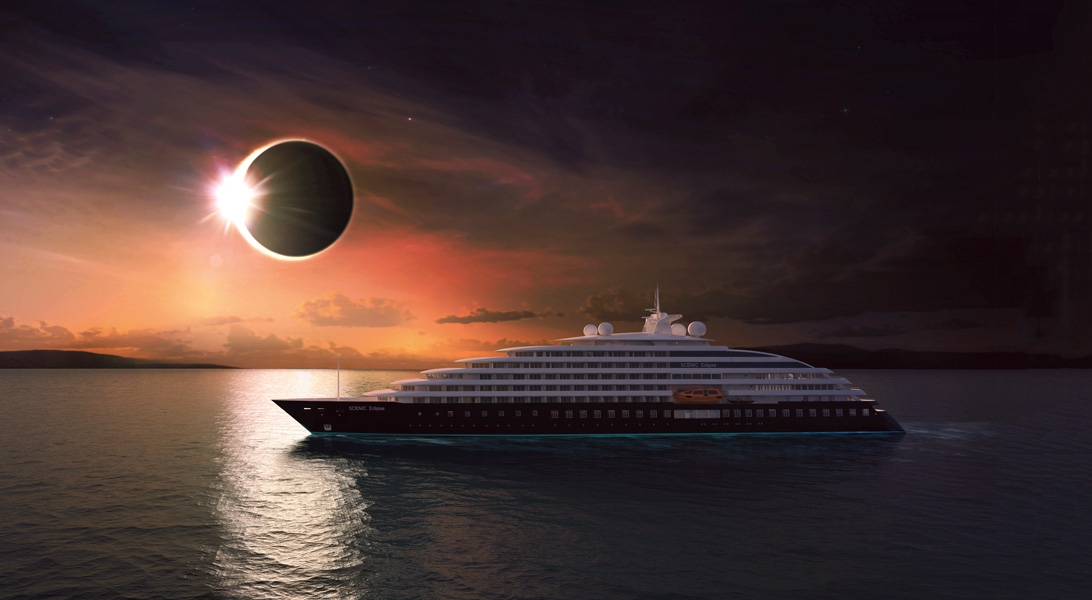
The images shown are for illustration purposes only and may not be an exact representation of what you find on the ship.
The images shown are for illustration purposes only and may not be an exact representation of what you find on the ship.
The images shown are for illustration purposes only and may not be an exact representation of what you find on the ship.
The images shown are for illustration purposes only and may not be an exact representation of what you find on the ship.
The images shown are for illustration purposes only and may not be an exact representation of what you find on the ship.


Our Fusion packages are all ABTA & ATOL protected ensuring that your booking is safe with us
| Return flights including luggage allowance | |||
| Overseas Transfers | |||
| 13 nights aboard the Scenic Eclipse II | |||
| Return Flights (including regional) | |||
| All Verandah Suites | |||
| Butler service for every guest | |||
| Nine Dining Venues | |||
| Gratuities Included | |||
| Complimentary drinks on-board | |||
| Free use of electric bikes | |||
| Comprehensive choice of shore excursions | |||
| Complimentary Wi-Fi | |||
| Explore under the sea in our submarine (additional charge) | |||
| Soar above and beyond by helicopter (additional charge) | |||
| Port Taxes and Fees | |||
 | ABTA and ATOL Protection* | ||
Fly/cruise package |
Date 30th Nov 2028 |
Nts 13 |
Interior  |
Oceanview |
Balcony |
Suite £13,633pp |
Interior |
Oceanview |
Balcony |
Suite £27,266pp |
Date 30th Nov 2028 |
Nts 13 |
Interior |
Oceanview |
Balcony |
Suite £13,633pp |
Interior |
Oceanview |
Balcony |
Suite £27,266pp |
Fusion Holidays when selling travel arrangements is a trading name of Co-op Travel Services Limited, registration 08903986. Fusion Cruises is an Accredited Body Member of Co-op Travel Services Limited ATOL 12904.
Book with Confidence. We are a Member of ABTA which means you have the benefit of ABTA’s assistance and Code of Conduct.
Some of the flights and flight-inclusive holidays on this website are financially protected by the ATOL scheme but ATOL protection does not apply to all holiday and travel services offered on this website. This website will provide you with information on the protection that applies in the case of each holiday and travel service offered before you make your booking. If you do not receive an ATOL Certificate then the booking will not be ATOL protected. If you do receive an ATOL Certificate but all parts of your trip are not listed on it, those parts will not be ATOL protected. Please see our booking conditions for information, or for more information about financial protection and the ATOL Certificate go to: www.caa.co.uk