This site uses cookies as defined in our Cookie Policy, by continuing to use this site you agree to their use.
Continue

| Arrive | Depart | ||||||
| 7th07 | JanJan | 202929 | Miami, Florida, United States, embark on the Seabourn Quest | 17:00 | |||
Miami is one of the world’s most popular holiday spots. It has so much to offer; from its countless beach areas, to culture and museums, from spa and shopping days out, to endless cuban restaurants and cafes. Miami is a multicultural city that has something to offer to everyone. | |||||||
| 8th08 | JanJan | 202929 | At Sea | ||||
| 9th09 | JanJan | 202929 | At Sea | ||||
| 10th10 | JanJan | 202929 | At Sea | ||||
| 11th11 | JanJan | 202929 | Cartagena, Colombia | 08:00 | 23:00 | ||
Cartagena's magnificent city walls and fortresses, now a UNESCO World Heritage Site, enclose a well-restored historic center (the Cuidad Amurallada, or walled city) with plazas, churches, museums, and shops that have made it a lively coastal vacation spot for South Americans and others. New hotels and restaurants make the walled city a desirable place to stay, and the formerly down-at-the-heels Getsemaní neighborhood attracts those seeking a bohemian buzz. The historic center is a small section of Cartagena; many hotels are in the Bocagrande district, an elongated peninsula where high-rise hotels overlook a long, gray-sand beach.When it was founded in 1533 by Spanish conquistador Pedro de Heredia, Cartagena was the only port on the South American mainland. Gold and silver looted from indigenous peoples passed through here en route to Spain and attracted pirates, including Sir Francis Drake, who in 1586 torched 200 buildings. Cartagena's walls protected the city's riches as well as the New World's most important African slave market. | |||||||
| 12th12 | JanJan | 202929 | At Sea | ||||
| 13th13 | JanJan | 202929 | At Sea | ||||
| 14th14 | JanJan | 202929 | At Sea | ||||
| 15th15 | JanJan | 202929 | At Sea | ||||
| 16th16 | JanJan | 202929 | Guayaquil, Ecuador | 05:00 | 18:00 | ||
The second major jumping off point for the Galapagos Islands after Quito, this is a little city with a big heart. A sea port first and foremost, the city’s personality has been founded on that, and all the better it is for it too. Almost Caribbean in feeling, the clement climate coupled with the intermingling rhythms floating from the windows and abundance of fresh seafood make this a very tropical destination. Once not even considered by the travel books as a potential destination in its own right, the city has undergone something of a resurgence in the past few years. Proud Guayaquileños will not hestitate to point out the Malecón or the exciting new riverfront promenade, once a no-go area after dark, now happily (and hippily) lined with museums, restaurants, shops, and ongoing entertainment. The new airport and urban transportation network are also lauded to the happy tourists who find themselves here. As the largest and most populous city in Ecuador as well as being the commercial centre, it would only be natural that the city would have some kind of modern architecture, but it is the colourful favelas, or to use their real name guasmos, that cling to the side of the hillside like limpets that really catch your eye. A blend of old and new, the first inhabitants can be traced back to 1948 when the government cleared the area for affordable housing, these shanty towns are witness to the social and political particularities that Guayaquil has faced in the past. | |||||||
| 17th17 | JanJan | 202929 | At Sea | ||||
| 18th18 | JanJan | 202929 | At Sea | ||||
| 19th19 | JanJan | 202929 | Callao, Peru | 05:00 | |||
When people discuss great South American cities, Lima is often overlooked. But Peru's capital can hold its own against its neighbors. It has an oceanfront setting, colonial-era splendor, sophisticated dining, and nonstop nightlife.It's true that the city—clogged with traffic and choked with fumes—doesn't make a good first impression, especially since the airport is in an industrial neighborhood. But wander around the regal edifices surrounding the Plaza de Armas, among the gnarled olive trees of San Isidro's Parque El Olivar, or along the winding lanes in the coastal community of Barranco, and you'll find yourself charmed.In 1535 Francisco Pizarro found the perfect place for the capital of Spain's colonial empire. On a natural port, the so-called Ciudad de los Reyes (City of Kings) allowed Spain to ship home all the gold the conquistador plundered from the Inca. Lima served as the capital of Spain's South American empire for 300 years, and it's safe to say that no other colonial city enjoyed such power and prestige during this period.When Peru declared its independence from Spain in 1821, the declaration was read in the square that Pizarro had so carefully designed. Many of the colonial-era buildings around the Plaza de Armas are standing today. Walk a few blocks in any direction for churches and elegant houses that reveal just how wealthy this city once was. But the poor state of most buildings attests to the fact that the country's wealthy families have moved to neighborhoods to the south over the past century.The walls that surrounded the city were demolished in 1870, making way for unprecedented growth. A former hacienda became the graceful residential neighborhood of San Isidro. In the early 1920s the construction of tree-lined Avenida Arequipa heralded the development of neighborhoods such as bustling Miraflores and bohemian Barranco.Almost a third of the country's population of 29 million lives in the metropolitan area, many of them in relatively poor conos: newer neighborhoods on the outskirts of the city. Most residents of those neighborhoods moved there from mountain villages during the political violence and poverty that marked the 1980s and ’90s, when crime increased dramatically. During the past decade the country has enjoyed peace and steady economic growth, which have been accompanied by many improvements and refurbishment in the city. Residents who used to steer clear of the historic center now stroll along its streets. And many travelers who once would have avoided the city altogether now plan to spend a day here and end up staying two or three. | |||||||
| 20th20 | JanJan | 202929 | Callao, Peru | 18:00 | |||
When people discuss great South American cities, Lima is often overlooked. But Peru's capital can hold its own against its neighbors. It has an oceanfront setting, colonial-era splendor, sophisticated dining, and nonstop nightlife.It's true that the city—clogged with traffic and choked with fumes—doesn't make a good first impression, especially since the airport is in an industrial neighborhood. But wander around the regal edifices surrounding the Plaza de Armas, among the gnarled olive trees of San Isidro's Parque El Olivar, or along the winding lanes in the coastal community of Barranco, and you'll find yourself charmed.In 1535 Francisco Pizarro found the perfect place for the capital of Spain's colonial empire. On a natural port, the so-called Ciudad de los Reyes (City of Kings) allowed Spain to ship home all the gold the conquistador plundered from the Inca. Lima served as the capital of Spain's South American empire for 300 years, and it's safe to say that no other colonial city enjoyed such power and prestige during this period.When Peru declared its independence from Spain in 1821, the declaration was read in the square that Pizarro had so carefully designed. Many of the colonial-era buildings around the Plaza de Armas are standing today. Walk a few blocks in any direction for churches and elegant houses that reveal just how wealthy this city once was. But the poor state of most buildings attests to the fact that the country's wealthy families have moved to neighborhoods to the south over the past century.The walls that surrounded the city were demolished in 1870, making way for unprecedented growth. A former hacienda became the graceful residential neighborhood of San Isidro. In the early 1920s the construction of tree-lined Avenida Arequipa heralded the development of neighborhoods such as bustling Miraflores and bohemian Barranco.Almost a third of the country's population of 29 million lives in the metropolitan area, many of them in relatively poor conos: newer neighborhoods on the outskirts of the city. Most residents of those neighborhoods moved there from mountain villages during the political violence and poverty that marked the 1980s and ’90s, when crime increased dramatically. During the past decade the country has enjoyed peace and steady economic growth, which have been accompanied by many improvements and refurbishment in the city. Residents who used to steer clear of the historic center now stroll along its streets. And many travelers who once would have avoided the city altogether now plan to spend a day here and end up staying two or three. | |||||||
| 21st21 | JanJan | 202929 | General San Martin, Peru | 07:00 | 17:00 | ||
| 22nd22 | JanJan | 202929 | At Sea | ||||
| 23rd23 | JanJan | 202929 | At Sea | ||||
| 24th24 | JanJan | 202929 | At Sea | ||||
| 25th25 | JanJan | 202929 | At Sea | ||||
| 26th26 | JanJan | 202929 | At Sea | ||||
| 27th27 | JanJan | 202929 | Hangaroa, Easter Island, Chile | 08:00 | |||
Discovered (by the Western world) on Easter Sunday, 1722, Easter Island is a UNESCO World Heritage Site and one of the most isolated places on the face of the Earth, some 2,300 miles from the Chilean mainland. Although more Polynesian than South American in character, the 64-square mile island was annexed by Chile in 1888, and is now famous as the world’s largest ‘open air museum’ on account of the Moai, or human-like stone statues, that can be found on the island. The Moai remain very much a mystery, which archaeologists are still trying to unlock by interpreting an ancient language of the Rapa Nui, which is the key to understanding this culture, and is written on the so called ‘rongo rongo tablets’. The island owes its origin to three volcanoes which erupted some three million years ago: Poike, Rano Kau and Maunga Terevaka. It is not known when or how the island was first populated, but the most credible theory suggests that the Rapa Nui people came from other Pacific islands in the 4th century AD. In addition to the cultural and archaeological interest, there are the beautiful beaches, transparent waters, and coral reefs that might be expected of a Pacific Island. | |||||||
| 28th28 | JanJan | 202929 | Hangaroa, Easter Island, Chile | 17:00 | |||
Discovered (by the Western world) on Easter Sunday, 1722, Easter Island is a UNESCO World Heritage Site and one of the most isolated places on the face of the Earth, some 2,300 miles from the Chilean mainland. Although more Polynesian than South American in character, the 64-square mile island was annexed by Chile in 1888, and is now famous as the world’s largest ‘open air museum’ on account of the Moai, or human-like stone statues, that can be found on the island. The Moai remain very much a mystery, which archaeologists are still trying to unlock by interpreting an ancient language of the Rapa Nui, which is the key to understanding this culture, and is written on the so called ‘rongo rongo tablets’. The island owes its origin to three volcanoes which erupted some three million years ago: Poike, Rano Kau and Maunga Terevaka. It is not known when or how the island was first populated, but the most credible theory suggests that the Rapa Nui people came from other Pacific islands in the 4th century AD. In addition to the cultural and archaeological interest, there are the beautiful beaches, transparent waters, and coral reefs that might be expected of a Pacific Island. | |||||||
| 29th29 | JanJan | 202929 | At Sea | ||||
| 30th30 | JanJan | 202929 | At Sea | ||||
| 31st31 | JanJan | 202929 | At Sea | ||||
| 1st01 | FebFeb | 202929 | At Sea | ||||
| 2nd02 | FebFeb | 202929 | At Sea | ||||
| 3rd03 | FebFeb | 202929 | Nuku Hiva Island, French Polynesia | 07:00 | 17:00 | ||
| 4th04 | FebFeb | 202929 | At Sea | ||||
| 5th05 | FebFeb | 202929 | Rangiroa, French Polynesia | 08:00 | 16:00 | ||
| 6th06 | FebFeb | 202929 | Papeete, Tahiti, French Polynesia | 08:00 | 23:00 | ||
Papeete will be your gateway to the tropical paradise of French Polynesia, where islands fringed with gorgeous beaches and turquoise ocean await to soothe the soul. This spirited city is the capital of French Polynesia, and serves as a superb base for onward exploration of Tahiti – an island of breathtaking landscapes and oceanic vistas. Wonderful lagoons of crisp, clear water beg to be snorkelled, stunning black beaches and blowholes pay tribute to the island's volcanic heritage, and lush green mountains beckon you inland on adventures, as you explore extraordinary Tahiti. Visit to relax inside picturesque stilted huts, which stand out over shimmering water, as you settle into the intoxicating rhythm of life, in this Polynesian paradise. | |||||||
| 7th07 | FebFeb | 202929 | Moorea, French Polynesia | 08:00 | 18:00 | ||
Mo’orea is one of the Society Islands of the French Polynesia. Located in the South Pacific, it is considered a magical island thanks to its majestic volcanic mountains, set against warm lagoon waters and green meadows. It is an island that attracts visitors of all abilities wanting to explore both above and below the ocean waters. | |||||||
| 8th08 | FebFeb | 202929 | Bora-Bora, French Polynesia | 08:00 | |||
Simply saying the name Bora Bora is usually enough to induce gasps of jealousy, as images of milky blue water, sparkling white beaches and casually leaning palm trees immediately spring to mind. The imagination doesn't lie, either, and if you visit, you’ll soon realise this island is every bit as gorgeous as you ever imagined. Thatched wooden huts stand out over shallow, sparkling seawater, with vivid fish swirling just below. Soak up the sun, scuba dive, or simply revel in the opulent luxury of one of the island's many magnificent resorts. If blissful inactivity doesn't appeal, then get active, and hike the greenery of the sharp Mount Pahia. | |||||||
| 9th09 | FebFeb | 202929 | Bora-Bora, French Polynesia | 16:00 | |||
Simply saying the name Bora Bora is usually enough to induce gasps of jealousy, as images of milky blue water, sparkling white beaches and casually leaning palm trees immediately spring to mind. The imagination doesn't lie, either, and if you visit, you’ll soon realise this island is every bit as gorgeous as you ever imagined. Thatched wooden huts stand out over shallow, sparkling seawater, with vivid fish swirling just below. Soak up the sun, scuba dive, or simply revel in the opulent luxury of one of the island's many magnificent resorts. If blissful inactivity doesn't appeal, then get active, and hike the greenery of the sharp Mount Pahia. | |||||||
| 10th10 | FebFeb | 202929 | At Sea | ||||
| 11th11 | FebFeb | 202929 | At Sea | ||||
| 12th12 | FebFeb | 202929 | At Sea | ||||
| 14th14 | FebFeb | 202929 | Nuku'alofa, Tonga | 10:00 | 19:00 | ||
Nukualofa is the capital city of the Kingdom of Tonga, a group of islands in the South Pacific. The islands of Tonga are lined with coral reefs and white sand beaches, and are protected by picturesque lagoons and limestone cliffs. Tonga is also one of the very few places in the world where visitors have the opportunity to swim with whales in the tropical ocean waters. | |||||||
| 15th15 | FebFeb | 202929 | At Sea | ||||
| 16th16 | FebFeb | 202929 | Savusavu, Fiji | 07:00 | 16:00 | ||
Suva, a multiracial city, is the pulsing heart of the South Pacific. Its location is on a hilly peninsula in the southeast corner of Viti Levu Island, the largest in the Fijian archipelago. Suva was named the country's capital in 1882; the former capital was Luvuka. Suva's natural harbour was no doubt a deciding factor that prompted the change. Its port is the country's main shipping facility, accommodating vessels from all over the world. The town is backed by the lush green hills of the Suva-Rewa range. The waterfront district, much of which is built on land reclaimed from tangled mangrove swamps, provides the hub for much of Suva's activities. The downtown centre is a hodgepodge of high-rise office buildings, colonial houses with second-story verandas, parks and government structures. The northern and western mountains catch the trade winds, with the result being damp conditions year-round and frequent tropical downpours. Despite the ever-present possibility of showers, Suva is an excellent place to explore on foot. Many points of interest are located on Victoria Parade and along tree-shaded Queen Elizabeth Drive. Suva's botanical park is lush with flowering plants, trees and green lawns. In its centre stands the Fiji Museum, where objects reflect 3,000 years of Fijian history. The museum boasts a fine collection of Melanesian artefacts and various exhibits that reflect on Fiji's maritime era. Government House stands on a hillside surrounded by landscaped grounds. A stern, uniformed sentry guards the pillared gate entrance. The monthly Changing of the Guard is executed with almost as much pomp and ceremony as at London's Buckingham Palace. Friendly Fiji will charm you; here Melanesia mixes with Polynesia, ancient India with Oceania and tradition with the modern world. The Fijian greeting "Bula!" is extended warmly to strangers on city streets and country roads. Fiji is one of the South Pacific's most hospitable countries and a holiday destination that has much to offer in recreational activities, shopping and joyous celebrations. | |||||||
| 17th17 | FebFeb | 202929 | At Sea | ||||
| 18th18 | FebFeb | 202929 | Mystery Island (Inyeug), Vanuatu | 10:00 | 18:00 | ||
| 19th19 | FebFeb | 202929 | Easo, Lifou Island, New Caledonia | 07:00 | 16:00 | ||
| 20th20 | FebFeb | 202929 | At Sea | ||||
| 21st21 | FebFeb | 202929 | At Sea | ||||
| 22nd22 | FebFeb | 202929 | Waitangi, Bay of Islands, New Zealand | 08:00 | 17:00 | ||
| 23rd23 | FebFeb | 202929 | Auckland, New Zealand | 07:00 | 19:00 | ||
| 24th24 | FebFeb | 202929 | Tauranga, New Zealand | 07:30 | 18:15 | ||
The population center of the Bay of Plenty, Tauranga is one of New Zealand's fastest-growing cities. Along with its neighbor, Whakatane, this seaside city claims to be one of the country's sunniest towns. Unlike most local towns, Tauranga doesn't grind to a halt in the off-season, because it has one of the busiest ports in the country, and the excellent waves at the neighboring beach resort of Mount Maunganui—just across Tauranga's harbor bridge—always draw surfers and holiday folk. | |||||||
| 25th25 | FebFeb | 202929 | Gisborne, New Zealand | 10:00 | 18:00 | ||
With a population of around 35,000 and located on the north island, Gisborne exudes history at every turn. Maori for “Great standing place of Kiwa”, Kiwa was a leading figure aboard the Maori ancestral canoe, Takitimu, which ran aground in Gisborne around 1450 AD. After landing, Kiwa became a coastal guardian, eventually marrying Parawhenuamea, the keeper of the streams. The union point of three rivers and the first place to see the sun, the city is filled with light and laugher and gracefully squeezes surfer’s beaches with the district’s colonial past. Captain Cook made his first landfall here, John Harris set up his first trading station in the then village and today, Gisborn is the major centre of Maori cultural life.Suffice to say then that the city is a watery wonderland. With its picture perfect beaches, what savvy traveller does not want to add being among the first people in the world to say they have watched the sky change colour as the sun bursts from out of the sea. A place of nature, spectacular beach cliff views are all just part and parcel of everyday life here, and easy walks from the centre of town to the Titirangi Reserve will award you with yet more unbelievable 180˚ vistas from Poverty Bay to Gisborne City; stretch your eyes with the panorama, while stretching your legs on one of the many enjoyable walks.A perfect place to stroll, amble and wander, like much of New Zealand Gisborne keeps a healthy respect for history and nature and enjoys a very laid back feel. | |||||||
| 26th26 | FebFeb | 202929 | Napier, New Zealand | 08:00 | 23:00 | ||
The earthquake that struck Napier at 10:46 am on February 3, 1931, was—at 7.8 on the Richter scale—the largest quake ever recorded in New Zealand. The coastline was wrenched upward several feet. Almost all the town's brick buildings collapsed; many people were killed on the footpaths as they rushed outside. The quake triggered fires throughout town, and with water mains shattered, little could be done to stop the blazes that devoured the remaining wooden structures. Only a few buildings survived (the Public Service Building with its neoclassical pillars is one), and the death toll was well over 100.The surviving townspeople set up tents and cookhouses in Nelson Park, and then tackled the city's reconstruction at a remarkable pace. In the rush to rebuild, Napier went mad for art deco, the bold, geometric style that had burst on the global design scene in 1925. Now a walk through the art deco district, concentrated between Emerson, Herschell, Dalton, and Browning streets, is a stylistic immersion. The decorative elements are often above the ground floors, so keep your eyes up. | |||||||
| 27th27 | FebFeb | 202929 | At Sea | ||||
| 28th28 | FebFeb | 202929 | Picton, New Zealand | 07:00 | 16:00 | ||
The maritime township of Picton (population 4,000) lies at the head of Queen Charlotte Sound and is the arrival point for ferries from the North Island, as well as a growing number of international cruise ships. It plays a major role in providing services and transport by water taxi to a multitude of remote communities in the vast area of islands, peninsulas, and waterways that make up the Marlborough Sounds Maritime Park. There's plenty to do in town, with crafts markets in summer, historical sights to see, and walking tracks to scenic lookouts over the sounds. The main foreshore is lined by London Quay, which looks up Queen Charlotte Sound to the bays beyond. High Street runs down to London Quay from the hills, and between them these two streets make up the center of town. | |||||||
| 1st01 | MarMar | 202929 | Christchurch, New Zealand | 09:00 | 18:00 | ||
Christchurch is one of New Zealand’s most English cities. The Anglisation of the area is quickly evident throughout. The name Christchurch, is named after one of the most famous Oxford Colleges. Traditional English styled punts can be seen drifting lazily along the Avon River, and customary striped blazers are still worn by students at Christ’s College. | |||||||
| 2nd02 | MarMar | 202929 | Port Chalmers, New Zealand | 08:00 | 18:00 | ||
European whaling ships first called at Otago Province during the early decades of the 1800s, yielding a mixed response from the native Māori. In 1848 Dunedin was settled, and by the mid-1860s the city was the economic hub of the Otago gold rush. Dunedin's historical wealth endures in such institutions as the University of Otago, the oldest in the country. But if any region can bring out the bird-watcher in you, this is it; the area is home to the Royal Albatross and yellow-eyed penguins. | |||||||
| 3rd03 | MarMar | 202929 | At Sea | ||||
| 4th04 | MarMar | 202929 | At Sea | ||||
| 5th05 | MarMar | 202929 | At Sea | ||||
| 6th06 | MarMar | 202929 | At Sea | ||||
| 7th07 | MarMar | 202929 | Sydney, New South Wales, Australia | 07:00 | |||
Sydney, capital of New South Wales and one of Australia's largest cities, is best known for its harbourfront Sydney Opera House, with a distinctive sail-like design. Massive Darling Harbour and the smaller Circular Quay port are hubs of waterside life, with the arched Harbour Bridge and esteemed Royal Botanic Garden nearby. Sydney Tower’s outdoor platform, the Skywalk, offers 360-degree views of the city and suburbs. | |||||||
| 8th08 | MarMar | 202929 | Sydney, New South Wales, Australia | 16:00 | |||
Sydney, capital of New South Wales and one of Australia's largest cities, is best known for its harbourfront Sydney Opera House, with a distinctive sail-like design. Massive Darling Harbour and the smaller Circular Quay port are hubs of waterside life, with the arched Harbour Bridge and esteemed Royal Botanic Garden nearby. Sydney Tower’s outdoor platform, the Skywalk, offers 360-degree views of the city and suburbs. | |||||||
| 9th09 | MarMar | 202929 | At Sea | ||||
| 10th10 | MarMar | 202929 | Burnie, Tasmania, Australia | 07:00 | 16:00 | ||
Burnie overlooks Emu Bay, on the north-west coast. This proudly industrial city is Australia’s fifth largest container port and a vibrant place to visit. Burnie was once surrounded by dense rainforest, but this has slowly disappeared, while fortunes were made felling and milling timber. The paper and pulp mill on the city’s outskirts operated from 1938 to 1998. Burnie was first explored by Bass and Flinders and was known as Emu Bay when it was settled by the Van Diemen’s Land Company in 1827. Today, Burnie has a population of almost 19,000. Burnie experiences temperate conditions, with an average maximum of 70 degrees Fahrenheit (21 degrees Celsius) in January and 56.5 degrees Fahrenheit (13.5) degrees Celsius in June. | |||||||
| 11th11 | MarMar | 202929 | Melbourne, Victoria, Australia | 09:00 | 19:00 | ||
Consistently rated among the "world's most livable cities" in quality-of-life surveys, Melbourne is built on a coastal plain at the top of the giant horseshoe of Port Phillip Bay. The city center is an orderly grid of streets where the state parliament, banks, multinational corporations, and splendid Victorian buildings that sprang up in the wake of the gold rush now stand. This is Melbourne's heart, which you can explore at a leisurely pace in a couple of days.In Southbank, one of the newer precincts south of the city center, the Southgate development of bars, restaurants, and shops has refocused Melbourne's vision on the Yarra River. Once a blighted stretch of factories and run-down warehouses, the southern bank of the river is now a vibrant, exciting part of the city, and the river itself is finally taking its rightful place in Melbourne's psyche.Just a hop away, Federation Square—with its host of galleries—has become a civic landmark for Melburnians. Stroll along the Esplanade in the suburb of St. Kilda, amble past the elegant houses of East Melbourne, enjoy the shops and cafés in Fitzroy or Carlton, rub shoulders with locals at the Victoria Market, nip into the Windsor for afternoon tea, or rent a canoe at Studley Park to paddle along one of the prettiest stretches of the Yarra—and you may discover Melbourne's soul as well as its heart. | |||||||
| 12th12 | MarMar | 202929 | Portland, Victoria, Australia | 12:00 | 20:00 | ||
| 13th13 | MarMar | 202929 | Robe, South Australia, Australia | 08:00 | 18:00 | ||
| 14th14 | MarMar | 202929 | Adelaide, South Australia, Australia | 09:00 | 23:00 | ||
Australians think of Adelaide as a city of churches, but Adelaide has outgrown its reputation as a sleepy country town dotted with cathedrals and spires. The Adelaide of this millennium is infinitely more complex, with a large, multiethnic population and thriving urban art and music scenes supported by a "space activation program" that encourages pop-up shops, markets, performances, street food, mini festivals, art exhibitions, and other "off-the-cuff" experiences in the cities underutilized streets and public spaces.Bright and clean, leafy and beautiful Adelaide is a breeze to explore, with a grid pattern of streets encircled by parkland. The heart of the greenbelt is divided by the meandering River Torrens, which passes the Festival Centre in its prettiest stretch. | |||||||
| 15th15 | MarMar | 202929 | Kangaroo Island, South Australia, Australia | 08:00 | 18:00 | ||
Kangaroo Island is with 1,740 square miles the third largest island off the coast of Australia. It is 96 miles long and 34 miles wide, and known for its outstanding natural beauty. Due to its remote location, Kangaroo Island was less affected than the mainland by the impact of European development. To this day, the island is rich in diverse flora and fauna seldom found elsewhere. As one of the world’s last unspoiled wilderness places, about 30 percent of the island has been designated as National Parks. The most important one is Flinders Chase at the western end of Kangaroo Island, with Seal Bay Conservation Park following close behind. Its large sandy beach and dune area is home to Australian sea lions where they come to rest and nurse their young. Kingscote, formerly known as Queenscliffe, is the largest town on the island and its main supply depot. Tourism is a significant element in the local economy. A mix of attractive small townships, wildlife sanctuaries and fascinating wilderness areas guarantee a steady stream of visitors each year. | |||||||
| 16th16 | MarMar | 202929 | At Sea | ||||
| 17th17 | MarMar | 202929 | At Sea | ||||
| 18th18 | MarMar | 202929 | At Sea | ||||
| 19th19 | MarMar | 202929 | Busselton, Western Australia, Australia | 08:00 | 22:00 | ||
| 20th20 | MarMar | 202929 | Perth, Western Australia, Australia | 07:00 | 23:00 | ||
| 21st21 | MarMar | 202929 | At Sea | ||||
| 22nd22 | MarMar | 202929 | At Sea | ||||
| 23rd23 | MarMar | 202929 | At Sea | ||||
| 24th24 | MarMar | 202929 | At Sea | ||||
| 25th25 | MarMar | 202929 | Benoa, Bali, Indonesia | 08:00 | |||
Bali really is as alluring as everyone says. This island, slightly bigger than Delaware, has it all: beaches, volcanoes, terraced rice fields, forests, renowned resorts, surfing, golf, and world-class dive sites. But what sets Bali apart from other nearby tropical destinations is Balinese tradition, and villagers dedicated to celebrating it. The hundreds of temples, dances, rituals, and crafts linked to their ancient Hindu faith aren't a show for tourists, but a living, breathing culture in which visitors are warmly received by the Balinese, who cherish their own identities. | |||||||
| 26th26 | MarMar | 202929 | Benoa, Bali, Indonesia | 17:00 | |||
Bali really is as alluring as everyone says. This island, slightly bigger than Delaware, has it all: beaches, volcanoes, terraced rice fields, forests, renowned resorts, surfing, golf, and world-class dive sites. But what sets Bali apart from other nearby tropical destinations is Balinese tradition, and villagers dedicated to celebrating it. The hundreds of temples, dances, rituals, and crafts linked to their ancient Hindu faith aren't a show for tourists, but a living, breathing culture in which visitors are warmly received by the Balinese, who cherish their own identities. | |||||||
| 27th27 | MarMar | 202929 | Probolinggo, Indonesia | 08:00 | 18:00 | ||
Probolinggo is a beautiful and enchanting city on the north coast of East Java, Indonesia. It is located on one of the major highways across Java, has a harbour filled with fishing vessels and is surrounded on the landward side by the Probolinggo Regency, but is not part of the regency. Probolinggo is home to the Javanese, Maduranese, Pendalungan (descents of Java and Maduranese) and Tenggerese, who still practice their centuries-old customs and traditions. Probolinggo is bordered by the imposing Mount Semeru, Bromo and Argopuro mountain group, and lined with lovely beaches to the north. Probolinggo's volcanic, mineral-rich soil is highly fertile. The mountains surrounding Probolinggo City abound with lush, tropical foliage, spectacular panoramic vistas, and points of natural interests, history and culture. The motto of the city is 'Bestari', which is an acronym of bersih (cleanliness), sehat (healthy), tertib (orderly), aman (safe), rapi (neat), and indah (beautiful). | |||||||
| 28th28 | MarMar | 202929 | At Sea | ||||
| 29th29 | MarMar | 202929 | At Sea | ||||
| 30th30 | MarMar | 202929 | Singapore, Singapore | 14:00 | |||
The main island of Singapore is shaped like a flattened diamond, 42 km (26 miles) east to west and 23 km (14 miles) north to south. Near the northern peak is the causeway leading to West Malaysia—Kuala Lumpur is less than four hours away by car. It is at the southern foot where you will find most of the city-state’s action, with its gleaming office towers, working docks, and futuristic "supertrees," which are solar-powered and serve as vertical gardens. Offshore are Sentosa and over 60 smaller islands, most uninhabited, that serve as bases for oil refining or as playgrounds and beach escapes from the city. To the east is Changi International Airport, connected to the city by metro, bus, and a tree-lined parkway. Of the island's total land area, more than half is built up, with the balance made up of parkland, farmland, plantations, swamp areas, and rain forest. Well-paved roads connect all parts of the island, and Singapore city has an excellent, and constantly expanding, public transportation system. The heart of Singapore's history and its modern wealth are in and around the Central Business District. The area includes the skyscrapers in the Central Business District, the 19th-century Raffles Hotel, the convention centers of Marina Square, on up to the top of Ft. Canning. Although most of old Singapore has been knocked down to make way for the modern city, most colonial landmarks have been preserved in the CBD, including early-19th-century buildings designed by the Irish architect George Coleman. | |||||||
| 31st31 | MarMar | 202929 | Singapore, Singapore | 19:00 | |||
The main island of Singapore is shaped like a flattened diamond, 42 km (26 miles) east to west and 23 km (14 miles) north to south. Near the northern peak is the causeway leading to West Malaysia—Kuala Lumpur is less than four hours away by car. It is at the southern foot where you will find most of the city-state’s action, with its gleaming office towers, working docks, and futuristic "supertrees," which are solar-powered and serve as vertical gardens. Offshore are Sentosa and over 60 smaller islands, most uninhabited, that serve as bases for oil refining or as playgrounds and beach escapes from the city. To the east is Changi International Airport, connected to the city by metro, bus, and a tree-lined parkway. Of the island's total land area, more than half is built up, with the balance made up of parkland, farmland, plantations, swamp areas, and rain forest. Well-paved roads connect all parts of the island, and Singapore city has an excellent, and constantly expanding, public transportation system. The heart of Singapore's history and its modern wealth are in and around the Central Business District. The area includes the skyscrapers in the Central Business District, the 19th-century Raffles Hotel, the convention centers of Marina Square, on up to the top of Ft. Canning. Although most of old Singapore has been knocked down to make way for the modern city, most colonial landmarks have been preserved in the CBD, including early-19th-century buildings designed by the Irish architect George Coleman. | |||||||
| 1st01 | AprApr | 202929 | Malacca, Malaysia | 07:00 | 16:00 | ||
| 2nd02 | AprApr | 202929 | Georgetown, Penang, Malaysia | 12:00 | 18:00 | ||
An island off the northwest coast of peninsular Malaysia, Penang is blessed with a multicultural history that's led to a fascinating fusion of East and West. Claimed by the British East India Company in 1786, the island's city center of Georgetown—listed as a UNESCO World Heritage Site—is filled with colonial architecture, temples, and museums. The island has also attracted many Chinese immigrants, who now make up the majority of the population. On Penang you'll find an exciting mix of jungle, coast, farmland, and fishing villages, along with the country's largest Buddhist temple. | |||||||
| 3rd03 | AprApr | 202929 | Phuket, Thailand | 08:00 | 18:00 | ||
Though few tourists linger here, Phuket Town, the provincial capital, is one of the more culturally interesting places on the island to spend half a day. About one-third of the island's population lives here, and the town is an intriguing mix of old Sino-Portuguese architecture and the influences of the Chinese, Muslims, and Thais that inhabit it. The old Chinese quarter along Talang Street is especially good for a stroll, as its history has not yet been replaced by modern concrete and tile. And this same area has a variety of antiques shops, art studios, and trendy cafés. Besides Talang, the major thoroughfares are Ratsada, Phuket, and Ranong roads. Ratsada connects Phuket Road (where you'll find the Tourism Authority of Thailand office) to Ranong Road, where there's an aromatic local market filled with fruits, vegetables, spices, and meats. | |||||||
| 4th04 | AprApr | 202929 | At Sea | ||||
| 5th05 | AprApr | 202929 | At Sea | ||||
| 6th06 | AprApr | 202929 | At Sea | ||||
| 7th07 | AprApr | 202929 | Colombo, Sri Lanka | 07:00 | 19:00 | ||
Sri Lanka's capital and largest city, Colombo offers fine restaurants, a buzzing nightlife scene, and good museums, parks, and beautiful Buddhist temples that are all worth visiting. The beach resort of Mt. Lavinia is only a short taxi ride from the downtown area and offers a golden, sandy beach and sunset views to die for. As an exciting blur of colors and cultures, Colombo presents a neatly packaged microcosm of this island nation. | |||||||
| 8th08 | AprApr | 202929 | At Sea | ||||
| 9th09 | AprApr | 202929 | Male, Maldives | 08:00 | 18:00 | ||
There are many nations around the world with bragging rights to miles of pristine white coral sand and balmy turquoise seas but few can take it to the same level as the Maldives. Its 1,200 islands are spread out over 26 coral atolls; the combined land of all the islands is little more than 100 square miles. That means you are rarely more than a few steps from the beach. Many of the villas are actually built on stilts out over the water, so you may actually have to walk onshore in order to get to the beach. Besides curling your toes in the sand, many people come here to sample the Maldives enviable world-class dive spots. Others simply snorkel among the endless coral reefs. There are so many coral atolls here that our English word derives from the Maldivian name atholhu. | |||||||
| 10th10 | AprApr | 202929 | At Sea | ||||
| 11th11 | AprApr | 202929 | At Sea | ||||
| 12th12 | AprApr | 202929 | At Sea | ||||
| 13th13 | AprApr | 202929 | Victoria, Mahé, Seychelles | 07:00 | 23:00 | ||
| 14th14 | AprApr | 202929 | Praslin Island, Seychelles | 08:00 | 17:00 | ||
Forty kilometers (25 miles) northeast of Mahé, Praslin is just a 15-minute flight or 45-minute ferry ride away. Praslin, at 11 km (7 miles) long and 4 km (2.5 miles) wide, is the second-largest island in the Seychelles. First settled as a hideaway by pirates and Arab merchants, the island's original name, Isle de Palmes, bears testament to its reputation as home of the Vallée de Mai UNESCO World Heritage Site: the only place in the world where the famous Coco de Mer, the world's heaviest nut, grows abundantly in the wild. Praslin's endemic palm forests shelter many rare species, and the island is a major bird-watching destination. Surrounded by a coral reef, majestic bays, and gorgeous beaches, Praslin is much quieter and less developed than Mahé. With few real "sights," the pleasures of Praslin largely involve relaxing in or exploring its stunning beaches and fantastical forests. | |||||||
| 15th15 | AprApr | 202929 | At Sea | ||||
| 16th16 | AprApr | 202929 | At Sea | ||||
| 17th17 | AprApr | 202929 | Zanzibar, Tanzania | 15:00 | |||
This ancient isle once ruled by sultans and slave traders served as the stepping stone into the African continent for missionaries and explorers. Today it attracts visitors intent on discovering sandy beaches, pristine rain forests, or colorful coral reefs. Once known as the Spice Island for its export of cloves, Zanzibar has become one of the most exotic flavors in travel, better than Bali or Mali when it comes to beauty that’ll make your jaw drop.Separated from the mainland by a channel only 35 km (22 miles) wide, and only 6 degrees south of the equator, this tiny archipelago—the name Zanzibar also includes the islands of Unguja (the main island) and Pemba—in the Indian Ocean was the launching base for a romantic era of expeditions into Africa. Sir Richard Burton and John Hanning Speke used it as their base when searching for the source of the Nile. It was in Zanzibar where journalist Henry Morton Stanley, perched in an upstairs room overlooking the Stone Town harbor, began his search for David Livingstone.The first ships to enter the archipelago's harbors are believed to have sailed in around 600 BC. Since then, every great navy in the Eastern Hemisphere has dropped anchor here at one time or another. But it was Arab traders who left an indelible mark. Minarets punctuate the skyline of Stone Town, where more than 90% of the residents are Muslim. In the harbor you'll see dhows, the Arabian boats with triangular sails. Islamic women covered by black boubou veils scurry down alleyways so narrow their outstretched arms could touch buildings on both sides. Stone Town received its odd name because most of its buildings were made of limestone and coral, which means exposure to salty air has eroded many foundations.The first Europeans who arrived here were the Portuguese in the 15th century, and thus began a reign of exploitation. As far inland as Lake Tanganyika, slave traders captured the residents or bartered for them from their own chiefs, then forced the newly enslaved to march toward the Indian Ocean carrying loads of ivory tusks. Once at the shore they were shackled together while waiting for dhows to collect them at Bagamoyo, a place whose name means, "here I leave my heart." Although it's estimated that 50,000 slaves passed through the Zanzibar slave market each year during the 19th century, many more died en route.Tanganyika and Zanzibar merged in 1964 to create Tanzania, but the honeymoon was brief. Zanzibar's relationship with the mainland remains uncertain as calls for independence continue. "Bismillah, will you let him go," a lyric from Queen's "Bohemian Rhapsody," has become a rebel chant for Zanzibar to break from Tanzania.Zanzibar Island, locally known as Unguja, has amazing beaches and resorts, decent dive spots, acres of spice plantations, the Jozani Forest Reserve, and Stone Town. Plus, it takes little more than an hour to fly there. It's a popular spot to head post-safari.Stone Town, the archipelago's major metropolis, is a maze of narrow streets lined with houses featuring magnificently carved doors studded with brass. There are 51 mosques, 6 Hindu temples, and 2 Christian churches. And though it can rightly be called a city, much of the western part of the larger island is a slumbering paradise where cloves, as well as rice and coconuts, still grow.Although the main island of Unguja feels untouched by the rest of the world, the nearby islands of Pemba and Mnemba offer retreats that are even more remote. For many years Arabs referred to Pemba as Al Khudra, or the Green Island, and indeed it still is, with forests of king palms, mangos, and banana trees. The 65-km-long (40-mile-long) island is less famous than Unguja except among scuba divers, who enjoy the coral gardens with colorful sponges and huge fans. Archaeology buffs are also discovering Pemba, where sites from the 9th to the 15th century have been unearthed. At Mtambwe Mkuu coins bearing the heads of sultans were discovered. Ruins along the coast include ancient mosques and tombs. In the 1930s Pemba was famous for its sorcerers, attracting disciples of the black arts from as far away as Haiti. Witchcraft is still practiced, and, oddly, so is bullfighting. Introduced by the Portuguese in the 17th century, the sport has been improved by locals, who rewrote the ending. After enduring the ritual teasing by the matador's cape, the bull is draped with flowers and paraded around the village.Beyond Pemba, smaller islands in the Zanzibar Archipelago range from mere sandbanks to Changu, once a prison island and now home to the giant Aldabra tortoise, Chumbe Island, and Mnemba, a private retreat for guests who pay hundreds of dollars per day to get away from it all. | |||||||
| 18th18 | AprApr | 202929 | Zanzibar, Tanzania | 17:00 | |||
This ancient isle once ruled by sultans and slave traders served as the stepping stone into the African continent for missionaries and explorers. Today it attracts visitors intent on discovering sandy beaches, pristine rain forests, or colorful coral reefs. Once known as the Spice Island for its export of cloves, Zanzibar has become one of the most exotic flavors in travel, better than Bali or Mali when it comes to beauty that’ll make your jaw drop.Separated from the mainland by a channel only 35 km (22 miles) wide, and only 6 degrees south of the equator, this tiny archipelago—the name Zanzibar also includes the islands of Unguja (the main island) and Pemba—in the Indian Ocean was the launching base for a romantic era of expeditions into Africa. Sir Richard Burton and John Hanning Speke used it as their base when searching for the source of the Nile. It was in Zanzibar where journalist Henry Morton Stanley, perched in an upstairs room overlooking the Stone Town harbor, began his search for David Livingstone.The first ships to enter the archipelago's harbors are believed to have sailed in around 600 BC. Since then, every great navy in the Eastern Hemisphere has dropped anchor here at one time or another. But it was Arab traders who left an indelible mark. Minarets punctuate the skyline of Stone Town, where more than 90% of the residents are Muslim. In the harbor you'll see dhows, the Arabian boats with triangular sails. Islamic women covered by black boubou veils scurry down alleyways so narrow their outstretched arms could touch buildings on both sides. Stone Town received its odd name because most of its buildings were made of limestone and coral, which means exposure to salty air has eroded many foundations.The first Europeans who arrived here were the Portuguese in the 15th century, and thus began a reign of exploitation. As far inland as Lake Tanganyika, slave traders captured the residents or bartered for them from their own chiefs, then forced the newly enslaved to march toward the Indian Ocean carrying loads of ivory tusks. Once at the shore they were shackled together while waiting for dhows to collect them at Bagamoyo, a place whose name means, "here I leave my heart." Although it's estimated that 50,000 slaves passed through the Zanzibar slave market each year during the 19th century, many more died en route.Tanganyika and Zanzibar merged in 1964 to create Tanzania, but the honeymoon was brief. Zanzibar's relationship with the mainland remains uncertain as calls for independence continue. "Bismillah, will you let him go," a lyric from Queen's "Bohemian Rhapsody," has become a rebel chant for Zanzibar to break from Tanzania.Zanzibar Island, locally known as Unguja, has amazing beaches and resorts, decent dive spots, acres of spice plantations, the Jozani Forest Reserve, and Stone Town. Plus, it takes little more than an hour to fly there. It's a popular spot to head post-safari.Stone Town, the archipelago's major metropolis, is a maze of narrow streets lined with houses featuring magnificently carved doors studded with brass. There are 51 mosques, 6 Hindu temples, and 2 Christian churches. And though it can rightly be called a city, much of the western part of the larger island is a slumbering paradise where cloves, as well as rice and coconuts, still grow.Although the main island of Unguja feels untouched by the rest of the world, the nearby islands of Pemba and Mnemba offer retreats that are even more remote. For many years Arabs referred to Pemba as Al Khudra, or the Green Island, and indeed it still is, with forests of king palms, mangos, and banana trees. The 65-km-long (40-mile-long) island is less famous than Unguja except among scuba divers, who enjoy the coral gardens with colorful sponges and huge fans. Archaeology buffs are also discovering Pemba, where sites from the 9th to the 15th century have been unearthed. At Mtambwe Mkuu coins bearing the heads of sultans were discovered. Ruins along the coast include ancient mosques and tombs. In the 1930s Pemba was famous for its sorcerers, attracting disciples of the black arts from as far away as Haiti. Witchcraft is still practiced, and, oddly, so is bullfighting. Introduced by the Portuguese in the 17th century, the sport has been improved by locals, who rewrote the ending. After enduring the ritual teasing by the matador's cape, the bull is draped with flowers and paraded around the village.Beyond Pemba, smaller islands in the Zanzibar Archipelago range from mere sandbanks to Changu, once a prison island and now home to the giant Aldabra tortoise, Chumbe Island, and Mnemba, a private retreat for guests who pay hundreds of dollars per day to get away from it all. | |||||||
| 19th19 | AprApr | 202929 | At Sea | ||||
| 20th20 | AprApr | 202929 | At Sea | ||||
| 21st21 | AprApr | 202929 | Antsiranana, Madagascar | 08:00 | 18:00 | ||
| 22nd22 | AprApr | 202929 | At Sea | ||||
| 23rd23 | AprApr | 202929 | At Sea | ||||
| 24th24 | AprApr | 202929 | Mauritius, Mauritius | 08:00 | 18:00 | ||
| Mauritius, a jewel of the Indian Ocean, is a paradise for travelers seeking sun, sea, and culture. Famous for its pristine white-sand beaches, turquoise lagoons, and vibrant coral reefs, the island offers world-class snorkeling, diving, and water sports. Beyond its natural beauty, Mauritius boasts lush sugarcane fields, volcanic landscapes, and the scenic Black River Gorges National Park, perfect for hiking and wildlife spotting. Its rich cultural tapestry reflects African, Indian, European, and Chinese influences, evident in colorful festivals, bustling markets, and diverse cuisine. Charming colonial architecture, luxury resorts, and warm, welcoming locals enhance the visitor experience. Whether relaxing on a serene beach, exploring scenic trails, or savoring local delicacies, Mauritius promises an unforgettable blend of adventure, culture, and tranquility, making it a must-visit destination. | |||||||
| 25th25 | AprApr | 202929 | Possession, Réunion | 08:00 | 17:00 | ||
| 26th26 | AprApr | 202929 | At Sea | ||||
| 27th27 | AprApr | 202929 | At Sea | ||||
| 28th28 | AprApr | 202929 | At Sea | ||||
| 29th29 | AprApr | 202929 | At Sea | ||||
| 30th30 | AprApr | 202929 | At Sea | ||||
| 1st01 | MayMay | 202929 | Cape Town, South Africa | 14:00 | |||
Sometimes referred to as the Mother City, Cape Town is the most famous port in South Africa and is influenced by many different cultures, including Dutch, British and Malay. The port was founded in 1652 by Dutch explorer Jan Van Riebeeck, and evidence of Dutch colonial rule remains throughout the region. The port is located on one of the world's most important trade routes, and is mainly a container port and handler of fresh fruit. Fishing is another vital industry, with large Asian fishing fleets using Cape Town as a logistical repair base for much of the year. The region is famous for its natural beauty, with the imposing Table Mountain and Lions Head, as well as the many nature reserves and botanical gardens such as Kirstenbosch which boasts an extensive range of indigenous plant life, including proteas and ferns. Cape Town's weather is mercurial, and can change from beautiful sunshine to dramatic thunderstorms within a short period. A local adage is that in Cape Town you can experience four seasons in one day. | |||||||
| 2nd02 | MayMay | 202929 | Cape Town, South Africa | ||||
Sometimes referred to as the Mother City, Cape Town is the most famous port in South Africa and is influenced by many different cultures, including Dutch, British and Malay. The port was founded in 1652 by Dutch explorer Jan Van Riebeeck, and evidence of Dutch colonial rule remains throughout the region. The port is located on one of the world's most important trade routes, and is mainly a container port and handler of fresh fruit. Fishing is another vital industry, with large Asian fishing fleets using Cape Town as a logistical repair base for much of the year. The region is famous for its natural beauty, with the imposing Table Mountain and Lions Head, as well as the many nature reserves and botanical gardens such as Kirstenbosch which boasts an extensive range of indigenous plant life, including proteas and ferns. Cape Town's weather is mercurial, and can change from beautiful sunshine to dramatic thunderstorms within a short period. A local adage is that in Cape Town you can experience four seasons in one day. | |||||||
| 3rd03 | MayMay | 202929 | Cape Town, South Africa | 17:00 | |||
Sometimes referred to as the Mother City, Cape Town is the most famous port in South Africa and is influenced by many different cultures, including Dutch, British and Malay. The port was founded in 1652 by Dutch explorer Jan Van Riebeeck, and evidence of Dutch colonial rule remains throughout the region. The port is located on one of the world's most important trade routes, and is mainly a container port and handler of fresh fruit. Fishing is another vital industry, with large Asian fishing fleets using Cape Town as a logistical repair base for much of the year. The region is famous for its natural beauty, with the imposing Table Mountain and Lions Head, as well as the many nature reserves and botanical gardens such as Kirstenbosch which boasts an extensive range of indigenous plant life, including proteas and ferns. Cape Town's weather is mercurial, and can change from beautiful sunshine to dramatic thunderstorms within a short period. A local adage is that in Cape Town you can experience four seasons in one day. | |||||||
| 4th04 | MayMay | 202929 | At Sea | ||||
| 5th05 | MayMay | 202929 | Lüderitz, Namibia | 07:00 | 16:00 | ||
The reopening of the diamond mine at Elizabeth Bay 20 years ago has brought the development of tourism and fishing back to this small 19th century village on the barren, windswept Namib Desert coast. One of Namibias oddities, it has everything you'd expect from a small German town - delicatessens, coffee shops and a Lutheran church. Here, the icy but clean South Atlantic is home to seals, penguins and other marine life and the desolate beaches support flamingoes. It was founded in 1883 when Heinrich Vogelsang purchased Angra Pequena and some of the surrounding land on behalf of Adolf Lüderitz, a Hanseat from Germany, from the local Nama chief. Lüderitz began its life as a trading post, with other activities in fishing and guano-harvesting. As a sign of Luderitz's revival, 1996 staged the first traditional German Karneval since 1960. | |||||||
| 6th06 | MayMay | 202929 | Walvis Bay, Namibia | 11:00 | 19:00 | ||
Once a whaling station, Walvis Bay provides a gateway to the extraordinary desert landscapes of Namibia and is itself an area of unusual natural beauty. The showpiece of the Walvis Bay area is the natural lagoon where you can see flamingos in their thousands at certain times of the year, along with a variety of other wading birds such as the white pelican. Further inland you will find the stunning Namib Desert, which provides an unlikely home for a diverse array of wildlife. Alternatively, you could venture into the desert of Sossusvlei, whose mountainous ochre sand dunes are said to be the highest in the world, or visit the colonial town of Swakopmund. | |||||||
| 7th07 | MayMay | 202929 | At Sea | ||||
| 8th08 | MayMay | 202929 | At Sea | ||||
| 9th09 | MayMay | 202929 | At Sea | ||||
| 10th10 | MayMay | 202929 | Jamestown, Saint Helena, Ascension and Tristan da Cunha | 08:00 | 17:00 | ||
In the South Atlantic Ocean, St Helena is a tropical island that has a variation of influences from all over the world. Explore the island with its many activities, local delicacies and rich culture. | |||||||
| 11th11 | MayMay | 202929 | At Sea | ||||
| 12th12 | MayMay | 202929 | At Sea | ||||
| 13th13 | MayMay | 202929 | At Sea | ||||
| 14th14 | MayMay | 202929 | At Sea | ||||
| 15th15 | MayMay | 202929 | At Sea | ||||
| 16th16 | MayMay | 202929 | Dakar, Senegal | 08:00 | 18:00 | ||
Dakar, set at the tip of the Cape Vert peninsula, is West Africa’s westernmost point and the capital of French-speaking Senegal. Although it was not founded until 1857, it is West Africa’s oldest European city and one of the most westernised. The opening of the Dakar-St Louis railway in 1885 put the town on the map; it subsequently became a French naval base and in 1904, the capital of Afrique Occidentale Française. It bears the legacy of Africa’s French colonial past, especially so in the downtown Plateau area, where the architecture is redolent of southern France. Every inch a modern city, Dakar is a frenetic buzz of activity, which can be startling. Perhaps sample the popular mint tea and try your hand at bartering in the colourful craft markets for traditional embroidery, woodcarvings, metalwork and costume jewellery. | |||||||
| 17th17 | MayMay | 202929 | At Sea | ||||
| 18th18 | MayMay | 202929 | Mindelo, São Vicente Island, Cape Verde | 08:00 | 18:00 | ||
Your next stop will be Cape Verde’s cultural capital, Mindelo. Get along with the locals listening to the real morna in the bars of the old town and sipping the local drink, a sugarcane spirit. This island is also known by its British and Portuguese colonial architecture and pastel-coloured houses, the municipal market and the facades of the old Governor’s Palace. | |||||||
| 19th19 | MayMay | 202929 | At Sea | ||||
| 20th20 | MayMay | 202929 | At Sea | ||||
| 21st21 | MayMay | 202929 | Las Palmas de Gran Canaria, Spain | 09:00 | 23:00 | ||
Perhaps the prettiest of the Canary Islands, Gran Canaria is an almost circular isle with the peak of Pozo de Las Nieves, its highest point, at the centre. With a wealth of natural beauty and all the exciting attractions of city life in the capital, the island offers the best of both worlds. You will no doubt wish to see the sights of the capital’s old quarter, which dates back to the 15th century and encompassses the Vegueta and Triana districts, and wherever you go you can enjoy the glorious subtropical climate, perfect for growing exotic palms and fruits. | |||||||
| 22nd22 | MayMay | 202929 | Arrecife, Lanzarote, Spain | 09:00 | 18:00 | ||
A volcanic island designated a UNESCO Biosphere Reserve, Lanzarote’s dramatic landscapes were shaped by an explosive past. Today, its pretty beaches and virtual absence of rain together with duty-free shopping make the island an extremely desirable destination. The main port and capital, Arrecife, is a pleasant town with a modern seafront and colourful gardens. Outside the capital there is plenty to explore, from the dazzling white salt flats of Janubio and the rugged terrain of Fire Mountain to the eerie caves of Los Verdes and an array of unspoilt fishing villages scattered around the coast. The island is home to a great selection of restaurants and local specialities including garbanzos compuestos – a chickpea stew; papas arrugadas – potatoes with carrots, peas, ham and green pepper; and of course, plenty of fresh seafood. Please note that those planning to participate in one of the shore excursions from this port may need to take an early lunch on board ship to suit the excursion schedules. | |||||||
| 23rd23 | MayMay | 202929 | At Sea | ||||
| 24th24 | MayMay | 202929 | Funchal, Madeira, Portugal | 07:00 | 18:00 | ||
Formed by a volcanic eruption, Madeira lies in the Gulf Stream, about 500 miles due west of Casablanca. Discovered by Portuguese explorer João Gonçalves Zarco in 1419, this beautiful island became part of Portugal’s vast empire and was named for the dense forest which cloaked it - 'Madeira' means 'wood' in Portuguese. Sugar plantations first brought wealth here, and when King Charles II of England granted an exclusive franchise to sell wine to England and its colonies, many British emigrants were drawn to the capital, Funchal. Today’s travellers come to Madeira for the varied and luxuriant scenery, from mountain slopes covered with vines to picturesque villages and a profusion of wild flowers. The natural beauty of the island has earned it many pseudonyms such as ‘The Floating Garden of the Atlantic’, 'The Island of Eternal Springtime' and ‘God’s Botanical Gardens’ and our selection of excursions aim to show you why. | |||||||
| 25th25 | MayMay | 202929 | At Sea | ||||
| 26th26 | MayMay | 202929 | Lisbon, Portugal, disembark the Seabourn Quest | 07:00 | |||
Set on seven hills on the banks of the River Tagus, Lisbon has been the capital of Portugal since the 13th century. It is a city famous for its majestic architecture, old wooden trams, Moorish features and more than twenty centuries of history. Following disastrous earthquakes in the 18th century, Lisbon was rebuilt by the Marques de Pombal who created an elegant city with wide boulevards and a great riverfront and square, Praça do Comércio. Today there are distinct modern and ancient sections, combining great shopping with culture and sightseeing in the Old Town, built on the city's terraced hillsides. The distance between the ship and your tour vehicle may vary. This distance is not included in the excursion grades. | |||||||
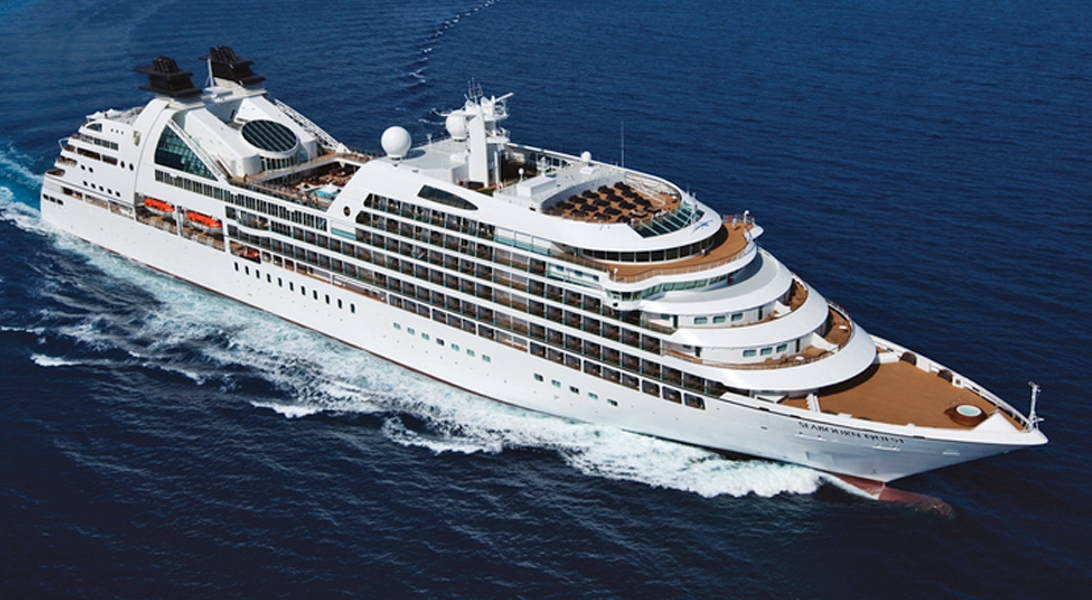
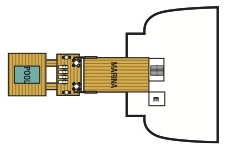

The images shown are for illustration purposes only and may not be an exact representation of what you find on the ship.
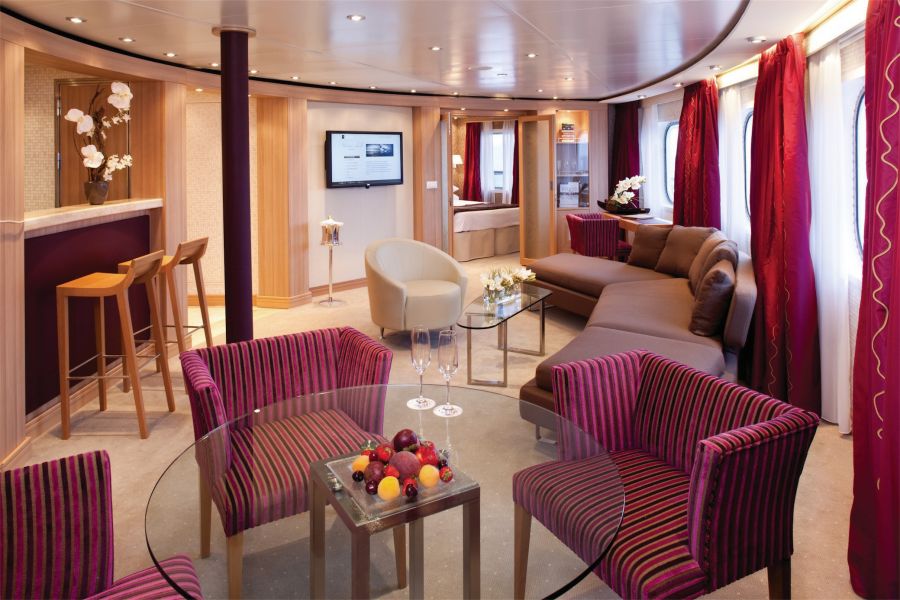
| Grade Code | From | To | |
| O1 | Owner's Suite (Deck 6) | £158,399 | £158,399 |
| O2 | Owner's Suite (Deck 8) | £183,744 | £183,744 |
Suites on board feature a comfortable living area, private veranda, queen-size-bed or two twin beds; walk-in closet with personal safe, interactive flat-screen TV with music and movies, fully stocked bar and refrigerator, writing desk with personalized stationary, makeup vanity, spacious bathroom with separate tub and shower, plush robes, slippers hair dryer and 110/220V AC outlets.
Owner's Suite features
*Wheelchair accessible suites are roll-in shower only.
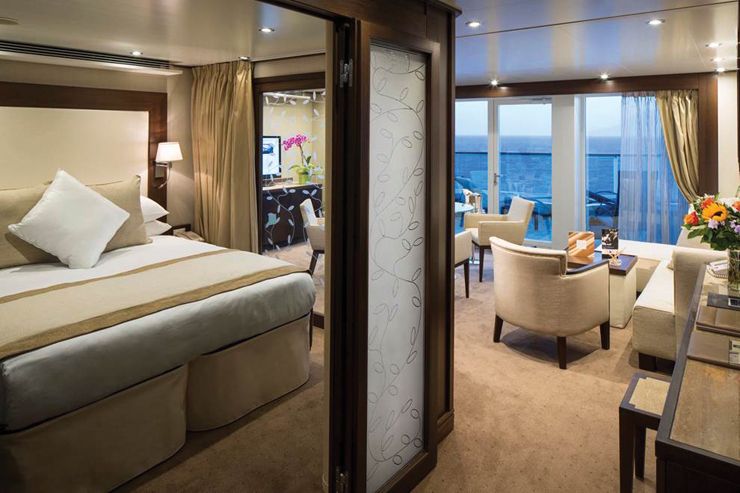
Suites on board feature a comfortable living area, private veranda, queen-size-bed or two twin beds; walk-in closet with personal safe, interactive flat-screen TV with music and movies, fully stocked bar and refrigerator, writing desk with personalized stationary, makeup vanity, spacious bathroom with separate tub and shower, plush robes, slippers hair dryer and 110/220V AC outlets.
All Penthouse Spa Suite feature:
*Wheelchair accessible suites are roll-in shower only.
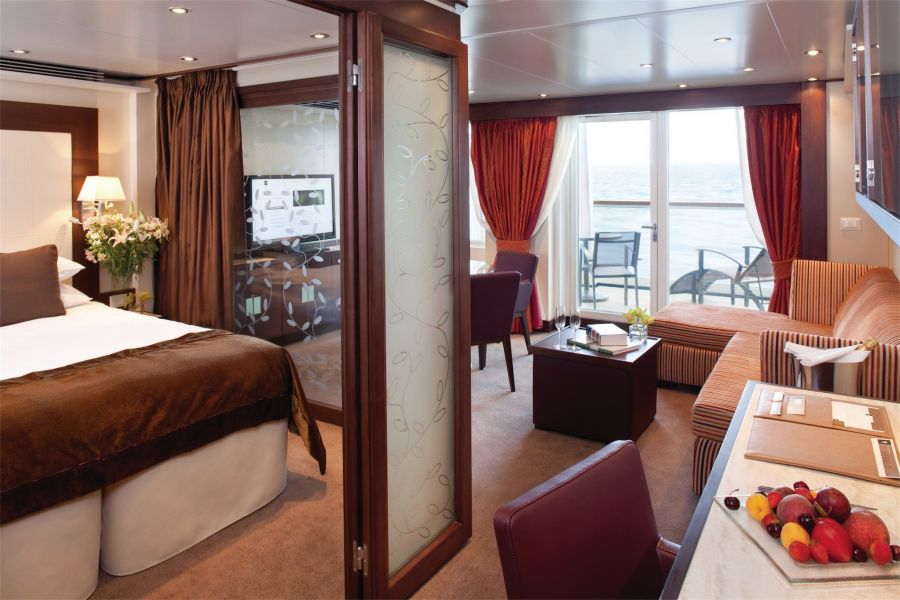
All Penthouse Suites on board feature a comfortable living area, glass door to private veranda, queen-size-bed or two twin beds; walk-in closet with personal safe, two flat-screen TV with music and movies, fully stocked bar and refrigerator, writing desk with personalized stationary, makeup vanity, spacious bathroom with separate tub and shower, plush robes, slippers hair dryer and 110/220V AC outlets
All Penthouse Suite feature
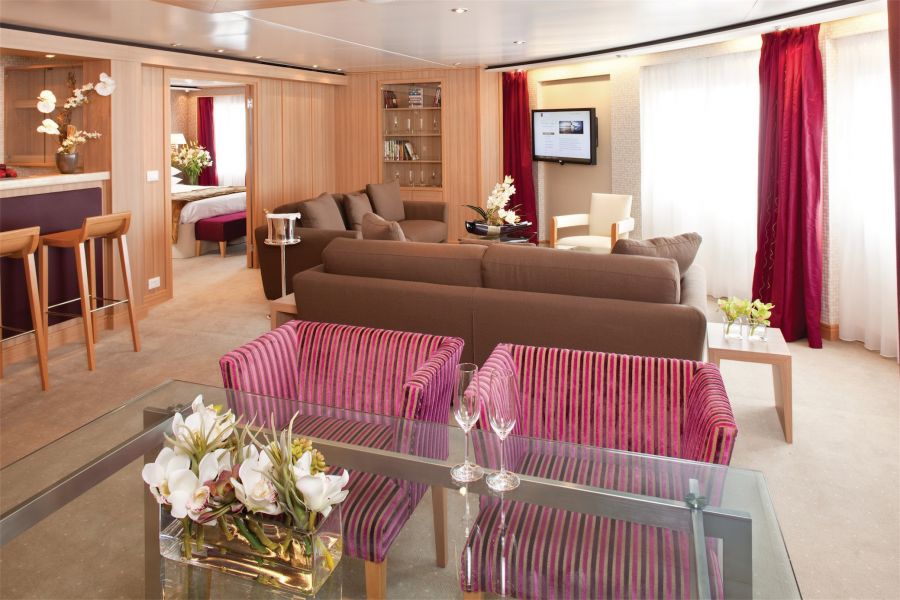
Suites on board feature a comfortable living area, private veranda, queen-size-bed or two twin beds; walk-in closet with personal safe, interactive flat-screen TV with music and movies, fully stocked bar and refrigerator, writing desk with personalized stationary, makeup vanity, spacious bathroom with separate tub and shower, plush robes, slippers hair dryer and 110/220V AC outlets.
Signature Suites feature:
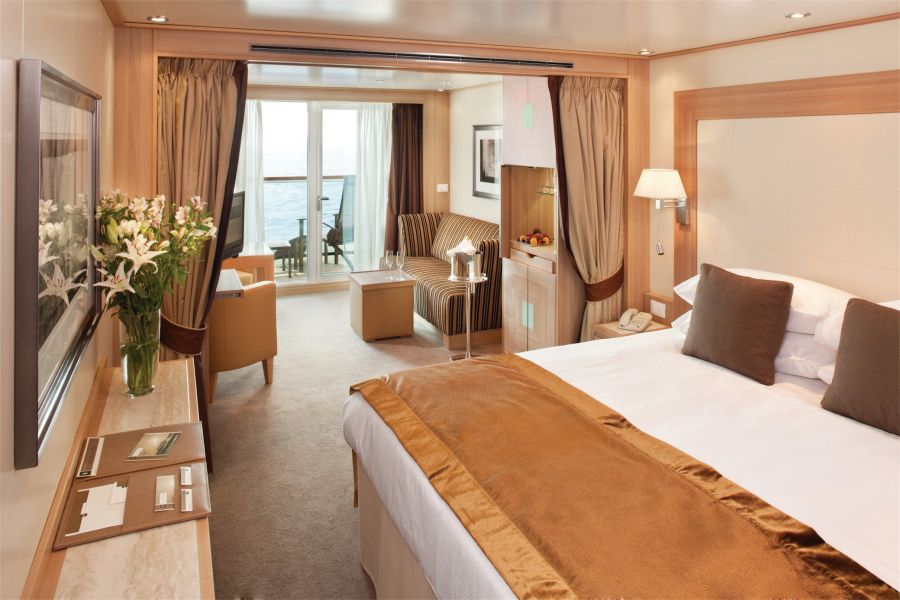
| Grade Code | From | To | |
| V1 | Veranda Suite (Deck 5 - Fwd) | £77,299 | £77,299 |
| V2 | Veranda Suite (Decks 6/7/8 - Fwd) | £82,324 | £82,324 |
| V3 | Veranda Suite (Deck 6 - Mid) | £89,864 | £89,864 |
| V4 | Veranda Suite (Deck 7/8 - Mid) | £94,889 | £94,889 |
All Veranda Suites feature a full-length window and glass door to private veranda, comfortable living area, queen-size bed or two twin beds, dining table for two, walk-in closet, interactive flat-screen television with music and movies, fully stocked bar and refrigerator, makeup vanity, spacious bathroom with separate tub and shower.
All Veranda Suites feature:
*Wheelchair accessible suites are roll-in shower only.
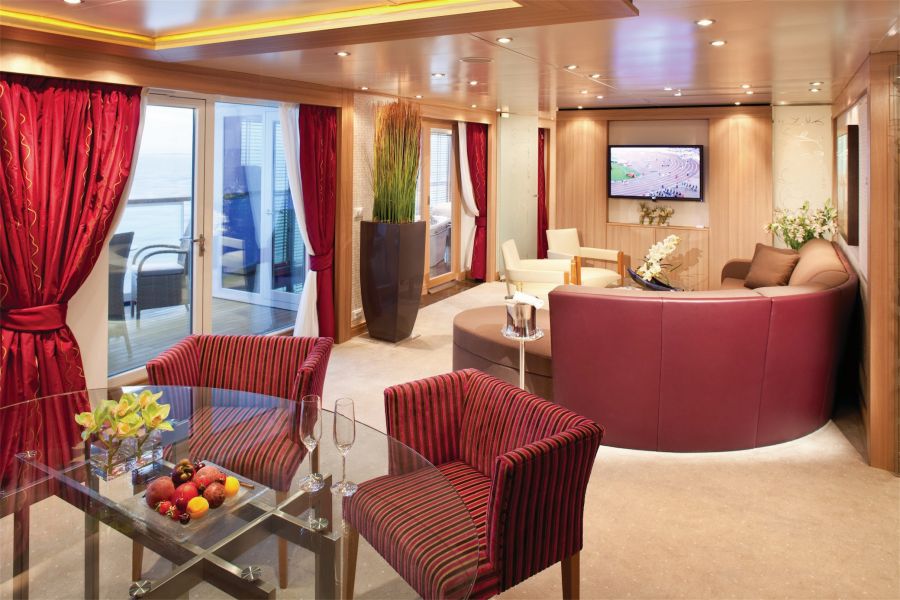
Suites on board feature a comfortable living area, private veranda, queen-size-bed or two twin beds; walk-in closet with personal safe, interactive flat-screen TV with music and movies, fully stocked bar and refrigerator, writing desk with personalized stationary, makeup vanity, spacious bathroom with separate tub and shower, plush robes, slippers hair dryer and 110/220V AC outlets.
Wintergarden Suites feature:
The images shown are for illustration purposes only and may not be an exact representation of what you find on the ship.
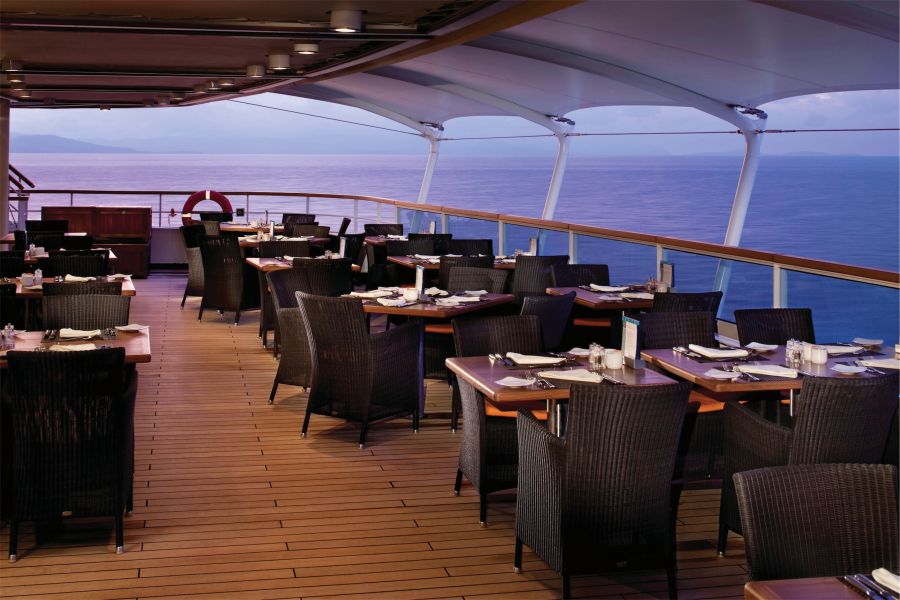
Our more casual, indoor/outdoor alternative, features an open kitchen, lavish buffets or table service for breakfasts and lunch, and serves regionally themed, bistro-style dinners with table service nightly.
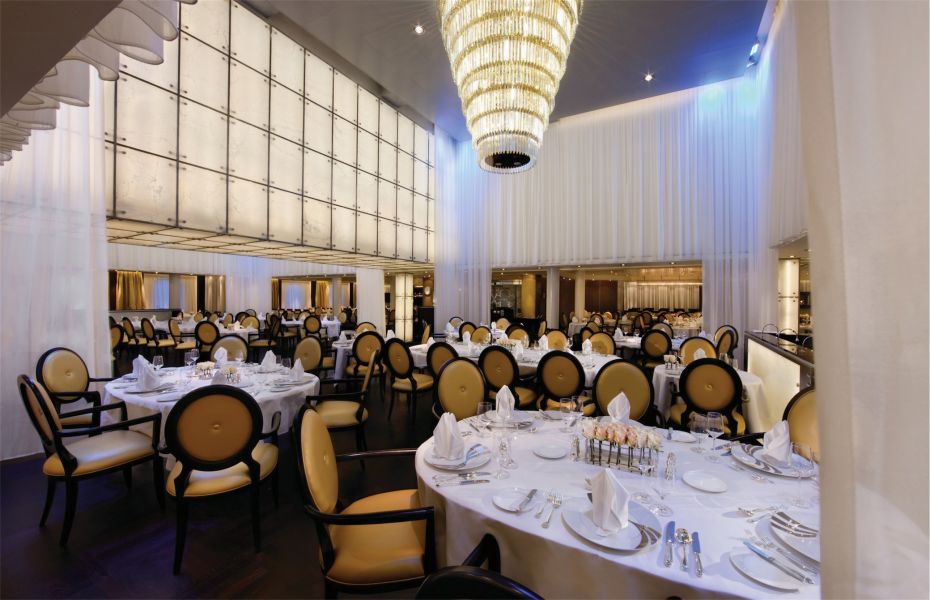
Before Seabourn, open-seating dining on a cruise ship was unheard of. Come when you like, with whom you please, and be seated as you wish. The room is beautiful, the cuisine is exquisite, and the service is simultaneously flawless, friendly and fun.
The images shown are for illustration purposes only and may not be an exact representation of what you find on the ship.
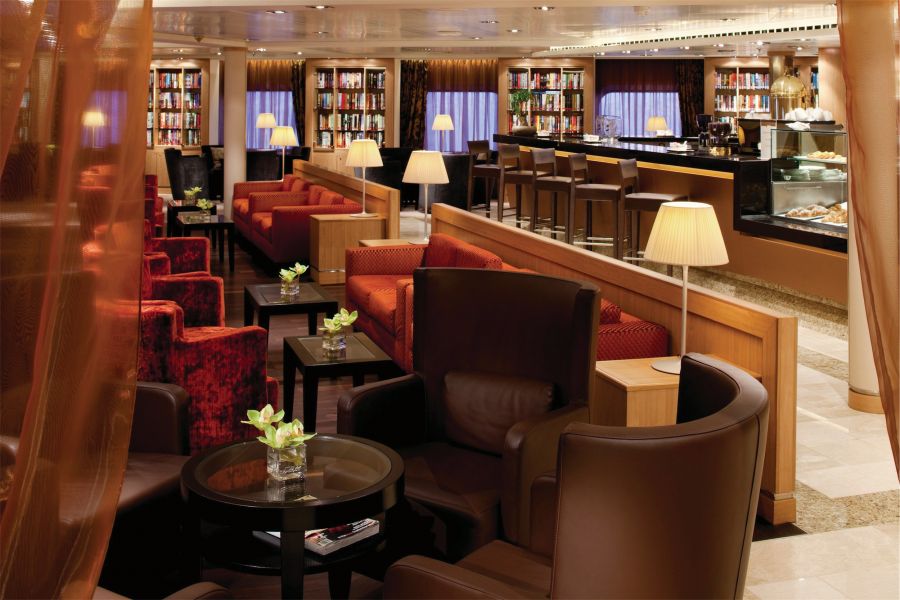
Whether you're looking for a place to enjoy your newspaper in the morning or want to socialize with your fellow passengers, Seabourn Square is what you're looking for. This inviting lounge offers plush seating, cocktail tables, a library, computer terminals, a coffee bar, and Guest Services staff.
Seabourn Square is the true ‘living room’ of the ships. An inviting sociable space where guests will find a charming European style coffee bar, Seabourn Square has been designed as an open, comfortable environment for guests to interact with onboard officers and the expedition team and engage in conversation with family and new friends. The space is also home to the highly-trained Guest Services staff, who provide a range of concierge services such as general ship information, assistance with special service requests, port and travel information, and more.
A selection of coffees are prepared by the skilled onboard baristas some using beans roasted in Seabourn Square. For those feeling a bit hungry, Seabourn Square offers freshly made pastries and other on-the-go breakfast items in the morning, as well as an assortment of light sandwiches and desserts later in the day, along with a selection of artisanal gelati made on board. Guests will also find a wide range of books in the adjoining library, with a host of titles on subjects such as adventure, expeditions and other topics of interest to enjoy while onboard. Staying current with the news is made easy with tablets featuring the Press Reader news application available to browse each day.
World's Finest Ultra-Luxury Cruise Line™
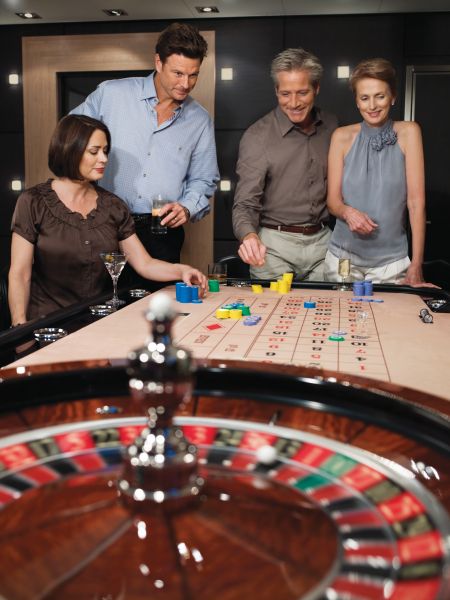
The Seabourn casino offers a handsome, well-appointed enclave for those attracted to games of chance and skill. Relax and test the odds on various mechanical games or pit your skills against personable, professional dealers at blackjack or poker tables.
The images shown are for illustration purposes only and may not be an exact representation of what you find on the ship.
The images shown are for illustration purposes only and may not be an exact representation of what you find on the ship.

Our Fusion packages are all ABTA & ATOL protected ensuring that your booking is safe with us
| 138 nights aboard the Seabourn Quest | |||
| All dining venues are complimentary | |||
| Open Bars throughout the Ship | |||
| Tipping is neither required nor expected | |||
| All Suite Accommodations | |||
| Intimate small size ships | |||
| Open-seating gourmet dining in The Restaurant | |||
| Port Taxes and Fees | |||
 | ABTA and ATOL Protection* | ||
Date 7th Jan 2029 |
Nts 138 |
Oceanview £63,799pp |
Balcony £77,299pp |
Suite £158,399pp |
Date 7th Jan 2029 |
Nts 138 |
Oceanview £63,799pp |
Balcony £77,299pp |
Suite £158,399pp |
| Oceanview staterooms from | £63,799pp | ||
| A | Ocean View Suite | £63,799pp | |
| A1 | Ocean View Suite | £65,969pp | |
| Balcony staterooms from | £77,299pp | ||
| V1 | Veranda Suite (Deck 5 - Fwd) | £77,299pp | |
| V2 | Veranda Suite (Decks 6/7/8 - Fwd) | £82,324pp | |
| V3 | Veranda Suite (Deck 6 - Mid) | £89,864pp | |
| V4 | Veranda Suite (Deck 7/8 - Mid) | £94,889pp | |
| Suite staterooms from | £158,399pp | ||
| O1 | Owner's Suite (Deck 6) | £158,399pp | |
| O2 | Owner's Suite (Deck 8) | £183,744pp | |
Fusion Holidays when selling travel arrangements is a trading name of Co-op Travel Services Limited, registration 08903986. Fusion Cruises is an Accredited Body Member of Co-op Travel Services Limited ATOL 12904.
Book with Confidence. We are a Member of ABTA which means you have the benefit of ABTA’s assistance and Code of Conduct.
Some of the flights and flight-inclusive holidays on this website are financially protected by the ATOL scheme but ATOL protection does not apply to all holiday and travel services offered on this website. This website will provide you with information on the protection that applies in the case of each holiday and travel service offered before you make your booking. If you do not receive an ATOL Certificate then the booking will not be ATOL protected. If you do receive an ATOL Certificate but all parts of your trip are not listed on it, those parts will not be ATOL protected. Please see our booking conditions for information, or for more information about financial protection and the ATOL Certificate go to: www.caa.co.uk