This site uses cookies as defined in our Cookie Policy, by continuing to use this site you agree to their use.
Continue

| Arrive | Depart | ||||||
| 25th25 | OctOct | 202828 | Piraeus, Greece, embark on the Emerald Raiya | ||||
It's no wonder that all roads lead to the fascinating and maddening metropolis of Athens. Lift your eyes 200 feet above the city to the Parthenon, its honey-color marble columns rising from a massive limestone base, and you behold architectural perfection that has not been surpassed in 2,500 years. But, today, this shrine of classical form dominates a 21st-century boomtown. To experience Athens—Athína in Greek—fully is to understand the essence of Greece: ancient monuments surviving in a sea of cement, startling beauty amid the squalor, tradition juxtaposed with modernity. Locals depend on humor and flexibility to deal with the chaos; you should do the same. The rewards are immense. Although Athens covers a huge area, the major landmarks of the ancient Greek, Roman, and Byzantine periods are close to the modern city center. You can easily walk from the Acropolis to many other key sites, taking time to browse in shops and relax in cafés and tavernas along the way. From many quarters of the city you can glimpse "the glory that was Greece" in the form of the Acropolis looming above the horizon, but only by actually climbing that rocky precipice can you feel the impact of the ancient settlement. The Acropolis and Filopappou, two craggy hills sitting side by side; the ancient Agora (marketplace); and Kerameikos, the first cemetery, form the core of ancient and Roman Athens. Along the Unification of Archaeological Sites promenade, you can follow stone-paved, tree-lined walkways from site to site, undisturbed by traffic. Cars have also been banned or reduced in other streets in the historical center. In the National Archaeological Museum, vast numbers of artifacts illustrate the many millennia of Greek civilization; smaller museums such as the Goulandris Museum of Cycladic Art Museum and the Byzantine and Christian Museum illuminate the history of particular regions or periods. Athens may seem like one huge city, but it is really a conglomeration of neighborhoods with distinctive characters. The Eastern influences that prevailed during the 400-year rule of the Ottoman Empire are still evident in Monastiraki, the bazaar area near the foot of the Acropolis. On the northern slope of the Acropolis, stroll through Plaka (if possible by moonlight), an area of tranquil streets lined with renovated mansions, to get the flavor of the 19th-century's gracious lifestyle. The narrow lanes of Anafiotika, a section of Plaka, thread past tiny churches and small, color-washed houses with wooden upper stories, recalling a Cycladic island village. In this maze of winding streets, vestiges of the older city are everywhere: crumbling stairways lined with festive tavernas; dank cellars filled with wine vats; occasionally a court or diminutive garden, enclosed within high walls and filled with magnolia trees and the flaming trumpet-shaped flowers of hibiscus bushes. Formerly run-down old quarters, such as Thission, Gazi and Psirri, popular nightlife areas filled with bars and mezedopoleia (similar to tapas bars), are now in the process of gentrification, although they still retain much of their original charm, as does the colorful produce and meat market on Athinas. The area around Syntagma Square, the tourist hub, and Omonia Square, the commercial heart of the city about 1 km (½ mi) northwest, is distinctly European, having been designed by the court architects of King Otho, a Bavarian, in the 19th century. The chic shops and bistros of ritzy Kolonaki nestle at the foot of Mt. Lycabettus, Athens's highest hill (909 feet). Each of Athens's outlying suburbs has a distinctive character: in the north is wealthy, tree-lined Kifissia, once a summer resort for aristocratic Athenians, and in the south and southeast lie Glyfada, Voula, and Vouliagmeni, with their sandy beaches, seaside bars, and lively summer nightlife. Just beyond the city's southern fringes is Piraeus, a bustling port city of waterside fish tavernas and Saronic Gulf views. Your mesmerizing journey through Greece, Turkey and Cyprus begins in Athens, where you’ll be transferred to your Emerald luxury yacht. Athens, the capital city of Greece, is a remarkable blend of ancient history and modern dynamism. Please book your flight to arrive into Athens prior to 02:00 PM. | |||||||
| 26th26 | OctOct | 202828 | Delos, Greece | ||||
This morning, step ashore on Delos, one of Greece’s most significant mythological and archaeological treasures. According to legend, this sacred island was the birthplace of Apollo and Artemis. Wander among remarkably preserved ruins, grand mosaics and ancient temples that paint a vivid picture of classical civilisation. Later, sail to glamorous Mykonos, where Cycladic charm meets cosmopolitan flair. Lose yourself in the maze of narrow lanes lined with whitewashed houses and chapels. Discover chic boutiques, waterfront tavernas and the island’s iconic windmills overlooking the Aegean. As evening falls, Mykonos reveals its vibrant energy, offering the perfect blend of tradition and modern sophistication. | |||||||
| 26th26 | OctOct | 202828 | Mykonos, Greece | ||||
Although the fishing boats still go out in good weather, Mykonos largely makes its living from tourism these days. The summer crowds have turned one of the poorest islands in Greece into one of the richest. Old Mykonians complain that their young, who have inherited stores where their grandfathers once sold eggs or wine, get so much rent that they have lost ambition, and in summer sit around pool bars at night with their friends, and hang out in Athens in winter when island life is less scintillating. Put firmly on the map by Jackie O in the 1960s, Mykonos town—called Hora by the locals—remains the Saint-Tropez of the Greek islands. The scenery is memorable, with its whitewashed streets, Little Venice, the Kato Myli ridge of windmills, and Kastro, the town's medieval quarter. Its cubical two- or three-story houses and churches, with their red or blue doors and domes and wooden balconies, have been long celebrated as some of the best examples of classic Cycladic architecture. Luckily, the Greek Archaeological Service decided to preserve the town, even when the Mykonians would have preferred to rebuild, and so the Old Town has been impressively preserved. Pink oleander, scarlet hibiscus, and trailing green pepper trees form a contrast amid the dazzling whiteness, whose frequent renewal with whitewash is required by law. Any visitor who has the pleasure of getting lost in its narrow streets (made all the narrower by the many outdoor stone staircases, which maximize housing space in the crowded village) will appreciate how its confusing layout was designed to foil pirates—if it was designed at all. After Mykonos fell under Turkish rule in 1537, the Ottomans allowed the islanders to arm their vessels against pirates, which had a contradictory effect: many of them found that raiding other islands was more profitable than tilling arid land. At the height of Aegean piracy, Mykonos was the principal headquarters of the corsair fleets—the place where pirates met their fellows, found willing women, and filled out their crews. Eventually the illicit activity evolved into a legitimate and thriving trade network. Morning on Mykonos town's main quay is busy with deliveries, visitors for the Delos boats, lazy breakfasters, and street cleaners dealing with the previous night's mess. In late morning the cruise-boat people arrive, and the shops are all open. In early afternoon, shaded outdoor tavernas are full of diners eating salads (Mykonos's produce is mostly imported); music is absent or kept low. In mid- and late afternoon, the town feels sleepy, since so many people are at the beach, on excursions, or sleeping in their air-conditioned rooms; even some tourist shops close for siesta. By sunset, people have come back from the beach, having taken their showers and rested. At night, the atmosphere in Mykonos ramps up. The cruise-boat people are mostly gone, coughing three-wheelers make no deliveries in the narrow streets, and everyone is dressed sexy for summer and starting to shimmy with the scene. Many shops stay open past midnight, the restaurants fill up, and the bars and discos make ice cubes as fast as they can. Ready to dive in? Begin your tour of Mykonos town (Hora) by starting out at its heart: Mando Mavrogenous Square. | |||||||
| 27th27 | OctOct | 202828 | Milos, Greece | ||||
Milos or Melos is a volcanic Greek island in the Aegean Sea, just north of the Sea of Crete. Milos is the southwesternmost island in the Cyclades group. The Venus de Milo and the Asclepius of Milos were both found on the island, as were a Poseidon and an archaic Apollo now in Athens. Welcome to Milos, the enchanting ‘Island of Colours’. Sculpted by volcanic forces, the island’s dramatic coastline is dotted with striking cliffs in shades of red, yellow, white and orange, rising above turquoise waters. Explore the surreal Sarakiniko landscape and the fishing villages of Klima or Pollonia. Milos is also famed as the discovery site of the Venus de Milo in 1820. While the original masterpiece resides in the Louvre, a replica and fascinating artifacts can be admired in the island’s archaeological museum, offering insight into its rich past. | |||||||
| 28th28 | OctOct | 202828 | Santorini, Greece | ||||
Undoubtedly the most extraordinary island in the Aegean, crescent-shape Santorini remains a mandatory stop on the Cycladic tourist route—even if it's necessary to enjoy the sensational sunsets from Ia, the fascinating excavations, and the dazzling white towns with a million other travelers. Called Kállisti (the "Loveliest") when first settled, the island has now reverted to its subsequent name of Thira, after the 9th-century-BC Dorian colonizer Thiras. The place is better known, however, these days as Santorini, a name derived from its patroness, St. Irene of Thessaloniki, the Byzantine empress who restored icons to Orthodoxy and died in 802. You can fly conveniently to Santorini, but to enjoy a true Santorini rite of passage, opt instead for the boat trip here, which provides a spectacular introduction. After the boat sails between Sikinos and Ios, your deck-side perch approaches two close islands with a passage between them. The bigger one on the left is Santorini, and the smaller on the right is Thirassia. Passing between them, you see the village of Ia adorning Santorini's northernmost cliff like a white geometric beehive. You are in the caldera (volcanic crater), one of the world's truly breathtaking sights: a demilune of cliffs rising 1,100 feet, with the white clusters of the towns of Fira and Ia perched along the top. The bay, once the high center of the island, is 1,300 feet in some places, so deep that when boats dock in Santorini's shabby little port of Athinios, they do not drop anchor. The encircling cliffs are the ancient rim of a still-active volcano, and you are sailing east across its flooded caldera. On your right are the Burnt isles, the White isle, and other volcanic remnants, all lined up as if some outsize display in a geology museum. Hephaestus's subterranean fires smolder still—the volcano erupted in 198 BC, about 735, and there was an earthquake in 1956. Indeed, Santorini and its four neighboring islets are the fragmentary remains of a larger landmass that exploded about 1600 BC: the volcano's core blew sky high, and the sea rushed into the abyss to create the great bay, which measures 10 km by 7 km (6 mi by 4½ mi) and is 1,292 feet deep. The other pieces of the rim, which broke off in later eruptions, are Thirassia, where a few hundred people live, and deserted little Aspronissi ("White isle"). In the center of the bay, black and uninhabited, two cones, the Burnt Isles of Palea Kameni and Nea Kameni, appeared between 1573 and 1925. There has been too much speculation about the identification of Santorini with the mythical Atlantis, mentioned in Egyptian papyri and by Plato (who says it's in the Atlantic), but myths are hard to pin down. This is not true of old arguments about whether tidal waves from Santorini's cataclysmic explosion destroyed Minoan civilization on Crete, 113 km (70 mi) away. The latest carbon-dating evidence, which points to a few years before 1600 BC for the eruption, clearly indicates that the Minoans outlasted the eruption by a couple of hundred years, but most probably in a weakened state. In fact, the island still endures hardships: since antiquity, Santorini has depended on rain collected in cisterns for drinking and irrigating—the well water is often brackish—and the serious shortage is alleviated by the importation of water. However, the volcanic soil also yields riches: small, intense tomatoes with tough skins used for tomato paste (good restaurants here serve them); the famous Santorini fava beans, which have a light, fresh taste; barley; wheat; and white-skin eggplants. Few destinations rival the breathtaking beauty of Santorini. Arriving by sea offers an unforgettable perspective of whitewashed villages perched dramatically atop volcanic cliffs. Stroll through Oia’s narrow lanes, where blue-domed churches and cascading bougainvillea create postcard-perfect scenes at every turn. Relax on distinctive volcanic-sand beaches or sample crisp local wines cultivated in mineral-rich soil. As you sail away, the sun sinks into the Aegean and Santorini’s legendary sunset paints the sky in hues of gold and crimson – a moment to cherish forever. | |||||||
| 29th29 | OctOct | 202828 | Pátmos, Greece | ||||
For better or worse, it can be difficult to reach Patmos—for many travelers, this lack of access is definitely for the better, since the island retains the air of an unspoiled retreat. Rocky and barren, the small, 34-square-km (21-square-mi) island lies beyond the islands of Kalymnos and Leros, northwest of Kos. Here on a hillside is the Monastery of the Apocalypse, which enshrines the cave where St. John received the Revelation in AD 95. Scattered evidence of Mycenaean presence remains on Patmos, and walls of the classical period indicate the existence of a town near Skala. Most of the island's approximately 2,800 people live in three villages: Skala, medieval Chora, and the small rural settlement of Kambos. The island is popular among the faithful making pilgrimages to the monastery as well as with vacationing Athenians and a newly growing community of international trendsetters—designers, artists, poets, and “taste gurus” (to quote Vogue’s July 2011 write-up of the island)—who have bought homes in Chora. These stylemeisters followed in the footsteps of Alexandrian John Stefanidis and the English artist Teddy Millington-Drake who, in the early ’60s, set about creating what eventually became hailed as one of the most gorgeous island homes in the world. The word soon spread thanks to their many guests (who included Jacqueline Kennedy Onassis) but, happily, administrators have carefully contained development, and as a result, Patmos retains its charm and natural beauty—even in the busy month of August. Patmos is a serene island of profound spiritual significance. Dominating the skyline is the World Heritage-listed Monastery of Saint John the Theologian, an imposing fortress-like structure that has stood for centuries. Nearby lies the sacred Cave of the Apocalypse, where Saint John is believed to have received the visions recorded in the Book of Revelation. Beyond its religious heritage, Patmos charms with its peaceful atmosphere, traditional villages and pristine coves. Enjoy authentic Greek cuisine featuring freshly caught seafood, local cheeses and sun-ripened produce. | |||||||
| 30th30 | OctOct | 202828 | Kusadasi, Turkey | ||||
Whilst the busy resort town of Kusadasi offers much in the way of shopping and dining – not to mention a flourishing beach life scene, the real jewel here is Ephesus and the stunning ruined city that really take centre stage. With only 20% of the classical ruins having been excavated, this archaeological wonder has already gained the status as Europe’s most complete classical metropolis. And a metropolis it really is; built in the 10th century BC this UNESCO World Heritage site is nothing short of spectacular. Although regrettably very little remains of the Temple of Artemis (one of the seven wonders of the ancient world), the superb Library of Celsus’ façade is practically intact and it is one of life’s great joys to attend an evening performance in the illuminated ruins once all the tourists have left. The history of the city is fascinating and multi-layered and it is well worth reading up on this beforehand if a visit is planned. Another point of interest for historians would be the house of the Virgin Mary, located on the romantically named Mount Nightingale and just nine kilometres away from Ephesus proper. Legend has it that Mary (along with St. John) spent her final years here, secluded from the rest of the population, spreading Christianity. An edifying experience, even for non-believers. For the less historical minded amongst you, Kusadasi offers plenty in the way of activities. After a stroll through the town, jump in a taxi to Ladies’ Beach (men are allowed), sample a Turkish kebap on one of the many beachfront restaurants and enjoy the clement weather. If you do want to venture further afield, then the crystal clear beaches of Guzelcamli (or the Millipark), the cave of Zeus and the white scalloped natural pools at Pamukkale, known as Cleopatra’s pools, are definitely worth a visit. Today you arrive in Kusadasi, a lively Turkish coastal town rich in history and culture. Its strategic location has made it a crossroads of civilisations for thousands of years. From here, you may explore the nearby ancient city of Ephesus, one of the best-preserved classical cities in the Mediterranean. Wander along marble streets lined with grand columns, temples and the magnificent Library of Celsus. Back in Kusadasi, vibrant bazaars and seaside promenades offer a colourful taste of Turkish hospitality. | |||||||
| 31st31 | OctOct | 202828 | Kos, Greece | ||||
Kos welcomes you with glorious landscapes and remarkable historical heritage. Known as the birthplace of Hippocrates, the father of modern medicine, the island offers a fascinating journey into the ancient world. Explore the Asklepion, once a renowned healing sanctuary, along with Roman villas, an ancient agora and medieval fortifications. The main town is a mishmash of architectural styles, and you’ll find whitewashed dwellings side by side with Muslim mosques, 1930s Italian-style buildings and the medieval NeratziaCastle. Kos also boasts beautiful beaches and relaxed island charm, perfect for leisurely exploration. | |||||||
| 1st01 | NovNov | 202828 | Rhodes, Greece | ||||
Early travelers described Rhodes as a town of two parts: a castle or high town (Collachium) and a lower city. Today Rhodes town—sometimes referred to as Ródos town—is still a city of two parts: the Old Town, a UNESCO World Heritage site that incorporates the high town and lower city, and the modern metropolis, or New Town, spreading away from the walls that encircle the Old Town. The narrow streets of the Old Town are for the most part closed to cars and are lined with Orthodox and Catholic churches, Turkish houses (some of which follow the ancient orthogonal plan), and medieval public buildings with exterior staircases and facades elegantly constructed of well-cut limestone from Lindos. Careful reconstruction in recent years has enhanced the harmonious effect. Step into history in Rhodes, the legendary ‘Island of Knights’. The World Heritage-listed medieval city transports you back to the era of crusaders and grand masters. Walk along the cobbled Street of the Knights and visit the impressive Palace of the Grand Master, enclosed within formidable stone walls. Beyond its medieval splendour, Rhodes delights with golden beaches and delicious local flavours. Sample traditional melekouni, a honey and sesame sweet, or savour crispy pitaroudia paired with local wine. | |||||||
| 2nd02 | NovNov | 202828 | Antalya, Turkey | ||||
As the largest Turkish city on the western Mediterranean coast, Antalya is a mix of antiquity and modernity. It is popular with tourist all year round for its warm climate and sandy white beaches. Antalya enchants with its striking natural beauty, framed by the Taurus Mountains and the shimmering Mediterranean Sea. Explore Kaleiçi, the atmospheric old town, where Roman harbour walls, ancient gates and Ottoman-era houses reveal layers of history. Waterfalls cascade dramatically into the sea, while pebbly beaches invite relaxation. Antalya blends ancient heritage with modern elegance. | |||||||
| 3rd03 | NovNov | 202828 | Alanya, Turkey | ||||
Alanya is a seaside gem rich in Seljuk history. It’s dominated by the imposing Alanya Castle, a medieval fortress offering panoramic views over the sparkling coastline. Discover the iconic Red Tower and the historic Seljuk shipyard, both reminders of the region’s maritime legacy. With its long sandy beaches and dramatic mountain backdrop, Alanya offers both relaxation and cultural discovery. | |||||||
| 4th04 | NovNov | 202828 | Limassol, Cyprus | ||||
A major commercial port, cruise ship port of call, and wine-making center on the south coast, Limassol, 75 km (47 miles) from Nicosia, is a bustling, cosmopolitan town, with some of the liveliest nightlife on the island. Luxury hotels, apartments, and guesthouses stretch along 12 km (7 miles) of seafront, with the most luxurious ones just to the north of town. In the center, the elegant, modern shops of Makarios Avenue (where you'll mainly find clothes and shoes) contrast with those of pedestrian-only Agiou Andreou in the old part of town, where local handicrafts such as lace, embroidery, and basketware prevail; make sure you avoid shopping on Wednesday and Saturday afternoons, when many shops close at 2 pm. A luxurious marina that will hold 650 yachts as well as house apartments, shops, and restaurants should further boost the town's lively appeal. Arriving in Cyprus, Limassol greets you with a vibrant cultural tapestry shaped by Greek, Turkish and British influences. Explore the charming old town, medieval castle and lively marina, or venture to nearby vineyards that produce some of the world’s oldest knownwines. Nature lovers should visit the Akrotiri Salt Lake, where graceful flamingos gather during winter months. | |||||||
| 5th05 | NovNov | 202828 | Larnaca, Cyprus | ||||
Larnaca is a city where ancient heritage meets relaxed coastal living. Built upon the ruins of ancient Kition,it offers fascinating archaeological sites alongside palm-lined promenades and inviting beaches. Visit the Church of Saint Lazarus, stroll along FinikoudesBeach, or enjoy fresh Cypriot cuisine at a seaside taverna. The warm hospitality of the locals adds to the city’s welcoming charm. | |||||||
| 6th06 | NovNov | 202828 | Larnaca, Cyprus, disembark the Emerald Raiya | ||||
Your luxurious yacht cruise concludes in Larnaca. After breakfast, you’ll be transferred to the airport for your onward journey, taking with you unforgettable memories of mythic islands, ancient civilisations and the dazzling beauty of the eastern Mediterranean. Please book your flight to depart out of Larnaca after 11:00 AM. The itinerary is a guide only and may be amended for operational reasons. As such, Emerald Cruises cannot guarantee the cruise will be operatedunaltered from the itinerary stated above. | |||||||
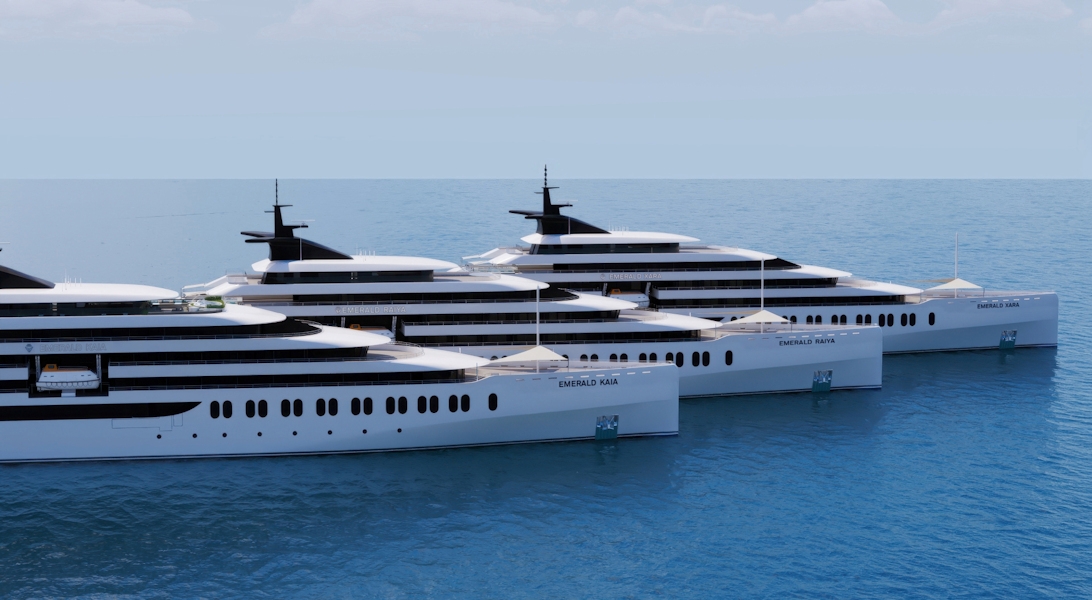
The images shown are for illustration purposes only and may not be an exact representation of what you find on the ship.
The images shown are for illustration purposes only and may not be an exact representation of what you find on the ship.
The images shown are for illustration purposes only and may not be an exact representation of what you find on the ship.
The images shown are for illustration purposes only and may not be an exact representation of what you find on the ship.
The images shown are for illustration purposes only and may not be an exact representation of what you find on the ship.


Our Fusion packages are all ABTA & ATOL protected ensuring that your booking is safe with us
| Return flights including luggage allowance | |||
| Overseas Transfers | |||
| 12 nights aboard the Emerald Raiya | |||
| Return airport transfers | |||
| Wine, beer & soft drinks with lunch & dinner | |||
| Gratuities Included | |||
| One complimentary shore excursion in every port | |||
| Bikes for passenger use | |||
| Free Wi-Fi included | |||
| Port Taxes and Fees | |||
 | ABTA and ATOL Protection* | ||
Fly/cruise package |
Date 25th Oct 2028 |
Nts 12 |
Interior  |
Oceanview £10,249pp |
Balcony |
Suite £13,270pp |
Interior |
Oceanview £20,498pp |
Balcony |
Suite £23,519pp |
Date 25th Oct 2028 |
Nts 12 |
Interior |
Oceanview £10,249pp |
Balcony |
Suite £13,270pp |
Interior |
Oceanview £20,498pp |
Balcony |
Suite £23,519pp |
Fusion Holidays when selling travel arrangements is a trading name of Co-op Travel Services Limited, registration 08903986. Fusion Cruises is an Accredited Body Member of Co-op Travel Services Limited ATOL 12904.
Book with Confidence. We are a Member of ABTA which means you have the benefit of ABTA’s assistance and Code of Conduct.
Some of the flights and flight-inclusive holidays on this website are financially protected by the ATOL scheme but ATOL protection does not apply to all holiday and travel services offered on this website. This website will provide you with information on the protection that applies in the case of each holiday and travel service offered before you make your booking. If you do not receive an ATOL Certificate then the booking will not be ATOL protected. If you do receive an ATOL Certificate but all parts of your trip are not listed on it, those parts will not be ATOL protected. Please see our booking conditions for information, or for more information about financial protection and the ATOL Certificate go to: www.caa.co.uk