This site uses cookies as defined in our Cookie Policy, by continuing to use this site you agree to their use.
Continue

| Arrive | Depart | ||||||
| 6th06 | JunJun | 202828 | Piraeus, Greece, embark on the Scenic Ikon | ||||
It's no wonder that all roads lead to the fascinating and maddening metropolis of Athens. Lift your eyes 200 feet above the city to the Parthenon, its honey-color marble columns rising from a massive limestone base, and you behold architectural perfection that has not been surpassed in 2,500 years. But, today, this shrine of classical form dominates a 21st-century boomtown. To experience Athens—Athína in Greek—fully is to understand the essence of Greece: ancient monuments surviving in a sea of cement, startling beauty amid the squalor, tradition juxtaposed with modernity. Locals depend on humor and flexibility to deal with the chaos; you should do the same. The rewards are immense. Although Athens covers a huge area, the major landmarks of the ancient Greek, Roman, and Byzantine periods are close to the modern city center. You can easily walk from the Acropolis to many other key sites, taking time to browse in shops and relax in cafés and tavernas along the way. From many quarters of the city you can glimpse "the glory that was Greece" in the form of the Acropolis looming above the horizon, but only by actually climbing that rocky precipice can you feel the impact of the ancient settlement. The Acropolis and Filopappou, two craggy hills sitting side by side; the ancient Agora (marketplace); and Kerameikos, the first cemetery, form the core of ancient and Roman Athens. Along the Unification of Archaeological Sites promenade, you can follow stone-paved, tree-lined walkways from site to site, undisturbed by traffic. Cars have also been banned or reduced in other streets in the historical center. In the National Archaeological Museum, vast numbers of artifacts illustrate the many millennia of Greek civilization; smaller museums such as the Goulandris Museum of Cycladic Art Museum and the Byzantine and Christian Museum illuminate the history of particular regions or periods. Athens may seem like one huge city, but it is really a conglomeration of neighborhoods with distinctive characters. The Eastern influences that prevailed during the 400-year rule of the Ottoman Empire are still evident in Monastiraki, the bazaar area near the foot of the Acropolis. On the northern slope of the Acropolis, stroll through Plaka (if possible by moonlight), an area of tranquil streets lined with renovated mansions, to get the flavor of the 19th-century's gracious lifestyle. The narrow lanes of Anafiotika, a section of Plaka, thread past tiny churches and small, color-washed houses with wooden upper stories, recalling a Cycladic island village. In this maze of winding streets, vestiges of the older city are everywhere: crumbling stairways lined with festive tavernas; dank cellars filled with wine vats; occasionally a court or diminutive garden, enclosed within high walls and filled with magnolia trees and the flaming trumpet-shaped flowers of hibiscus bushes. Formerly run-down old quarters, such as Thission, Gazi and Psirri, popular nightlife areas filled with bars and mezedopoleia (similar to tapas bars), are now in the process of gentrification, although they still retain much of their original charm, as does the colorful produce and meat market on Athinas. The area around Syntagma Square, the tourist hub, and Omonia Square, the commercial heart of the city about 1 km (½ mi) northwest, is distinctly European, having been designed by the court architects of King Otho, a Bavarian, in the 19th century. The chic shops and bistros of ritzy Kolonaki nestle at the foot of Mt. Lycabettus, Athens's highest hill (909 feet). Each of Athens's outlying suburbs has a distinctive character: in the north is wealthy, tree-lined Kifissia, once a summer resort for aristocratic Athenians, and in the south and southeast lie Glyfada, Voula, and Vouliagmeni, with their sandy beaches, seaside bars, and lively summer nightlife. Just beyond the city's southern fringes is Piraeus, a bustling port city of waterside fish tavernas and Saronic Gulf views. Known as the birthplace of Western civilisation, Athens is a vibrant tapestry of history and modernity. Standing sentinel above the city is the famous Acropolis, a fortified hill dominated by the Parthenon, atmospheric ruins of a white marble temple built during the height of the ancient Greek Empire. Please book your flight to arrive into Athens prior to 02:00 PM. | |||||||
| 7th07 | JunJun | 202828 | Náfplion, Greece | ||||
Oraia (beautiful) is the word Greeks use to describe Nafplion. The town's old section, on a peninsula jutting into the gulf of Argos, mixes Greek, Venetian, and Turkish architecture; narrow streets, often just broad flights of stone stairs, climb the slopes beneath the walls of Acronafplia. Tree-shaded plazas surround neoclassic buildings. The Palamidi fortress—an elegant display of Venetian might from the early 1700s—guards the town. Nafplion deserves at least a leisurely day of your undivided attention, and you may want to spend several days or a week here and use the city as the base from which to explore the many surrounding ancient sights. Discover the rich tapestry of history as you wander through Nafplion’s charming streets adorned with neoclassical architecture, Venetian fortresses and Turkish mosques. Explore the winding alleys of the Old Town, where traditional tavernas and quaint cafes beckon you to indulge in local delicacies. Climb the steps to Palamidi Fortress for breathtaking views of the town and sea below or relax on the shores of Arvanitia Beach. See the World Heritage-listed Epidaurus Theatre and archaeological site of Mycenae, dating back to the second century BC. | |||||||
| 8th08 | JunJun | 202828 | Nydri, Lefkada Island, Greece | ||||
| 9th09 | JunJun | 202828 | Corfu, Greece | ||||
Corfu town today is a vivid tapestry of cultures—a sophisticated weave, where charm, history, and natural beauty blend. Located about midway along the island's east coast, this spectacularly lively capital is the cultural heart of Corfu and has a remarkable historic center that UNESCO designated as a World Heritage Site in 2007. All ships and planes dock or land near Corfu town, which occupies a small peninsula jutting into the Ionian Sea.Whether arriving by ferry from mainland Greece or Italy, from another island, or directly by plane, catch your breath by first relaxing with a coffee or a gelato in Corfu town's shaded Liston Arcade, then stroll the narrow lanes of its pedestrians-only quarter. For an overview of the immediate area, and a quick tour of Mon Repos palace, hop on the little tourist train that runs from May to September. Corfu town has a different feel at night, so book a table at one of its famed tavernas to savor the island's unique cuisine.The best way to get around Corfu town is on foot. The town is small enough so that you can easily walk to every sight. There are local buses, but they do not thread their way into the streets (many now car-free) of the historic center. If you are arriving by ferry or plane, it's best to take a taxi to your hotel. Expect to pay about €10 from the airport or ferry terminal to a hotel in Corfu town. If there are no taxis waiting, you can call for one. The ruggedly beautiful island of Corfu is dotted with whitewashed houses and olive groves, creating an enchanting Mediterranean allure. The World Heritage-listed Old Town boasts a rich history and stunning Renaissance and Baroque architecture. Wander the vibrant Spianada, Greece’s largest square, and immerse yourself in Corfu’s timeless charm and cultural treasures. | |||||||
| 10th10 | JunJun | 202828 | Monopoli, Italy | ||||
A true gem of the Adriatic, Monopoli charms with its whitewashed buildings, vibrant fishing port and maze of narrow streets. Wander the historic old town, explore magnificent churches, or unwind by the sea with a gelato in hand. This coastal town captures the heart of Puglia in every detail. | |||||||
| 11th11 | JunJun | 202828 | Kotor, Montenegro | ||||
Backed by imposing mountains, tiny Kotor lies hidden from the open sea, tucked into the deepest channel of the Bokor Kotorska (Kotor Bay), which is Europe's most southerly fjord. To many, this town is more charming than its sister UNESCO World Heritage Site, Dubrovnik, retaining more authenticity, but with fewer tourists and spared the war damage and subsequent rebuilding which has given Dubrovnik something of a Disney feel.Kotor's medieval Stari Grad (Old Town) is enclosed within well-preserved defensive walls built between the 9th and 18th centuries and is presided over by a proud hilltop fortress. Within the walls, a labyrinth of winding cobbled streets leads through a series of splendid paved piazzas, rimmed by centuries-old stone buildings. The squares are now haunted by strains from buskers but although many now house trendy cafés and chic boutiques, directions are still given medieval-style by reference to the town’s landmark churches.In the Middle Ages, as Serbia's chief port, Kotor was an important economic and cultural center with its own highly regarded schools of stonemasonry and iconography. From 1391 to 1420 it was an independent city-republic and later, it spent periods under Venetian, Austrian, and French rule, though it was undoubtedly the Venetians who left the strongest impression on the city's architecture. Since the breakup of Yugoslavia, some 70% of the stone buildings in the romantic Old Town have been snapped up by foreigners, mostly Brits and Russians. Porto Montenegro, a new marina designed to accommodate some of the world’s largest super yachts, opened in nearby Tivat in 2011, and along the bay are other charming seaside villages, all with better views of the bay than the vista from Kotor itself where the waterside is congested with cruise ships and yachts. Try sleepy Muo or the settlement of Prčanj in one direction around the bay, or Perast and the Roman mosaics of Risan in the other direction. Today, arrive in Kotor, a fortified city nestled between towering mountains and the shimmering Adriatic. This World Heritage-listed town is brimming with Venetian palaces, cobblestone lanes and café-hemmed squares. Guarded by medieval walls, Kotor is a place of ancient stories and modern culture. | |||||||
| 11th11 | JunJun | 202828 | Dubrovnik, Croatia | ||||
Nothing can prepare you for your first sight of Dubrovnik. Lying 216 km (135 miles) southeast of Split and commanding a jaw-dropping coastal location, it is one of the world's most beautiful fortified cities. Its massive stone ramparts and fortress towers curve around a tiny harbor, enclosing graduated ridges of sun-bleached orange-tiled roofs, copper domes, and elegant bell towers. Your imagination will run wild picturing what it looked like seven centuries ago when the walls were built, without any suburbs or highways around it, just this magnificent stone city rising out of the sea.In the 7th century AD, residents of the Roman city Epidaurum (now Cavtat) fled the Avars and Slavs of the north and founded a new settlement on a small rocky island, which they named Laus, and later Ragusa. On the mainland hillside opposite the island, the Slav settlement called Dubrovnik grew up. In the 12th century the narrow channel separating the two settlements was filled in (now the main street through the Old Town, called Stradun), and Ragusa and Dubrovnik became one. The city was surrounded by defensive walls during the 13th century, and these were reinforced with towers and bastions in the late 15th century.From 1358 to 1808 the city thrived as a powerful and remarkably sophisticated independent republic, reaching its golden age during the 16th century. In 1667 many of its splendid Gothic and Renaissance buildings were destroyed by an earthquake. The defensive walls survived the disaster, and the city was rebuilt in baroque style.Dubrovnik lost its independence to Napoléon in 1808, and in 1815 passed to Austria-Hungary. During the 20th century, as part of Yugoslavia, the city became a popular tourist destination, and in 1979 it was listed as a UNESCO World Heritage Site. During the war for independence, it came under heavy siege. Thanks to careful restoration, few traces of damage remain; however, there are maps inside the Pile and Ploče Gates illustrating the points around the city where damage was done. It’s only when you experience Dubrovnik yourself that you can understand what a treasure the world nearly lost | |||||||
| 12th12 | JunJun | 202828 | Dubrovnik, Croatia | ||||
Nothing can prepare you for your first sight of Dubrovnik. Lying 216 km (135 miles) southeast of Split and commanding a jaw-dropping coastal location, it is one of the world's most beautiful fortified cities. Its massive stone ramparts and fortress towers curve around a tiny harbor, enclosing graduated ridges of sun-bleached orange-tiled roofs, copper domes, and elegant bell towers. Your imagination will run wild picturing what it looked like seven centuries ago when the walls were built, without any suburbs or highways around it, just this magnificent stone city rising out of the sea.In the 7th century AD, residents of the Roman city Epidaurum (now Cavtat) fled the Avars and Slavs of the north and founded a new settlement on a small rocky island, which they named Laus, and later Ragusa. On the mainland hillside opposite the island, the Slav settlement called Dubrovnik grew up. In the 12th century the narrow channel separating the two settlements was filled in (now the main street through the Old Town, called Stradun), and Ragusa and Dubrovnik became one. The city was surrounded by defensive walls during the 13th century, and these were reinforced with towers and bastions in the late 15th century.From 1358 to 1808 the city thrived as a powerful and remarkably sophisticated independent republic, reaching its golden age during the 16th century. In 1667 many of its splendid Gothic and Renaissance buildings were destroyed by an earthquake. The defensive walls survived the disaster, and the city was rebuilt in baroque style.Dubrovnik lost its independence to Napoléon in 1808, and in 1815 passed to Austria-Hungary. During the 20th century, as part of Yugoslavia, the city became a popular tourist destination, and in 1979 it was listed as a UNESCO World Heritage Site. During the war for independence, it came under heavy siege. Thanks to careful restoration, few traces of damage remain; however, there are maps inside the Pile and Ploče Gates illustrating the points around the city where damage was done. It’s only when you experience Dubrovnik yourself that you can understand what a treasure the world nearly lost Known as the ‘Pearl of the Adriatic’, Dubrovnik is a compelling historic city along Croatia's Dalmatian Coast. Its walled Old Town is one of the finest examples of medieval citadel architecture in Europe. With its storied history and breathtaking views of iconic terracotta rooftops and the alluring Adriatic Sea, Dubrovnik offers the perfect blend of cultural exploration and serene seaside strolls. | |||||||
| 13th13 | JunJun | 202828 | Korčula, Croatia | ||||
Off the coast of Croatia in the southern Adriatic Sea lie some thousand islands and the largest of them, Korçula, is considered the most beautiful. With an average of 3,000 hours of sunshine per annum, which guarantees a wide assortment of Mediterranean vegetation, it is not difficult to understand why seasoned travelers compare Korçula to a latter-day Eden. Separated from the mainland by a channel of only one mile, Korçula's main town, named the same as the island, ranks among the best preserved medieval towns in the Mediterranean. It is the island's main tourist, economic and cultural center. Thanks to its strategic location along the sea trade routes, Korçula has always attracted travelers and settlers. Korcula was founded by Greek colonists, who were followed by Illyrians, Romans and finally the Croats. The Korçula Statute of 1214 is one of the oldest legal documents to have been adopted in this part of Europe. The same century saw the birth of the famous world traveler, Marco Polo. The house said to be his birthplace can be seen in town. Korçulans have always been known as keen seafarers, excellent shipbuilders, stonemasons and artists. From their many voyages, sailors brought back new ideas, which eventually mixed with local customs. To this day, Korçula has maintained the tradition of performing knightly games such as the chivalrous Moreska dance, which has been in existence for more than 400 years. Visitors to Korçula enjoy its stunning location, natural beauty and medieval ambiance. And if that's not enough, the town offers numerous attractions that are within walking distance from the pier, including the City Museum and the Bishop's Treasury. Korcula, Croatia, is the Adriatic’s sixth-largest island and has been dubbed the ‘Emerald Isle’ for its lush, green landscape. It is renowned for its medieval Old Town, often called ‘Little Dubrovnik’. Famed as Marco Polo’s birthplace, it boasts Gothic-Renaissance architecture and quaint squares, whilst vineyards grace nearby Cara and Smokvica, yielding the prized Croatian wine, Pošip. | |||||||
| 14th14 | JunJun | 202828 | Sibenik, Croatia | ||||
Šibenik's main monument, its Gothic-Renaissance cathedral, built of pale-gray Dalmatian stone and designated a UNESCO World Heritage Site, stands on a raised piazza close to the seafront promenade. From here a network of narrow, cobbled streets leads through the medieval quarter of tightly packed, terra-cotta–roof houses, and up to the ruins of a 16th-century hilltop fortress. The city has never been a real tourist destination. Before the Croatian war for independence, it was a relatively prosperous industrial center, but when the factories closed, Šibenik sank into an economic depression. However, the cathedral more than warrants a look, and it makes a decent base for visiting the waterfalls of Krka National Park. Šibenik, a Dalmatian treasure, was founded in the ninth century and is one of the oldest Croatian cities on the Adriatic. It’s famous for the World Heritage-listed Cathedral of St. James, a Renaissance masterpiece as well as medieval fortresses like St. Michael’s and the winding cobblestone alleys of its car-free Old Town. It also neighbours Krka National Park, home to a series of seven stunning waterfalls. | |||||||
| 15th15 | JunJun | 202828 | Piran, Slovenia | ||||
Piran, a lesser-known coastal gem on Slovenia’s Adriatic shore, enchants with its medieval charm. Clustered on the Piran peninsula, its red-tiled, white-washed buildings reflect a vibrant Venetian heritage, shaped by the Venetian empire from the late 13th to late 18th century. Elegant gothic-style architecture and narrow cobblestone streets invite exploration. | |||||||
| 16th16 | JunJun | 202828 | Venice, Italy | ||||
Venice is a city unlike any other. No matter how often you've seen it in photos and films, the real thing is more dreamlike than you could imagine. With canals where streets should be, water shimmers everywhere. The fabulous palaces and churches reflect centuries of history in what was a wealthy trading center between Europe and the Orient. Getting lost in the narrow alleyways is a quintessential part of exploring Venice, but at some point you'll almost surely end up in Piazza San Marco, where tourists and locals congregate for a coffee or an aperitif. Sailing into Venice is a stunning introduction to a city where enchanting canals, rich culture and timeless beauty await your discovery. Explore this iconic city with a stroll through St. Mark’s Square, admire the artistry of the Doge’s Palace, glide along quiet canals by gondola, or simply lose yourself in the charm of hidden alleyways and artisan boutiques. | |||||||
| 17th17 | JunJun | 202828 | Rovinj, Croatia | ||||
One of the true jewels of the Mediterranean, Rovinj is a jaw-droppingly beautiful town, which juts out into sparkling Mediterranean. Dominated by the pencil-like bell tower of the Venetian Saint Euphemia Cathedral, pine tree forests flow to the borders of the quaint Old Town - which evokes the romantic, tangled backstreets of the Venice. Rovinj - or Rovino in Italian - is a city of split personalities, with two official languages - having been owned by the Kingdom of Italy between 1919 and 1947. Today, explore Rovinj, a picturesque coastal town on Croatia’s Istrian Peninsula. Known for its charming old town with cobblestone streets, colourful buildings and a bustling harbour, Rovinj offers a perfect blend of history, culture, and seaside beauty. Wander through quaint alleys, visit the hilltop Church of St. Euphemia, and enjoy a coffee at one of the vibrant cafés along the waterfront. | |||||||
| 18th18 | JunJun | 202828 | Zadar, Croatia | ||||
Dalmatia's capital for more than 1,000 years, Zadar is all too often passed over by travelers on their way to Split or Dubrovnik. What they miss out on is a city of more than 73,000 that is remarkably lovely and lively despite—and, in some measure, because of—its tumultuous history. The Old Town, separated from the rest of the city on a peninsula some 4 km (2½ miles) long and just 1,640 feet wide, is bustling and beautiful: the marble pedestrian streets are replete with Roman ruins, medieval churches, palaces, museums, archives, and libraries. Parts of the new town are comparatively dreary, a testament to what a world war followed by decades of communism, not to mention a civil war, can do to the architecture of a city that is 3,000 years old. A settlement had already existed on the site of the present-day city for some 2,000 years when Rome finally conquered Zadar in the 1st century BC; the foundations of the forum can be seen today. Before the Romans came the Liburnians had made it a key center for trade with the Greeks and Romans for 800 years. In the 3rd century BC the Romans began to seriously pester the Liburnians, but required two centuries to bring the area under their control. During the Byzantine era, Zadar became the capital of Dalmatia, and this period saw the construction of its most famous church, the 9th-century St. Donat's Basilica. It remained the region's foremost city through the ensuing centuries. The city then experienced successive onslaughts and occupations—both long and short—by the Osogoths, the Croatian-Hungarian kings, the Venetians, the Turks, the Habsburgs, the French, the Habsburgs again, and finally the Italians before becoming part of Yugoslavia and, in 1991, the independent republic of Croatia. Zadar was for centuries an Italian-speaking city, and Italian is still spoken widely, especially by older people. Indeed, it was ceded to Italy in 1921 under the Treaty of Rapallo (and reverted to its Italian name of Zara). Its occupation by the Germans from 1943 led to intense bombing by the Allies during World War II, which left most of the city in ruins. Zadar became part of Tito's Yugoslavia in 1947, prompting many Italian residents to leave. Zadar's most recent ravages occurred during a three-month siege by Serb forces and months more of bombardment during the Croatian-Serbian war between 1991 and 1995. But you'd be hard-pressed to find outward signs of this today in what is a city to behold. There are helpful interpretive signs in English all around the Old Town, so you certainly won't feel lost when trying to make sense of the wide variety of architectural sites you might otherwise pass by with only a cursory look. Discover Zadar, a vibrant city on the Dalmatian Coast where history meets the sea. Enjoy a walk along the waterfront to hear the sounds of the Sea Organ, a unique wave-powered creation; explore the charming old town filled with ancient Roman ruins and lively streets, and take in the beautiful views that make this a truly special destination. | |||||||
| 19th19 | JunJun | 202828 | Hvar Island, Croatia | ||||
The Croatian island of Hvar bills itself as the "sunniest island in the Adriatic." Not only does it have the figures to back up this claim—an annual average of 2,724 hours of sunshine—but it also makes visitors a sporting proposition, offering them a money-back guarantee if there are seven consecutive days of snow (snow has been known to fall here; the last time being February 2012). Explore Hvar, Dalmatia’s gem, founded as Pharos in the fourth century BC. Admire its vibrant Pjaca (main town square) and ornate Venetian architecture, and inhale the scent of the nearby fragrant lavender fields. The sunniest spot in Croatia and consistently ranked among the world’s most popular islands, Hvar captivates with stunning beauty surrounded by the deep blues of the Adriatic Sea. | |||||||
| 20th20 | JunJun | 202828 | At Sea | ||||
| 21st21 | JunJun | 202828 | Siracuse, Sicily, Italy | ||||
Siracusa, known to English speakers as Syracuse, is a wonder to behold. One of the great ancient capitals of Western civilization, the city was founded in 734 BC by Greek colonists from Corinth and soon grew to rival, and even surpass, Athens in splendor and power. It became the largest, wealthiest city-state in the West and a bulwark of Greek civilization. Although Siracusa lived under tyranny, rulers such as Dionysius filled their courts with Greeks of the highest cultural stature—among them the playwrights Aeschylus and Euripides, and the philosopher Plato. The Athenians, who didn't welcome Siracusa's rise, set out to conquer Sicily, but the natives outsmarted them in what was one of the greatest military campaigns in ancient history (413 BC). The city continued to prosper until it was conquered two centuries later by the Romans.Present-day Siracusa still has some of the finest examples of Baroque art and architecture; dramatic Greek and Roman ruins; and a Duomo that's the stuff of legend—a microcosm of the city's entire history in one building. The modern city also has a wonderful, lively, Baroque old town worthy of extensive exploration, as well as pleasant piazzas, outdoor cafés and bars, and a wide assortment of excellent seafood. There are essentially two areas to explore in Siracusa: the Parco Archeologico (Archaeological Zone), on the mainland; and the island of Ortygia, the ancient city first inhabited by the Greeks, which juts out into the Ionian Sea and is connected to the mainland by two small bridges. Ortygia is becoming increasingly popular with tourists, and is starting to lose its old-fashioned charm in favor of modern boutiques.Siracusa's old nucleus of Ortygia, a compact area, is a pleasure to amble around without getting unduly tired. In contrast, mainland Siracusa is a grid of wider avenues. At the northern end of Corso Gelone, above Viale Paolo Orsi, the orderly grid gives way to the ancient quarter of Neapolis, where the sprawling Parco Archeologico is accessible from Viale Teracati (an extension of Corso Gelone). East of Viale Teracati, about a 10-minute walk from the Parco Archeologico, the district of Tyche holds the archaeological museum and the church and catacombs of San Giovanni, both off Viale Teocrito (drive or take a taxi or city bus from Ortygia). Coming from the train station, it's a 15-minute trudge to Ortygia along Via Francesco Crispi and Corso Umberto. If you're not up for that, take one of the free electric buses leaving every 10 minutes from the bus station around the corner. Spend the day in the city of Syracuse on the Ionian coast of the island of Sicily, a tapestry of lush citrus orchards, golden stone buildings and sparkling blue seas. Explore the remnants of ancient civilisations in the Archaeological Park of Neapolis, where the Greek Theatre and Roman Amphitheatre stand as testaments to the city's rich history. Stroll through the charming streets of Ortigia, the historic heart of Syracuse, with its baroque architecture and bustling markets. Indulge in authentic Sicilian cuisine at traditional waterfront trattorias, savouring local delicacies like arancini and cannoli. | |||||||
| 22nd22 | JunJun | 202828 | Giardini Naxos, Italy | ||||
Known as the ‘Jewel of Sicily’, Taormina is one of Sicily’s most popular resort towns. Once a stop on the famed Grand Tour of the 19th century, today it is synonymous with luxury hotels, exceptional restaurants and designer boutiques. It’s also the gateway to World Heritage-listed Mount Etna, the largest active volcano in Europe, which dominates the picturesque backdrop. This charming small town set high above the Ionian Sea is known for its ancient Greco-Roman theatre, beautifully restored medieval buildings, astonishing vistas and exclusive atmosphere. | |||||||
| 23rd23 | JunJun | 202828 | Palermo, Italy | ||||
Once the intellectual capital of southern Europe, Palermo has always been at the crossroads of civilization. Favorably situated on a crescent-shaped bay at the foot of Monte Pellegrino, it has attracted almost every culture touching the Mediterranean world. To Palermo's credit, it has absorbed these diverse cultures into a unique personality that is at once Arab and Christian, Byzantine and Roman, Norman and Italian. The city's heritage encompasses all of Sicily's varied ages, but its distinctive aspect is its Arab-Norman identity, an improbable marriage that, mixed in with Byzantine and Jewish elements, created some resplendent works of art. No less noteworthy than the architecture is Palermo's chaotic vitality, on display at some of Italy's most vibrant outdoor markets, public squares, street bazaars, and food vendors, and above all in its grand climax of Italy's most spectacular passeggiata (the leisurely social stroll along the principal thoroughfare). Welcome to Palermo, a vibrant and historic city located on the northern coast of Sicily. The island’s capital reveals a mix of cultures, including Italian, Arabic, and Norman influences, which is evident in its diverse architectural styles and cuisine. Palermo's historic centre is a World Heritage-listed site, brimming with beautiful churches, royal palaces, and bustling squares. Palermo is also known for its street food scene, with markets like Mercato Ballarò and Mercato Vucciria serving up a wide range of local specialties, such as arancini, panelle, and sfincione. | |||||||
| 24th24 | JunJun | 202828 | Lipari, Italy | ||||
The largest and most developed of the Aeolians, Lipari welcomes you with distinctive pastel-color houses. Fields of spiky agaves dot the northernmost tip of the island, Acquacalda, indented with pumice and obsidian quarries. In the west is San Calogero, where you can explore hot springs and mud baths. From the red-lava base of the island rises a plateau crowned with a 16th-century castle and a 17th-century cathedral. The World Heritage-listed Aeolian Islands are seven volcanic outcrops set off the north coast of Sicily with a rich history dating back to 5000 BC. As you sail into the islands this morning, look out for the huge rock formations that rise dramatically from the water. Lipari is the largest and most popular of the islands, known for its pebbled beaches, hiking trails and historic harbour. From its panoramic position, a castle overlooks the seafront of pastel-coloured townhouses, with windswept highlands and steep cliffs in the distance. | |||||||
| 25th25 | JunJun | 202828 | Amalfi, Italy | ||||
At first glance, it's hard to imagine that this resort destination was one of the world's great naval powers, and a sturdy rival of Genoa and Pisa for control of the Mediterranean in the 11th and 12th centuries. Once the seat of the Amalfi Maritime Republic, the town is set in a verdant valley of the Lattari Mountains, with cream-colored and pastel-hued buildings tightly packing a gorge on the Bay of Salerno. The harbor, which once launched the greatest fleet in Italy, now bobs with ferries and blue-and-white fishing boats. The main street, lined with shops and pasticcerie, has replaced a raging mountain torrent, and terraced hills flaunt the green and gold of lemon groves. Bearing testimony to its great trade with Tunis, Tripoli, and Algiers, Amalfi remains honeycombed with Arab-Sicilian cloisters and covered passages. In a way Amalfi has become great again, showing off its medieval glory days with sea pageants, convents-turned-hotels, ancient paper mills, covered streets, and its glimmering cathedral. This morning you’ll arrive in the historic town of Amalfi, which gave this region its name. Nestled between mountains and the sea, Amalfi was one of the four Maritime Republics of Italy in the Middle Ages, bringing great wealth and power. Wander along its meandering alleyways to admire historic buildings, grand churches and ornate fountains, or just relax at one of the many cafes that spill out onto the street. The nearby village of Ravello offers spectacular views of the Bay of Salerno and peaceful gardens surrounding medieval ruins. | |||||||
| 26th26 | JunJun | 202828 | Capri, Italy | ||||
Tour description Capri, Italy Popular since Roman times when the emperors built their villas on Capri, this island is surely one of the world's most famous and beautiful spots. Visiting Capri, it is easy to see why the ancient Romans fell in love with this place 2,000 years ago - the craggy mountains, the sea caves and grottos and the brilliantly colored flowers cast a magic spell then and still capture the admiration of today's travelers. There are sleek yachts moored in the deep blue waters of the bays, and beautiful villas and tiny villages cling to steep slopes. An excellent year-round climate and a breathtaking landscape complete the picture of a storybook island. There are two main villages - Capri Town, site of the popular meeting point "Piazzetta," and Anacapri, the upper town, dominated by 1,750-foot-high Monte Solaro, the highest point on the island. Both remain the "in" scene for international travelers. By spending millions on comfort and style, the island has ensured its continuing success. After a trip to upper-level Anacapri, visitors enjoy strolling the narrow, cobbled streets of Capri Town, browsing in chic boutiques and spending time in the Piazzetta with a drink in one of the outdoor cafés. There is a funicular from the main port of Marina Grande to Capri Town; from Anacapri, a chair lift whisks visitors to the top of Monte Solaro for a spellbinding view. The magical Blue Grotto can be reached by boat from Marina Grande, but entrance into the grotto depends for the most part on sea conditions. Please Note: For your convenience, the shore excursions offered for this port of call are available to reserve in advance at www.silversea.com until August 8 , as well as offered for purchase on board, unless otherwise noted in the description. Going Ashore in Capri Pier Information The ship is scheduled to anchor off Capri's main port, Marina Grande. Guests will be taken ashore via local tenders, arriving at the pier just a short distance from the funicular to Capri Town. Taxis and minibuses are also available near the pier area. Be sure to agree on the fare before starting out. Shopping Capri is a shopping mecca, though by no means inexpensive. Upscale shops and boutiques offer an array of jewelry, designer fashions, resort wear, straw articles and souvenir items. Start from the Piazzetta and the streets fanning out from the square. Some shops may be closed between 12:30/1:00 p.m. and 4:00/4:30 p.m. The local currency is the euro. Cuisine Capri features plenty of open-air eateries in addition to top rated restaurants. Fresh seafood and delicious pasta dishes make for a nice lunch; for a quick meal there are tempting sandwiches and pizza. You might enjoy a hearty Italian table wine with lunch. Other Sights Capri Town La Piazzetta is the main square of Capri Town located just opposite the upper funicular station. The square is an ideal place from where to start exploring or shopping. Sidewalk cafés around the square provide residents and visitors with a popular pastime - people-watching while sipping a drink or enjoying a coffee. Anacapri Reaching Capri's second town is via local minibus. In addition to numerous souvenir shops and designer boutiques, attractions include Axel Munthe's Villa San Michele and the chair lift to Monte Solaro. Blue Grotto Boat excursions to the Blue Grotto can be booked locally at Marina Grande. Be aware that it is necessary to transfer into smaller boats in front of the grotto. Also, entrance to the grotto is subject to weather and sea conditions. For this reason, tours to the Blue Grotto are frequently cancelled. Private arrangements are not available in this port. Capri’s mythic charm has captured hearts for more than 2,000 years. Roman Emperor Caesar Augustus fell in love with the island in 29 BC, building villas, temples and gardens for his own private paradise. Today, its jaw-dropping beauty still draws royalty, celebrities and fashionable travellers from all over the world. | |||||||
| 27th27 | JunJun | 202828 | Civitavecchia, Italy, disembark the Scenic Ikon | ||||
Italy's vibrant capital lives in the present, but no other city on earth evokes its past so powerfully. For over 2,500 years, emperors, popes, artists, and common citizens have left their mark here. Archaeological remains from ancient Rome, art-stuffed churches, and the treasures of Vatican City vie for your attention, but Rome is also a wonderful place to practice the Italian-perfected il dolce far niente, the sweet art of idleness. Your most memorable experiences may include sitting at a caffè in the Campo de' Fiori or strolling in a beguiling piazza. Your Signature Yacht Cruise concludes this morning in Civitavecchia, an ancient port dating back to the second century and the gateway to Rome. Explore the timeless beauty of Rome, the Eternal City, where historic monuments and ornate churches sit alongside busy cafes and famous designer boutiques, and every corner tells a story of empires past. Please book your flight to depart out of Rome after 12:00 PM. #Spa treatments and services at additional cost. Daily activities may be subject to change; please consult your Daily Wonder for updates. +All drinks on board, including those stocked in your mini bar, are included, except for a very small number of rare, fine and vintage wines, Champagnes and spirits. Specialty restaurants require a reservation, enquire on board. Submersible not operational in Europe. The itinerary is a guide only and may be amended for operational reasons. As such Scenic cannot guarantee the voyage will operate unaltered from the itinerary stated above. Please refer to our terms and conditions for further information. | |||||||
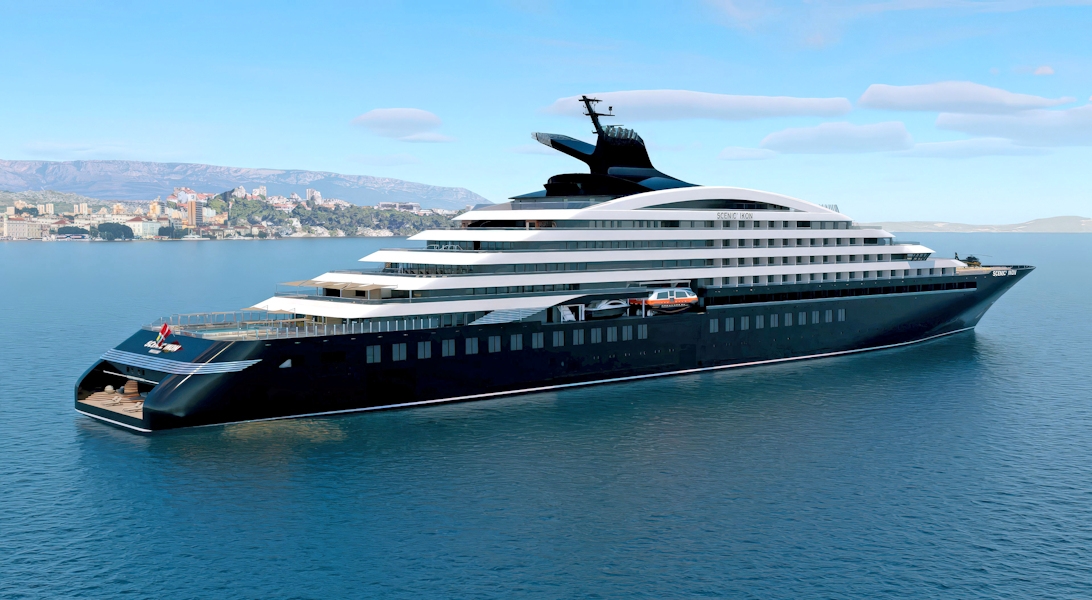
The images shown are for illustration purposes only and may not be an exact representation of what you find on the ship.
The images shown are for illustration purposes only and may not be an exact representation of what you find on the ship.
The images shown are for illustration purposes only and may not be an exact representation of what you find on the ship.
The images shown are for illustration purposes only and may not be an exact representation of what you find on the ship.
The images shown are for illustration purposes only and may not be an exact representation of what you find on the ship.


Our Fusion packages are all ABTA & ATOL protected ensuring that your booking is safe with us
| Return flights including luggage allowance | |||
| Overseas Transfers | |||
| 21 nights aboard the Scenic Ikon | |||
| Return Flights (including regional) | |||
| All Verandah Suites | |||
| Butler service for every guest | |||
| Nine Dining Venues | |||
| Gratuities Included | |||
| Complimentary drinks on-board | |||
| Free use of electric bikes | |||
| Comprehensive choice of shore excursions | |||
| Complimentary Wi-Fi | |||
| Explore under the sea in our submarine (additional charge) | |||
| Soar above and beyond by helicopter (additional charge) | |||
| Port Taxes and Fees | |||
 | ABTA and ATOL Protection* | ||
Fly/cruise package |
Date 6th Jun 2028 |
Nts 21 |
Interior  |
Oceanview |
Balcony |
Suite £23,861pp |
Interior |
Oceanview |
Balcony |
Suite £47,722pp |
Date 6th Jun 2028 |
Nts 21 |
Interior |
Oceanview |
Balcony |
Suite £23,861pp |
Interior |
Oceanview |
Balcony |
Suite £47,722pp |
Fusion Holidays when selling travel arrangements is a trading name of Co-op Travel Services Limited, registration 08903986. Fusion Cruises is an Accredited Body Member of Co-op Travel Services Limited ATOL 12904.
Book with Confidence. We are a Member of ABTA which means you have the benefit of ABTA’s assistance and Code of Conduct.
Some of the flights and flight-inclusive holidays on this website are financially protected by the ATOL scheme but ATOL protection does not apply to all holiday and travel services offered on this website. This website will provide you with information on the protection that applies in the case of each holiday and travel service offered before you make your booking. If you do not receive an ATOL Certificate then the booking will not be ATOL protected. If you do receive an ATOL Certificate but all parts of your trip are not listed on it, those parts will not be ATOL protected. Please see our booking conditions for information, or for more information about financial protection and the ATOL Certificate go to: www.caa.co.uk