This site uses cookies as defined in our Cookie Policy, by continuing to use this site you agree to their use.
Continue

| Arrive | Depart | ||||||
| 21st21 | AprApr | 202828 | Civitavecchia, Italy, embark on the Scenic Ikon | ||||
Italy's vibrant capital lives in the present, but no other city on earth evokes its past so powerfully. For over 2,500 years, emperors, popes, artists, and common citizens have left their mark here. Archaeological remains from ancient Rome, art-stuffed churches, and the treasures of Vatican City vie for your attention, but Rome is also a wonderful place to practice the Italian-perfected il dolce far niente, the sweet art of idleness. Your most memorable experiences may include sitting at a caffè in the Campo de' Fiori or strolling in a beguiling piazza. Welcome to Rome, the Eternal City, where ancient monuments and elaborate churches sit alongside busy cafes and designer boutiques. Its port, Civitavecchia, dates back to the second century and remains one of the busiest ports in the Mediterranean. Your next-generation Discovery Yacht will be waiting for you here. Upon arrival you’ll be warmly welcomed by the Captain and crew. Meet your butler and settle into your spacious suite, then toast the beginning of your Signature Yacht Cruise as you sail away from this ancient harbour. Please book your flight to arrive into Rome prior to 02:00 PM. | |||||||
| 22nd22 | AprApr | 202828 | Bonifacio, Corsica, France | ||||
Located in the South of Corsica, Bonifacio is one of the island’s most beautiful destinations. From its breathtaking views and sandy white islands to its historic citadel, the city is a must visit for anyone travelling to the island. Stand out on your private balcony as you sail into Bonifacio this morning. The town appears perched on soaring limestone cliffs, offering breathtaking views over the Mediterranean and a most memorable arrival. Step ashore to explore the atmospheric old town, with its winding lanes, historic buildings and relaxed Corsican charm. Whether you're enjoying the panoramic vistas from the ancient citadel or strolling the picturesque marina, Bonifacio promises a delightful blend of history, culture and coastal beauty. | |||||||
| 23rd23 | AprApr | 202828 | Porto Cervo, Italy | ||||
This morning you’ll arrive in Porto Cervo, at the heart of the spectacular Costa Smeralda on the Italian island of Sardinia. Built as a millionaire’s playground by Prince Aga Khan in the 1960s, Porto Cervo oozes sophistication with high-end boutiques, stylish restaurants, glamorous nightclubs, world-class golf courses and tennis clubs, and many sumptuous hotels. Your ultra-luxury yacht will look right at home amongst the stylish superyachts in the harbour and you can keep your eyes peeled for celebrities or royalty as you explore. | |||||||
| 24th24 | AprApr | 202828 | Sorrento, Italy | ||||
Sorrento may have become a jumping-off point for visitors to Pompeii, Capri, and Amalfi, but you can find countless reasons to love it for itself. The Sorrentine people are fair-minded and hardworking, bubbling with life and warmth. The tuff cliff on which the town rests is spread over the bay, absorbing sunlight, while orange and lemon trees waft their perfume in spring. Winding along a cliff above a small beach and two harbors, the town is split in two by a narrow ravine formed by a former mountain stream. To the east, dozens of hotels line busy Via Correale along the cliff—many have "grand" included in their names, and some indeed still are. To the west, however, is the historic sector, which still enchants. It's a relatively flat area, with winding, stone-paved lanes bordered by balconied buildings, some joined by medieval stone arches. The central piazza is named after the poet Torquato Tasso, born here in 1544. This part of town is a delightful place to walk through. Craftspeople are often at work in their stalls and shops and are happy to let you watch; in fact, that's the point. Music spots and bars cluster in the side streets near Piazza Tasso. A small resort town with a huge reputation, Sorrento is known as the land of lemons and orange groves. It’s the birthplace of limoncello liqueur and a gateway to the spectacular Amalfi Coast. One of Italy’s most romantic cities, it was first discovered by famed writers like Byron, Keats and Dickens in the 18th and 19th centuries. Perched on cliffs that plunge into the deep blue of the Mediterranean, it’s a place of peaceful alleyways, pastel-coloured buildings, grand villas and luxury hotels. | |||||||
| 25th25 | AprApr | 202828 | Siracuse, Sicily, Italy | ||||
Siracusa, known to English speakers as Syracuse, is a wonder to behold. One of the great ancient capitals of Western civilization, the city was founded in 734 BC by Greek colonists from Corinth and soon grew to rival, and even surpass, Athens in splendor and power. It became the largest, wealthiest city-state in the West and a bulwark of Greek civilization. Although Siracusa lived under tyranny, rulers such as Dionysius filled their courts with Greeks of the highest cultural stature—among them the playwrights Aeschylus and Euripides, and the philosopher Plato. The Athenians, who didn't welcome Siracusa's rise, set out to conquer Sicily, but the natives outsmarted them in what was one of the greatest military campaigns in ancient history (413 BC). The city continued to prosper until it was conquered two centuries later by the Romans.Present-day Siracusa still has some of the finest examples of Baroque art and architecture; dramatic Greek and Roman ruins; and a Duomo that's the stuff of legend—a microcosm of the city's entire history in one building. The modern city also has a wonderful, lively, Baroque old town worthy of extensive exploration, as well as pleasant piazzas, outdoor cafés and bars, and a wide assortment of excellent seafood. There are essentially two areas to explore in Siracusa: the Parco Archeologico (Archaeological Zone), on the mainland; and the island of Ortygia, the ancient city first inhabited by the Greeks, which juts out into the Ionian Sea and is connected to the mainland by two small bridges. Ortygia is becoming increasingly popular with tourists, and is starting to lose its old-fashioned charm in favor of modern boutiques.Siracusa's old nucleus of Ortygia, a compact area, is a pleasure to amble around without getting unduly tired. In contrast, mainland Siracusa is a grid of wider avenues. At the northern end of Corso Gelone, above Viale Paolo Orsi, the orderly grid gives way to the ancient quarter of Neapolis, where the sprawling Parco Archeologico is accessible from Viale Teracati (an extension of Corso Gelone). East of Viale Teracati, about a 10-minute walk from the Parco Archeologico, the district of Tyche holds the archaeological museum and the church and catacombs of San Giovanni, both off Viale Teocrito (drive or take a taxi or city bus from Ortygia). Coming from the train station, it's a 15-minute trudge to Ortygia along Via Francesco Crispi and Corso Umberto. If you're not up for that, take one of the free electric buses leaving every 10 minutes from the bus station around the corner. Spend the day in the city of Syracuse on the Ionian coast of the island of Sicily, a tapestry of lush citrus orchards, golden stone buildings and sparkling blue seas. Explore the remnants of ancient civilisations in the Archaeological Park of Neapolis, where the Greek Theatre and Roman Amphitheatre stand as testaments to the city's rich past. Stroll through the charming streets of Ortigia, the historic heart of Syracuse, with its baroque architecture and bustling markets. Indulge in authentic Sicilian cuisine at waterfront trattorias, savouring local delicacies like arancini and cannoli. | |||||||
| 26th26 | AprApr | 202828 | Valletta, Malta | ||||
Malta's capital, the minicity of Valletta, has ornate palaces and museums protected by massive fortifications of honey-color limestone. Houses along the narrow streets have overhanging wooden balconies for people-watching from indoors. Generations ago they gave housebound women a window on the world of the street. The main entrance to town is through the City Gate (where all bus routes end), which leads onto Triq Repubblika (Republic Street), the spine of the grid-pattern city and the main shopping street. Triq Mercante (Merchant Street) parallels Repubblika to the east and is also good for strolling. From these two streets, cross streets descend toward the water; some are stepped. Valletta's compactness makes it ideal to explore on foot. City Gate and the upper part of Valletta are experiencing vast redevelopment that includes a new Parliament Building and open-air performance venue. The complex, completed mid-2013, has numerous pedestrian detours in place along with building noise and dust. Before setting out along Republic Street, stop at the tourist information office on Merchant Street for maps and brochures. A jewel of the Mediterranean, Valletta is Europe’s smallest capital. In 2018 it was honoured as the European Capital of Culture by the European Union, a celebration of the richness of its culture and the diversity of the modern city. Built by the Knights of the Order of St John in the 16th century, Valletta’s UNESCO World Heritage-listed walls encircle a beautifully preserved centre where Baroque architecture, chic galleries, and vibrant gastronomy come together in perfect harmony. | |||||||
| 27th27 | AprApr | 202828 | At Sea | ||||
| 28th28 | AprApr | 202828 | Khania, Greece | ||||
The second-largest city in Crete and capital of the Homonym Prefecture, Chania is located in Minoan Kidonia at the end of the Homonym Gulf between the Akrotiri and Onicha peninsulas. Chania City is divided into two parts; the Old Town, which is comprised of several connected districts built around the old Venetian Harbour, and New Town, a larger, more modern city whose centre is situated next to, and south of, the Old Town. The Old Town is home to Venetian buildings and Turkish elements that combine to create a unique architectural style, and is considered to be the most beautiful urban district on Crete. It was once surrounded by old Venetian fortifications that separated it from the New Town; however, only the eastern and western parts remain today. Due to its compact size, Skiathos can be easily explored in just a single day. Chania, the capital of Crete until the 1970s, boasts a rich history dating back more than 5,000 thousand years, with influences from civilisations such as Minoan, Venetian and Ottoman. Its charming maze-like Old Town is known for its picturesque harbour, narrow cobblestone streets, and well-preserved Venetian and Turkish architecture. Spend the day exploring historic landmarks like the 16th-century lighthouse, the dusky pink Mosque of Kioutsouk Hasan and the Byzantine walls. | |||||||
| 29th29 | AprApr | 202828 | At Sea | ||||
| 30th30 | AprApr | 202828 | Alexandria, Egypt | ||||
Founded by Alexander the Great, Alexandria was Egypt's capital for over 1,000 years. Now, it is visited by tourists looking to enjoy some diving and those interested in the Great Library, one of the Seven Wonders of the Ancient World. The shores of a new continent beckon this morning as you sail into North Africa. The ancient city of Alexandria is a bustling, captivating Mediterranean gem just hours from Cairo. Founded by Alexander the Great in 331 BC, it became a beacon of knowledge with its Great Library and Lighthouse, and continues to enchant with its storied heritage. | |||||||
| 1st01 | MayMay | 202828 | Alexandria, Egypt | ||||
Founded by Alexander the Great, Alexandria was Egypt's capital for over 1,000 years. Now, it is visited by tourists looking to enjoy some diving and those interested in the Great Library, one of the Seven Wonders of the Ancient World. Delve deeper into Alexandria’s vibrant history and culture with a second day to explore this ancient city. Though many of its wonders have been subsumed by the sea over the centuries, you can still feel the power of its magnificent past. Choose from a selection of Scenic Freechoice options to uncover more of its wonders. | |||||||
| 2nd02 | MayMay | 202828 | At Sea | ||||
| 3rd03 | MayMay | 202828 | Rhodes, Greece | ||||
Early travelers described Rhodes as a town of two parts: a castle or high town (Collachium) and a lower city. Today Rhodes town—sometimes referred to as Ródos town—is still a city of two parts: the Old Town, a UNESCO World Heritage site that incorporates the high town and lower city, and the modern metropolis, or New Town, spreading away from the walls that encircle the Old Town. The narrow streets of the Old Town are for the most part closed to cars and are lined with Orthodox and Catholic churches, Turkish houses (some of which follow the ancient orthogonal plan), and medieval public buildings with exterior staircases and facades elegantly constructed of well-cut limestone from Lindos. Careful reconstruction in recent years has enhanced the harmonious effect. Famed for its medieval architecture and rich history, the Greek island of Rhodes sits in the sparkling Aegean Sea close to the coast of Turkey. Its well-preserved medieval Old Town is a designated World Heritage site, resplendent with cobblestone streets, ancient walls and the impressive Kastello - Palace of the Grand Master of the Knights. Rhodes also boasts a fascinating hybrid of Greek, Ottoman and Italian influences, that you can experience through its diverse architecture, cuisine and culture. | |||||||
| 4th04 | MayMay | 202828 | Mykonos, Greece | ||||
Although the fishing boats still go out in good weather, Mykonos largely makes its living from tourism these days. The summer crowds have turned one of the poorest islands in Greece into one of the richest. Old Mykonians complain that their young, who have inherited stores where their grandfathers once sold eggs or wine, get so much rent that they have lost ambition, and in summer sit around pool bars at night with their friends, and hang out in Athens in winter when island life is less scintillating. Put firmly on the map by Jackie O in the 1960s, Mykonos town—called Hora by the locals—remains the Saint-Tropez of the Greek islands. The scenery is memorable, with its whitewashed streets, Little Venice, the Kato Myli ridge of windmills, and Kastro, the town's medieval quarter. Its cubical two- or three-story houses and churches, with their red or blue doors and domes and wooden balconies, have been long celebrated as some of the best examples of classic Cycladic architecture. Luckily, the Greek Archaeological Service decided to preserve the town, even when the Mykonians would have preferred to rebuild, and so the Old Town has been impressively preserved. Pink oleander, scarlet hibiscus, and trailing green pepper trees form a contrast amid the dazzling whiteness, whose frequent renewal with whitewash is required by law. Any visitor who has the pleasure of getting lost in its narrow streets (made all the narrower by the many outdoor stone staircases, which maximize housing space in the crowded village) will appreciate how its confusing layout was designed to foil pirates—if it was designed at all. After Mykonos fell under Turkish rule in 1537, the Ottomans allowed the islanders to arm their vessels against pirates, which had a contradictory effect: many of them found that raiding other islands was more profitable than tilling arid land. At the height of Aegean piracy, Mykonos was the principal headquarters of the corsair fleets—the place where pirates met their fellows, found willing women, and filled out their crews. Eventually the illicit activity evolved into a legitimate and thriving trade network. Morning on Mykonos town's main quay is busy with deliveries, visitors for the Delos boats, lazy breakfasters, and street cleaners dealing with the previous night's mess. In late morning the cruise-boat people arrive, and the shops are all open. In early afternoon, shaded outdoor tavernas are full of diners eating salads (Mykonos's produce is mostly imported); music is absent or kept low. In mid- and late afternoon, the town feels sleepy, since so many people are at the beach, on excursions, or sleeping in their air-conditioned rooms; even some tourist shops close for siesta. By sunset, people have come back from the beach, having taken their showers and rested. At night, the atmosphere in Mykonos ramps up. The cruise-boat people are mostly gone, coughing three-wheelers make no deliveries in the narrow streets, and everyone is dressed sexy for summer and starting to shimmy with the scene. Many shops stay open past midnight, the restaurants fill up, and the bars and discos make ice cubes as fast as they can. Ready to dive in? Begin your tour of Mykonos town (Hora) by starting out at its heart: Mando Mavrogenous Square. This morning, arrive at the island of Mykonos, Greece, a cosmopolitan Cycladic gem known for its iconic windmills and distinctive architecture. Founded as a port in the 11th century BC, it boasts pristine beaches, whitewashed buildings and vibrant bougainvillea climbing along winding streets. Discover picturesque churches, savour authentic Greek cuisine in lively waterfront cafés, and immerse yourself in the island’s rich history and spirited charm. | |||||||
| 5th05 | MayMay | 202828 | Piraeus, Greece, disembark the Scenic Ikon | ||||
It's no wonder that all roads lead to the fascinating and maddening metropolis of Athens. Lift your eyes 200 feet above the city to the Parthenon, its honey-color marble columns rising from a massive limestone base, and you behold architectural perfection that has not been surpassed in 2,500 years. But, today, this shrine of classical form dominates a 21st-century boomtown. To experience Athens—Athína in Greek—fully is to understand the essence of Greece: ancient monuments surviving in a sea of cement, startling beauty amid the squalor, tradition juxtaposed with modernity. Locals depend on humor and flexibility to deal with the chaos; you should do the same. The rewards are immense. Although Athens covers a huge area, the major landmarks of the ancient Greek, Roman, and Byzantine periods are close to the modern city center. You can easily walk from the Acropolis to many other key sites, taking time to browse in shops and relax in cafés and tavernas along the way. From many quarters of the city you can glimpse "the glory that was Greece" in the form of the Acropolis looming above the horizon, but only by actually climbing that rocky precipice can you feel the impact of the ancient settlement. The Acropolis and Filopappou, two craggy hills sitting side by side; the ancient Agora (marketplace); and Kerameikos, the first cemetery, form the core of ancient and Roman Athens. Along the Unification of Archaeological Sites promenade, you can follow stone-paved, tree-lined walkways from site to site, undisturbed by traffic. Cars have also been banned or reduced in other streets in the historical center. In the National Archaeological Museum, vast numbers of artifacts illustrate the many millennia of Greek civilization; smaller museums such as the Goulandris Museum of Cycladic Art Museum and the Byzantine and Christian Museum illuminate the history of particular regions or periods. Athens may seem like one huge city, but it is really a conglomeration of neighborhoods with distinctive characters. The Eastern influences that prevailed during the 400-year rule of the Ottoman Empire are still evident in Monastiraki, the bazaar area near the foot of the Acropolis. On the northern slope of the Acropolis, stroll through Plaka (if possible by moonlight), an area of tranquil streets lined with renovated mansions, to get the flavor of the 19th-century's gracious lifestyle. The narrow lanes of Anafiotika, a section of Plaka, thread past tiny churches and small, color-washed houses with wooden upper stories, recalling a Cycladic island village. In this maze of winding streets, vestiges of the older city are everywhere: crumbling stairways lined with festive tavernas; dank cellars filled with wine vats; occasionally a court or diminutive garden, enclosed within high walls and filled with magnolia trees and the flaming trumpet-shaped flowers of hibiscus bushes. Formerly run-down old quarters, such as Thission, Gazi and Psirri, popular nightlife areas filled with bars and mezedopoleia (similar to tapas bars), are now in the process of gentrification, although they still retain much of their original charm, as does the colorful produce and meat market on Athinas. The area around Syntagma Square, the tourist hub, and Omonia Square, the commercial heart of the city about 1 km (½ mi) northwest, is distinctly European, having been designed by the court architects of King Otho, a Bavarian, in the 19th century. The chic shops and bistros of ritzy Kolonaki nestle at the foot of Mt. Lycabettus, Athens's highest hill (909 feet). Each of Athens's outlying suburbs has a distinctive character: in the north is wealthy, tree-lined Kifissia, once a summer resort for aristocratic Athenians, and in the south and southeast lie Glyfada, Voula, and Vouliagmeni, with their sandy beaches, seaside bars, and lively summer nightlife. Just beyond the city's southern fringes is Piraeus, a bustling port city of waterside fish tavernas and Saronic Gulf views. Your Signature Yacht Cruise concludes this morning in Piraeus, where you’ll disembark and be transferred to Athens airport. Considered the birthplace of Western civilisation, Athens is a vibrant tapestry of history and modernity. Standing sentinel above the city is the famous Acropolis, a fortified hill dominated by the Parthenon, atmospheric ruins of a white marble temple built during the height of the ancient Greek Empire. Please book your flight to depart out of Athens after 01:00 PM. # Spa treatments and services at additional cost. Daily activities may be subject to change; please consult your Daily Wonder for updates. +All drinks on board, including those stocked in your mini bar, are included, except for a very small number of rare, fine and vintage wines, Champagnes and spirits. Specialty restaurants require a reservation, enquire on board. Helicopter not operational in France. Submersible not operational in Europe. The itinerary is a guide only and may be amended for operational reasons. As such Scenic cannot guarantee the voyage will operate unaltered from the itinerary stated above. Please refer to our terms and conditions for further information. | |||||||
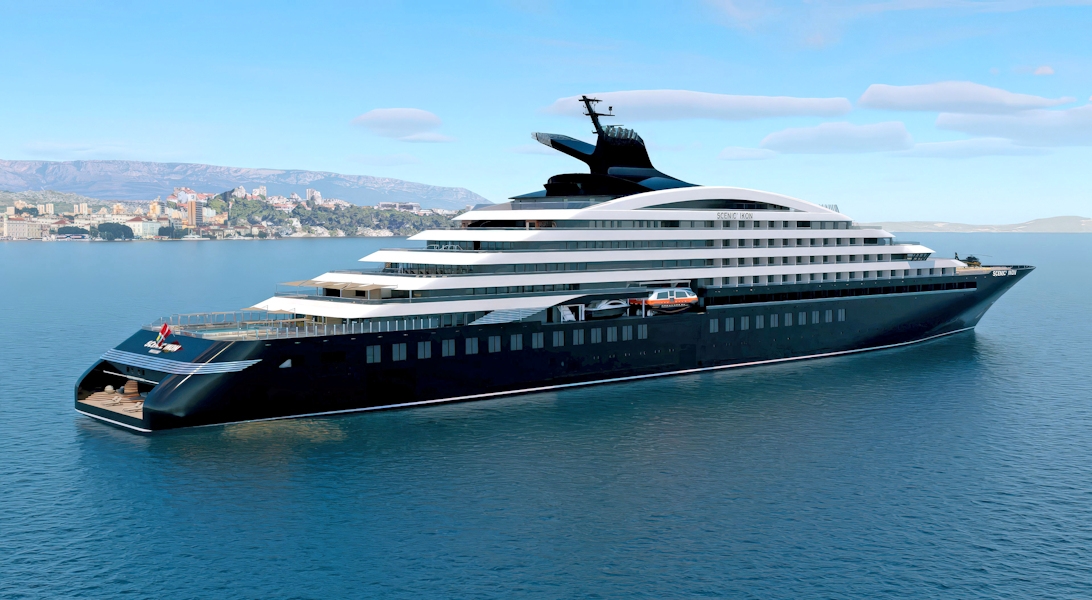
The images shown are for illustration purposes only and may not be an exact representation of what you find on the ship.
The images shown are for illustration purposes only and may not be an exact representation of what you find on the ship.
The images shown are for illustration purposes only and may not be an exact representation of what you find on the ship.
The images shown are for illustration purposes only and may not be an exact representation of what you find on the ship.
The images shown are for illustration purposes only and may not be an exact representation of what you find on the ship.


Our Fusion packages are all ABTA & ATOL protected ensuring that your booking is safe with us
| 14 nights aboard the Scenic Ikon | |||
| Return Flights (including regional) | |||
| All Verandah Suites | |||
| Butler service for every guest | |||
| Nine Dining Venues | |||
| Gratuities Included | |||
| Complimentary drinks on-board | |||
| Free use of electric bikes | |||
| Comprehensive choice of shore excursions | |||
| Complimentary Wi-Fi | |||
| Explore under the sea in our submarine (additional charge) | |||
| Soar above and beyond by helicopter (additional charge) | |||
| Port Taxes and Fees | |||
 | ABTA and ATOL Protection* | ||
Date 21st Apr 2028 |
Nts 14 |
Please Call for Availability |
Date 21st Apr 2028 |
Nts 14 |
Please Call for Availability |
Fusion Holidays when selling travel arrangements is a trading name of Co-op Travel Services Limited, registration 08903986. Fusion Cruises is an Accredited Body Member of Co-op Travel Services Limited ATOL 12904.
Book with Confidence. We are a Member of ABTA which means you have the benefit of ABTA’s assistance and Code of Conduct.
Some of the flights and flight-inclusive holidays on this website are financially protected by the ATOL scheme but ATOL protection does not apply to all holiday and travel services offered on this website. This website will provide you with information on the protection that applies in the case of each holiday and travel service offered before you make your booking. If you do not receive an ATOL Certificate then the booking will not be ATOL protected. If you do receive an ATOL Certificate but all parts of your trip are not listed on it, those parts will not be ATOL protected. Please see our booking conditions for information, or for more information about financial protection and the ATOL Certificate go to: www.caa.co.uk