This site uses cookies as defined in our Cookie Policy, by continuing to use this site you agree to their use.
Continue

| Arrive | Depart | ||||||
| 23rd23 | AugAug | 202828 | Piraeus, Greece, embark on the Scenic Ikon | ||||
It's no wonder that all roads lead to the fascinating and maddening metropolis of Athens. Lift your eyes 200 feet above the city to the Parthenon, its honey-color marble columns rising from a massive limestone base, and you behold architectural perfection that has not been surpassed in 2,500 years. But, today, this shrine of classical form dominates a 21st-century boomtown. To experience Athens—Athína in Greek—fully is to understand the essence of Greece: ancient monuments surviving in a sea of cement, startling beauty amid the squalor, tradition juxtaposed with modernity. Locals depend on humor and flexibility to deal with the chaos; you should do the same. The rewards are immense. Although Athens covers a huge area, the major landmarks of the ancient Greek, Roman, and Byzantine periods are close to the modern city center. You can easily walk from the Acropolis to many other key sites, taking time to browse in shops and relax in cafés and tavernas along the way. From many quarters of the city you can glimpse "the glory that was Greece" in the form of the Acropolis looming above the horizon, but only by actually climbing that rocky precipice can you feel the impact of the ancient settlement. The Acropolis and Filopappou, two craggy hills sitting side by side; the ancient Agora (marketplace); and Kerameikos, the first cemetery, form the core of ancient and Roman Athens. Along the Unification of Archaeological Sites promenade, you can follow stone-paved, tree-lined walkways from site to site, undisturbed by traffic. Cars have also been banned or reduced in other streets in the historical center. In the National Archaeological Museum, vast numbers of artifacts illustrate the many millennia of Greek civilization; smaller museums such as the Goulandris Museum of Cycladic Art Museum and the Byzantine and Christian Museum illuminate the history of particular regions or periods. Athens may seem like one huge city, but it is really a conglomeration of neighborhoods with distinctive characters. The Eastern influences that prevailed during the 400-year rule of the Ottoman Empire are still evident in Monastiraki, the bazaar area near the foot of the Acropolis. On the northern slope of the Acropolis, stroll through Plaka (if possible by moonlight), an area of tranquil streets lined with renovated mansions, to get the flavor of the 19th-century's gracious lifestyle. The narrow lanes of Anafiotika, a section of Plaka, thread past tiny churches and small, color-washed houses with wooden upper stories, recalling a Cycladic island village. In this maze of winding streets, vestiges of the older city are everywhere: crumbling stairways lined with festive tavernas; dank cellars filled with wine vats; occasionally a court or diminutive garden, enclosed within high walls and filled with magnolia trees and the flaming trumpet-shaped flowers of hibiscus bushes. Formerly run-down old quarters, such as Thission, Gazi and Psirri, popular nightlife areas filled with bars and mezedopoleia (similar to tapas bars), are now in the process of gentrification, although they still retain much of their original charm, as does the colorful produce and meat market on Athinas. The area around Syntagma Square, the tourist hub, and Omonia Square, the commercial heart of the city about 1 km (½ mi) northwest, is distinctly European, having been designed by the court architects of King Otho, a Bavarian, in the 19th century. The chic shops and bistros of ritzy Kolonaki nestle at the foot of Mt. Lycabettus, Athens's highest hill (909 feet). Each of Athens's outlying suburbs has a distinctive character: in the north is wealthy, tree-lined Kifissia, once a summer resort for aristocratic Athenians, and in the south and southeast lie Glyfada, Voula, and Vouliagmeni, with their sandy beaches, seaside bars, and lively summer nightlife. Just beyond the city's southern fringes is Piraeus, a bustling port city of waterside fish tavernas and Saronic Gulf views. Known as the birthplace of Western civilisation, Athens is a vibrant tapestry of history and modernity. Standing sentinel above the city is the famous Acropolis, a fortified hill dominated by the Parthenon, atmospheric ruins of a white marble temple built during the height of the ancient Greek Empire. Please book your flight to arrive into Athens prior to 02:00 PM. | |||||||
| 24th24 | AugAug | 202828 | Náfplion, Greece | ||||
Oraia (beautiful) is the word Greeks use to describe Nafplion. The town's old section, on a peninsula jutting into the gulf of Argos, mixes Greek, Venetian, and Turkish architecture; narrow streets, often just broad flights of stone stairs, climb the slopes beneath the walls of Acronafplia. Tree-shaded plazas surround neoclassic buildings. The Palamidi fortress—an elegant display of Venetian might from the early 1700s—guards the town. Nafplion deserves at least a leisurely day of your undivided attention, and you may want to spend several days or a week here and use the city as the base from which to explore the many surrounding ancient sights. Discover the rich tapestry of history as you wander through Nafplion’s charming streets adorned with neoclassical architecture, Venetian fortresses and Turkish mosques. Explore the winding alleys of the Old Town, where traditional tavernas and quaint cafes beckon you to indulge in local delicacies. Climb the steps to Palamidi Fortress for breathtaking views of the town and sea below or relax on the shores of Arvanitia Beach. See the World Heritage-listed Epidaurus Theatre and archaeological site of Mycenae, dating back to the second century BC. | |||||||
| 25th25 | AugAug | 202828 | Nydri, Lefkada Island, Greece | ||||
| 26th26 | AugAug | 202828 | Corfu, Greece | ||||
Corfu town today is a vivid tapestry of cultures—a sophisticated weave, where charm, history, and natural beauty blend. Located about midway along the island's east coast, this spectacularly lively capital is the cultural heart of Corfu and has a remarkable historic center that UNESCO designated as a World Heritage Site in 2007. All ships and planes dock or land near Corfu town, which occupies a small peninsula jutting into the Ionian Sea.Whether arriving by ferry from mainland Greece or Italy, from another island, or directly by plane, catch your breath by first relaxing with a coffee or a gelato in Corfu town's shaded Liston Arcade, then stroll the narrow lanes of its pedestrians-only quarter. For an overview of the immediate area, and a quick tour of Mon Repos palace, hop on the little tourist train that runs from May to September. Corfu town has a different feel at night, so book a table at one of its famed tavernas to savor the island's unique cuisine.The best way to get around Corfu town is on foot. The town is small enough so that you can easily walk to every sight. There are local buses, but they do not thread their way into the streets (many now car-free) of the historic center. If you are arriving by ferry or plane, it's best to take a taxi to your hotel. Expect to pay about €10 from the airport or ferry terminal to a hotel in Corfu town. If there are no taxis waiting, you can call for one. The ruggedly beautiful island of Corfu is dotted with whitewashed houses and olive groves, creating an enchanting Mediterranean allure. The World Heritage-listed Old Town boasts a rich history and stunning Renaissance and Baroque architecture. Wander the vibrant Spianada, Greece’s largest square, and immerse yourself in Corfu’s timeless charm and cultural treasures. | |||||||
| 27th27 | AugAug | 202828 | Monopoli, Italy | ||||
A true gem of the Adriatic, Monopoli charms with its whitewashed buildings, vibrant fishing port and maze of narrow streets. Wander the historic old town, explore magnificent churches, or unwind by the sea with a gelato in hand. This coastal town captures the heart of Puglia in every detail. | |||||||
| 28th28 | AugAug | 202828 | Kotor, Montenegro | ||||
Backed by imposing mountains, tiny Kotor lies hidden from the open sea, tucked into the deepest channel of the Bokor Kotorska (Kotor Bay), which is Europe's most southerly fjord. To many, this town is more charming than its sister UNESCO World Heritage Site, Dubrovnik, retaining more authenticity, but with fewer tourists and spared the war damage and subsequent rebuilding which has given Dubrovnik something of a Disney feel.Kotor's medieval Stari Grad (Old Town) is enclosed within well-preserved defensive walls built between the 9th and 18th centuries and is presided over by a proud hilltop fortress. Within the walls, a labyrinth of winding cobbled streets leads through a series of splendid paved piazzas, rimmed by centuries-old stone buildings. The squares are now haunted by strains from buskers but although many now house trendy cafés and chic boutiques, directions are still given medieval-style by reference to the town’s landmark churches.In the Middle Ages, as Serbia's chief port, Kotor was an important economic and cultural center with its own highly regarded schools of stonemasonry and iconography. From 1391 to 1420 it was an independent city-republic and later, it spent periods under Venetian, Austrian, and French rule, though it was undoubtedly the Venetians who left the strongest impression on the city's architecture. Since the breakup of Yugoslavia, some 70% of the stone buildings in the romantic Old Town have been snapped up by foreigners, mostly Brits and Russians. Porto Montenegro, a new marina designed to accommodate some of the world’s largest super yachts, opened in nearby Tivat in 2011, and along the bay are other charming seaside villages, all with better views of the bay than the vista from Kotor itself where the waterside is congested with cruise ships and yachts. Try sleepy Muo or the settlement of Prčanj in one direction around the bay, or Perast and the Roman mosaics of Risan in the other direction. Today, arrive in Kotor, a fortified city nestled between towering mountains and the shimmering Adriatic. This World Heritage-listed town is brimming with Venetian palaces, cobblestone lanes and café-hemmed squares. Guarded by medieval walls, Kotor is a place of ancient stories and modern culture. | |||||||
| 28th28 | AugAug | 202828 | Dubrovnik, Croatia | ||||
Nothing can prepare you for your first sight of Dubrovnik. Lying 216 km (135 miles) southeast of Split and commanding a jaw-dropping coastal location, it is one of the world's most beautiful fortified cities. Its massive stone ramparts and fortress towers curve around a tiny harbor, enclosing graduated ridges of sun-bleached orange-tiled roofs, copper domes, and elegant bell towers. Your imagination will run wild picturing what it looked like seven centuries ago when the walls were built, without any suburbs or highways around it, just this magnificent stone city rising out of the sea.In the 7th century AD, residents of the Roman city Epidaurum (now Cavtat) fled the Avars and Slavs of the north and founded a new settlement on a small rocky island, which they named Laus, and later Ragusa. On the mainland hillside opposite the island, the Slav settlement called Dubrovnik grew up. In the 12th century the narrow channel separating the two settlements was filled in (now the main street through the Old Town, called Stradun), and Ragusa and Dubrovnik became one. The city was surrounded by defensive walls during the 13th century, and these were reinforced with towers and bastions in the late 15th century.From 1358 to 1808 the city thrived as a powerful and remarkably sophisticated independent republic, reaching its golden age during the 16th century. In 1667 many of its splendid Gothic and Renaissance buildings were destroyed by an earthquake. The defensive walls survived the disaster, and the city was rebuilt in baroque style.Dubrovnik lost its independence to Napoléon in 1808, and in 1815 passed to Austria-Hungary. During the 20th century, as part of Yugoslavia, the city became a popular tourist destination, and in 1979 it was listed as a UNESCO World Heritage Site. During the war for independence, it came under heavy siege. Thanks to careful restoration, few traces of damage remain; however, there are maps inside the Pile and Ploče Gates illustrating the points around the city where damage was done. It’s only when you experience Dubrovnik yourself that you can understand what a treasure the world nearly lost | |||||||
| 29th29 | AugAug | 202828 | Dubrovnik, Croatia | ||||
Nothing can prepare you for your first sight of Dubrovnik. Lying 216 km (135 miles) southeast of Split and commanding a jaw-dropping coastal location, it is one of the world's most beautiful fortified cities. Its massive stone ramparts and fortress towers curve around a tiny harbor, enclosing graduated ridges of sun-bleached orange-tiled roofs, copper domes, and elegant bell towers. Your imagination will run wild picturing what it looked like seven centuries ago when the walls were built, without any suburbs or highways around it, just this magnificent stone city rising out of the sea.In the 7th century AD, residents of the Roman city Epidaurum (now Cavtat) fled the Avars and Slavs of the north and founded a new settlement on a small rocky island, which they named Laus, and later Ragusa. On the mainland hillside opposite the island, the Slav settlement called Dubrovnik grew up. In the 12th century the narrow channel separating the two settlements was filled in (now the main street through the Old Town, called Stradun), and Ragusa and Dubrovnik became one. The city was surrounded by defensive walls during the 13th century, and these were reinforced with towers and bastions in the late 15th century.From 1358 to 1808 the city thrived as a powerful and remarkably sophisticated independent republic, reaching its golden age during the 16th century. In 1667 many of its splendid Gothic and Renaissance buildings were destroyed by an earthquake. The defensive walls survived the disaster, and the city was rebuilt in baroque style.Dubrovnik lost its independence to Napoléon in 1808, and in 1815 passed to Austria-Hungary. During the 20th century, as part of Yugoslavia, the city became a popular tourist destination, and in 1979 it was listed as a UNESCO World Heritage Site. During the war for independence, it came under heavy siege. Thanks to careful restoration, few traces of damage remain; however, there are maps inside the Pile and Ploče Gates illustrating the points around the city where damage was done. It’s only when you experience Dubrovnik yourself that you can understand what a treasure the world nearly lost Known as the ‘Pearl of the Adriatic’, Dubrovnik is a compelling historic city along Croatia's Dalmatian Coast. Its walled Old Town is one of the finest examples of medieval citadel architecture in Europe. With its storied history and breathtaking views of iconic terracotta rooftops and the alluring Adriatic Sea, Dubrovnik offers the perfect blend of cultural exploration and serene seaside strolls. | |||||||
| 30th30 | AugAug | 202828 | Korčula, Croatia | ||||
Off the coast of Croatia in the southern Adriatic Sea lie some thousand islands and the largest of them, Korçula, is considered the most beautiful. With an average of 3,000 hours of sunshine per annum, which guarantees a wide assortment of Mediterranean vegetation, it is not difficult to understand why seasoned travelers compare Korçula to a latter-day Eden. Separated from the mainland by a channel of only one mile, Korçula's main town, named the same as the island, ranks among the best preserved medieval towns in the Mediterranean. It is the island's main tourist, economic and cultural center. Thanks to its strategic location along the sea trade routes, Korçula has always attracted travelers and settlers. Korcula was founded by Greek colonists, who were followed by Illyrians, Romans and finally the Croats. The Korçula Statute of 1214 is one of the oldest legal documents to have been adopted in this part of Europe. The same century saw the birth of the famous world traveler, Marco Polo. The house said to be his birthplace can be seen in town. Korçulans have always been known as keen seafarers, excellent shipbuilders, stonemasons and artists. From their many voyages, sailors brought back new ideas, which eventually mixed with local customs. To this day, Korçula has maintained the tradition of performing knightly games such as the chivalrous Moreska dance, which has been in existence for more than 400 years. Visitors to Korçula enjoy its stunning location, natural beauty and medieval ambiance. And if that's not enough, the town offers numerous attractions that are within walking distance from the pier, including the City Museum and the Bishop's Treasury. Korcula, Croatia, is the Adriatic’s sixth-largest island and has been dubbed the ‘Emerald Isle’ for its lush, green landscape. It is renowned for its medieval Old Town, often called ‘Little Dubrovnik’. Famed as Marco Polo’s birthplace, it boasts Gothic-Renaissance architecture and quaint squares, whilst vineyards grace nearby Cara and Smokvica, yielding the prized Croatian wine, Pošip. | |||||||
| 31st31 | AugAug | 202828 | Sibenik, Croatia | ||||
Šibenik's main monument, its Gothic-Renaissance cathedral, built of pale-gray Dalmatian stone and designated a UNESCO World Heritage Site, stands on a raised piazza close to the seafront promenade. From here a network of narrow, cobbled streets leads through the medieval quarter of tightly packed, terra-cotta–roof houses, and up to the ruins of a 16th-century hilltop fortress. The city has never been a real tourist destination. Before the Croatian war for independence, it was a relatively prosperous industrial center, but when the factories closed, Šibenik sank into an economic depression. However, the cathedral more than warrants a look, and it makes a decent base for visiting the waterfalls of Krka National Park. Šibenik, a Dalmatian treasure, was founded in the ninth century and is one of the oldest Croatian cities on the Adriatic. It’s famous for the World Heritage-listed Cathedral of St. James, a Renaissance masterpiece as well as medieval fortresses like St. Michael’s and the winding cobblestone alleys of its car-free Old Town. It also neighbours Krka National Park, home to a series of seven stunning waterfalls. | |||||||
| 1st01 | SepSep | 202828 | Piran, Slovenia | ||||
Piran, a lesser-known coastal gem on Slovenia’s Adriatic shore, enchants with its medieval charm. Clustered on the Piran peninsula, its red-tiled, white-washed buildings reflect a vibrant Venetian heritage, shaped by the Venetian empire from the late 13th to late 18th century. Elegant gothic-style architecture and narrow cobblestone streets invite exploration. | |||||||
| 2nd02 | SepSep | 202828 | Venice, Italy, disembark the Scenic Ikon | ||||
Venice is a city unlike any other. No matter how often you've seen it in photos and films, the real thing is more dreamlike than you could imagine. With canals where streets should be, water shimmers everywhere. The fabulous palaces and churches reflect centuries of history in what was a wealthy trading center between Europe and the Orient. Getting lost in the narrow alleyways is a quintessential part of exploring Venice, but at some point you'll almost surely end up in Piazza San Marco, where tourists and locals congregate for a coffee or an aperitif. Your Signature Yacht Cruise concludes this morning in Venice, where you’ll disembark after breakfast, taking with you unforgettable memories of your journey through the Mediterranean. Founded in the fifth century and known as the ‘City of Canals’, Venice captivates visitors with its romantic waterways and Byzantine artistry. Please book your flight to depart out of Venice after 12:00 PM. #Spa treatments and services at additional cost. Daily activities may be subject to change; please consult your Daily Wonder for updates. +All drinks on board, including those stocked in your mini bar, are included, except for a very small number of rare, fine and vintage wines, Champagnes and spirits. Specialty restaurants require a reservation, enquire on board. Submersible not operational in Europe. The itinerary is a guide only and may be amended for operational reasons. As such Scenic cannot guarantee the voyage will operate unaltered from the itinerary stated above. Please refer to our terms and conditions for further information. | |||||||
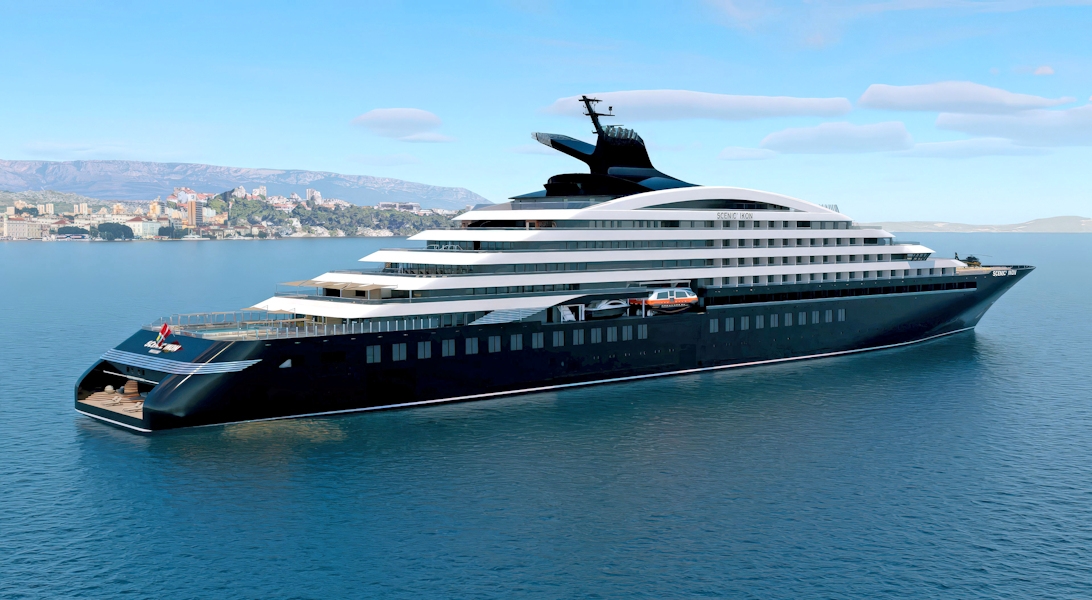
The images shown are for illustration purposes only and may not be an exact representation of what you find on the ship.
The images shown are for illustration purposes only and may not be an exact representation of what you find on the ship.
The images shown are for illustration purposes only and may not be an exact representation of what you find on the ship.
The images shown are for illustration purposes only and may not be an exact representation of what you find on the ship.
The images shown are for illustration purposes only and may not be an exact representation of what you find on the ship.


Our Fusion packages are all ABTA & ATOL protected ensuring that your booking is safe with us
| Return flights including luggage allowance | |||
| Overseas Transfers | |||
| 10 nights aboard the Scenic Ikon | |||
| Return Flights (including regional) | |||
| All Verandah Suites | |||
| Butler service for every guest | |||
| Nine Dining Venues | |||
| Gratuities Included | |||
| Complimentary drinks on-board | |||
| Free use of electric bikes | |||
| Comprehensive choice of shore excursions | |||
| Complimentary Wi-Fi | |||
| Explore under the sea in our submarine (additional charge) | |||
| Soar above and beyond by helicopter (additional charge) | |||
| Port Taxes and Fees | |||
 | ABTA and ATOL Protection* | ||
Fly/cruise package |
Date 23rd Aug 2028 |
Nts 10 |
Interior  |
Oceanview |
Balcony |
Suite £12,496pp |
Interior |
Oceanview |
Balcony |
Suite £24,992pp |
Date 23rd Aug 2028 |
Nts 10 |
Interior |
Oceanview |
Balcony |
Suite £12,496pp |
Interior |
Oceanview |
Balcony |
Suite £24,992pp |
| Suite | |
| (All prices are £GBP per person) | |
| Tue 6th Jun 202806 Jun 28 | 11,542 |
| Tue 6th Jun 202806 Jun 28 | 23,084 |
Fusion Holidays when selling travel arrangements is a trading name of Co-op Travel Services Limited, registration 08903986. Fusion Cruises is an Accredited Body Member of Co-op Travel Services Limited ATOL 12904.
Book with Confidence. We are a Member of ABTA which means you have the benefit of ABTA’s assistance and Code of Conduct.
Some of the flights and flight-inclusive holidays on this website are financially protected by the ATOL scheme but ATOL protection does not apply to all holiday and travel services offered on this website. This website will provide you with information on the protection that applies in the case of each holiday and travel service offered before you make your booking. If you do not receive an ATOL Certificate then the booking will not be ATOL protected. If you do receive an ATOL Certificate but all parts of your trip are not listed on it, those parts will not be ATOL protected. Please see our booking conditions for information, or for more information about financial protection and the ATOL Certificate go to: www.caa.co.uk