This site uses cookies as defined in our Cookie Policy, by continuing to use this site you agree to their use.
Continue

| Arrive | Depart | ||||||
| 19th19 | MayMay | 202727 | Dublin, Ireland, embark on the Silver Endeavour | 20:00 | |||
Dublin is making a comeback. The decade-long "Celtic Tiger" boom era was quickly followed by the Great Recession, but The Recovery has finally taken a precarious hold. For visitors, this newer and wiser Dublin has become one of western Europe's most popular and delightful urban destinations. Whether or not you're out to enjoy the old or new Dublin, you'll find it a colossally entertaining city, all the more astonishing considering its intimate size.It is ironic and telling that James Joyce chose Dublin as the setting for his famous Ulysses, Dubliners, and A Portrait of the Artist as a Young Man because it was a "center of paralysis" where nothing much ever changed. Which only proves that even the greats get it wrong sometimes. Indeed, if Joyce were to return to his once-genteel hometown today—disappointed with the city's provincial outlook, he left it in 1902 at the age of 20—and take a quasi-Homeric odyssey through the city (as he so famously does in Ulysses), would he even recognize Dublin as his "Dear Dirty Dumpling, foostherfather of fingalls and dotthergills"?For instance, what would he make of Temple Bar—the city's erstwhile down-at-the-heels neighborhood, now crammed with cafés and trendy hotels and suffused with a nonstop, international-party atmosphere? Or the simple sophistication of the open-air restaurants of the tiny Italian Quarter (named Quartier Bloom after his own creation), complete with sultry tango lessons? Or of the hot–cool Irishness, where every aspect of Celtic culture results in sold-out theaters, from Once, the cult indie movie and Broadway hit, to Riverdance, the old Irish mass-jig recast as a Las Vegas extravaganza? Plus, the resurrected Joyce might be stirred by the songs of Hozier, fired up by the sultry acting of Michael Fassbender, and moved by the award-winning novels of Colum McCann. As for Ireland's capital, it's packed with elegant shops and hotels, theaters, galleries, coffeehouses, and a stunning variety of new, creative little restaurants can be found on almost every street in Dublin, transforming the provincial city that suffocated Joyce into a place almost as cosmopolitan as the Paris to which he fled. And the locals are a hell of a lot more fun! Now that the economy has finally turned a corner, Dublin citizens can cast a cool eye over the last 20 crazy years. Some argue that the boomtown transformation of their heretofore-tranquil city has permanently affected its spirit and character. These skeptics (skepticism long being a favorite pastime in the capital city) await the outcome of "Dublin: The Sequel," and their greatest fear is the possibility that the tattered old lady on the Liffey has become a little less unique, a little more like everywhere else.Oh ye of little faith: the rare ole gem that is Dublin is far from buried. The fundamentals—the Georgian elegance of Merrion Square, the Norman drama of Christ Church Cathedral, the foamy pint at an atmospheric pub—are still on hand to gratify. Most of all, there are the locals themselves: the nod and grin when you catch their eye on the street, the eagerness to hear half your life story before they tell you all of theirs, and their paradoxically dark but warm sense of humor. It's expected that 2016 will be an extra-special year in the capital, as centenary celebrations of the fateful 1916 Easter Rising will dominate much of the cultural calendar. Atmospheric cobbled streets with buskers scraping fiddles and characterful pubs inviting passersby inside is Dublin in a snapshot. Horse-drawn carriages plod along cobbled centuries-old streets blending with an easy-going cosmopolitan outlook. Known for its fun-filled gathering of pubs any excuse works to enjoy a celebratory toast and chat among good company. Home to perhaps the world's most famous beer - slurp perfect pourings of thick dark Guinness - cranked out for the city's thirsty punters. Learn more of the humble pint's journey at the Guinness Storehouse. Dublin has come along way since the Vikings established a trading port here back in the 9th Century. In the time since the city became the British Empire's defacto second city and the Georgian imprint still adds oodles of historic character. Learn of 1916's Easter Uprising when the Irish rebelled and established their independence here as you visit the infamous haunting Kilmainham Gaol. The uprising's leaders were tried and executed in these dark confines. Dublin's St. Patrick's Cathedral has immense history below its steep spire which dates back to 1191. There's rich literary heritage to leaf through too and the city's streets were rendered vividly in James Joyce's classic Ullyses. The Museum of Literature celebrates the full scope of Dublin's lyrical talents. Trinity College also has a prestigious roll-call of alumni - visit to see the Book of Kells a beautifully illustrated bible of the medieval era. | |||||||
| 20th20 | MayMay | 202727 | Belfast, Northern Ireland | 07:30 | 18:00 | ||
Before English and Scottish settlers arrived in the 1600s, Belfast was a tiny village called Béal Feirste ("sandbank ford") belonging to Ulster's ancient O'Neill clan. With the advent of the Plantation period (when settlers arrived in the 1600s), Sir Arthur Chichester, from Devon in southwestern England, received the city from the English Crown, and his son was made Earl of Donegall. Huguenots fleeing persecution from France settled near here, bringing their valuable linen-work skills. In the 18th century, Belfast underwent a phenomenal expansion—its population doubled every 10 years, despite an ever-present sectarian divide. Although the Anglican gentry despised the Presbyterian artisans—who, in turn, distrusted the native Catholics—Belfast's growth continued at a dizzying speed. The city was a great Victorian success story, an industrial boomtown whose prosperity was built on trade, especially linen and shipbuilding. Famously (or infamously), the Titanic was built here, giving Belfast, for a time, the nickname "Titanic Town." Having laid the foundation stone of the city's university in 1845, Queen Victoria returned to Belfast in 1849 (she is recalled in the names of buildings, streets, bars, monuments, and other places around the city), and in the same year, the university opened under the name Queen's College. Nearly 40 years later, in 1888, Victoria granted Belfast its city charter. Today its population is nearly 300,000, tourist numbers have increased, and this dramatically transformed city is enjoying an unparalleled renaissance.This is all a welcome change from the period when news about Belfast meant reports about "the Troubles." Since the 1994 ceasefire, Northern Ireland's capital city has benefited from major hotel investment, gentrified quaysides (or strands), a sophisticated new performing arts center, and major initiatives to boost tourism. Although the 1996 bombing of offices at Canary Wharf in London disrupted the 1994 peace agreement, the ceasefire was officially reestablished on July 20, 1997, and this embattled city began its quest for a newfound identity.Since 2008, the city has restored all its major public buildings such as museums, churches, theaters, City Hall, Ulster Hall—and even the glorious Crown Bar—spending millions of pounds on its built heritage. A gaol that at the height of the Troubles held some of the most notorious murderers involved in paramilitary violence is now a major visitor attraction.Belfast's city center is made up of three roughly contiguous areas that are easy to navigate on foot. From the south end to the north, it's about an hour's leisurely walk. Reborn as a cool modern city Belfast has successfully left its troubles behind emerging as a hotbed of culture and architecture where the comfort of a cosy pub is never far away. A walk across the Lagan Weir Footbridge brings you to Belfast’s fascinating Titanic District – an area of the city devoted to its rich ship-building heritage. The state-of-the-art Titanic Museum brings the story of the doomed vessel to life and is the largest museum dedicated to the infamously ‘unsinkable’ ship. There’s just enough time to give the 10-metre long Salmon of Knowledge sculpture a quick peck for luck before continuing to explore. A stark barbed wire and graffitied sheet metal barrier marks an abrupt scar through the city’s residential areas. The Peace Line was constructed during the height of the Troubles when Belfast was plagued by sectarian divisions between Protestants and Catholics. Nowadays you can jump in a black taxi tour to see the colourful murals and living history of the walls which stand as a stark reminder of the fragility of peace. After exploring the city’s historic divisions a reminder of Belfast’s uniting creativity can be found at the Metropolitan Arts Centre – a seven-storey tall building which invites light to gloriously cascade inside. The Cathedral Quarter is a cobbled blend of flower-adorned pubs restaurants and theatres and venues where music spills out onto the streets at night and many a pint is cheerily shared. | |||||||
| 21st21 | MayMay | 202727 | Canna, Inner Hebrides, Scotland | 07:30 | 15:00 | ||
| Many different groups of people have lived on the small Canna Isle. Neolithic people settled thousands of years ago. Later, Christian Celtic monks, Norse settlers and various Scottish groups lived on Canna. Evidence of most are still present, notably stone churches. One unusual relic is a standing stone with a hole above people’s heads in which the thumb of a lawbreaker was jammed. The accused was left for a time to reflect on his or her deeds. Canna is one of the Little Isles group of the Inner Hebrides. A bridge connects it to the adjacent Sanday Island. Both islands are small, with a tiny resident population. Today, the island is managed by the National Trust of Scotland. Compass Hill, 139 metres (456 feet) high, is a prominent landmark. It is named after the high iron content of the tuff—consolidated volcanic ash—makes up the hill. This attracted the needles of compasses on nearby ships causing confusion to pre-satellite navigators. The hill slopes have a variety of wildflowers that take advantage of good soils, and warm springs and summers. Canna is a bird sanctuary, with 15,000 breeding seabirds of 14 species. Half of the birds are Common Guillemots who nest on cliff ledges. A long-term National Trust bird ringing study has found guillemots live for a long time, with the oldest ever recorded for Britain being a 38 -year-old bird on Canne. As well as abundant seabirds, we may see scarcer birds including birds of prey. The majestic White-tailed Sea-eagle is one to look out for. | |||||||
| 22nd22 | MayMay | 202727 | Lerwick, Shetland Islands, Scotland | 12:30 | 22:00 | ||
Founded by Dutch fishermen in the 17th century, Lerwick today is a busy town and administrative center. Handsome stone buildings—known as lodberries—line the harbor; they provided loading bays for goods, some of them illegal. The town's twisting flagstone lanes and harbor once heaved with activity, and Lerwick is still an active port today. This is also where most visitors to Shetland dock, spilling out of cruise ships, allowing passengers to walk around the town. Adrift between the Scottish and Norwegian coasts the craggy Shetland Islands form the most northerly point of the British Isles. Sprawling across 100 islands connected by sandy bridges and crisscrossing ferries explore the highlights of this scenic archipelago outpost. Look out over dramatic coastline from atmospheric Iron Age towers. Sweeping windswept beaches and wisps of sand connect islands and rugged cliffs - stand back as the sounds of the waves smashing against the shore and calling gulls fills the air. The islands are also home to some of the most adorable four-legged creatures you’ll ever meet the diminutive and wavy-fringed Shetland Ponies who roam the hills and reach a maximum size of 42 inches. Don't be fooled though they are amongst the strongest and toughest of all breeds. Their existence here points to Viking history as local horses bred with ponies brought ashore by Norse settlers creating the lovable crossbreed that is an icon of these islands today. The towering Broch of Mousa is perhaps Europe’s best-preserved Iron Age building - and one of the Shetland's finest brochs - a series of round stone towers believed to have been constructed around 100 BC. Seals and birdlife ensure that the isolated islands are always well-populated with life - and you can embark on hikes to discover their coastal homes. Lerwick is the islands’ capital and there's a charming welcome on offer as you arrive before the waterfront of stone buildings which cascade down to the shore. | |||||||
| 23rd23 | MayMay | 202727 | Isle of Noss, Scotland | 06:30 | 12:30 | ||
Exploring the sandstone cliff faces of the Isle of Noss will reveal ledges loaded with gannets, puffins, guillemots, shags, kittiwakes, Razorbills, fulmars and Great Skuas. The island was recognized as a National Nature Reserve in 1955, and has one of Europe’s largest and most diverse seabird colonies. Sheep have grazed the inland hillsides of Noss since the late 1800s and early 1900s when around twenty people lived on the island to manage the sheep farm. Along with the sheep, shaggy Shetland ponies graze the windblown slopes of Noss. Exploring the sandstone cliff faces of the Isle of Noss will reveal ledges loaded with gannets puffins guillemots shags kittiwakes Razorbills fulmars and Great Skuas. The island was recognized as a National Nature Reserve in 1955 and has one of Europe’s largest and most diverse seabird colonies. Sheep have grazed the inland hillsides of Noss since the late 1800s and early 1900s when around twenty people lived on the island to manage the sheep farm. Along with the sheep shaggy Shetland ponies graze the windblown slopes of Noss. | |||||||
| 24th24 | MayMay | 202727 | Fosnavåg, Norway | 07:00 | 13:00 | ||
| 25th25 | MayMay | 202727 | Brønnøysund, Norway | 08:30 | 18:00 | ||
Sitting just below the Arctic Circle, a visit to Bronnoysund guarantees a journey of culture and extraordinary scenery. Bronnoysund is quintessential Norway, and encompasses everything you'd expect from this stunning country - along with plenty of surprises along the way. Raking fjords, scattered islands, and roaring rivers provide a huge natural bounty - but it’s the Torghatten Mountain that’s Bronnoysund’s true crowning glory. Torghatten Mountain rises like a colossal castle of sheer granite, and is particularly striking because it’s punctured right through the centre by a giant hole. Line up the view just right, and you can see sunlight bursting through the hole, as if illuminated by a massive spotlight. It's hard to imagine how such a striking phenomenon would form naturally, and indeed the local folklore has a persuasive explanation – that it was created when an arrow ripped through the troll king's hat, which was thrown into the air to protect a fleeing girl. The hat turned to stone, and the arrow’s hole is preserved there to this day. If you care to climb Torghatten Mountain, you can walk through its cavernous interior, to look down over the red wooden barns and glistening lakes below. Norway’s advertising slogan is that it is “powered by nature”. One trip to Bronnoysund and it’s easy to see why. This is quintessential Norway, vast, wild and beautiful, with a few surprises to keep you on your toes! Arrival by sea in Bronnoysund is a bit of an experience. Norway is famously the land of the midnight sun, and with Bronnoysund enjoying the favourable position of being just beneath the Arctic Circle, early morning arrival is both eerie and awe inspiring. The otherworldliness is amplified by the sun shining through the giant hole in Torghatten Mountain. The vast (258 metre) granite mountain is pierced right through centre by a natural hole. Never forgetting that Norway is the country of pixies and trolls, local legend has the answer to this scientifically unexplainable phenomenon: it was created when an arrow ripped through the troll king’s hat, which was thrown into the air to protect a fleeing girl. The hat turned to stone, and the arrow’s hole is preserved there to this day. It is possible to walk through it and enjoy the fabulous views beyond. The rest of Bronnoysund’s surroundings are no less spectacular. The 13,000-plus nearby islands include the Vega Archipelago, a cluster of 6,500 islands that enjoy UNESCO World Heritage Site status. The outstanding universal value of the islands is seen not only in stone age indications but in the unique cultural landscape (particularly that of Eider duck farming) that has provided at least 1,500 islanders with income from the 9th century. | |||||||
| 26th26 | MayMay | 202727 | Svartisen Glacier, Norway | 07:00 | 20:00 | ||
| 27th27 | MayMay | 202727 | Svolvær, Norway | 06:30 | 15:00 | ||
Salt and pepper coloured mountains erupt from the ground behind the pretty port of Svolvaer, which opens up the extraordinary beauty of the Lofoten Islands. You'll never quite get over the majesty of the mountainous backdrop as you explore, although with natural wonders like the rippling Northern Lights, the Midnight Sun, and cruising pods of orcas to admire, there are plenty of distractions. The Gulf Stream shuffles warmer air here, so the climate is surprisingly mild considering how northerly the town is. Wander the compact streets, to see the morning's haul of fish and shrimp on-sale in the harbour, and watch sightseeing boats heading off to some of Norway’s most incredible natural scenery. | |||||||
| 28th28 | MayMay | 202727 | Tromsø, Norway | 08:00 | 18:00 | ||
With its centre located on the island of Tromsø, the municipality of Tromsø is more than five times the size of Norway’s capital, Oslo, and is the world’s northernmost university city. Lying 200 miles inside the Arctic Circle, it is known as the 'Gateway to the Arctic' because it was used as a starting point for hunters looking for Arctic foxes, polar bears and seals. In the 19th century it was a base for explorers on Arctic expeditions – a history that is remembered in the city’s Polar Museum, which you can visit on an excursion. Also commemorated in the area is the history of Norway’s indigenous people, the Sami. Visitors can learn about the traditions, heritage and modern preservation of the Sami culture at the Tromsø Museum. Nowadays, Tromsø is a charming mix of old and new, with wooden buildings sitting alongside contemporary architecture such as the impressive glacier-like Arctic Cathedral, which features one of the largest stained glass windows in Europe. Looking down on the city is Mount Storsteinen, and a cable car runs to the top, giving wonderful views over the surrounding countryside of forested peaks and reindeer pastures. Feel your heart flutter, as you catch your first glimpse of that famous emerald haze dancing across the stars, during your visit to this wonderful Arctic gateway. Located in the far north of Norway, a visit to Tromso beckons you to the extremes of this magical country, to explore a fairytale land of jagged mountains, glistening glaciers and husky-pulled sledges. Despite its remote location, you'll discover a perhaps surprisingly cosmopolitan city, with a healthy student population injecting plenty of energy. Sat 250 miles above the Arctic Circle - at 69° north - you can bathe in the midnight sun's glow during summer, before winter brings the thick blackness and starry skies of endless polar nights. The darkness doesn't stop the fun - with a polar night half-marathon taking place in January - but the return of the sun is always a reason for a celebration here. To get the best view over the city, take the cable car to Storsteinen's amazing viewpoint. Magnificent views down over the city, fjord and Tromso's arching bridge will unravel before you. Learn more about northerly traditions, polar expeditions and arctic hunting at the Polar Museum. The Science Centre, meanwhile, explains how humans have harnessed and survived these epic landscapes over the years, and explores Tromso's breathtaking natural spectacle - the northern lights. The city is famed for its extraordinary viewing opportunities, which are often said to be the best in the world. The Alpine Botanic Garden is the most northern such garden on the planet, showcasing some of Norway's hardiest plantlife, which survives and thrives at this nose-bleeding altitude. | |||||||
| 29th29 | MayMay | 202727 | Skarsvåg, Norway | 13:00 | 18:00 | ||
| For those who like to travel far (very far) off the beaten track, then you have found your Nordic nirvana in Skarsvag. Large, sparsely populated (there are just 60 human year round residents), and a joy to all those who revel in stark, unbridled beauty, Skarsvag also enjoys the auspicious title of being the world’s most northerly fishing village. But rolling hills, prolific birdlife and arctic fjords aside, Skarsvag is above all famous for its proximity to the North Cape. Found on the island of Magerøya, the most northernmost point of Europe above the arctic circle is a bucket list basic. Stand beneath the massive metal globe and gaze out onto the Barents Sea, where the only land between you and the North Pole is the Svalbard archipelago. This is truly the land of the midnight sun – in fact, you are so far north that the sun doesn’t even dip beneath the horizon between May and mid-July. The island’s famous bird cliffs are quite spectacular, and home to thousands of puffins, gannets and cormorants. Those willing to hike to cape Knivskjellodden, the northernmost point on Magerøya, will be rewarded with stunning cliff face views of the North Cape Plateau. Before leaving, head into the impressive North Cape Hall for exhibitions on the North Cape’s history. Travellers have been visiting since 1664, when Italian priest Francesco Negri arrived, so there are some tales to tell! More intriguingly, a tunnel has been hewn into the rock, leading down to the cliff face, complete with a chapel. | |||||||
| 30th30 | MayMay | 202727 | Bear Island, Norway | 13:00 | 17:30 | ||
Almost half way between Tromsø and Svalbard is isolated Bear Island – considered the southernmost island of the Svalbard Archipelago. The unglaciated island is an impressive Nature Reserve of steep, high cliffs that are frequented by seabirds, specifically at the southern tip. Brünnich’s Guillemots, Common Guillemots, Black Guillemots, Razorbills, Little Auks, Northern Fulmars, Glaucous Gulls, Black-legged Kittiwakes, and even Atlantic Puffins and Northern Gannets nest along the cliffs south of Sørhamna. Because of the large numbers of birds and the isolated location, Bear Island has been recognized as an Important Bird Area. It was once a hotspot for whaling and walrus hunting, and at one stage even mining. Bear Island received its name because of a polar bear encountered by early explorer Willem Barentsz. Today polar bears rarely visit the island and its only settlement is a meteorological station manned all-year round on the north side. Bear Island is considered Svalbard’s southernmost island, roughly half way between Spitsbergen and Norway’s North Cape. Although the last polar bears were seen in 2004, the name goes back to Dutch explorer Willem Barentsz and his visit in 1596. The island has been used to hunt walrus, for whaling, and even coal mining has taken place. The strategic location on the border of the Norwegian Sea and the Barents Sea has led to a meteorological station being set up by Norway near Gravodden on Bear Island’s north coast. Some two thirds of the island is a relatively flat plain with shallow freshwater lakes and Ramsar Wetland, while the entire island and the surrounding waters are a Nature Reserve. Bear Island has also been designated an Import Bird Area as it is a staging area for Pink-footed and Barnacle Geese and the steep cliffs south of Sørhamna are home to thousands of breeding seabirds. This is a specially protected area where Zodiacs are allowed to cruise along the cliffs around Kapp Kolthoff. In smaller amounts Atlantic Puffins, Northern Gannets, Glaucous Gulls and Great Skuas are found in between the large Black-legged Kittiwake, Little Auk, Common Guillemot and Brünnich’s Guillemot colonies. The constant battering of the sea has not only created impressive sea caves and tunnels, but unfortunately the Russian vessel Petrozavodsk shipwrecked near Revdalen at the base of the limestone cliffs and the waves are causing a continuous disintegration of the remains of the ship. | |||||||
| 31st31 | MayMay | 202727 | Svalbard Archipelago, Svalbard and Jan Mayen | 12:30 | 12:30 | ||
A flexible itinerary allows us to take advantage of favorable ice and weather conditions to travel through the northern stretches of Svalbard to points visited by famous polar explorers such as Andrée, Amundsen and Nobile. Destinations might include the narrow waterways and striking mountains of Krossfjord and Raudfjord. The ship may visit the historic settings of Ny Alesund, Ny London or Amsterdamoya. And of course, we hope to see distinctly Arctic wildlife from walrus hauled out in noisy groups on remote shorelines, to reindeer grazing alpine slopes, and from ptarmigan in their camouflaged hiding places, to mighty polar bears striding the shores in search of their next meal. Svalbard’s Southern Region and specifically Spitsbergen’s west coast is less ice-clogged than the rest of Svalbard due to the moderating influenced of the Gulf Stream. Several fjords cut into the western coast of Spitsbergen and have been used by trappers and hunters as well as the different mining companies that tried to exploit the riches of the archipelago’s largest island of Spitsbergen. Remains of huts and mines as well as active commercial and scientific settlements can be found and visited. Depending on the time of the season glaciers can be visited on foot or by sea. Northern places like Magdalenefjorden and Hornsund will reveal fascinating views of geological formations craggy mountains spectacular glaciers and a variety of seabirds and seals. | |||||||
| 1st01 | JunJun | 202727 | Svalbard Archipelago, Svalbard and Jan Mayen | ||||
A flexible itinerary allows us to take advantage of favorable ice and weather conditions to travel through the northern stretches of Svalbard to points visited by famous polar explorers such as Andrée, Amundsen and Nobile. Destinations might include the narrow waterways and striking mountains of Krossfjord and Raudfjord. The ship may visit the historic settings of Ny Alesund, Ny London or Amsterdamoya. And of course, we hope to see distinctly Arctic wildlife from walrus hauled out in noisy groups on remote shorelines, to reindeer grazing alpine slopes, and from ptarmigan in their camouflaged hiding places, to mighty polar bears striding the shores in search of their next meal. Svalbard’s Southern Region and specifically Spitsbergen’s west coast is less ice-clogged than the rest of Svalbard due to the moderating influenced of the Gulf Stream. Several fjords cut into the western coast of Spitsbergen and have been used by trappers and hunters as well as the different mining companies that tried to exploit the riches of the archipelago’s largest island of Spitsbergen. Remains of huts and mines as well as active commercial and scientific settlements can be found and visited. Depending on the time of the season glaciers can be visited on foot or by sea. Northern places like Magdalenefjorden and Hornsund will reveal fascinating views of geological formations craggy mountains spectacular glaciers and a variety of seabirds and seals. | |||||||
| 2nd02 | JunJun | 202727 | Svalbard Archipelago, Svalbard and Jan Mayen | ||||
A flexible itinerary allows us to take advantage of favorable ice and weather conditions to travel through the northern stretches of Svalbard to points visited by famous polar explorers such as Andrée, Amundsen and Nobile. Destinations might include the narrow waterways and striking mountains of Krossfjord and Raudfjord. The ship may visit the historic settings of Ny Alesund, Ny London or Amsterdamoya. And of course, we hope to see distinctly Arctic wildlife from walrus hauled out in noisy groups on remote shorelines, to reindeer grazing alpine slopes, and from ptarmigan in their camouflaged hiding places, to mighty polar bears striding the shores in search of their next meal. Svalbard’s northern region is less influenced by the Norwegian Current coming through the Greenland Sea than the southern region and shows more ice. The northern part of the island of Spitsbergen shows quite a number of impressive fjords, bays and glaciers. The Nordaust Svalbard Nature Reserve includes Spitsbergen’s east coast, the Hinlopen Strait, Nordaustlandet and some islands further east like Kvitoya and Storoya. Several walrus haul-outs, spectacular glaciers, bird cliffs and bird islands, as well as surprising flora in Arctic deserts and the possibility to see polar bears and to visit historically important sites make this an area prone for exploration. Ice conditions will dictate which sites can be seen. | |||||||
| 3rd03 | JunJun | 202727 | Svalbard Archipelago, Svalbard and Jan Mayen | ||||
A flexible itinerary allows us to take advantage of favorable ice and weather conditions to travel through the northern stretches of Svalbard to points visited by famous polar explorers such as Andrée, Amundsen and Nobile. Destinations might include the narrow waterways and striking mountains of Krossfjord and Raudfjord. The ship may visit the historic settings of Ny Alesund, Ny London or Amsterdamoya. And of course, we hope to see distinctly Arctic wildlife from walrus hauled out in noisy groups on remote shorelines, to reindeer grazing alpine slopes, and from ptarmigan in their camouflaged hiding places, to mighty polar bears striding the shores in search of their next meal. Svalbard’s northern region is less influenced by the Norwegian Current coming through the Greenland Sea than the southern region and shows more ice. The northern part of the island of Spitsbergen shows quite a number of impressive fjords, bays and glaciers. The Nordaust Svalbard Nature Reserve includes Spitsbergen’s east coast, the Hinlopen Strait, Nordaustlandet and some islands further east like Kvitoya and Storoya. Several walrus haul-outs, spectacular glaciers, bird cliffs and bird islands, as well as surprising flora in Arctic deserts and the possibility to see polar bears and to visit historically important sites make this an area prone for exploration. Ice conditions will dictate which sites can be seen. | |||||||
| 4th04 | JunJun | 202727 | Svalbard Archipelago, Svalbard and Jan Mayen | ||||
A flexible itinerary allows us to take advantage of favorable ice and weather conditions to travel through the northern stretches of Svalbard to points visited by famous polar explorers such as Andrée, Amundsen and Nobile. Destinations might include the narrow waterways and striking mountains of Krossfjord and Raudfjord. The ship may visit the historic settings of Ny Alesund, Ny London or Amsterdamoya. And of course, we hope to see distinctly Arctic wildlife from walrus hauled out in noisy groups on remote shorelines, to reindeer grazing alpine slopes, and from ptarmigan in their camouflaged hiding places, to mighty polar bears striding the shores in search of their next meal. Svalbard’s northern region is less influenced by the Norwegian Current coming through the Greenland Sea than the southern region and shows more ice. The northern part of the island of Spitsbergen shows quite a number of impressive fjords, bays and glaciers. The Nordaust Svalbard Nature Reserve includes Spitsbergen’s east coast, the Hinlopen Strait, Nordaustlandet and some islands further east like Kvitoya and Storoya. Several walrus haul-outs, spectacular glaciers, bird cliffs and bird islands, as well as surprising flora in Arctic deserts and the possibility to see polar bears and to visit historically important sites make this an area prone for exploration. Ice conditions will dictate which sites can be seen. | |||||||
| 5th05 | JunJun | 202727 | Svalbard Archipelago, Svalbard and Jan Mayen | ||||
A flexible itinerary allows us to take advantage of favorable ice and weather conditions to travel through the northern stretches of Svalbard to points visited by famous polar explorers such as Andrée, Amundsen and Nobile. Destinations might include the narrow waterways and striking mountains of Krossfjord and Raudfjord. The ship may visit the historic settings of Ny Alesund, Ny London or Amsterdamoya. And of course, we hope to see distinctly Arctic wildlife from walrus hauled out in noisy groups on remote shorelines, to reindeer grazing alpine slopes, and from ptarmigan in their camouflaged hiding places, to mighty polar bears striding the shores in search of their next meal. Svalbard’s northern region is less influenced by the Norwegian Current coming through the Greenland Sea than the southern region and shows more ice. The northern part of the island of Spitsbergen shows quite a number of impressive fjords, bays and glaciers. The Nordaust Svalbard Nature Reserve includes Spitsbergen’s east coast, the Hinlopen Strait, Nordaustlandet and some islands further east like Kvitoya and Storoya. Several walrus haul-outs, spectacular glaciers, bird cliffs and bird islands, as well as surprising flora in Arctic deserts and the possibility to see polar bears and to visit historically important sites make this an area prone for exploration. Ice conditions will dictate which sites can be seen. | |||||||
| 6th06 | JunJun | 202727 | Longyearbyen, Svalbard and Jan Mayen, disembark the Silver Endeavour | ||||
Longyearbyen is the biggest settlement in Svalbard. Seat of the Norwegian administration, it also has the best services and infrastructure in the archipelago. Located deep in the Adventfjord, a sidearm of the Isfjorden (Icefjord), Longyearbyen’s airport can be used all-year round, but its harbor is blocked by ice in winter. Most shops, hotels, restaurants and a hospital are within easy walking distance of the port. One of the most prominent buildings in town is the UNIS center, where several Norwegian universities have joined forces to operate and offer the northernmost higher education to both Norwegian and international students. Adjacent to UNIS, and well worth a visit, is the Svalbard Museum, covering the natural history and exploitation of Svalbard. Remnants of the former mining activity can be seen all around Longyearbyen and even in town. Longyearbyen is the biggest settlement in Svalbard. Seat of the Norwegian administration it also has the best services and infrastructure in the archipelago. Located deep in the Adventfjord a sidearm of the Isfjorden (Icefjord) Longyearbyen’s airport can be used all-year round but its harbor is blocked by ice in winter. Most shops hotels restaurants and a hospital are within easy walking distance of the port. One of the most prominent buildings in town is the UNIS center where several Norwegian universities have joined forces to operate and offer the northernmost higher education to both Norwegian and international students. Adjacent to UNIS and well worth a visit is the Svalbard Museum covering the natural history and exploitation of Svalbard. Remnants of the former mining activity can be seen all around Longyearbyen and even in town. | |||||||
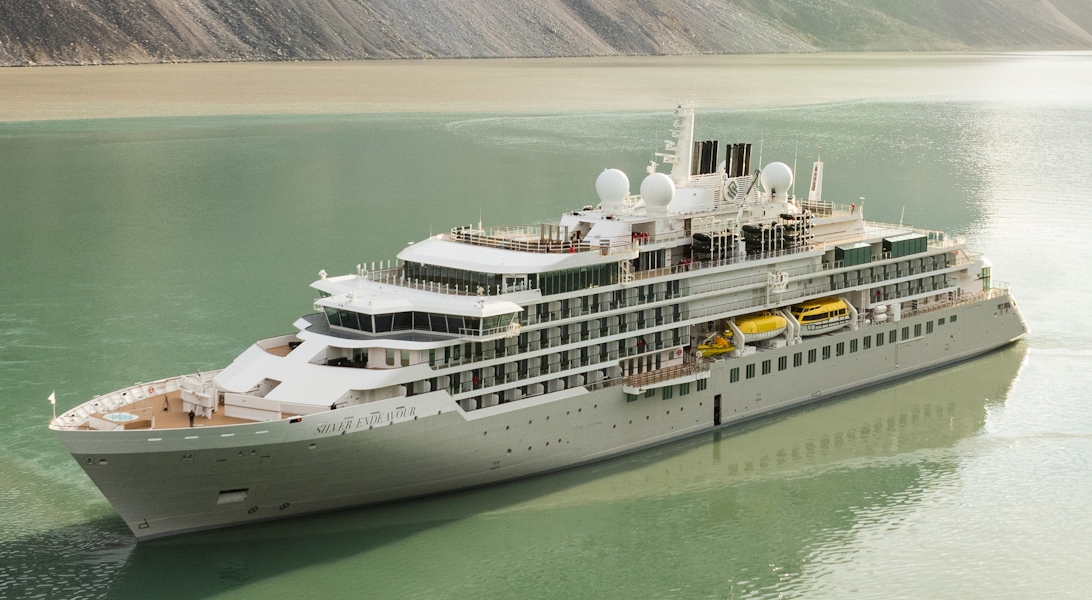
The images shown are for illustration purposes only and may not be an exact representation of what you find on the ship.
The images shown are for illustration purposes only and may not be an exact representation of what you find on the ship.
The images shown are for illustration purposes only and may not be an exact representation of what you find on the ship.
The images shown are for illustration purposes only and may not be an exact representation of what you find on the ship.
The images shown are for illustration purposes only and may not be an exact representation of what you find on the ship.


Our Fusion packages are all ABTA & ATOL protected ensuring that your booking is safe with us
| 18 nights aboard the Silver Endeavour | |||
| Butler Service in Every Suite | |||
| Gratuities Always Included | |||
| Beverages In-Suite and Throughout the Ship | |||
| Gourmet Dining | |||
| In Suite Dining & 24-Hour Room Service | |||
| Intimate small size ships | |||
| Free Wifi Throughout the Ship | |||
| Free Zodiac, Land and Sea Tours & Activities & Complimentary Expedition gear | |||
| Port Taxes and Fees | |||
 | ABTA and ATOL Protection* | ||
Date 19th May 2027 |
Nts 18 |
Suite £21,900pp |
Date 19th May 2027 |
Nts 18 |
Suite £21,900pp |
| Suite staterooms from | £21,900pp | ||
| CV | Classic Veranda Suite | £21,900pp | |
| DX | Deluxe Veranda Suite | £23,400pp | |
| PV | Premium Veranda Suite | £23,800pp | |
| SV | Superior Veranda Suite | £22,650pp | |
| SL | Silver Suite | £39,200pp | |
| SS | Signature Suite |  | |
| G1 | Grand Suite (1 Bedroom) | £61,550pp | |
| MS | Master Suite | £51,850pp | |
| O1 | Owner's Suite (1 Bedroom) | | |
Fusion Holidays when selling travel arrangements is a trading name of Co-op Travel Services Limited, registration 08903986. Fusion Cruises is an Accredited Body Member of Co-op Travel Services Limited ATOL 12904.
Book with Confidence. We are a Member of ABTA which means you have the benefit of ABTA’s assistance and Code of Conduct.
Some of the flights and flight-inclusive holidays on this website are financially protected by the ATOL scheme but ATOL protection does not apply to all holiday and travel services offered on this website. This website will provide you with information on the protection that applies in the case of each holiday and travel service offered before you make your booking. If you do not receive an ATOL Certificate then the booking will not be ATOL protected. If you do receive an ATOL Certificate but all parts of your trip are not listed on it, those parts will not be ATOL protected. Please see our booking conditions for information, or for more information about financial protection and the ATOL Certificate go to: www.caa.co.uk