This site uses cookies as defined in our Cookie Policy, by continuing to use this site you agree to their use.
Continue

| Arrive | Depart | ||||||
| 22nd22 | MayMay | 202828 | Fusina, Italy, embark on the Azamara Journey | 18:00 | |||
| 23rd23 | MayMay | 202828 | Pula, Croatia | 08:00 | 15:00 | ||
Today an industrial port town and Istria's chief administrative center (pop. 58,000), as well as a major tourist destination, Pula became a Roman colony in the 1st century BC. This came about a century after the decisive defeat by the Romans, in 177 BC, of the nearby Histrian stronghold of Nesactium, prompting the Histrian king Epulon to plunge a sword into his chest lest he fall into the hands of the victors, who indeed conquered all of Istria. Remains from Pula's ancient past have survived up to the present day: as you drive in on the coastal route toward its choice setting on a bay near the southern tip of the Istrian peninsula, the monumental Roman amphitheater blocks out the sky on your left. Under Venetian rule (1331–1797), Pula was architecturally neglected, even substantially dismantled. Many structures from the Roman era were pulled down, and stones and columns were carted off across the sea to Italy to be used for new buildings there. Pula's second great period of development took place in the late 19th century, under the Habsburgs, when it served as the chief base for the Imperial Austro-Hungarian Navy. Today it's as much working city as tourist town, where Roman ruins and Austro-Hungarian architecture serve as backdrop for the bustle of everyday life amid a bit of communist-era soot and socialist realism, too. James Joyce lived here for a short time, in 1904–05, before fleeing what he dismissed as a cultural backwater for Trieste. What's more, there are some outstanding restaurants and a number of pleasant family-run hotels, not to mention the nearby resort area of Verudela, where seaside tourism thrives in all its soothing, sunny sameness. Pula may be a relatively undiscovered gem by most modern-day travelers, but with its protected harbor and strategic location on the southern tip of Croatia’s Istrian Peninsula, it’s proven a popular hit with invaders. | |||||||
| 24th24 | MayMay | 202828 | Dubrovnik, Croatia | 10:00 | 22:00 | ||
Nothing can prepare you for your first sight of Dubrovnik. Lying 216 km (135 miles) southeast of Split and commanding a jaw-dropping coastal location, it is one of the world's most beautiful fortified cities. Its massive stone ramparts and fortress towers curve around a tiny harbor, enclosing graduated ridges of sun-bleached orange-tiled roofs, copper domes, and elegant bell towers. Your imagination will run wild picturing what it looked like seven centuries ago when the walls were built, without any suburbs or highways around it, just this magnificent stone city rising out of the sea.In the 7th century AD, residents of the Roman city Epidaurum (now Cavtat) fled the Avars and Slavs of the north and founded a new settlement on a small rocky island, which they named Laus, and later Ragusa. On the mainland hillside opposite the island, the Slav settlement called Dubrovnik grew up. In the 12th century the narrow channel separating the two settlements was filled in (now the main street through the Old Town, called Stradun), and Ragusa and Dubrovnik became one. The city was surrounded by defensive walls during the 13th century, and these were reinforced with towers and bastions in the late 15th century.From 1358 to 1808 the city thrived as a powerful and remarkably sophisticated independent republic, reaching its golden age during the 16th century. In 1667 many of its splendid Gothic and Renaissance buildings were destroyed by an earthquake. The defensive walls survived the disaster, and the city was rebuilt in baroque style.Dubrovnik lost its independence to Napoléon in 1808, and in 1815 passed to Austria-Hungary. During the 20th century, as part of Yugoslavia, the city became a popular tourist destination, and in 1979 it was listed as a UNESCO World Heritage Site. During the war for independence, it came under heavy siege. Thanks to careful restoration, few traces of damage remain; however, there are maps inside the Pile and Ploče Gates illustrating the points around the city where damage was done. It’s only when you experience Dubrovnik yourself that you can understand what a treasure the world nearly lost To visit Dubrovnik is to step back in time to the Middle Ages, as the town is one massive museum of fountains, palaces and churches, with thick walls that date back to the 13th century and encircle the city. | |||||||
| 25th25 | MayMay | 202828 | Kotor, Montenegro | 09:30 | 18:00 | ||
Backed by imposing mountains, tiny Kotor lies hidden from the open sea, tucked into the deepest channel of the Bokor Kotorska (Kotor Bay), which is Europe's most southerly fjord. To many, this town is more charming than its sister UNESCO World Heritage Site, Dubrovnik, retaining more authenticity, but with fewer tourists and spared the war damage and subsequent rebuilding which has given Dubrovnik something of a Disney feel.Kotor's medieval Stari Grad (Old Town) is enclosed within well-preserved defensive walls built between the 9th and 18th centuries and is presided over by a proud hilltop fortress. Within the walls, a labyrinth of winding cobbled streets leads through a series of splendid paved piazzas, rimmed by centuries-old stone buildings. The squares are now haunted by strains from buskers but although many now house trendy cafés and chic boutiques, directions are still given medieval-style by reference to the town’s landmark churches.In the Middle Ages, as Serbia's chief port, Kotor was an important economic and cultural center with its own highly regarded schools of stonemasonry and iconography. From 1391 to 1420 it was an independent city-republic and later, it spent periods under Venetian, Austrian, and French rule, though it was undoubtedly the Venetians who left the strongest impression on the city's architecture. Since the breakup of Yugoslavia, some 70% of the stone buildings in the romantic Old Town have been snapped up by foreigners, mostly Brits and Russians. Porto Montenegro, a new marina designed to accommodate some of the world’s largest super yachts, opened in nearby Tivat in 2011, and along the bay are other charming seaside villages, all with better views of the bay than the vista from Kotor itself where the waterside is congested with cruise ships and yachts. Try sleepy Muo or the settlement of Prčanj in one direction around the bay, or Perast and the Roman mosaics of Risan in the other direction. One of Europe’s best-preserved cities of medieval or Renaissance vintage, Kotor’s walls were constructed right into the slopes of the mountain behind it, making it an amazing sight on approach from the sea. | |||||||
| 26th26 | MayMay | 202828 | At Sea | ||||
| 27th27 | MayMay | 202828 | Sorrento, Italy | 08:00 | 19:00 | ||
Sorrento may have become a jumping-off point for visitors to Pompeii, Capri, and Amalfi, but you can find countless reasons to love it for itself. The Sorrentine people are fair-minded and hardworking, bubbling with life and warmth. The tuff cliff on which the town rests is spread over the bay, absorbing sunlight, while orange and lemon trees waft their perfume in spring. Winding along a cliff above a small beach and two harbors, the town is split in two by a narrow ravine formed by a former mountain stream. To the east, dozens of hotels line busy Via Correale along the cliff—many have "grand" included in their names, and some indeed still are. To the west, however, is the historic sector, which still enchants. It's a relatively flat area, with winding, stone-paved lanes bordered by balconied buildings, some joined by medieval stone arches. The central piazza is named after the poet Torquato Tasso, born here in 1544. This part of town is a delightful place to walk through. Craftspeople are often at work in their stalls and shops and are happy to let you watch; in fact, that's the point. Music spots and bars cluster in the side streets near Piazza Tasso. A warming sun and gentle sea breezes have been attracting visitors to Sorrento for two millennia, and its reputation as a playground of the ancient rich and famous have resulted in lavish villas and palaces. | |||||||
| 28th28 | MayMay | 202828 | Civitavecchia, Italy | 07:00 | 19:00 | ||
Italy's vibrant capital lives in the present, but no other city on earth evokes its past so powerfully. For over 2,500 years, emperors, popes, artists, and common citizens have left their mark here. Archaeological remains from ancient Rome, art-stuffed churches, and the treasures of Vatican City vie for your attention, but Rome is also a wonderful place to practice the Italian-perfected il dolce far niente, the sweet art of idleness. Your most memorable experiences may include sitting at a caffè in the Campo de' Fiori or strolling in a beguiling piazza. Whether it’s tossing a coin in a fabled fountain or being awestruck by the magnificence of St. Peter’s Basilica and Michelangelo’s masterpieces, Rome seems to live up to its sobriquet, the Eternal City. | |||||||
| 29th29 | MayMay | 202828 | Livorno, Italy | 07:30 | 22:00 | ||
Livorno is a gritty city with a long and interesting history. In the early Middle Ages it alternately belonged to Pisa and Genoa. In 1421 Florence, seeking access to the sea, bought it. Cosimo I (1519–74) started construction of the harbor in 1571, putting Livorno on the map. After Ferdinando I de' Medici (1549–1609) proclaimed Livorno a free city, it became a haven for people suffering from religious persecution; Roman Catholics from England and Jews and Moors from Spain and Portugal, among others, settled here. The Quattro Mori (Four Moors), also known as the Monument to Ferdinando I, commemorates this. (The statue of Ferdinando I dates from 1595, the bronze Moors by Pietro Tacca from the 1620s.)In the following centuries, and particularly in the 18th, Livorno boomed as a port. In the 19th century the town drew a host of famous Britons passing through on their grand tours. Its prominence continued up to World War II, when it was heavily bombed. Much of the town's architecture, therefore, postdates the war, and it's somewhat difficult to imagine what it might have looked like before. Livorno has recovered from the war, however, as it's become a huge point of departure for container ships, as well as the only spot in Tuscany for cruise ships to dock for the day.Most of Livorno's artistic treasures date from the 17th century and aren't all that interesting unless you dote on obscure baroque artists. Livorno's most famous native artist, Amedeo Modigliani (1884–1920), was of much more recent vintage. Sadly, there's no notable work by him in his hometown.There may not be much in the way of art, but it's still worth strolling around the city. The Mercato Nuovo, which has been around since 1894, sells all sorts of fruits, vegetables, grains, meat, and fish. Outdoor markets nearby are also chock-full of local color. The presence of Camp Darby, an American military base just outside town, accounts for the availability of many American products.If you have time, Livorno is worth a stop for lunch or dinner at the very least. As the birthplace of the Renaissance, Florence and its historic center is bursting with elegant squares, imposing palaces, magnificent churches, incredible art galleries and museums with an abundance of riches. | |||||||
| 30th30 | MayMay | 202828 | Nice, France | 08:00 | 20:00 | ||
United with France only since 1860, Nice has its own history and atmosphere, which dates back 230,000 years. It was on Colline du Château (now château-less) and at the Plage des Ponchettes, in front of the Old Town, that the Greeks established a market-port in 350 BC and named it Nikaia, which would become Marseilles' chief coastal rival. The Romans established themselves a little later on the hills of Cimiez (Cemenelum), already previously occupied by Ligurians and Celts, and quickly overshadowed the waterfront port. After falling to the Saracen invasions, Nice regained power as an independent state, becoming an important port in the early Middle Ages.So cocksure did it become that in 1388, Nice, along with the hill towns behind, effectively seceded from the county of Provence, under Louis d'Anjou, and allied itself with Savoie. Thus began its liaison with the House of Savoy, and through it with Piedmont and Sardinia, it was the Comté de Nice (Nice County). This relationship lasted some 500 years, tinting the culture, architecture, and dialect in rich Italian hues.By the 19th century Nice was flourishing commercially, locked in rivalry with the neighboring shipping port of Genoa. Another source of income: the dawning of tourism, as first the English, then the Russian nobility, discovered its extraordinary climate and superb waterfront position. A parade of fine stone mansions and hotels closed into a nearly solid wall of masonry, separated from the smooth-round rocks of the beach by what was originally named Camin deis Anglés (the English Way), which of course is now the famous Promenade des Anglais. This magnificent crescent, which is seeking UNESCO recognition, is one of the noblest in France. Many of Nice's most delightful attractions—the Cours Saleya market, the Old Town streets, the Hotel Negresco, and the Palais Masséna—are on or close to this 10-km (6-mile) waterfront, making it the first stop for most visitors, while the redevelopment of Nice's port, around the other side of the Colline du Château, makes it easier for amblers who want to take in the Genoese architecture or peruse the antiques at the Puces de Nice, now part of the Promenade des 100 Antiquaires, along Quai Papacino. Nice also has the distinction of the "Family Plus" label, with free strollers, play areas, and restaurants with child-friendly activities. Nice, Queen of the Riviera, is filled with a treasure trove of archaeological and fine art museums, the famous flower market, and a warren of meandering lanes edged by tall houses and small, alluring shops. | |||||||
| 31st31 | MayMay | 202828 | Marseille, France | 08:00 | 16:00 | ||
Since being designated a European Capital of Culture for 2013, with an estimated €660 million of funding in the bargain, Marseille has been in the throes of an extraordinary transformation, with no fewer than five major new arts centers, a beautifully refurbished port, revitalized neighborhoods, and a slew of new shops and restaurants. Once the underdog, this time-burnished city is now welcoming an influx of weekend tourists who have colonized entire neighborhoods and transformed them into elegant pieds-à-terre (or should we say, mer). The second-largest city in France, Marseille is one of Europe's most vibrant destinations. Feisty and fond of broad gestures, it is also as complicated and as cosmopolitan now as it was when a band of Phoenician Greeks first sailed into the harbor that is today's Vieux Port in 600 BC. Legend has it that on that same day a local chieftain's daughter, Gyptis, needed to choose a husband, and her wandering eyes settled on the Greeks' handsome commander Protis. Her dowry brought land near the mouth of the Rhône, where the Greeks founded Massalia, the most important Continental shipping port in antiquity. The port flourished for some 500 years as a typical Greek city, enjoying the full flush of classical culture, its gods, its democratic political system, its sports and theater, and its naval prowess. Caesar changed all that, besieging the city in 49 BC and seizing most of its colonies. In 1214 Marseille was seized again, this time by Charles d'Anjou, and was later annexed to France by Henri IV in 1481, but it was not until Louis XIV took the throne that the biggest transformations of the port began; he pulled down the city walls in 1666 and expanded the port to the Rive Neuve (New Riverbank). The city was devastated by plague in 1720, losing more than half its population. By the time of the Revolution, Marseille was on the rebound once again, with industries of soap manufacturing and oil processing flourishing, encouraging a wave of immigration from Provence and Italy. With the opening of the Suez Canal in 1869, Marseille became the greatest boomtown in 19th-century Europe. With a large influx of immigrants from areas as exotic as Tangiers, the city quickly acquired the multicultural population it maintains to this day. At the same time bustling and picturesque—filled with colorful markets, fabulous wine and food and sights like le Vieux Port—Marseille is one of Europe’s oldest cities and the largest port in the Mediterranean. | |||||||
| 1st01 | JunJun | 202828 | Barcelona, Spain, disembark the Azamara Journey | 06:00 | |||
The infinite variety of street life, the nooks and crannies of the medieval Barri Gòtic, the ceramic tile and stained glass of Art Nouveau facades, the art and music, the throb of street life, the food (ah, the food!)—one way or another, Barcelona will find a way to get your full attention. The capital of Catalonia is a banquet for the senses, with its beguiling mix of ancient and modern architecture, tempting cafés and markets, and sun-drenched Mediterranean beaches. A stroll along La Rambla and through waterfront Barceloneta, as well as a tour of Gaudí's majestic Sagrada Famíliaand his other unique creations, are part of a visit to Spain's second-largest city. Modern art museums and chic shops call for attention, too. Barcelona's vibe stays lively well into the night, when you can linger over regional wine and cuisine at buzzing tapas bars. Dynamic Barcelona is all about architecture, from the magnificent medieval buildings of the Gothic Quarter to the Modernist movement typified by the work of Antoni Gaudi including the amazing Sagrada Familia. | |||||||
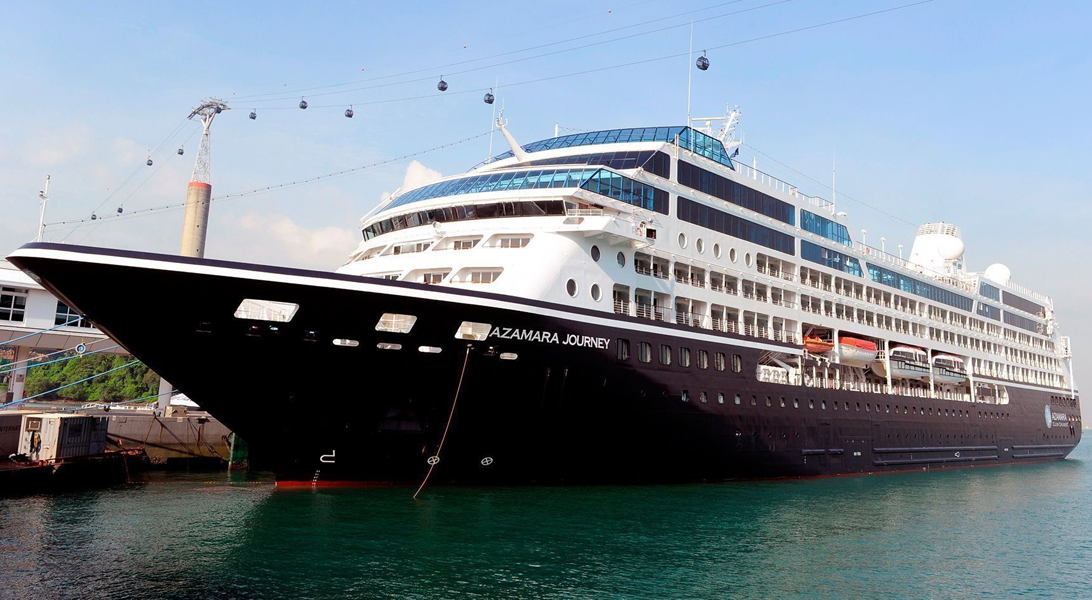


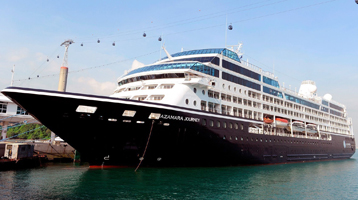
The images shown are for illustration purposes only and may not be an exact representation of what you find on the ship.
The images shown are for illustration purposes only and may not be an exact representation of what you find on the ship.
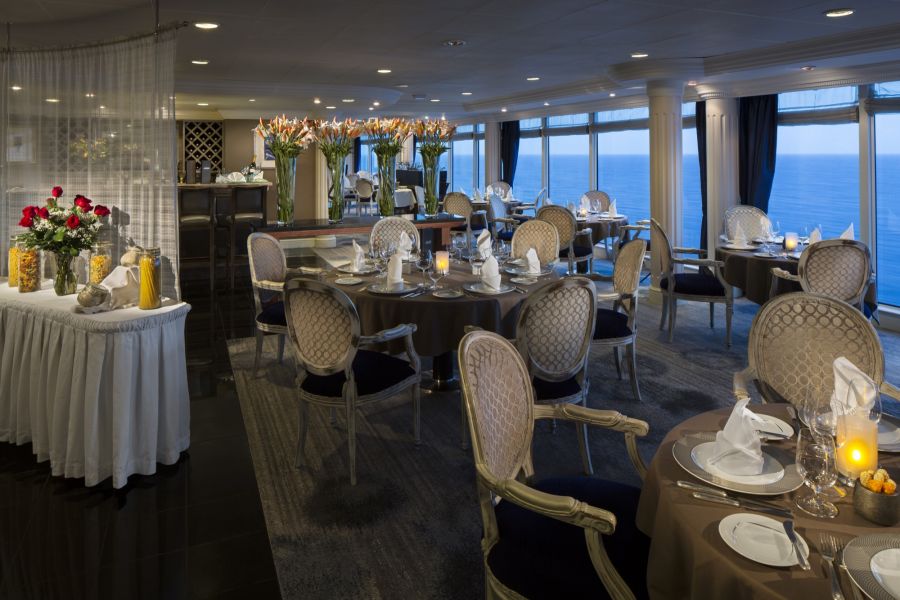
At Aqualina, you’ll find some of Italy’s most authentic dishes. Pastas made from scratch, traditional recipes, and scrumptious vegetarian dishes that make sure there’s something for everyone. Plus our famous desserts: Sorrento lemon liqueur mousse, hazelnut chocolate soufflé and more.
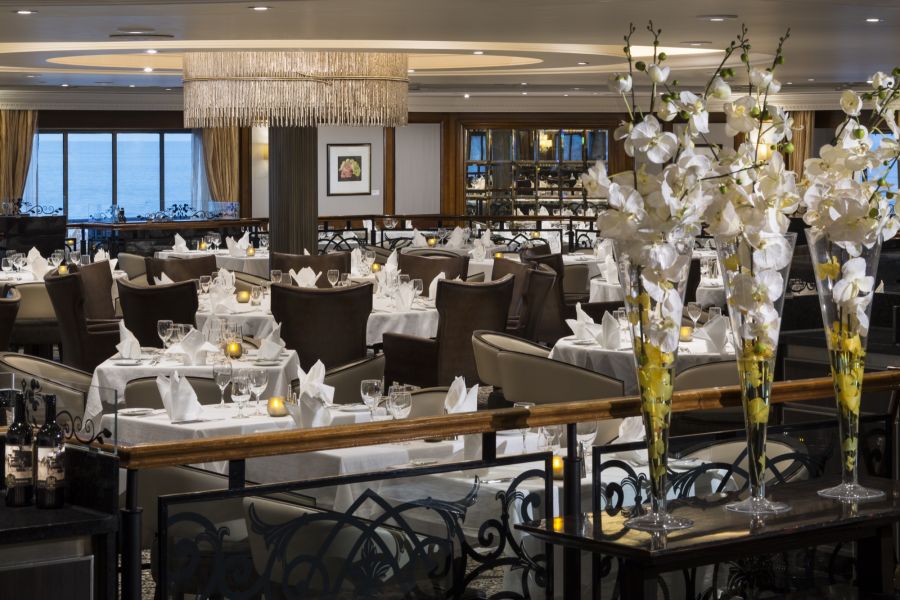
Discover the world through dishes and flavors from the places we visit. Of course, you’ll also enjoy a wide variety of nightly selections such as filet mignon with black truffle sauce. Choose being seated at a table for two or as part of a larger group of fellow guests.
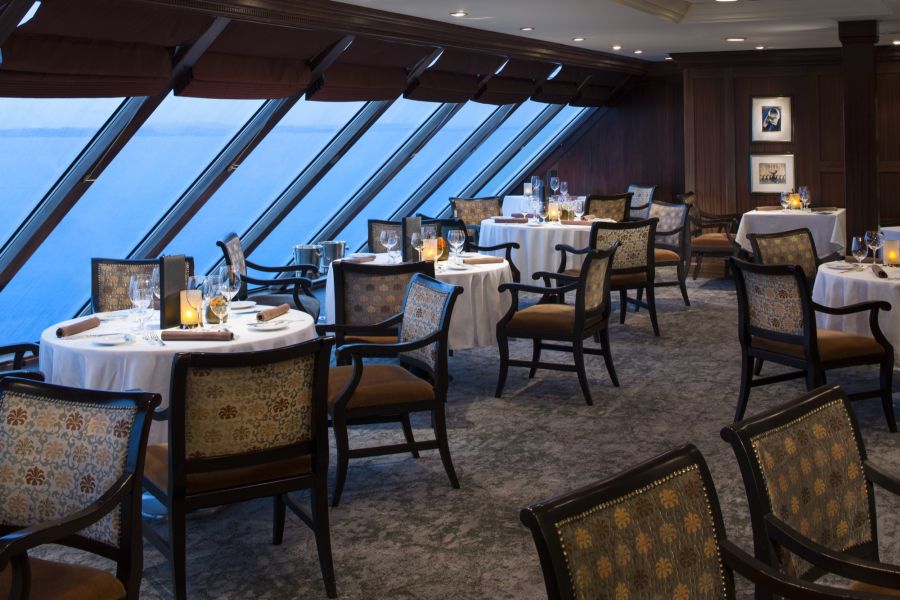
Your choice of steak, cooked to perfection. Herb-coated rack of lamb, duck confit and Chilean sea bass—all paired with savory sides. At Prime C, you’re in for more than delectable dining. Expect a great evening with stunning views and lush décor.
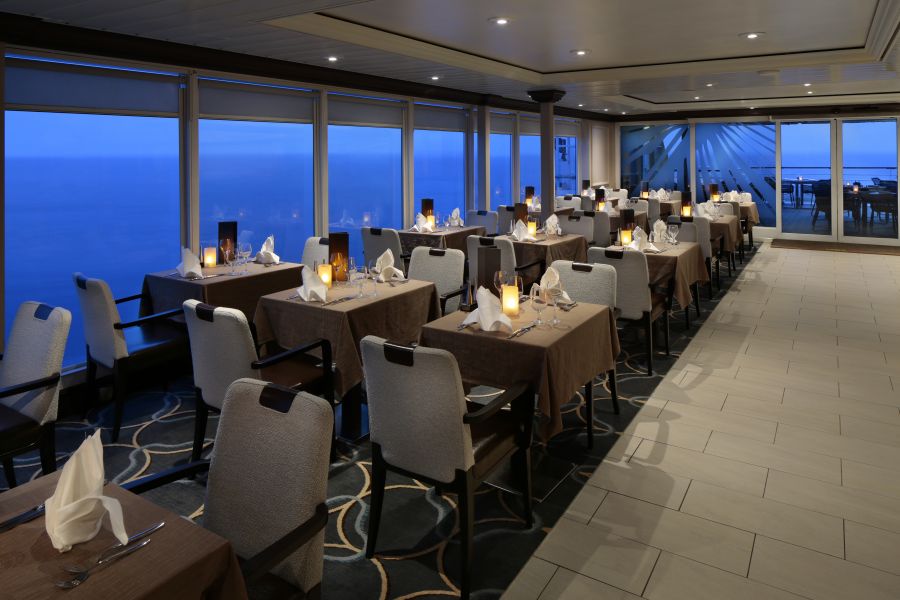
Our daily themed dinner often takes its inspiration from the region we’re visiting—Indian, Mexican, Spanish, Italian. We also create an extra live station made from local ingredients purchased in port: Greek salad made with local feta (Greece), pasta prepared with local mushrooms (Italy), fresh Mussels served with garlic bread (Netherlands).
The images shown are for illustration purposes only and may not be an exact representation of what you find on the ship.
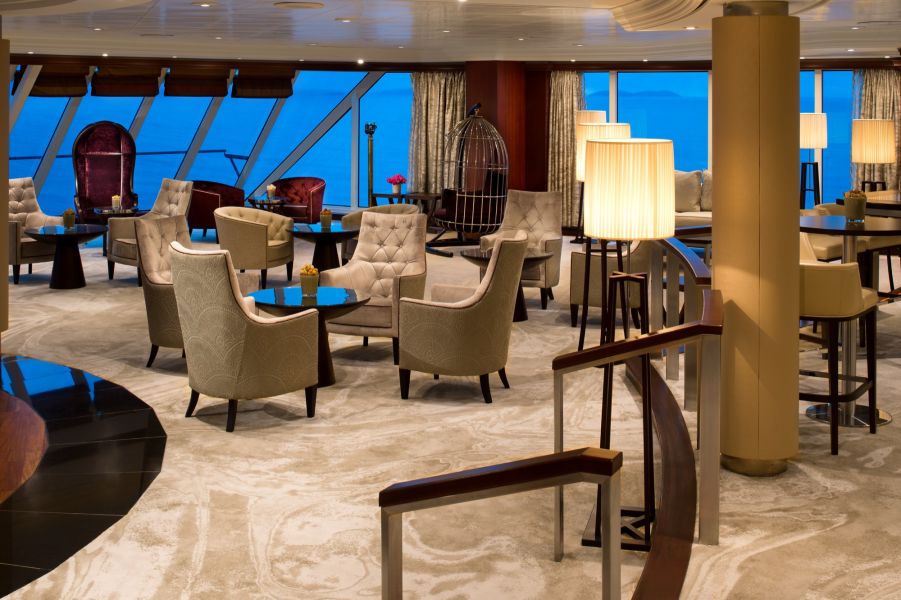
The idea of the Living Room is just that. To “live in” and to enjoy time with friends and fellow guests! Much of the room is furnished as a living room, with clusters of large comfortable chairs and sofas....
The images shown are for illustration purposes only and may not be an exact representation of what you find on the ship.
The images shown are for illustration purposes only and may not be an exact representation of what you find on the ship.


Our Fusion packages are all ABTA & ATOL protected ensuring that your booking is safe with us
| 10 nights aboard the Azamara Journey | |||
| AzAmazing Evenings event on voyages over 7 nights | |||
| Pre-Paid Gratuities | |||
| Select standard spirits, international beers & wines | |||
| Free bottled water, soft drinks, specialty coffees & teas | |||
| Concierge services for personal guidance & reservations | |||
| Free self-service laundry | |||
| Shuttle service to & from port where available | |||
| English Butler Service for suite Guests | |||
| Port Taxes and Fees | |||
 | ABTA and ATOL Protection* | ||
Date 22nd May 2028 |
Nts 10 |
Interior £2,599pp |
Oceanview £2,819pp |
Balcony £3,489pp |
Suite £4,929pp |
Date 22nd May 2028 |
Nts 10 |
Interior £2,599pp |
Oceanview £2,819pp |
Balcony £3,489pp |
Suite £4,929pp |
| Interior staterooms from | £2,599pp | ||
| 9 | Club Interior Stateroom (Deck 8, Mid/Fwd) | £3,139pp | |
| 10 | Club Interior Stateroom (Deck 7, Mid) | £3,049pp | |
| 11 | Club Interior Stateroom (Deck 6,7, Fwd) | £2,969pp | |
| 12 | Club Interior Stateroom (Deck 4, Mid) | £2,869pp | |
| Z | Interior Guarantee | £2,599pp | |
| Oceanview staterooms from | £2,819pp | ||
| 4 | Club Oceanview Stateroom (Deck 6, Fwd) | £3,389pp | |
| 5 | Club Oceanview Stateroom (Deck 4, Mid) | £3,299pp | |
| 6 | Club Oceanview Stateroom (Deck 4, Fwd) | £3,209pp | |
| 8 | Club Oceanview Stateroom (Deck 6, Obstructed) | £3,119pp | |
| Y | Oceanview Guarantee | £2,819pp | |
| Balcony staterooms from | £3,489pp | ||
| V1 | Club Veranda Stateroom (Deck 4) | £4,079pp | |
| V2 | Club Veranda Stateroom (Deck 7) | £3,959pp | |
| V3 | Club Veranda Stateroom (Deck 6) | £3,849pp | |
| X | Veranda Guarantee | £3,489pp | |
| P1 | Club Veranda Plus Stateroom (Decks 6,7,8, Aft/Fwd) | £4,849pp | |
| P2 | Club Veranda Plus Stateroom (Deck 8, Mid) | £4,719pp | |
| P3 | Club Veranda Plus Stateroom (Deck 8, Fwd) | £4,579pp | |
| XP | Club Veranda Plus Guarantee | £4,139pp | |
| Suite staterooms from | £4,929pp | ||
| N1 | Club Continent Suite (Deck 8, Mid) | £5,619pp | |
| N2 | Club Continent Suite (Deck 8, Aft) | £5,459pp | |
| SP | Club Spa Suite | £7,599pp | |
| CO | Club Ocean Suite | £8,499pp | |
| CW | Club World Owner's Suite | £9,489pp | |
| W | Suite Guarantee | £4,929pp | |
Fusion Holidays when selling travel arrangements is a trading name of Co-op Travel Services Limited, registration 08903986. Fusion Cruises is an Accredited Body Member of Co-op Travel Services Limited ATOL 12904.
Book with Confidence. We are a Member of ABTA which means you have the benefit of ABTA’s assistance and Code of Conduct.
Some of the flights and flight-inclusive holidays on this website are financially protected by the ATOL scheme but ATOL protection does not apply to all holiday and travel services offered on this website. This website will provide you with information on the protection that applies in the case of each holiday and travel service offered before you make your booking. If you do not receive an ATOL Certificate then the booking will not be ATOL protected. If you do receive an ATOL Certificate but all parts of your trip are not listed on it, those parts will not be ATOL protected. Please see our booking conditions for information, or for more information about financial protection and the ATOL Certificate go to: www.caa.co.uk