This site uses cookies as defined in our Cookie Policy, by continuing to use this site you agree to their use.
Continue

| Arrive | Depart | ||||||
| 14th14 | OctOct | 202828 | Athens, Greece, embark on the Azamara Onward | 18:00 | |||
| 15th15 | OctOct | 202828 | Monemvasía, Greece | 08:00 | 18:00 | ||
Monemvasia boasts a varied and colorful history that can be traced to the 8th-century when Greeks fleeing the Slav invasion of Lakonia found refuge here. In its heyday it controlled sea travel between the Levant and European shores. The wall-encircled Lower Town extends along the slopes of a 985-foot-high crag that projects into the sea on the east side of the Peloponnese. For centuries an impressive stronghold, population dwindled as the inhabitants moved to the mainland. But with the beginning of a restoration program aimed to preserve Monemvasia's heritage, the Lower Town experienced a new lease on life, and people have begun to return. The Upper Town is situated on top of the Rock of Monemvasia. It is reached via a zigzagging, paved lane. An almost impregnable bastion in earlier days, it has been uninhabited for centuries, but still manages to preserve its magnificent appearance. Visitors today can explore the remains of the ancient citadel-castle and visit the church of Hagia Sofia. From the summit there is also a fantastic view of the surrounding area. One look at Monemvasia as you pull in to port and it’s easy to understand why locals nicknamed it The Rock. Shrouded by precipitous cliffs along the brilliant teal waters of the Myrtoan Sea, Monemvasia is a castle town suspended in history. | |||||||
| 16th16 | OctOct | 202828 | Heraklion (Iraklion), Crete, Greece | 08:00 | 18:00 | ||
Having been controlled by Arabic, Venetian and Ottoman empires over the years - it's no surprise that Heraklion is a diverse patchwork of exotic cultures and historical treasures. Celebrated as the birthplace of the Spanish Renaissance artist, El Greco, you can visit to explore the storied ruins of the Minoan empire's capital, and unearth the rich cultural treasures that Crete’s bustling modern capital has to offer. As the largest city on the isle of Crete, with a history that dates back to the 9th century, Heraklion has seen its share of travelers over the millennia. Discover the many treasures at the Archaeological Museum, regarded as one of the most important museums in Greece. Given that it’s Greece we’re talking about, the food here is naturally outstanding, and comes with a delicious Cretan touch. | |||||||
| 17th17 | OctOct | 202828 | Rhodes, Greece | 08:00 | 22:00 | ||
Early travelers described Rhodes as a town of two parts: a castle or high town (Collachium) and a lower city. Today Rhodes town—sometimes referred to as Ródos town—is still a city of two parts: the Old Town, a UNESCO World Heritage site that incorporates the high town and lower city, and the modern metropolis, or New Town, spreading away from the walls that encircle the Old Town. The narrow streets of the Old Town are for the most part closed to cars and are lined with Orthodox and Catholic churches, Turkish houses (some of which follow the ancient orthogonal plan), and medieval public buildings with exterior staircases and facades elegantly constructed of well-cut limestone from Lindos. Careful reconstruction in recent years has enhanced the harmonious effect. Said to have more fine days than anywhere else in Europe, Rhodes’ diverse historical influences are evident in an old town remarkably intact—in particular the medieval presence of the Knights of St John. | |||||||
| 18th18 | OctOct | 202828 | Bodrum, Turkey | 08:00 | 22:00 | ||
As the site of the ancient city of Halikarnassus (and one of the Seven Wonders of the Ancient World), Bodrum’s ties to the past are evident everywhere; but there are plenty of modern-day pleasures, too. | |||||||
| 19th19 | OctOct | 202828 | Pátmos, Greece | 08:00 | 18:00 | ||
For better or worse, it can be difficult to reach Patmos—for many travelers, this lack of access is definitely for the better, since the island retains the air of an unspoiled retreat. Rocky and barren, the small, 34-square-km (21-square-mi) island lies beyond the islands of Kalymnos and Leros, northwest of Kos. Here on a hillside is the Monastery of the Apocalypse, which enshrines the cave where St. John received the Revelation in AD 95. Scattered evidence of Mycenaean presence remains on Patmos, and walls of the classical period indicate the existence of a town near Skala. Most of the island's approximately 2,800 people live in three villages: Skala, medieval Chora, and the small rural settlement of Kambos. The island is popular among the faithful making pilgrimages to the monastery as well as with vacationing Athenians and a newly growing community of international trendsetters—designers, artists, poets, and “taste gurus” (to quote Vogue’s July 2011 write-up of the island)—who have bought homes in Chora. These stylemeisters followed in the footsteps of Alexandrian John Stefanidis and the English artist Teddy Millington-Drake who, in the early ’60s, set about creating what eventually became hailed as one of the most gorgeous island homes in the world. The word soon spread thanks to their many guests (who included Jacqueline Kennedy Onassis) but, happily, administrators have carefully contained development, and as a result, Patmos retains its charm and natural beauty—even in the busy month of August. In Patmos, there is no missing the incredible Monastery of St. John, a massive dark 11th century fortress atop a hill, standing out against the traditional white houses of the village of Hora that surround it. | |||||||
| 20th20 | OctOct | 202828 | Mykonos, Greece | 08:00 | 18:00 | ||
Although the fishing boats still go out in good weather, Mykonos largely makes its living from tourism these days. The summer crowds have turned one of the poorest islands in Greece into one of the richest. Old Mykonians complain that their young, who have inherited stores where their grandfathers once sold eggs or wine, get so much rent that they have lost ambition, and in summer sit around pool bars at night with their friends, and hang out in Athens in winter when island life is less scintillating. Put firmly on the map by Jackie O in the 1960s, Mykonos town—called Hora by the locals—remains the Saint-Tropez of the Greek islands. The scenery is memorable, with its whitewashed streets, Little Venice, the Kato Myli ridge of windmills, and Kastro, the town's medieval quarter. Its cubical two- or three-story houses and churches, with their red or blue doors and domes and wooden balconies, have been long celebrated as some of the best examples of classic Cycladic architecture. Luckily, the Greek Archaeological Service decided to preserve the town, even when the Mykonians would have preferred to rebuild, and so the Old Town has been impressively preserved. Pink oleander, scarlet hibiscus, and trailing green pepper trees form a contrast amid the dazzling whiteness, whose frequent renewal with whitewash is required by law. Any visitor who has the pleasure of getting lost in its narrow streets (made all the narrower by the many outdoor stone staircases, which maximize housing space in the crowded village) will appreciate how its confusing layout was designed to foil pirates—if it was designed at all. After Mykonos fell under Turkish rule in 1537, the Ottomans allowed the islanders to arm their vessels against pirates, which had a contradictory effect: many of them found that raiding other islands was more profitable than tilling arid land. At the height of Aegean piracy, Mykonos was the principal headquarters of the corsair fleets—the place where pirates met their fellows, found willing women, and filled out their crews. Eventually the illicit activity evolved into a legitimate and thriving trade network. Morning on Mykonos town's main quay is busy with deliveries, visitors for the Delos boats, lazy breakfasters, and street cleaners dealing with the previous night's mess. In late morning the cruise-boat people arrive, and the shops are all open. In early afternoon, shaded outdoor tavernas are full of diners eating salads (Mykonos's produce is mostly imported); music is absent or kept low. In mid- and late afternoon, the town feels sleepy, since so many people are at the beach, on excursions, or sleeping in their air-conditioned rooms; even some tourist shops close for siesta. By sunset, people have come back from the beach, having taken their showers and rested. At night, the atmosphere in Mykonos ramps up. The cruise-boat people are mostly gone, coughing three-wheelers make no deliveries in the narrow streets, and everyone is dressed sexy for summer and starting to shimmy with the scene. Many shops stay open past midnight, the restaurants fill up, and the bars and discos make ice cubes as fast as they can. Ready to dive in? Begin your tour of Mykonos town (Hora) by starting out at its heart: Mando Mavrogenous Square. With its many charms including iconic windmills, fabulous beaches and an irresistible traditional town of twisting streets and alleys, Mykonos is living proof that picture postcard destinations do exist. | |||||||
| 21st21 | OctOct | 202828 | Athens, Greece | 05:00 | 18:00 | ||
| 22nd22 | OctOct | 202828 | At Sea | ||||
| 23rd23 | OctOct | 202828 | Limassol, Cyprus | 08:00 | 22:00 | ||
A major commercial port, cruise ship port of call, and wine-making center on the south coast, Limassol, 75 km (47 miles) from Nicosia, is a bustling, cosmopolitan town, with some of the liveliest nightlife on the island. Luxury hotels, apartments, and guesthouses stretch along 12 km (7 miles) of seafront, with the most luxurious ones just to the north of town. In the center, the elegant, modern shops of Makarios Avenue (where you'll mainly find clothes and shoes) contrast with those of pedestrian-only Agiou Andreou in the old part of town, where local handicrafts such as lace, embroidery, and basketware prevail; make sure you avoid shopping on Wednesday and Saturday afternoons, when many shops close at 2 pm. A luxurious marina that will hold 650 yachts as well as house apartments, shops, and restaurants should further boost the town's lively appeal. A fascinating intersection of cultural influences and an intriguing history have shaped Limassol, a vibrant city located in the shadow of the Troodos mountains, on Akrotiri Bay on the southern coast of Cyprus. | |||||||
| 24th24 | OctOct | 202828 | At Sea | ||||
| 25th25 | OctOct | 202828 | Alexandria, Egypt | 05:00 | |||
Founded by Alexander the Great, Alexandria was Egypt's capital for over 1,000 years. Now, it is visited by tourists looking to enjoy some diving and those interested in the Great Library, one of the Seven Wonders of the Ancient World. Though little remains of the ancient city of Alexandria, as the new one was built on top of it, it remains a gateway to Cairo, the pyramids and the fascinating culture of one of the world's oldest civilizations. | |||||||
| 26th26 | OctOct | 202828 | Alexandria, Egypt | ||||
Founded by Alexander the Great, Alexandria was Egypt's capital for over 1,000 years. Now, it is visited by tourists looking to enjoy some diving and those interested in the Great Library, one of the Seven Wonders of the Ancient World. Though little remains of the ancient city of Alexandria, as the new one was built on top of it, it remains a gateway to Cairo, the pyramids and the fascinating culture of one of the world's oldest civilizations. | |||||||
| 27th27 | OctOct | 202828 | Alexandria, Egypt | 20:00 | |||
Founded by Alexander the Great, Alexandria was Egypt's capital for over 1,000 years. Now, it is visited by tourists looking to enjoy some diving and those interested in the Great Library, one of the Seven Wonders of the Ancient World. Though little remains of the ancient city of Alexandria, as the new one was built on top of it, it remains a gateway to Cairo, the pyramids and the fascinating culture of one of the world's oldest civilizations. | |||||||
| 28th28 | OctOct | 202828 | At Sea | ||||
| 29th29 | OctOct | 202828 | At Sea | ||||
| 30th30 | OctOct | 202828 | Valletta, Malta | 08:00 | 22:00 | ||
Malta's capital, the minicity of Valletta, has ornate palaces and museums protected by massive fortifications of honey-color limestone. Houses along the narrow streets have overhanging wooden balconies for people-watching from indoors. Generations ago they gave housebound women a window on the world of the street. The main entrance to town is through the City Gate (where all bus routes end), which leads onto Triq Repubblika (Republic Street), the spine of the grid-pattern city and the main shopping street. Triq Mercante (Merchant Street) parallels Repubblika to the east and is also good for strolling. From these two streets, cross streets descend toward the water; some are stepped. Valletta's compactness makes it ideal to explore on foot. City Gate and the upper part of Valletta are experiencing vast redevelopment that includes a new Parliament Building and open-air performance venue. The complex, completed mid-2013, has numerous pedestrian detours in place along with building noise and dust. Before setting out along Republic Street, stop at the tourist information office on Merchant Street for maps and brochures. Valetta is a living museum of baroque architecture, constructed by the Knights of St. John 500 years ago, yet also a dynamic hub of cultural and commercial activity, welcoming luxury yachts and cruise ships. | |||||||
| 31st31 | OctOct | 202828 | Siracuse, Sicily, Italy | 08:00 | 22:00 | ||
Siracusa, known to English speakers as Syracuse, is a wonder to behold. One of the great ancient capitals of Western civilization, the city was founded in 734 BC by Greek colonists from Corinth and soon grew to rival, and even surpass, Athens in splendor and power. It became the largest, wealthiest city-state in the West and a bulwark of Greek civilization. Although Siracusa lived under tyranny, rulers such as Dionysius filled their courts with Greeks of the highest cultural stature—among them the playwrights Aeschylus and Euripides, and the philosopher Plato. The Athenians, who didn't welcome Siracusa's rise, set out to conquer Sicily, but the natives outsmarted them in what was one of the greatest military campaigns in ancient history (413 BC). The city continued to prosper until it was conquered two centuries later by the Romans.Present-day Siracusa still has some of the finest examples of Baroque art and architecture; dramatic Greek and Roman ruins; and a Duomo that's the stuff of legend—a microcosm of the city's entire history in one building. The modern city also has a wonderful, lively, Baroque old town worthy of extensive exploration, as well as pleasant piazzas, outdoor cafés and bars, and a wide assortment of excellent seafood. There are essentially two areas to explore in Siracusa: the Parco Archeologico (Archaeological Zone), on the mainland; and the island of Ortygia, the ancient city first inhabited by the Greeks, which juts out into the Ionian Sea and is connected to the mainland by two small bridges. Ortygia is becoming increasingly popular with tourists, and is starting to lose its old-fashioned charm in favor of modern boutiques.Siracusa's old nucleus of Ortygia, a compact area, is a pleasure to amble around without getting unduly tired. In contrast, mainland Siracusa is a grid of wider avenues. At the northern end of Corso Gelone, above Viale Paolo Orsi, the orderly grid gives way to the ancient quarter of Neapolis, where the sprawling Parco Archeologico is accessible from Viale Teracati (an extension of Corso Gelone). East of Viale Teracati, about a 10-minute walk from the Parco Archeologico, the district of Tyche holds the archaeological museum and the church and catacombs of San Giovanni, both off Viale Teocrito (drive or take a taxi or city bus from Ortygia). Coming from the train station, it's a 15-minute trudge to Ortygia along Via Francesco Crispi and Corso Umberto. If you're not up for that, take one of the free electric buses leaving every 10 minutes from the bus station around the corner. As one of the major powers of the Mediterranean world in 5th century BC, Siracusa is known for the archaeological and historical sights (like the tomb of Archimedes and Ear of Dionysus) that define its grand past. | |||||||
| 1st01 | NovNov | 202828 | Catania, Italy | 08:00 | 16:00 | ||
Catania is an ancient port city on Sicily's east coast. It sits at the foot of Mt. Etna, an active volcano with trails leading up to the summit. The city's wide central square, Piazza del Duomo, features the whimsical Fontana dell'Elefante statue and richly decorated Catania Cathedral. In the southwest corner of the square, La Pescheria weekday fish market is a rowdy spectacle surrounded by seafood restaurants. Mountainous and rugged, Sicily’s highest point is the tip of that infamous and still active Mt. Etna, and as a result Catania is richly layered, having been buried under lava seven times in recorded history. | |||||||
| 2nd02 | NovNov | 202828 | Salerno, Italy | 08:00 | |||
Salerno is an Italian city located on the Gulf of Salerno. Famous for being home to the first medical university, Salerno is a great destination for anyone looking for gorgeous sea views filled with sunshine and Italian food. Known for its rich history, beautiful coastal views, and significant landmarks, Salerno is a vibrant city with a blend of historical charm and modern amenities. | |||||||
| 3rd03 | NovNov | 202828 | Salerno, Italy | 16:00 | |||
Salerno is an Italian city located on the Gulf of Salerno. Famous for being home to the first medical university, Salerno is a great destination for anyone looking for gorgeous sea views filled with sunshine and Italian food. Known for its rich history, beautiful coastal views, and significant landmarks, Salerno is a vibrant city with a blend of historical charm and modern amenities. | |||||||
| 4th04 | NovNov | 202828 | Civitavecchia, Italy, disembark the Azamara Onward | 06:00 | |||
Italy's vibrant capital lives in the present, but no other city on earth evokes its past so powerfully. For over 2,500 years, emperors, popes, artists, and common citizens have left their mark here. Archaeological remains from ancient Rome, art-stuffed churches, and the treasures of Vatican City vie for your attention, but Rome is also a wonderful place to practice the Italian-perfected il dolce far niente, the sweet art of idleness. Your most memorable experiences may include sitting at a caffè in the Campo de' Fiori or strolling in a beguiling piazza. Whether it’s tossing a coin in a fabled fountain or being awestruck by the magnificence of St. Peter’s Basilica and Michelangelo’s masterpieces, Rome seems to live up to its sobriquet, the Eternal City. | |||||||
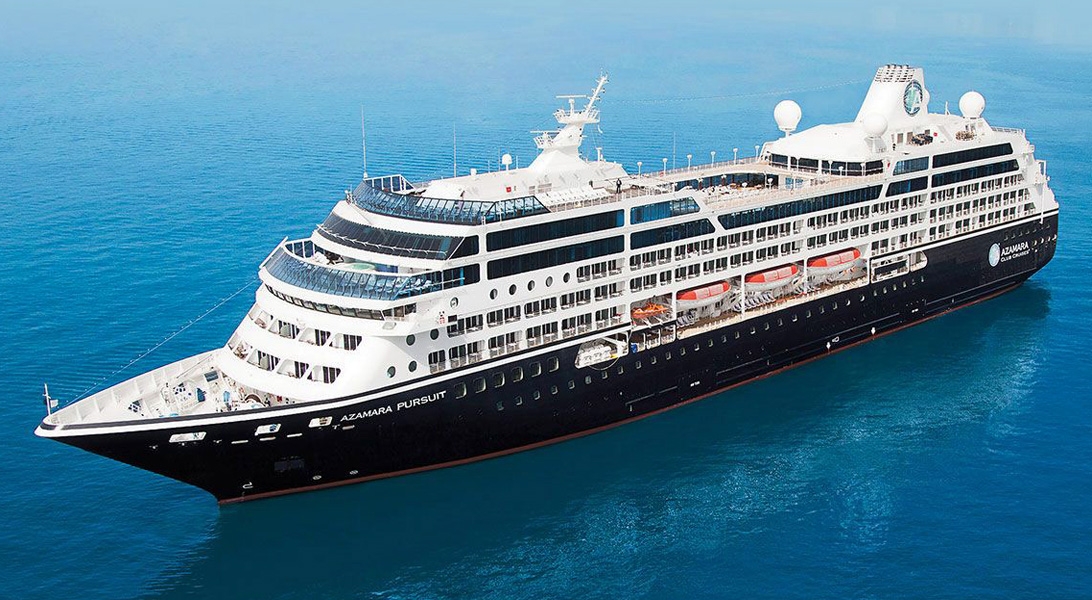
The images shown are for illustration purposes only and may not be an exact representation of what you find on the ship.
The images shown are for illustration purposes only and may not be an exact representation of what you find on the ship.
The images shown are for illustration purposes only and may not be an exact representation of what you find on the ship.
The images shown are for illustration purposes only and may not be an exact representation of what you find on the ship.
The images shown are for illustration purposes only and may not be an exact representation of what you find on the ship.


Our Fusion packages are all ABTA & ATOL protected ensuring that your booking is safe with us
| 21 nights aboard the Azamara Onward | |||
| AzAmazing Evenings event on voyages over 7 nights | |||
| Pre-Paid Gratuities | |||
| Select standard spirits, international beers & wines | |||
| Free bottled water, soft drinks, specialty coffees & teas | |||
| Concierge services for personal guidance & reservations | |||
| Free self-service laundry | |||
| Shuttle service to & from port where available | |||
| English Butler Service for suite Guests | |||
| Port Taxes and Fees | |||
 | ABTA and ATOL Protection* | ||
Date 14th Oct 2028 |
Nts 21 |
Interior £5,919pp |
Oceanview £6,399pp |
Balcony £8,259pp |
Suite £11,689pp |
Date 14th Oct 2028 |
Nts 21 |
Interior £5,919pp |
Oceanview £6,399pp |
Balcony £8,259pp |
Suite £11,689pp |
| Interior staterooms from | £5,919pp | ||
| 9 | Club Interior Stateroom (Deck 8, Mid/Fwd) | £6,429pp | |
| 10 | Club Interior Stateroom (Deck 7, Mid) | £6,259pp | |
| 11 | Club Interior Stateroom (Deck 6,7, Fwd) | £6,099pp | |
| 12 | Club Interior Stateroom (Deck 4, Mid) | £5,919pp | |
| Oceanview staterooms from | £6,399pp | ||
| 4 | Club Oceanview Stateroom (Deck 6, Fwd) | £6,959pp | |
| 5 | Club Oceanview Stateroom (Deck 4, Mid) | £6,769pp | |
| 8 | Club Oceanview Stateroom (Deck 6, Obstructed) | £6,399pp | |
| Balcony staterooms from | £8,259pp | ||
| P1 | Club Veranda Plus Stateroom (Decks 6,7,8, Aft/Fwd) | £10,389pp | |
| P2 | Club Veranda Plus Stateroom (Deck 8, Mid) | £10,099pp | |
| P3 | Club Veranda Plus Stateroom (Deck 8, Fwd) | £9,809pp | |
| V1 | Club Veranda Stateroom (Deck 4) | £8,729pp | |
| V2 | Club Veranda Stateroom (Deck 7) | £8,489pp | |
| V3 | Club Veranda Stateroom (Deck 6) | £8,259pp | |
| Suite staterooms from | £11,689pp | ||
| CO | Club Ocean Suite | £18,139pp | |
| N1 | Club Continent Suite (Deck 8, Mid) | £12,029pp | |
| N2 | Club Continent Suite (Deck 8, Aft) | £11,689pp | |
Fusion Holidays when selling travel arrangements is a trading name of Co-op Travel Services Limited, registration 08903986. Fusion Cruises is an Accredited Body Member of Co-op Travel Services Limited ATOL 12904.
Book with Confidence. We are a Member of ABTA which means you have the benefit of ABTA’s assistance and Code of Conduct.
Some of the flights and flight-inclusive holidays on this website are financially protected by the ATOL scheme but ATOL protection does not apply to all holiday and travel services offered on this website. This website will provide you with information on the protection that applies in the case of each holiday and travel service offered before you make your booking. If you do not receive an ATOL Certificate then the booking will not be ATOL protected. If you do receive an ATOL Certificate but all parts of your trip are not listed on it, those parts will not be ATOL protected. Please see our booking conditions for information, or for more information about financial protection and the ATOL Certificate go to: www.caa.co.uk