This site uses cookies as defined in our Cookie Policy, by continuing to use this site you agree to their use.
Continue

| Arrive | Depart | ||||||
| 11th11 | NovNov | 202727 | Fusina, Italy, embark on the Silver Spirit | 19:00 | |||
| Losing none of its allure over the years, this floating city of canals, bridges and masks is a place of eternal beauty and enduring elegance. The lagoon of more than 100 islands is a heavenly sight, transporting visitors on a journey through time - from its Roman inception, through centuries of trade to the modern face we see today. Navigate Venice’s sparkling waterways by romantic gondola, or on cruises along wide canal boulevards. Span the Grand Canal over its iconic original crossing, the Rialto Bridge, which - with its parade of tiny shops - gives some of the city’s most endearing views. If the crowds unsettle you at any point, take two turns away from the main thoroughfares to find peace alone, amid the city's labyrinth of tiny streets. Hurry to Piazza San Marco to be immersed in Venice’s elegant glory. Basilica San Marco transports you back to the wealthy days of the Doges, who ruled for over 1,000 years. Initially their private chapel, it’s now decorated with beautiful Byzantine mosaics. Nearby the Campanile di San Marco bell tower offers views over the higgledy-piggledy rooftops of times gone by. Just a hop skip and a jump around the corner is the Doge’s Palace, where the levels of opulence ramp up even further. Justice was meted out in this stunning Palace, with the guilty walking to the cells across the covered Bridge of Sighs. Vaporetto trips to local islands offer even more adventures to float your boat, whether it’s Murano with its world-famous glass, Torcello with its amazing Cathedrals, or Burano with its handmade lace and delightfully colourful painted houses. | |||||||
| 12th12 | NovNov | 202727 | Trieste, Italy | 08:00 | 17:00 | ||
Up until the end of World War I, Trieste was the only port of the vast Austro-Hungarian Empire and therefore a major industrial and financial center. In the early years of the 20th century, Trieste and its surroundings also became famous by their association with some of the most important names of Italian literature, such as Italo Svevo, and English and German letters. James Joyce drew inspiration from the city's multiethnic population, and Rainer Maria Rilke was inspired by the seacoast west of the city. Although it has lost its importance as a port and a center of finance, it has never fully lost its roll as an intellectual center. The streets hold a mix of monumental, neoclassical, and art-nouveau architecture built by the Austrians during Trieste's days of glory, granting an air of melancholy stateliness to a city that lives as much in the past as the present. A city happy to keep one foot resolutely in its beautiful illustrious past Trieste is a treasure which sits on a historical frontier of civilisations and cultures. Wealth as a trading hub helped to shape Trieste's grand piazzas and soaring artistic architectural achievements. The legendary Bora wind is greeted like an old friend and it buffs the city in winter. Just like Trieste itself it will take your breath away. Piazza Unità d'Italia is the grand central square and it opens up to the lap of blue waves at one end. Settle in for a quick caffeine hit in this coffee capital - a word of warning however most Trieste baristas don't serve cappuccinos - so plump for a caffè latte instead. The God of the Sea Neptune is honoured in a fountain at Piazza del Borsa nearby. Canale Grande is a centrepiece and was built in the 18th century to allow boats to unload their wares and trade. Lined by grandiose neoclassical buildings you can enjoy a picturesque stroll by the water. Three pretty bridges span it while little boats bob and jostle below. Glorious castles crown the area towering from esteemed vineyards. Don't miss the fairytale castle of Miramare which watches over the azure Gulf of Trieste and looms above glorious gardens. Trieste Cathedral is a constant and reassuring presence for the city standing on a hilltop overlooking the old town - it features an enchanting chandelier and remarkable painted ceiling. | |||||||
| 13th13 | NovNov | 202727 | Ravenna, Italy | 08:00 | 18:00 | ||
A small, quiet, well-heeled city, Ravenna has brick palaces, cobblestone streets, magnificent monuments, and spectacular Byzantine mosaics. The high point in its civic history occurred in the 5th century, when Pope Honorious moved his court here from Rome. Gothic kings Odoacer and Theodoric ruled the city until it was conquered by the Byzantines in AD 540. Ravenna later fell under the sway of Venice, and then, inevitably, the Papal States.Because Ravenna spent much of its past looking east, its greatest art treasures show that Byzantine influence. Churches and tombs with the most unassuming exteriors contain within them walls covered with sumptuous mosaics. These beautifully preserved Byzantine mosaics put great emphasis on nature, which you can see in the delicate rendering of sky, earth, and animals. Outside Ravenna, the town of Classe hides even more mosaic gems. Wander the historic streets of Ravenna and you may not immediately realise the wealth of artistry contained here. Leave the sun’s glow and let your eyes adjust to the interior of the city’s churches however and you'll discover some of the world’s finest Byzantine mosaics waiting for you. Decorated with spectacular explosions of colour even the humblest church facade can conceal momentous and magnificent artistic displays in this city which harbours 1 500 years of extraordinary history. Ravenna is home to a plethora of UNESCO World Heritage Site designated buildings and no fewer than eight have received protection. Basilica di San Vitale of 525 AD stands as the town’s pièce de résistance - itself a precious mosaic of influence where Byzantine meets Baroque. Glorious light spills in vibrantly illuminating and highlighting the craftwork of its knaves and archways. The Mausoleum of Galla Placido is another noble achievement described by UNESCO as ‘the earliest and best-preserved of all mosaic monuments'. Look up at the glittering stars of the night sky from within and you may be inspired just as Cole Porter was when he penned Night and Day. Ravenna’s beauty has always been stimulating and Dante finished his masterpiece Paradiso here during exile from Florence. Sangiovese wines and prosciutto-filled piadina flatbreads will keep you fed and watered during your stay. Don't miss a taste of the local olive oil either which bursts with intense fruity flavours. | |||||||
| 14th14 | NovNov | 202727 | Split, Croatia | 09:00 | 18:00 | ||
Split's ancient core is so spectacular and unusual that a visit is more than worth your time. The heart of the city lies within the walls of Roman emperor Diocletian's retirement palace, which was built in the 3rd century AD. Diocletian, born in the nearby Roman settlement of Salona in AD 245, achieved a brilliant career as a soldier and became emperor at the age of 40. In 295 he ordered this vast palace to be built in his native Dalmatia, and when it was completed he stepped down from the throne and retired to his beloved homeland. Upon his death, he was laid to rest in an octagonal mausoleum, around which Split's magnificent cathedral was built.In 615, when Salona was sacked by barbarian tribes, those fortunate enough to escape found refuge within the stout palace walls and divided up the vast imperial apartments into more modest living quarters. Thus, the palace developed into an urban center, and by the 11th century the settlement had expanded beyond the ancient walls.Under the rule of Venice (1420–1797), Split—as a gateway to the Balkan interior—became one of the Adriatic's main trading ports, and the city's splendid Renaissance palaces bear witness to the affluence of those times. When the Habsburgs took control during the 19th century, an overland connection to Central Europe was established by the construction of the Split–Zagreb–Vienna railway line.After World War II, the Tito years saw a period of rapid urban expansion: industrialization accelerated and the suburbs extended to accommodate high-rise apartment blocks. Today the historic center of Split is included on UNESCO's list of World Heritage Sites. Bathing in the Dalmatian Coast’s generous sunshine and overlooking sparkling island-studded waters Split is a city of romantic beauty built around an extraordinary - still beating - historical heart. The setting may be spectacular but it’s the Diocletian’s Palace - a Roman remain of incredible scale and detail that is truly bewitching. With a natural backdrop of dramatic limestone mountains and Croatia’s trademark scenic wonders all around Split is a true heavyweight of the Adriatic. To enter Split’s Diocletian’s Palace is to step into a beautiful time warp. Head first to the Cathedral of Saint Domnius where a hollow bell tower rockets up puncturing the sky. The perfume of lavender hangs heavy wherever you walk in the old town where tucked shops offer artisan chocolates dried figs and freshly-ground coffees. The expansive seafront promenade is all palm trees buzzing bars and eateries and further out you’ll find the peace of Marion Hill - where you can climb to some of the best views in town. Or take the far less exerting wander to Sustipan cemetery’s breathtaking panorama of sea city and distant islands. Trips to island paradises like Hvar and Brac are tempting as are longer excursions to sites like Krka National Park’s Waterfalls - where wide terraces of frothing water thunder into cooling swimmable splash pools below. Nearby Trogir is another UNESCO World Heritage Site offering a cosier no less charming old town and historic port. | |||||||
| 15th15 | NovNov | 202727 | Dubrovnik, Croatia | 08:00 | 18:00 | ||
Nothing can prepare you for your first sight of Dubrovnik. Lying 216 km (135 miles) southeast of Split and commanding a jaw-dropping coastal location, it is one of the world's most beautiful fortified cities. Its massive stone ramparts and fortress towers curve around a tiny harbor, enclosing graduated ridges of sun-bleached orange-tiled roofs, copper domes, and elegant bell towers. Your imagination will run wild picturing what it looked like seven centuries ago when the walls were built, without any suburbs or highways around it, just this magnificent stone city rising out of the sea.In the 7th century AD, residents of the Roman city Epidaurum (now Cavtat) fled the Avars and Slavs of the north and founded a new settlement on a small rocky island, which they named Laus, and later Ragusa. On the mainland hillside opposite the island, the Slav settlement called Dubrovnik grew up. In the 12th century the narrow channel separating the two settlements was filled in (now the main street through the Old Town, called Stradun), and Ragusa and Dubrovnik became one. The city was surrounded by defensive walls during the 13th century, and these were reinforced with towers and bastions in the late 15th century.From 1358 to 1808 the city thrived as a powerful and remarkably sophisticated independent republic, reaching its golden age during the 16th century. In 1667 many of its splendid Gothic and Renaissance buildings were destroyed by an earthquake. The defensive walls survived the disaster, and the city was rebuilt in baroque style.Dubrovnik lost its independence to Napoléon in 1808, and in 1815 passed to Austria-Hungary. During the 20th century, as part of Yugoslavia, the city became a popular tourist destination, and in 1979 it was listed as a UNESCO World Heritage Site. During the war for independence, it came under heavy siege. Thanks to careful restoration, few traces of damage remain; however, there are maps inside the Pile and Ploče Gates illustrating the points around the city where damage was done. It’s only when you experience Dubrovnik yourself that you can understand what a treasure the world nearly lost Croatia’s crowning glory rears up vertically from the tranquil waters of the Adriatic and Dubrovnik’s daunting fortresses town is a truly imposing sight to behold. Encircled by chunky stone walls so thick and dramatic they could have been purpose-built as a film set this city’s unmatched old town is the setting for countless films and shows - from Star Wars to Robin Hood Game of Thrones and every production in-between seeking a truly authentic medieval flavour. Fully restored now the stone streets of the city take you through a beautiful mosaic of architectural splendour baroque churches and splashing fountains. Tapering alleys rocket up from the central boulevard of Stradun offering spectacular views down but you’ll need to walk the city walls to appreciate the fortress city’s full scale. Visit the neighbouring fort of Lovrijenac for another perspective or swing up to Srd fortress’s glorious panorama on a cable car. Dubrovnik’s streets are crammed with eateries and candlelit tables where couples splash wine into glasses and enjoy gnocchi mixed with creamy truffle sauces. Nearby beaches like Banje are also close by and hidden bays reward the intrepid who venture out beyond the old town. Take sunset drinks to sit back and watch as flotillas of sea kayaks roll by or sail on the pristine waters to explore island gems like Lokrum - where peacocks are the only permanent residents. | |||||||
| 16th16 | NovNov | 202727 | Bari, Italy | 08:00 | 18:00 | ||
Bari, capital of the province of Apulia, lies on southern Italy's Adriatic coast. Its busy port is a leading commercial and industrial centre as well as a transit point for travellers catching ferries across the Adriatic to Greece. Bari comprises a new and an old town. To the north, on a promontory between the old and new harbours, lies the picturesque old town, or Citta Vecchia, with a maze of narrow, crooked streets. To the south is the spacious and regularly planned new town, which has developed considerably since 1930, when the Levant Fair was first held here. The heart of the modern town is Piazza della Liberta. The busy thoroughfare, Corso Vittorio Emanuele II, separates the new town from the old. At the eastern end of the Corso begins the Lungomare Nazario Sauro, a magnificent seafront promenade that runs along the old harbour. Bari and the Apulian region were long recognized for their strategic location, attracting a succession of colonizers such as the Normans, Moors and Spaniards, each leaving their mark. Explore further afield to immerse yourself in Puglia’s beauty and cultural wonders - or simply soak up the atmosphere roaming the crooked streets of Bari’s old town - Bari Vecchia - where matriarchs roll out sheets of pasta in open doorways footballs rattle along dusty streets and sun-wrinkled old men lay out hands of cards. The photogenic old town’s streets are crowned by the chalky white Cattedrale di San Sabino where vaulted archways pretty mosaics and a large rose window await. Wander along the ruler-straight Lungomare Promenade to breathe in fresh salty air and look up at the slowly twirling ferris wheel - take a ride for some of the best views out over Bari’s waterfront. Feeling hungry? Enjoy some local cucina povera - cooking of the poor – deeply traditional food that is simple and rich in elemental flavours. Warm focaccia bread pasted with fruity local olive oil and ear-shaped orecchiette pasta tangled with sun-gorged cherry tomatoes and creamy ricotta cheese is all on the menu. Puglia’s whitewashed ancient villages stunning beaches and laid-back down-to-earth approach to life means you’ll most likely want to explore further than just Bari. Powdery white sand beaches await at Salento - punctuated by arching rock formations. The incredible cave dwellings of Matera – 2019’s European Capital of Culture - are also easily within your grasp as is Polignano a Mare’s spectacularly scenic narrow wedge of urban beach. | |||||||
| 17th17 | NovNov | 202727 | At Sea | ||||
| 18th18 | NovNov | 202727 | Trapani, Sicily, Italy | 08:00 | 19:00 | ||
Trapani, the most important town on Sicily’s west coast, lies below the headland of Mount Erice and offers stunning views of the Egadi Islands on a clear day. Trapani’s Old District occupies a scimitarshaped promontory between the open sea on the north and the salt marshes to the south. The ancient industry of extracting salt from the marshes has recently been revived, and it is documented in the Museo delle Saline. In addition to the salt marshes,Trapani’s other interesting environs include the beautiful little hill town of Erice, the promontory of Capo San Vito stretching north beyond the splendid headland of Monte Cofano, the lovely island of Motya and the town of Marsala. Trips farther afield will take you to the magnificent site of Segesta or the Egadi Islands, reached by boat or hydrofoil from Trapani Port. Surrounded by glowing turquoise waters and rugged coastline Trapani invites you to explore western Sicily's ruins intense flavours and sun-soaked leisure pursuits. Built on salt and tuna exports Trapani is experiencing a renaissance having been lovingly spruced up as a sailing capital and an international airport bringing in visitors from far and wide. The town looks out over the Egadi Islands gazing west to witness some of Siciliy's most evocative sunset displays. Start exploring Trapani from its historic core a dense network of alleys hosting a collection of small shops restaurants and wine bars. You’ll encounter the Cathedral of San Lorenzo – where colourful artworks are spread below sweeping arches and a beautiful domed roof. Sicily feels like an island on the cusp of continents and Trapani practically has one foot in Africa as you soak in its pretty whitewash houses and fusion of foods and arts. Discover the Ancient Greek influence by venturing to rich archaeological sites nearby like Selinus and Segesta where the treasures from the past have been unearthed and displayed. Pyramids of white salt rise up at the Riserva Naturale Saline di Trapani e Paceco. These salt marshes and windmills are a symbol of Trapani and although sea salt production is much less important today the small white hills remain a Trapani landmark. Look out for the pink flamingos wading in the salt pans below. For beach days the Egadi Islands can be easily reached from Trapani - Favignana is the largest and most popular. | |||||||
| 19th19 | NovNov | 202727 | La Goulette, Tunisia | 08:00 | 19:00 | ||
| Tunisia's capital lies at the western end of the shallow Lake Tunis which opens to the sea at La Goulette. This is the first of a string of beach suburbs that stretches away to the north it is here that the city's port is located. This coastal area includes the ruins of ancient Carthage and the picturesque suburb of Sidi Bou Said places that attract more visitors than Tunis itself. As far as capital cities go Tunis has an easy-going unhurried air about it. It is a very liberal city by Islamic standards and certainly leading the way in Western trends for the rest of the country. In Tunisia the struggle for independence didn't take the violent course that it did in Algeria. Ruler Ahmed Bey who governed from 1837 to 1855 encouraged Westernization and brought in military and other advisors to this end. In 1861 during the reign of Mohammed Sadiq a constitution - the first in the Arab world - was proclaimed. Until the time of the French protectorate the medina was very much the center of things. Then under the French influence the ville nouvelle (new city) emerged with its major banks department stores and administrative services. The main focus of ville nouvelle is the wide tree-lined Avenue Habib Bourguiba. At its western end this major thoroughfare becomes the Avenue de France terminating in the Place de la Victoire and the entrance to the medina. | |||||||
| 20th20 | NovNov | 202727 | At Sea | ||||
| 21st21 | NovNov | 202727 | Naples, Italy | 07:00 | 18:00 | ||
Naples, in the Campania region, is Italy's third largest city. Its claim to fame is the spectacular location along one of the world's most splendid bays, backed by the perfect cone of Mount Vesuvius. In addition to its beautiful setting, Naples' surprises with other outstanding attractions such as the Royal Palace, San Carlos Opera House, the impressive National Archaeological Museum and the Castel Nuovo, dating from the 13th-century. The city's central area is best explored on foot. Chaotic traffic conditions make driving around the city a very frustrating experience. Naples provides a convenient starting point for trips to such favored destinations as Pompeii, Herculaneum and Mount Vesuvius. The Isle of Capri can be reached via a 45-minute hydrofoil service. The region of Campania was home to Greeks settlers some 300 years before Rome was founded. Pompeii, too, was a Greek town before being conquered by the Romans during the 5th century BC. It was under the Romans that Pompeii flourished and grew prosperous. When Mount Vesuvius erupted in 79 AD, the population of 20,000 was wiped out, but dozens of buildings were preserved under layers of cinder more than 20 feet deep. The most important finds from Pompeii are displayed in Naples' National Archaeological Museum. A visit here will no doubt enhance a visit to ancient Pompeii. Raw, unvarnished and refreshingly authentic, Naples is Italy’s third-largest city and a place like nowhere else. They say ‘see Naples and die,’ and you’ll soon discover the unique energy and exuberance of this sprawling city, which balances urban grit and timeless wonder like no other. Set on the breathtaking Bay of Naples, with the looming cone of Mount Vesuvius puncturing the blue sky close by, it can take a little time for Naples to work its way under your skin - but once you attune to its rhythms, you’ll be hopelessly under its spell. Naples’ densely packed, towering streets lend a claustrophobic, canyon-like feel to the UNESCO World Heritage Site city centre. Here, overflowing market stalls sell handcrafted goods along tight alleyways, and hidden courtyards serve up glasses of glowing Aperol Spritz. The smell of freshly-baked focaccias and drying washing hang over the thoroughly lived-in streets, while stunning baroque churches rise out of nowhere. Wherever you wander, this is a city sprinkled with immense cultural treasures and artistry - from palaces to fortresses and ruins from antiquity. Unpretentious food, made from simple, flavourful ingredients is a feature of Naples' revered cuisine, and the birthplace of pizza is the perfect city to taste fire-baked, shockingly under-priced, margherita. Wash it down with a bottle of wine perfected by the fertile slopes of Vesuvius. A sharp espresso is always welcome to punctuate your time exploring. Mount Vesuvius’s destructive impulses destroyed and conserved the ancient city of Pompeii in the blink of an eye, and the town is one of the best-preserved Roman ruins in the world. Naples' National Archaeological Museum displays many magnificent finds should you wish to stay in the city. The Amalfi coast’s immeasurable beauty also stretches out close by, while Capri’s glorious island glamorously luxuriates just offshore. | |||||||
| 22nd22 | NovNov | 202727 | Civitavecchia, Italy, disembark the Silver Spirit | ||||
Italy's vibrant capital lives in the present, but no other city on earth evokes its past so powerfully. For over 2,500 years, emperors, popes, artists, and common citizens have left their mark here. Archaeological remains from ancient Rome, art-stuffed churches, and the treasures of Vatican City vie for your attention, but Rome is also a wonderful place to practice the Italian-perfected il dolce far niente, the sweet art of idleness. Your most memorable experiences may include sitting at a caffè in the Campo de' Fiori or strolling in a beguiling piazza. All roads lead to Rome, and with good reason - this city is one of the world’s most thrilling, offering unmatched history along every street. An evocative, inspiring and utterly artistic capital of unrivalled cultural impact, Rome is a city of back-to-back landmarks, which will take you on an exhilarating journey through the ages. This may be one of the world’s oldest cities, but it’s well and truly lived in. The ruins are punctuated with murmuring cafes, and the outdoor seating of restaurants sprawls out across piazzas, enticing you to sample tangles of creamy pasta and crispy pizzas. Rome’s incredible Roman Forum is littered with the ruins of its ancient administrations, which have stood firm for 2,000 years, since the times when the area was the centre of the Western world. Few sites are more simultaneously beautiful and haunting than that of the storied Colosseum, which looms deep into Rome’s rich blue sky. Take a tour to learn details of the grisly goings-on within. The best way to experience Rome is to wander its streets, gelato in hand. There is a lot to see here - whether it’s the domed spectacle of the Pantheon, or the elaborate flowing waters and artistry of the Trevi Fountain. Vatican City is an astonishing, colossal display of Catholic grandeur, while the Spanish Steps – crowned by the Trinità dei Monti church – offer a beautiful spot to gather and soak up the lively atmosphere of this humming city. With so much on the to-do list, you’ll relish the breaks you take, enjoying simple pleasures like a strong espresso, or fresh pasta with tomato sauce and ripped basil. | |||||||
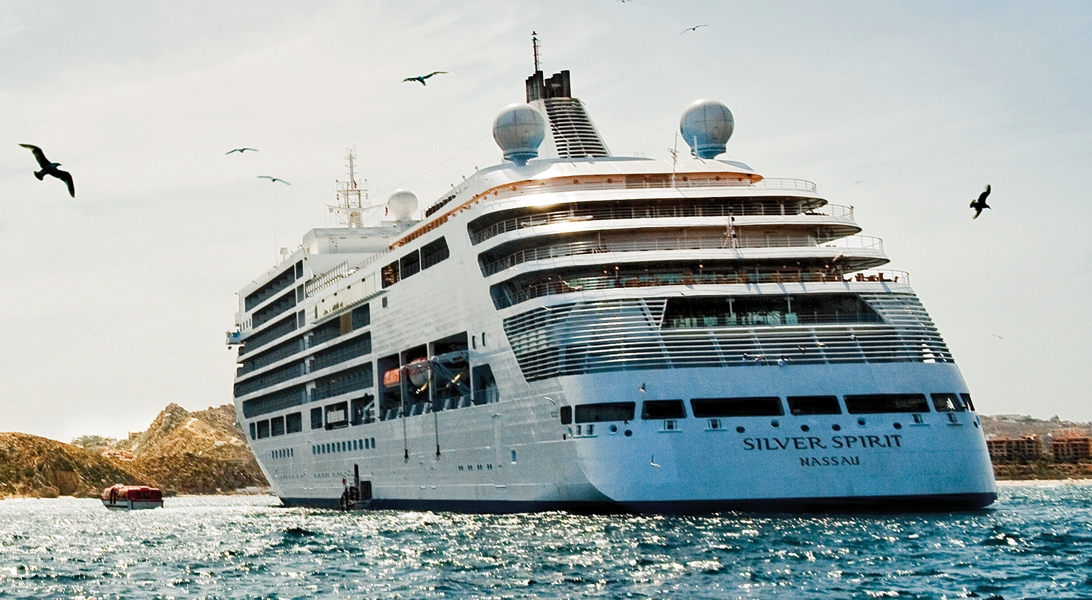
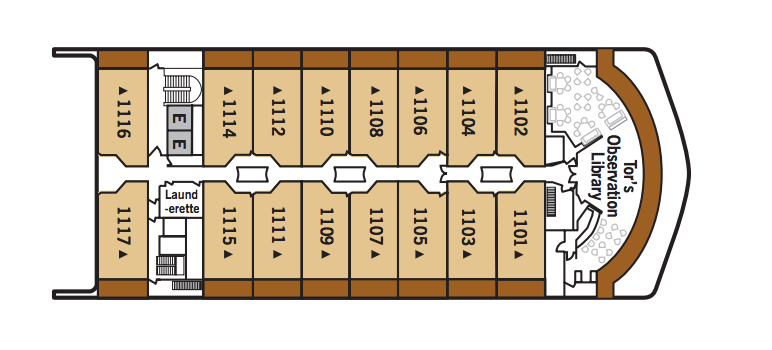

The images shown are for illustration purposes only and may not be an exact representation of what you find on the ship.
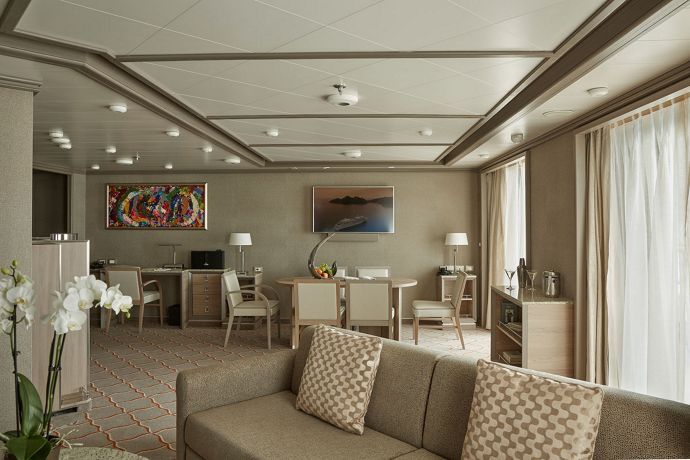
| Grade Code | From | To | |
| G1 | Grand Suite (1 Bedroom) | £9,500 | £9,850 |
| G2 | Grand Suite (2 Bedrooms) | £15,500 | £16,250 |
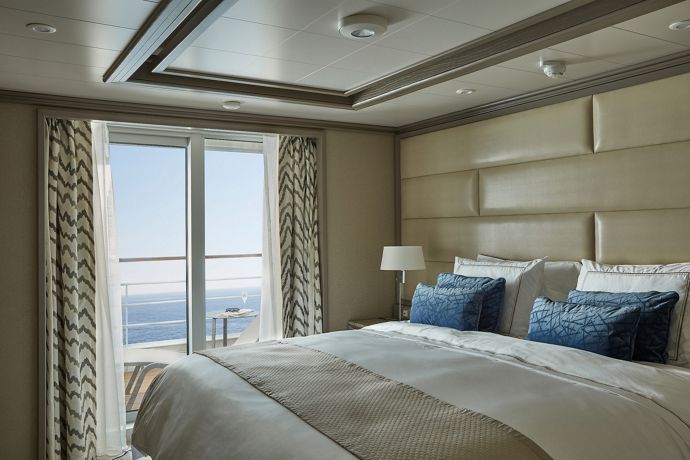
Expertly designed and exquisitely appointed. Ideal for entertaining friends while you cruise or enjoying a quiet dinner “at home.” Available as a one-bedroom configuration or as two bedrooms by adjoining with a Veranda Suite.
One bedroom: 132–142 sq m including veranda (52–62 sq m)
Two bedrooms: 175 sq m including veranda (55–65 sq m)
Please note that the third guest will sleep on a comfortable sofa bed in the reception area of the suite.
Essentials
Characteristics
Furniture
Media & Communication
Onboard Services
Amenities
| Grade Code | From | To | |
| O1 | Owner's Suite (1 Bedroom) | £10,250 | £10,600 |
| O2 | Owner's Suite (2 Bedrooms) | £15,950 | £16,650 |
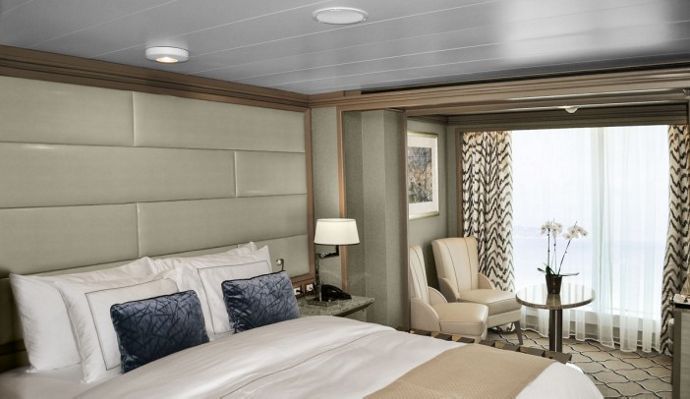
The name Owner’s Suite says it all. A stylish apartment. Prestigious and classic. For those who seek the superlative level of space, comfort, and service on board. Available as a one-bedroom configuration or as two bedrooms by adjoining with the Panorama Suite.
One bedroom: 120 sq m including veranda (12 sq m)
Two bedrooms: 114 sq m including veranda (12 sq m)
Please note that the 3rd guest will sleep on a comfortable sofa bed in the reception area of the suite.
Essentials
Characteristics
Furniture
Media & Communication
Onboard Services
Amenities
| Grade Code | From | To | |
| PA | Panorama Suite | £4,300 | £4,700 |
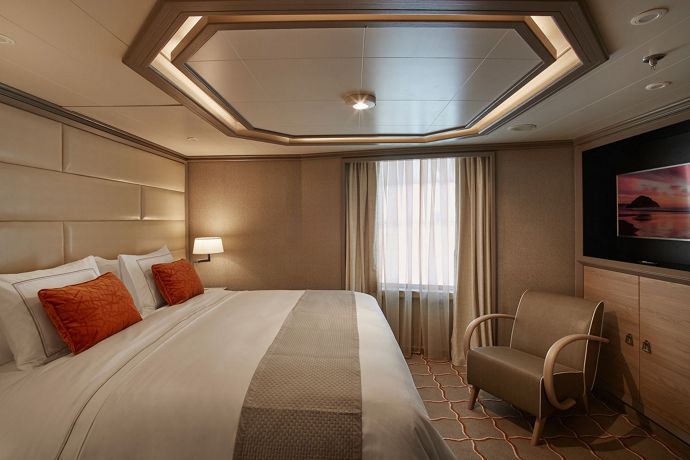
The Panorama Suite provides generous living space for voyagers. Located on deck 9, the Panorama offers all the comfort and attention to detail that you can expect aboard. A generous expanse of interior comforts—elegant decor, a stunning marble bathroom, and an ample seating area make this a cozy home away from home. The seating area of the Panorama Suite has plenty of room to relax while large picture windows frame panoramic ocean views.
One bedroom: 31 sq m
Essentials
Characteristics
Furniture
Media & Communication
Onboard Services
Amenities
| Grade Code | From | To | |
| R1 | Royal Suite (1 Bedroom) | £8,700 | £9,100 |
| R2 | Royal Suite (2 Bedrooms) | £14,750 | £15,500 |
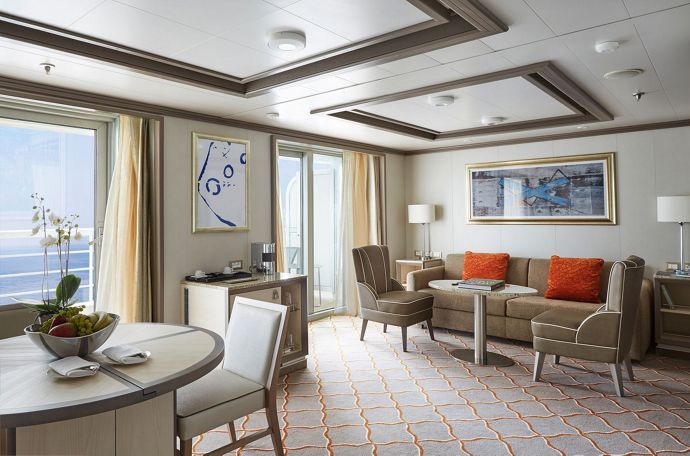
Stately describes the Royal Suite. Commanding and majestic. Perfect for entertaining. Enough living space to roam. The pinnacle of good living. Available as a one-bedroom configuration or as two bedrooms by adjoining with a Veranda Suite.
One bedroom: 92 sq m including veranda (12 sq ft)
Two bedrooms: 127 sq m including veranda (18 sq m)
Please note that the third guest will sleep on a comfortable sofa bed in the reception area of the suite.
Essentials
Characteristics
Furniture
Media & Communication
Onboard Services
Amenities
| Grade Code | From | To | |
| SL | Silver Suite | £7,900 | £8,300 |
| S2 | Silver Suite (2 Bedrooms) | £13,600 | £14,350 |
Step onto your terrace and bask in the calm feeling of the ocean breeze. Dissolve into the comfort of your king-size bed. Prepare for the evening in the beautiful marble bathroom. The upper deck location gives the most spectacular of ocean views while the spacious living area allows for comfortable relaxing, where cozy nights in become veritable experiences in themselves. The two-bedroom configuration of this suite makes this the ideal option for families.
One bedroom: 69 sq m including veranda (12 sq ft)
Please note that the 3rd guest will sleep on a comfortable sofa bed in the reception area of the suite.
Two bedrooms: 100 sq m including veranda (12 sq ft)
Essentials
Characteristics
Furniture
Media & Communication
Onboard Services
Amenities
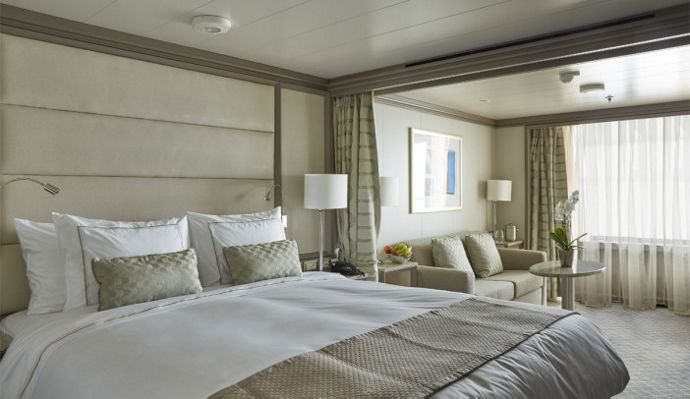
| Grade Code | From | To | |
| VI | Vista Suite | £4,100 | £4,450 |
A quiet sanctuary. The seating area of the Vista Suite has plenty of room to relax. Large picture windows frame panoramic ocean views. The perfect backdrop for breakfast in bed during the cruise. Some Vista Suites accommodate three guests.
One bedroom: 32 sq m
Please note that the 3rd guest will sleep on a comfortable sofa bed in the reception area of the suite.
Essentials
Characteristics
Furniture
Media & Communication
Onboard Services
Amenities
The images shown are for illustration purposes only and may not be an exact representation of what you find on the ship.
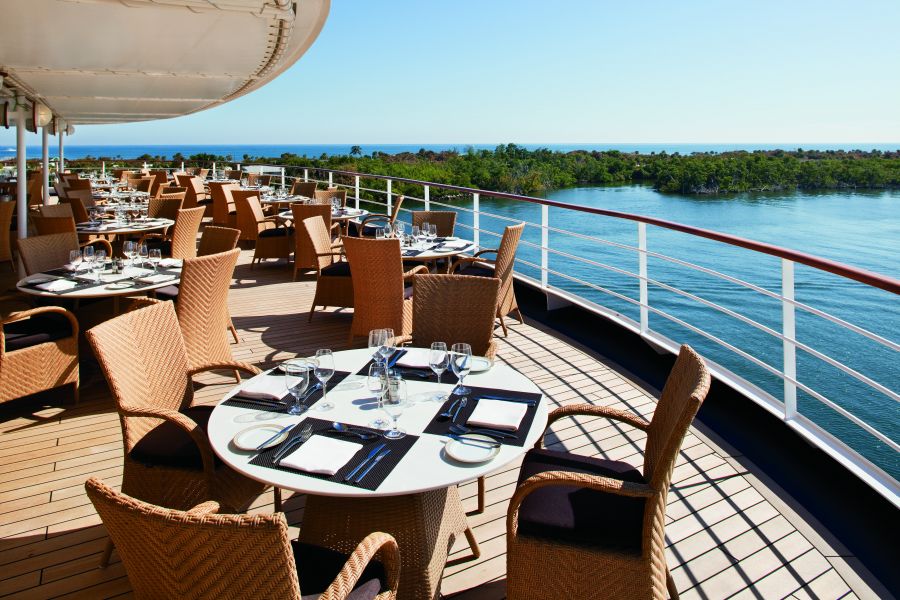
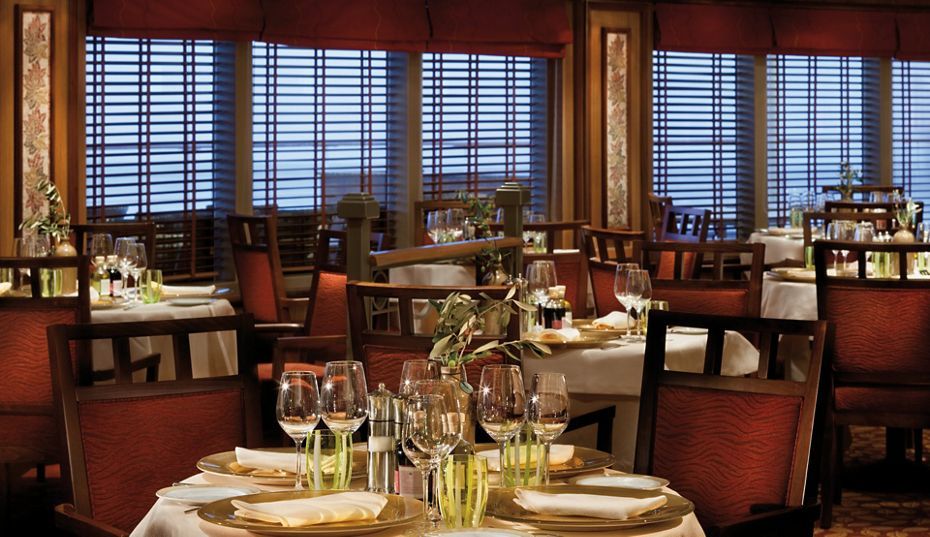
La Terrazza elevates casual dining by day and delivers an authentic Italian experience by night. During the breakfast and lunch buffets, our master chefs prepare global favorites at live stations. As evening falls, handmade pastas and classic seafood dishes are the centerpiece — every impeccable bite paired with fine wines from around the world.
Reservation recommended for dinner.
Images are intended as a general reference. Features, materials, finishes and layout may be different than shown.
The images shown are for illustration purposes only and may not be an exact representation of what you find on the ship.
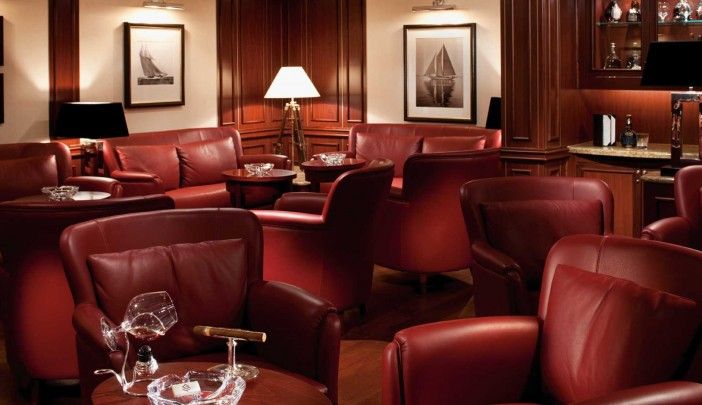
Discreet. Tasteful. Polished. If you appreciate the finer things in life, then the sophisticated touches of the Connoisseur’s Corner will not disappoint. Rich and luxurious, yet airy and spacious, this indoor/outdoor venue is where you sip the finest cognac or whiskey from a prestigious range and revel in the tranquil murmur of after-dinner conversation. A premium choice of cigars is also available, making this a perfect evening haven of serenity.
Images are intended as a general reference. Features, materials, finishes and layout may be different than shown.
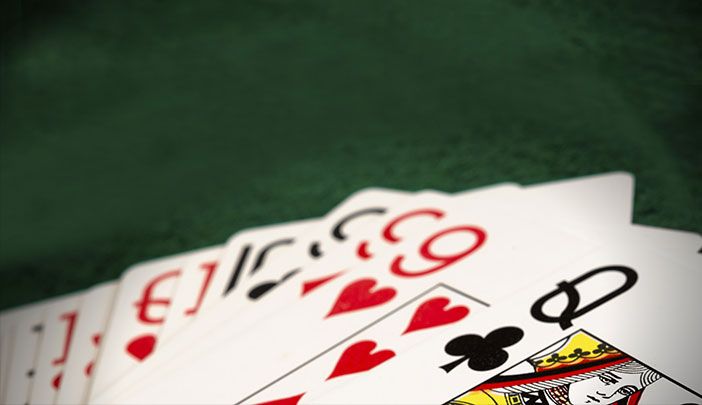
Whatever your conference or meeting requirements, Silversea is pleased to provide a tailor-made experience. Audiovisual equipment is available and complimentary on board this luxury cruise ship.
Images are intended as a general reference. Features, materials, finishes and layout may be different than shown.
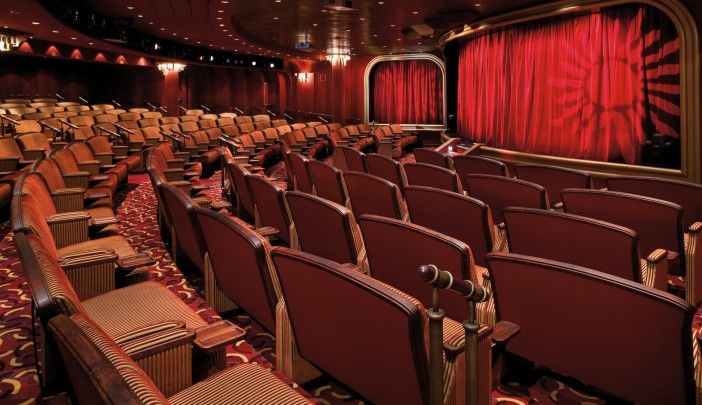
Step inside The Venetian Lounge, a cabaret-style theater draped in gilded glamour and Belle Époque charm. Cozy seating and intimate tables invite you to bask in the glow of live productions and cinematic screenings, complemented with Champagne, fine wines, and classic cocktails. In a setting this grand, every night feels like opening night.
Images are intended as a general reference. Features, materials, finishes and layout may be different than shown.
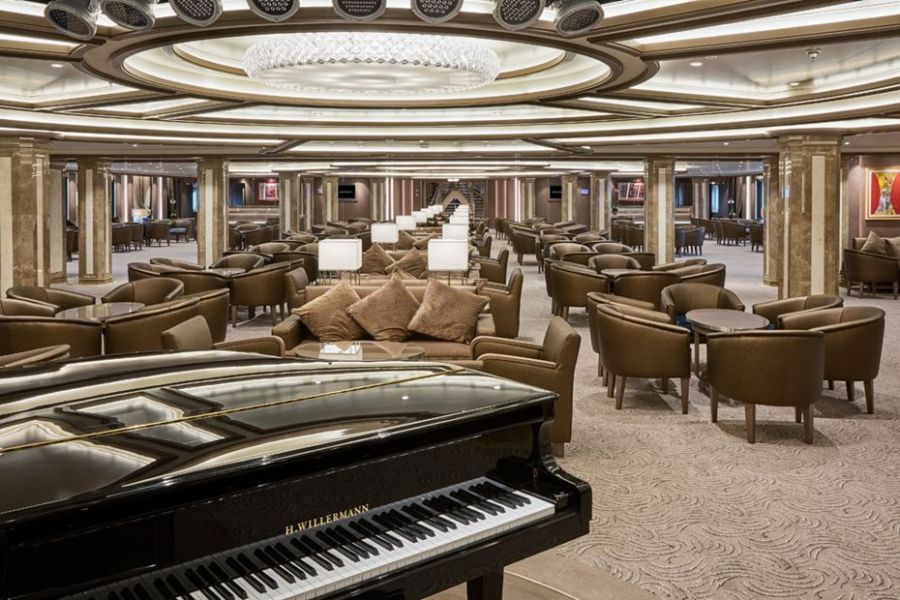
Surrender to a world of Italian elegance where the art of aperitivo takes pride of place. Ideal for connecting over spritzes, negronis, and light bites, here each evening feels like a celebration. As laughter lingers, crystal glasses clink, and live piano notes ripple through the air, Dolce Vita compels you to savor the sweetness of life on board.
Images are intended as a general reference. Features, materials, finishes and layout may be different than shown.
The images shown are for illustration purposes only and may not be an exact representation of what you find on the ship.
The images shown are for illustration purposes only and may not be an exact representation of what you find on the ship.


Our Fusion packages are all ABTA & ATOL protected ensuring that your booking is safe with us
| 11 nights aboard the Silver Spirit | |||
| Butler Service in Every Suite | |||
| Gratuities Always Included | |||
| Beverages In-Suite and Throughout the Ship | |||
| Gourmet Dining | |||
| In Suite Dining & 24-Hour Room Service | |||
| Intimate small size ships | |||
| Free Wifi Throughout the Ship | |||
| Free Zodiac, Land and Sea Tours & Activities & Complimentary Expedition gear | |||
| Port Taxes and Fees | |||
 | ABTA and ATOL Protection* | ||
Date 11th Nov 2027 |
Nts 11 |
Suite £4,550pp |
Date 11th Nov 2027 |
Nts 11 |
Suite £4,550pp |
| Suite staterooms from | £4,550pp | ||
| CV | Classic Veranda Suite | £4,550pp | |
| DX | Deluxe Veranda Suite | £4,850pp | |
| G1 | Grand Suite (1 Bedroom) | £9,500pp | |
| G2 | Grand Suite (2 Bedrooms) |  | |
| O1 | Owner's Suite (1 Bedroom) | £10,250pp | |
| O2 | Owner's Suite (2 Bedrooms) | | |
| ME | Medallion Suite | £5,600pp | |
| PA | Panorama Suite | | |
| R1 | Royal Suite (1 Bedroom) | £8,700pp | |
| R2 | Royal Suite (2 Bedrooms) | | |
| S2 | Silver Suite (2 Bedrooms) | | |
| SL | Silver Suite | £7,900pp | |
| SV | Superior Veranda Suite | £4,700pp | |
| VI | Vista Suite | | |
Fusion Holidays when selling travel arrangements is a trading name of Co-op Travel Services Limited, registration 08903986. Fusion Cruises is an Accredited Body Member of Co-op Travel Services Limited ATOL 12904.
Book with Confidence. We are a Member of ABTA which means you have the benefit of ABTA’s assistance and Code of Conduct.
Some of the flights and flight-inclusive holidays on this website are financially protected by the ATOL scheme but ATOL protection does not apply to all holiday and travel services offered on this website. This website will provide you with information on the protection that applies in the case of each holiday and travel service offered before you make your booking. If you do not receive an ATOL Certificate then the booking will not be ATOL protected. If you do receive an ATOL Certificate but all parts of your trip are not listed on it, those parts will not be ATOL protected. Please see our booking conditions for information, or for more information about financial protection and the ATOL Certificate go to: www.caa.co.uk