This site uses cookies as defined in our Cookie Policy, by continuing to use this site you agree to their use.
Continue

| Arrive | Depart | ||||||
| 15th15 | SepSep | 202727 | Civitavecchia, Italy, embark on the Silver Spirit | 18:00 | |||
Italy's vibrant capital lives in the present, but no other city on earth evokes its past so powerfully. For over 2,500 years, emperors, popes, artists, and common citizens have left their mark here. Archaeological remains from ancient Rome, art-stuffed churches, and the treasures of Vatican City vie for your attention, but Rome is also a wonderful place to practice the Italian-perfected il dolce far niente, the sweet art of idleness. Your most memorable experiences may include sitting at a caffè in the Campo de' Fiori or strolling in a beguiling piazza. All roads lead to Rome, and with good reason - this city is one of the world’s most thrilling, offering unmatched history along every street. An evocative, inspiring and utterly artistic capital of unrivalled cultural impact, Rome is a city of back-to-back landmarks, which will take you on an exhilarating journey through the ages. This may be one of the world’s oldest cities, but it’s well and truly lived in. The ruins are punctuated with murmuring cafes, and the outdoor seating of restaurants sprawls out across piazzas, enticing you to sample tangles of creamy pasta and crispy pizzas. Rome’s incredible Roman Forum is littered with the ruins of its ancient administrations, which have stood firm for 2,000 years, since the times when the area was the centre of the Western world. Few sites are more simultaneously beautiful and haunting than that of the storied Colosseum, which looms deep into Rome’s rich blue sky. Take a tour to learn details of the grisly goings-on within. The best way to experience Rome is to wander its streets, gelato in hand. There is a lot to see here - whether it’s the domed spectacle of the Pantheon, or the elaborate flowing waters and artistry of the Trevi Fountain. Vatican City is an astonishing, colossal display of Catholic grandeur, while the Spanish Steps – crowned by the Trinità dei Monti church – offer a beautiful spot to gather and soak up the lively atmosphere of this humming city. With so much on the to-do list, you’ll relish the breaks you take, enjoying simple pleasures like a strong espresso, or fresh pasta with tomato sauce and ripped basil. | |||||||
| 16th16 | SepSep | 202727 | Salerno, Italy | 08:00 | 18:00 | ||
Salerno is an Italian city located on the Gulf of Salerno. Famous for being home to the first medical university, Salerno is a great destination for anyone looking for gorgeous sea views filled with sunshine and Italian food. Salerno is situated at the northern end of the Gulf of Salerno. The old town, rising up the slopes of the hill on the site of the ancient Salernum, still bears evidence of its great days during the medieval period. It had the oldest medical school in Europe, which flourished from the 11th century until it was closed down by Napoleon's brother-in-law, Murat, in 1812. Today, Salerno's main attraction is an imposing Romanesque cathedral, built in 1085 and remodeled in the late 18th century. A flight of steps leads up to an atrium with 28 columns from Paestum and fourteen ancient sarcophagi. The magnificent bronze doors were made in Constantinople in 1099. Inside is the ornate tomb of Margaret of Anjou and the tomb of Pope Gregory VII, who died in Salerno in 1085. In the richly decorated crypt under the alter lie the remains of the Evangelist Matthew, brought here from Paestum.A 45-minute walk from the cathedral leads to a hilltop crowned by the old Lombard Castello, from where extensive views are available. Along the seafront, to the east of the harbor, extends a fine promenade lined with impressive modern buildings. The Corso Giuseppe Garibaldi is the town's principal traffic artery.Travelers coming to Salerno mainly use the port as a starting point for visits to the Greek temples of Paestum. Other favorite excursions from here are to Pompeii and to visit the popular resort towns of Amalfi and Ravello. Pier Information The ship is scheduled to dock at Pier 22. A tourist office is located at the port and is open from 8:00 a.m. to 1:30 p.m. From the pier it is approximately two miles to the town center. Taxis are generally available at the pier for trips farther afield. Be sure to establish the fare with the driver before starting out. Shopping Local handicrafts, clothing, shoes and mozzarella cheese are items to look for. Major shopping areas are along Via dei Mercanti, Via Duomo and Corso Vittorio Emanuele. Most shops are closed between 1:30 p.m. and 5:00 p.m. The local currency is the euro. Cuisine The always popular pasta dishes are a good choice. Other favorites include fresh seafood and local specialties. The home-produced ricotta and mozzarella are especially recommended. Good local wines will complement your meal. Other Sites Museo Diocesano At the Piazza Plebiscito, behind the cathedral, this museum houses a fine collection of medieval carved tablets. Museo Provinciale Occupying two floors of the San Benedetto Monastery, the main attraction at the museum is a handsome bronze head of Apollo fished out of the bay in the 1930s. | |||||||
| 17th17 | SepSep | 202727 | Agropoli, Italy | 08:00 | 18:30 | ||
| 18th18 | SepSep | 202727 | Taormina, Italy | 08:00 | 19:00 | ||
The medieval cliff-hanging town of Taormina is overrun with tourists, yet its natural beauty is still hard to dispute. The view of the sea and Mt. Etna from its jagged cactus-covered cliffs is as close to perfection as a panorama can get—especially on clear days, when the snowcapped volcano's white puffs of smoke rise against the blue sky. Writers have extolled Taormina's beauty almost since it was founded in the 6th century BC by Greeks from nearby Naxos; Goethe and D. H. Lawrence were among its well-known enthusiasts. The town's boutique-lined main streets get old pretty quickly, but the many hiking paths that wind through the beautiful hills surrounding Taormina promise a timeless alternative. A trip up to stunning Castelmola (whether on foot or by car) should also be on your itinerary. Hugging a long, sweeping bay, Giardini Naxos welcomes you ashore to some of Sicily’s most scenic and historic sites. Naxos was the first Greek settlement on Sicily, and it is surrounded by remarkable remains and swirling mythology. With a long arc of sun-soaked golden sand, you can kick back by the waves - and cool off with a dip into the sea's refreshing embrace. Up above the seaside revelry, the spectacular Taormina hillside town perches - containing rich Roman and Greek history. Visit to encounter one of Sicily’s best views, as you look down over the rejuvenating blue of the sea, and the looming backdrop of Mount Etna rising in the distance. The majestic, honey-coloured Greek theatre is a highlight, standing before the distant loom of the volcano. Head towards the puffs of cloud, and wisps of smoke, that gather around the peak of Sicily’s mighty volcano, which is among the most active in Europe. Arrive through vineyards, thriving in this fertile soil, before taking the 1,737-metre incline to the summit of the legendary mountain of fire, across fields of solidified lava flows. Known to the Greeks as the home of the God of Fire, and the one-eyed Cyclops, the mountain continues to amaze and awe with its restless power. Vineyards carpet the scenery - interrupted by occasional cactai and citrus groves – and produce some of Sicily’s most refined flavours. Enjoy a glass of wine on Giardini Naxos’ seafront, and toast your time on these rich Sicilian shores. | |||||||
| 19th19 | SepSep | 202727 | Valletta, Malta | 08:00 | 18:00 | ||
Malta's capital, the minicity of Valletta, has ornate palaces and museums protected by massive fortifications of honey-color limestone. Houses along the narrow streets have overhanging wooden balconies for people-watching from indoors. Generations ago they gave housebound women a window on the world of the street. The main entrance to town is through the City Gate (where all bus routes end), which leads onto Triq Repubblika (Republic Street), the spine of the grid-pattern city and the main shopping street. Triq Mercante (Merchant Street) parallels Repubblika to the east and is also good for strolling. From these two streets, cross streets descend toward the water; some are stepped. Valletta's compactness makes it ideal to explore on foot. City Gate and the upper part of Valletta are experiencing vast redevelopment that includes a new Parliament Building and open-air performance venue. The complex, completed mid-2013, has numerous pedestrian detours in place along with building noise and dust. Before setting out along Republic Street, stop at the tourist information office on Merchant Street for maps and brochures. Perched high on the imposing Sciberras Peninsula, Valletta immediately presents its massive, protective walls and vertical bastions to visitors arriving by sea. Rising to 47 metres in places, the fortifications protect lavish palaces, grand domes and illustrious gardens. Built by the Knights of St John on the narrow peninsular, Valletta is a compact, richly historical treasure trove of Baroque wonders. Ascend to reach the restful, flower-filled Upper Barrakka Gardens, where cannons fire and boom in salute at noon each day, sending echoing cracks of noise out across the waves below. Recognised as 2018’s European Capital of Culture, Valletta is a fascinating and dense haven of history and intrigue. A busy, bustling capital, the breathtaking St John’s Cathedral - commissioned in 1572 - is almost concealed among its narrow streets. The relatively modest exterior is counterpointed by a staggeringly opulent, gold-leaf bathed interior, containing a Caravaggio masterpiece - the shadowy vision of the Beheading of St John. Cinematic and magnificent, Valletta has served as a filming location for Game of Thrones - but real epic history abounds on this rocky isle too. From the prehistoric and megalithic sites of the Hypogeum of Paola and Tarxien, to the fascinating War Museum at Fort St Elmo. Mdina also waits nearby, and the former medieval capital is a striking contrast to the island’s main city. Cars are barred from its streets, and it offers endlessly atmospheric old-time wanders. With a strategic positioning in the Mediterranean, Malta is a jewel that many have wrestled for over the centuries. Independence from Britain was finally achieved in 1964, but the close allegiance remains evident, with English recognised as an official language, cars driving on the left, and red post boxes and telephone gleaming in Malta’s sunshine. | |||||||
| 20th20 | SepSep | 202727 | At Sea | ||||
| 21st21 | SepSep | 202727 | Sarandë, Albania | 07:00 | 17:30 | ||
Sarandë is a city in southern Albania on the coast of the Ionian Sea. Sarandë can be reached easily from the Greek island of Corfu by ferry. An early Christian monastery dedicated to 40 saints (Santi Quaranta) gave Sarandë its name. The city center of Sarandë has been scarred by communist architecture but since the fall of communism many small shops and bars have sprung up which give it a Mediterranean feel. This southernmost harbour of Albania was once the ancient port of Onchesmos. Today, Sarandë’s main attractions are its sunny climate and the nearby ruins of Butrint. Please Note: For your convenience, shore excursions offered for this port of call are available to reserve in advance at www.silversea.com, unless otherwise noted in the description. The deadline to reserve these tours is August 19, after which they will be available for purchase on board, unless otherwise noted in the description. Pier Information The ship is scheduled to anchor at Main Pier. The town center is 875 yards from the pier. Taxis are generally available at the pier. Shopping Typical souvenirs include t-shirts, postcards, wood carvings and dolls in national costume. Cuisine Albanian cuisine has been strongly influenced by Turkey. Grilled meats like shisqubap (shish kebab), romstek (minced meat patties) and gofte (meat balls) are served all across the Balkans. Some local dishes include comlek (meat and onion stew), fërges (a rich beef stew), rosto me salcë kosi (roast beef with sour cream) and tavë kosi (mutton with yoghurt. Lake Shkodra carp and Lake Ohrid trout are the most common fish dishes. Try the ice cream (akullore), which is popular everywhere. Other Sites Blue Eye Spring The iridescent blue water gushes from the depths of the earth and feeds the Bistrica River. Catacombs Recently discovered catacombs of the church of the Forty Saints can also be explored. Private arrangements for independent sightseeing may be requested through the Tour Office on board. Overlooking the turquoise blue Ionian Sea Albania’s most southerly harbour is a short 20-minute boat ride from Corfu and bathes in the glow of more than 300 sunny days each year. Revel in Albania’s best beach life or explore historic ancient cities and fortresses embedded with immense archaeological interest. Clear turquoise waters lap the city's beaches and there's always something to see along the lively Boulevard Hasan Tahsini - which traces the seafront and is stacked with bars restaurants and shops. The hardy 16th-century Lekuresi Castle has been battered by weather and war over the years but it offers a fantastic lookout point to survey Sarande's expanse Corfu's island and the turquoise sea beyond. From here you can head to the Blue Eye Spring a rejuvenating natural landmark where a groundswell of the purest water gushes up 50 metres to surface amid the forest. Bathe in the immaculate waters which are intensely refreshing on sunny days. The majestic ruins of Butrint's ancient city stand nearby unearthed from the leafy site after the city was abandoned in medieval times. Albania's first UNESCO World Heritage Site Butrint was an ancient Greek and Roman stronghold - and you can walk back in time along stone-paved streets to discover the immense history here. Roam between the compact Roman theatre and the impressive arched-windows of the basilica before admiring the stunning floor mosaics that have been left behind. | |||||||
| 22nd22 | SepSep | 202727 | Kotor, Montenegro | 08:30 | 19:00 | ||
Backed by imposing mountains, tiny Kotor lies hidden from the open sea, tucked into the deepest channel of the Bokor Kotorska (Kotor Bay), which is Europe's most southerly fjord. To many, this town is more charming than its sister UNESCO World Heritage Site, Dubrovnik, retaining more authenticity, but with fewer tourists and spared the war damage and subsequent rebuilding which has given Dubrovnik something of a Disney feel.Kotor's medieval Stari Grad (Old Town) is enclosed within well-preserved defensive walls built between the 9th and 18th centuries and is presided over by a proud hilltop fortress. Within the walls, a labyrinth of winding cobbled streets leads through a series of splendid paved piazzas, rimmed by centuries-old stone buildings. The squares are now haunted by strains from buskers but although many now house trendy cafés and chic boutiques, directions are still given medieval-style by reference to the town’s landmark churches.In the Middle Ages, as Serbia's chief port, Kotor was an important economic and cultural center with its own highly regarded schools of stonemasonry and iconography. From 1391 to 1420 it was an independent city-republic and later, it spent periods under Venetian, Austrian, and French rule, though it was undoubtedly the Venetians who left the strongest impression on the city's architecture. Since the breakup of Yugoslavia, some 70% of the stone buildings in the romantic Old Town have been snapped up by foreigners, mostly Brits and Russians. Porto Montenegro, a new marina designed to accommodate some of the world’s largest super yachts, opened in nearby Tivat in 2011, and along the bay are other charming seaside villages, all with better views of the bay than the vista from Kotor itself where the waterside is congested with cruise ships and yachts. Try sleepy Muo or the settlement of Prčanj in one direction around the bay, or Perast and the Roman mosaics of Risan in the other direction. Embedded into the slopes of the steep Lovćen mountain and overlooking the deep blue Adriatic the fortified town of Kotor boasts a spectacular imposing staging that few can match. Sq Squeezing in through the tight Bay of Kotor is a daunting and impressive approach in itself as you arrive via one of Europe’s most stunning waterways. A pearl of Montenegro and the Adriatic Kotor's warren-like streets drip with history and authenticity. Under Venetian influence for four centuries the city's UNESCO World Heritage Site old town invites you to wander amid atmospheric stone-clad streets overlooked by a sea of terracotta roofs and the double towers of the cathedral. Many favour Kotor for its compact layout smaller crowds and authenticity however - having been spared from shelling during Yugoslavia's breakup. The tightknit streets here are patrolled by a slinking population of feline residents who were adopted as the town’s mascots after being left behind by transient trader ships. Learn of the city's extensive heritage on the waves in the dedicated maritime museum that is contained within Grgurina Palace. Pick your way through tight alleys of workshops and studios walking below fresh laundry strung from windows before settling into shiny paved piazzas for an afternoon coffee or seafood meal. If you’re up for an aerobic challenge tackle the 1 350 steps up the steep walls to St John's fortress. The views over the gorgeous bay make the arduous slog worth it. | |||||||
| 23rd23 | SepSep | 202727 | Dubrovnik, Croatia | 08:00 | 19:00 | ||
Nothing can prepare you for your first sight of Dubrovnik. Lying 216 km (135 miles) southeast of Split and commanding a jaw-dropping coastal location, it is one of the world's most beautiful fortified cities. Its massive stone ramparts and fortress towers curve around a tiny harbor, enclosing graduated ridges of sun-bleached orange-tiled roofs, copper domes, and elegant bell towers. Your imagination will run wild picturing what it looked like seven centuries ago when the walls were built, without any suburbs or highways around it, just this magnificent stone city rising out of the sea.In the 7th century AD, residents of the Roman city Epidaurum (now Cavtat) fled the Avars and Slavs of the north and founded a new settlement on a small rocky island, which they named Laus, and later Ragusa. On the mainland hillside opposite the island, the Slav settlement called Dubrovnik grew up. In the 12th century the narrow channel separating the two settlements was filled in (now the main street through the Old Town, called Stradun), and Ragusa and Dubrovnik became one. The city was surrounded by defensive walls during the 13th century, and these were reinforced with towers and bastions in the late 15th century.From 1358 to 1808 the city thrived as a powerful and remarkably sophisticated independent republic, reaching its golden age during the 16th century. In 1667 many of its splendid Gothic and Renaissance buildings were destroyed by an earthquake. The defensive walls survived the disaster, and the city was rebuilt in baroque style.Dubrovnik lost its independence to Napoléon in 1808, and in 1815 passed to Austria-Hungary. During the 20th century, as part of Yugoslavia, the city became a popular tourist destination, and in 1979 it was listed as a UNESCO World Heritage Site. During the war for independence, it came under heavy siege. Thanks to careful restoration, few traces of damage remain; however, there are maps inside the Pile and Ploče Gates illustrating the points around the city where damage was done. It’s only when you experience Dubrovnik yourself that you can understand what a treasure the world nearly lost Croatia’s crowning glory rears up vertically from the tranquil waters of the Adriatic and Dubrovnik’s daunting fortresses town is a truly imposing sight to behold. Encircled by chunky stone walls so thick and dramatic they could have been purpose-built as a film set this city’s unmatched old town is the setting for countless films and shows - from Star Wars to Robin Hood Game of Thrones and every production in-between seeking a truly authentic medieval flavour. Fully restored now the stone streets of the city take you through a beautiful mosaic of architectural splendour baroque churches and splashing fountains. Tapering alleys rocket up from the central boulevard of Stradun offering spectacular views down but you’ll need to walk the city walls to appreciate the fortress city’s full scale. Visit the neighbouring fort of Lovrijenac for another perspective or swing up to Srd fortress’s glorious panorama on a cable car. Dubrovnik’s streets are crammed with eateries and candlelit tables where couples splash wine into glasses and enjoy gnocchi mixed with creamy truffle sauces. Nearby beaches like Banje are also close by and hidden bays reward the intrepid who venture out beyond the old town. Take sunset drinks to sit back and watch as flotillas of sea kayaks roll by or sail on the pristine waters to explore island gems like Lokrum - where peacocks are the only permanent residents. | |||||||
| 24th24 | SepSep | 202727 | Split, Croatia | 08:00 | 18:00 | ||
Split's ancient core is so spectacular and unusual that a visit is more than worth your time. The heart of the city lies within the walls of Roman emperor Diocletian's retirement palace, which was built in the 3rd century AD. Diocletian, born in the nearby Roman settlement of Salona in AD 245, achieved a brilliant career as a soldier and became emperor at the age of 40. In 295 he ordered this vast palace to be built in his native Dalmatia, and when it was completed he stepped down from the throne and retired to his beloved homeland. Upon his death, he was laid to rest in an octagonal mausoleum, around which Split's magnificent cathedral was built.In 615, when Salona was sacked by barbarian tribes, those fortunate enough to escape found refuge within the stout palace walls and divided up the vast imperial apartments into more modest living quarters. Thus, the palace developed into an urban center, and by the 11th century the settlement had expanded beyond the ancient walls.Under the rule of Venice (1420–1797), Split—as a gateway to the Balkan interior—became one of the Adriatic's main trading ports, and the city's splendid Renaissance palaces bear witness to the affluence of those times. When the Habsburgs took control during the 19th century, an overland connection to Central Europe was established by the construction of the Split–Zagreb–Vienna railway line.After World War II, the Tito years saw a period of rapid urban expansion: industrialization accelerated and the suburbs extended to accommodate high-rise apartment blocks. Today the historic center of Split is included on UNESCO's list of World Heritage Sites. Bathing in the Dalmatian Coast’s generous sunshine and overlooking sparkling island-studded waters Split is a city of romantic beauty built around an extraordinary - still beating - historical heart. The setting may be spectacular but it’s the Diocletian’s Palace - a Roman remain of incredible scale and detail that is truly bewitching. With a natural backdrop of dramatic limestone mountains and Croatia’s trademark scenic wonders all around Split is a true heavyweight of the Adriatic. To enter Split’s Diocletian’s Palace is to step into a beautiful time warp. Head first to the Cathedral of Saint Domnius where a hollow bell tower rockets up puncturing the sky. The perfume of lavender hangs heavy wherever you walk in the old town where tucked shops offer artisan chocolates dried figs and freshly-ground coffees. The expansive seafront promenade is all palm trees buzzing bars and eateries and further out you’ll find the peace of Marion Hill - where you can climb to some of the best views in town. Or take the far less exerting wander to Sustipan cemetery’s breathtaking panorama of sea city and distant islands. Trips to island paradises like Hvar and Brac are tempting as are longer excursions to sites like Krka National Park’s Waterfalls - where wide terraces of frothing water thunder into cooling swimmable splash pools below. Nearby Trogir is another UNESCO World Heritage Site offering a cosier no less charming old town and historic port. | |||||||
| 25th25 | SepSep | 202727 | Ravenna, Italy | 08:30 | 19:00 | ||
A small, quiet, well-heeled city, Ravenna has brick palaces, cobblestone streets, magnificent monuments, and spectacular Byzantine mosaics. The high point in its civic history occurred in the 5th century, when Pope Honorious moved his court here from Rome. Gothic kings Odoacer and Theodoric ruled the city until it was conquered by the Byzantines in AD 540. Ravenna later fell under the sway of Venice, and then, inevitably, the Papal States.Because Ravenna spent much of its past looking east, its greatest art treasures show that Byzantine influence. Churches and tombs with the most unassuming exteriors contain within them walls covered with sumptuous mosaics. These beautifully preserved Byzantine mosaics put great emphasis on nature, which you can see in the delicate rendering of sky, earth, and animals. Outside Ravenna, the town of Classe hides even more mosaic gems. Wander the historic streets of Ravenna and you may not immediately realise the wealth of artistry contained here. Leave the sun’s glow and let your eyes adjust to the interior of the city’s churches however and you'll discover some of the world’s finest Byzantine mosaics waiting for you. Decorated with spectacular explosions of colour even the humblest church facade can conceal momentous and magnificent artistic displays in this city which harbours 1 500 years of extraordinary history. Ravenna is home to a plethora of UNESCO World Heritage Site designated buildings and no fewer than eight have received protection. Basilica di San Vitale of 525 AD stands as the town’s pièce de résistance - itself a precious mosaic of influence where Byzantine meets Baroque. Glorious light spills in vibrantly illuminating and highlighting the craftwork of its knaves and archways. The Mausoleum of Galla Placido is another noble achievement described by UNESCO as ‘the earliest and best-preserved of all mosaic monuments'. Look up at the glittering stars of the night sky from within and you may be inspired just as Cole Porter was when he penned Night and Day. Ravenna’s beauty has always been stimulating and Dante finished his masterpiece Paradiso here during exile from Florence. Sangiovese wines and prosciutto-filled piadina flatbreads will keep you fed and watered during your stay. Don't miss a taste of the local olive oil either which bursts with intense fruity flavours. | |||||||
| 26th26 | SepSep | 202727 | Trieste, Italy | 08:00 | 17:00 | ||
Up until the end of World War I, Trieste was the only port of the vast Austro-Hungarian Empire and therefore a major industrial and financial center. In the early years of the 20th century, Trieste and its surroundings also became famous by their association with some of the most important names of Italian literature, such as Italo Svevo, and English and German letters. James Joyce drew inspiration from the city's multiethnic population, and Rainer Maria Rilke was inspired by the seacoast west of the city. Although it has lost its importance as a port and a center of finance, it has never fully lost its roll as an intellectual center. The streets hold a mix of monumental, neoclassical, and art-nouveau architecture built by the Austrians during Trieste's days of glory, granting an air of melancholy stateliness to a city that lives as much in the past as the present. A city happy to keep one foot resolutely in its beautiful illustrious past Trieste is a treasure which sits on a historical frontier of civilisations and cultures. Wealth as a trading hub helped to shape Trieste's grand piazzas and soaring artistic architectural achievements. The legendary Bora wind is greeted like an old friend and it buffs the city in winter. Just like Trieste itself it will take your breath away. Piazza Unità d'Italia is the grand central square and it opens up to the lap of blue waves at one end. Settle in for a quick caffeine hit in this coffee capital - a word of warning however most Trieste baristas don't serve cappuccinos - so plump for a caffè latte instead. The God of the Sea Neptune is honoured in a fountain at Piazza del Borsa nearby. Canale Grande is a centrepiece and was built in the 18th century to allow boats to unload their wares and trade. Lined by grandiose neoclassical buildings you can enjoy a picturesque stroll by the water. Three pretty bridges span it while little boats bob and jostle below. Glorious castles crown the area towering from esteemed vineyards. Don't miss the fairytale castle of Miramare which watches over the azure Gulf of Trieste and looms above glorious gardens. Trieste Cathedral is a constant and reassuring presence for the city standing on a hilltop overlooking the old town - it features an enchanting chandelier and remarkable painted ceiling. | |||||||
| 27th27 | SepSep | 202727 | Fusina, Italy, disembark the Silver Spirit | ||||
| Losing none of its allure over the years, this floating city of canals, bridges and masks is a place of eternal beauty and enduring elegance. The lagoon of more than 100 islands is a heavenly sight, transporting visitors on a journey through time - from its Roman inception, through centuries of trade to the modern face we see today. Navigate Venice’s sparkling waterways by romantic gondola, or on cruises along wide canal boulevards. Span the Grand Canal over its iconic original crossing, the Rialto Bridge, which - with its parade of tiny shops - gives some of the city’s most endearing views. If the crowds unsettle you at any point, take two turns away from the main thoroughfares to find peace alone, amid the city's labyrinth of tiny streets. Hurry to Piazza San Marco to be immersed in Venice’s elegant glory. Basilica San Marco transports you back to the wealthy days of the Doges, who ruled for over 1,000 years. Initially their private chapel, it’s now decorated with beautiful Byzantine mosaics. Nearby the Campanile di San Marco bell tower offers views over the higgledy-piggledy rooftops of times gone by. Just a hop skip and a jump around the corner is the Doge’s Palace, where the levels of opulence ramp up even further. Justice was meted out in this stunning Palace, with the guilty walking to the cells across the covered Bridge of Sighs. Vaporetto trips to local islands offer even more adventures to float your boat, whether it’s Murano with its world-famous glass, Torcello with its amazing Cathedrals, or Burano with its handmade lace and delightfully colourful painted houses. | |||||||
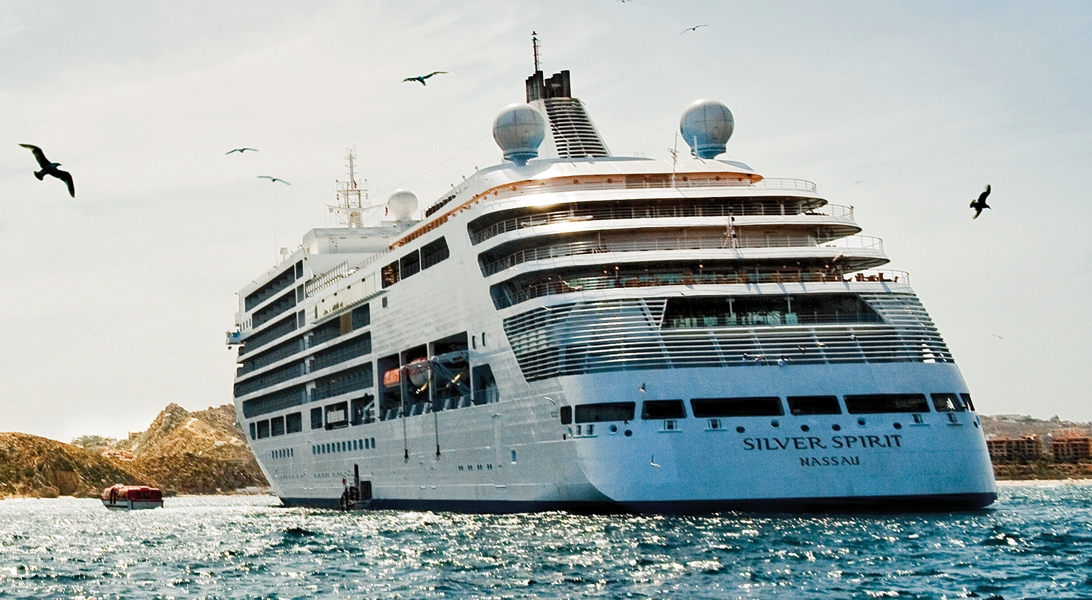
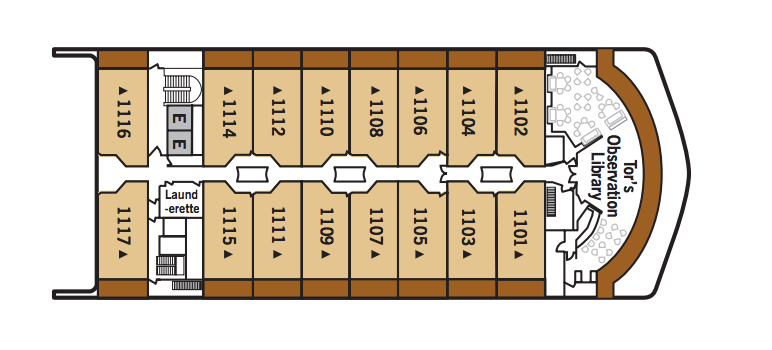

The images shown are for illustration purposes only and may not be an exact representation of what you find on the ship.
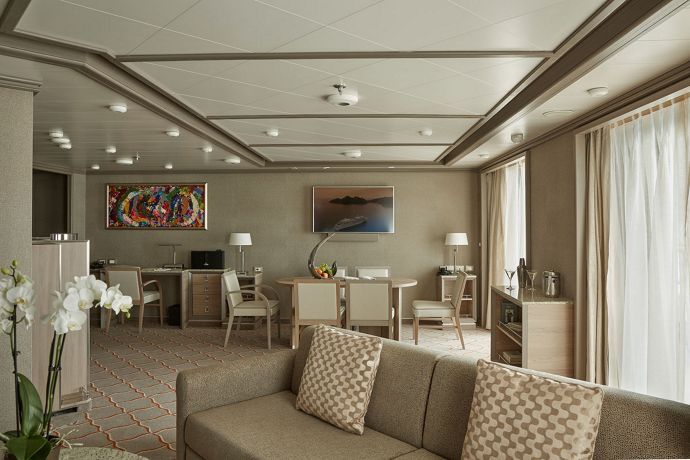
| Grade Code | From | To | |
| G1 | Grand Suite (1 Bedroom) | £19,150 | £19,700 |
| G2 | Grand Suite (2 Bedrooms) | £27,600 | £28,600 |
Expertly designed and exquisitely appointed. Ideal for entertaining friends while you cruise or enjoying a quiet dinner “at home.” Available as a one-bedroom configuration or as two bedrooms by adjoining with a Veranda Suite.
One bedroom: 132–142 sq m including veranda (52–62 sq m)
Two bedrooms: 175 sq m including veranda (55–65 sq m)
Please note that the third guest will sleep on a comfortable sofa bed in the reception area of the suite.
Essentials
Characteristics
Furniture
Media & Communication
Onboard Services
Amenities
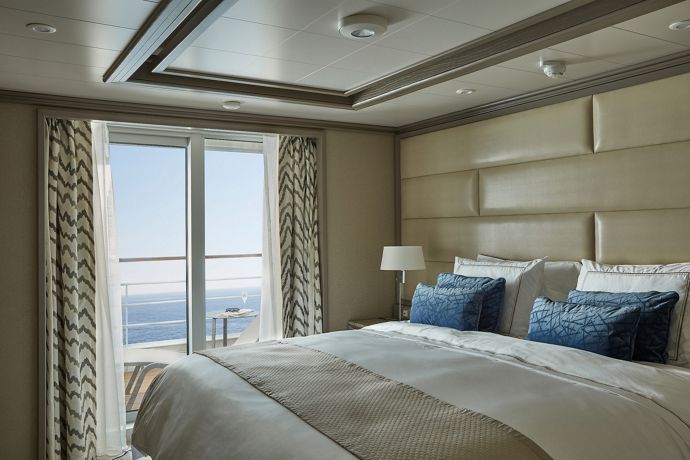
| Grade Code | From | To | |
| O1 | Owner's Suite (1 Bedroom) | £21,400 | £21,900 |
| O2 | Owner's Suite (2 Bedrooms) | £28,950 | £29,900 |
The name Owner’s Suite says it all. A stylish apartment. Prestigious and classic. For those who seek the superlative level of space, comfort, and service on board. Available as a one-bedroom configuration or as two bedrooms by adjoining with the Panorama Suite.
One bedroom: 120 sq m including veranda (12 sq m)
Two bedrooms: 114 sq m including veranda (12 sq m)
Please note that the 3rd guest will sleep on a comfortable sofa bed in the reception area of the suite.
Essentials
Characteristics
Furniture
Media & Communication
Onboard Services
Amenities
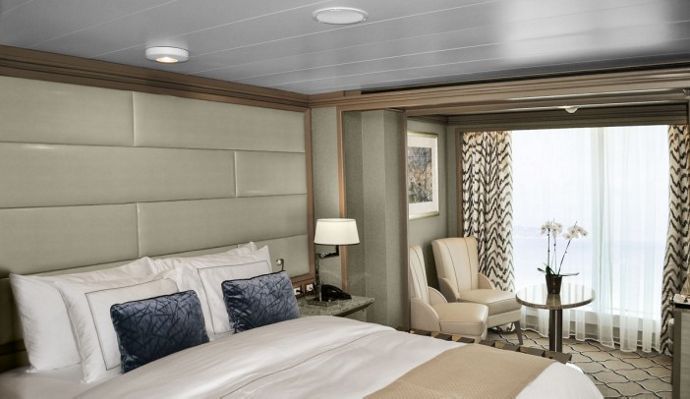
| Grade Code | From | To | |
| PA | Panorama Suite | £6,400 | £6,900 |
The Panorama Suite provides generous living space for voyagers. Located on deck 9, the Panorama offers all the comfort and attention to detail that you can expect aboard. A generous expanse of interior comforts—elegant decor, a stunning marble bathroom, and an ample seating area make this a cozy home away from home. The seating area of the Panorama Suite has plenty of room to relax while large picture windows frame panoramic ocean views.
One bedroom: 31 sq m
Essentials
Characteristics
Furniture
Media & Communication
Onboard Services
Amenities
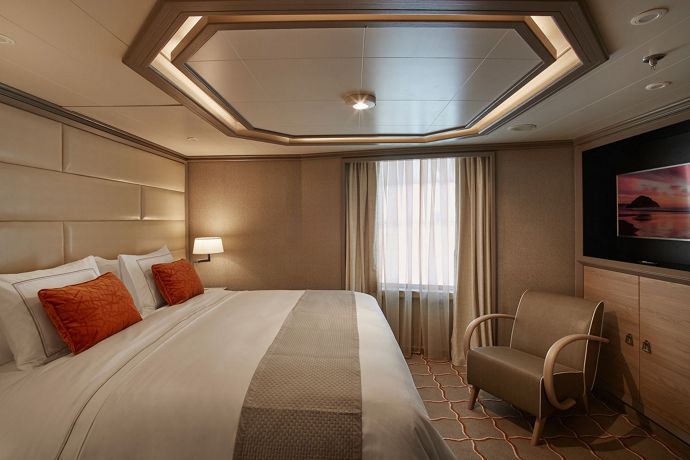
| Grade Code | From | To | |
| R1 | Royal Suite (1 Bedroom) | £17,400 | £17,900 |
| R2 | Royal Suite (2 Bedrooms) | £25,850 | £26,800 |
Stately describes the Royal Suite. Commanding and majestic. Perfect for entertaining. Enough living space to roam. The pinnacle of good living. Available as a one-bedroom configuration or as two bedrooms by adjoining with a Veranda Suite.
One bedroom: 92 sq m including veranda (12 sq ft)
Two bedrooms: 127 sq m including veranda (18 sq m)
Please note that the third guest will sleep on a comfortable sofa bed in the reception area of the suite.
Essentials
Characteristics
Furniture
Media & Communication
Onboard Services
Amenities
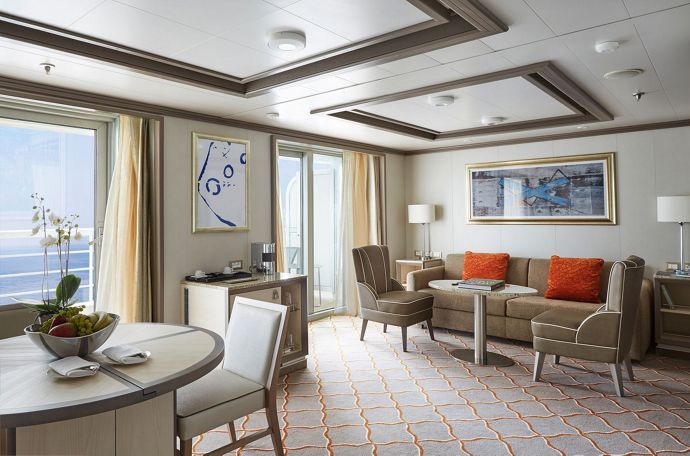
| Grade Code | From | To | |
| SL | Silver Suite | £14,300 | £14,800 |
| S2 | Silver Suite (2 Bedrooms) | £21,850 | £22,800 |
Step onto your terrace and bask in the calm feeling of the ocean breeze. Dissolve into the comfort of your king-size bed. Prepare for the evening in the beautiful marble bathroom. The upper deck location gives the most spectacular of ocean views while the spacious living area allows for comfortable relaxing, where cozy nights in become veritable experiences in themselves. The two-bedroom configuration of this suite makes this the ideal option for families.
One bedroom: 69 sq m including veranda (12 sq ft)
Please note that the 3rd guest will sleep on a comfortable sofa bed in the reception area of the suite.
Two bedrooms: 100 sq m including veranda (12 sq ft)
Essentials
Characteristics
Furniture
Media & Communication
Onboard Services
Amenities
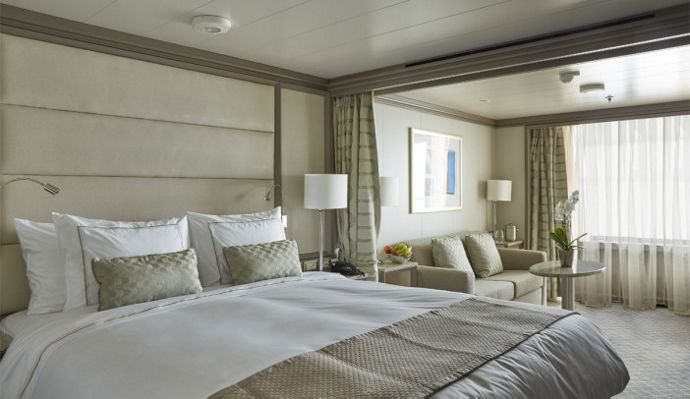
| Grade Code | From | To | |
| VI | Vista Suite | £6,000 | £6,500 |
A quiet sanctuary. The seating area of the Vista Suite has plenty of room to relax. Large picture windows frame panoramic ocean views. The perfect backdrop for breakfast in bed during the cruise. Some Vista Suites accommodate three guests.
One bedroom: 32 sq m
Please note that the 3rd guest will sleep on a comfortable sofa bed in the reception area of the suite.
Essentials
Characteristics
Furniture
Media & Communication
Onboard Services
Amenities
The images shown are for illustration purposes only and may not be an exact representation of what you find on the ship.
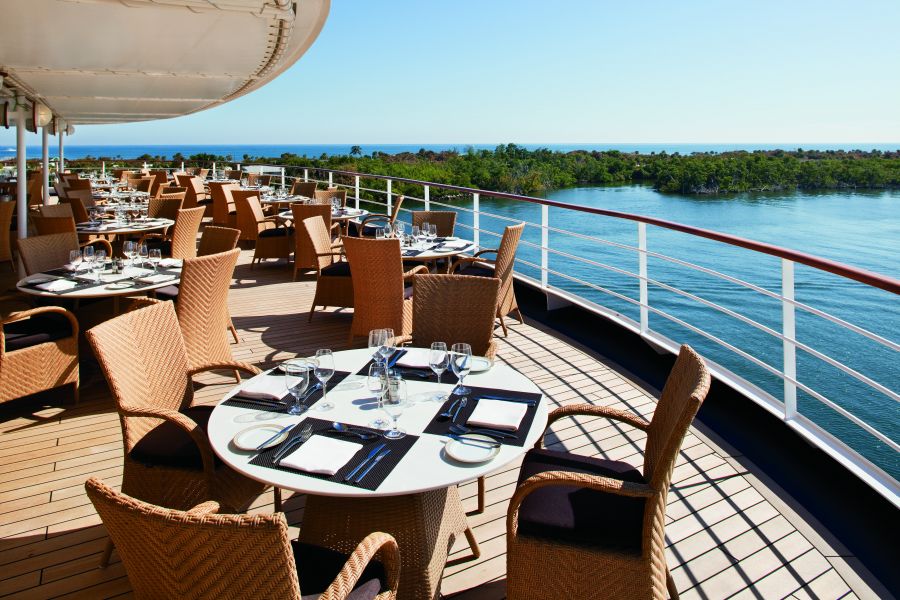
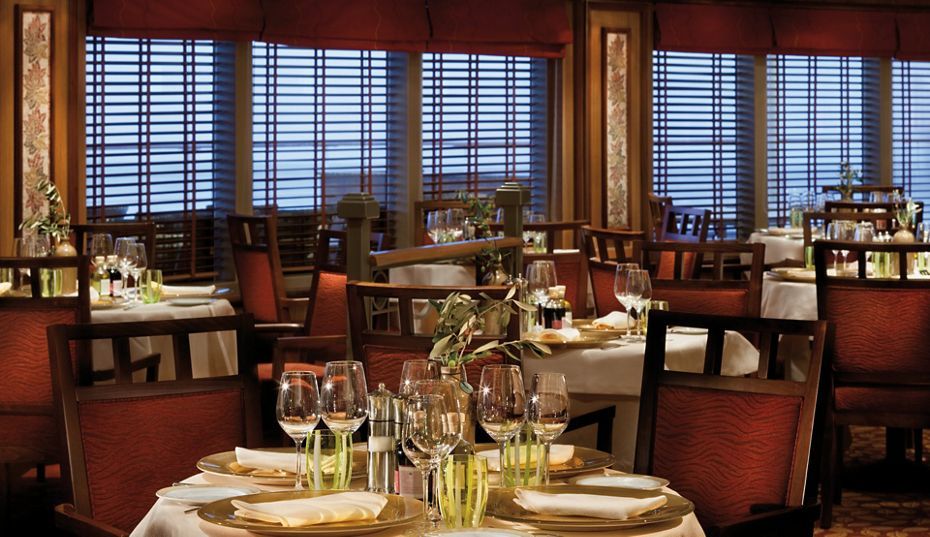
On board this luxury cruise ship, a divine selection of Italy’s best cuisine is served à la carte in La Terrazza. Authentic recipes and the freshest ingredients come together with flair and passion—a flavorful expression of Silversea’s distinctive Italian heritage. La Terrazza uses buffalo mozzarella from Naples, organic balsamic vinegar and olive oil from Umbria, and air-dried ham out of Parma. The Emilia-Romagna region also produces Silversea’s 24-month aged Parmigiano Reggiano, and the pasta is made daily right on board. La Terrazza is open for casual, buffet-style breakfast and lunch with indoor or alfresco dining on the outdoor terrace. During the evening, La Terrazza transforms into an à la carte traditional Italian restaurant.
Open seating for breakfast and lunch. Reservations recommended for dinner.
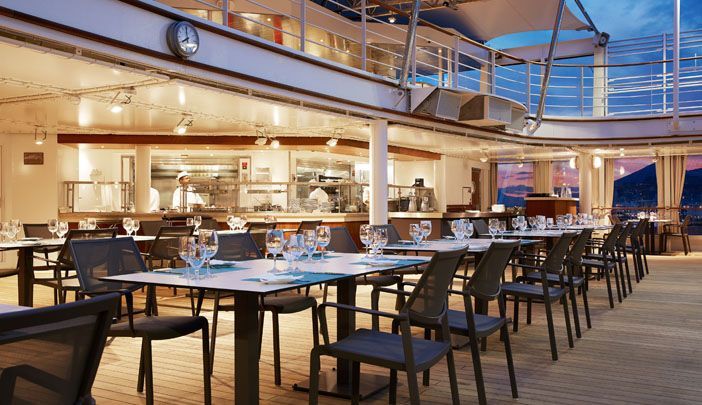
Silversea’s much-loved casual dining restaurant serves a delectable range of burgers and salads by day and turns into our famous Hot Rocks table BBQ concept by night. The Grill is quite simply the best place to eat between sea and sky. If you like flavorsome meals cooked to perfection, a casual, laid-back atmosphere, and OMG views, then The Grill is the answer to your prayers.
Open seating for lunch. Reservation recommended for dinner.
Images are intended as a general reference. Features, materials, finishes and layout may be different than shown.
The images shown are for illustration purposes only and may not be an exact representation of what you find on the ship.
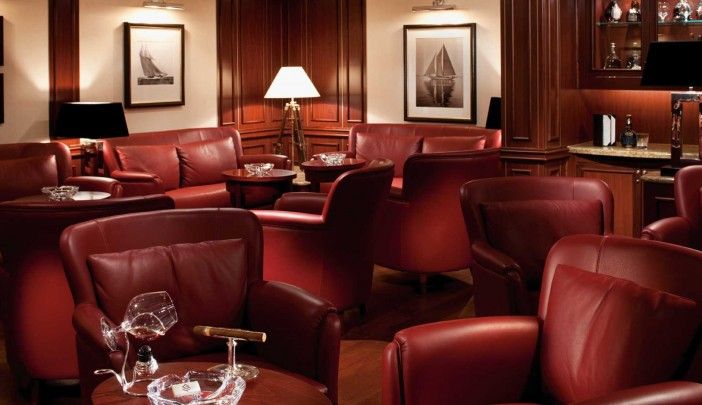
Discreet. Tasteful. Polished. If you appreciate the finer things in life, then the sophisticated touches of the Connoisseur’s Corner will not disappoint. Rich and luxurious, yet airy and spacious, this indoor/outdoor venue is where you sip the finest cognac or whiskey from a prestigious range and revel in the tranquil murmur of after-dinner conversation. A premium choice of cigars is also available, making this a perfect evening haven of serenity.
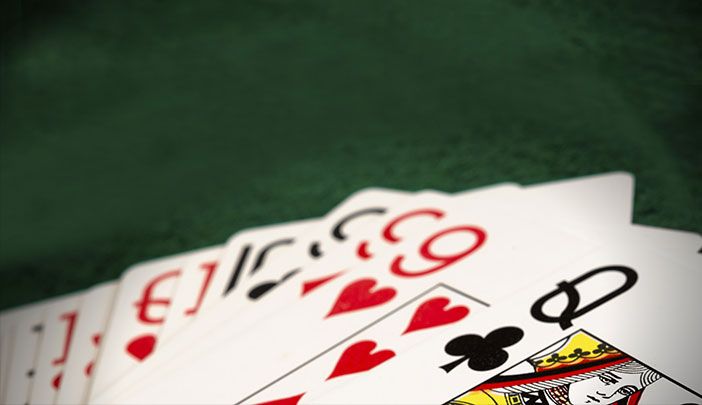
Whatever your conference or meeting requirements, Silversea is pleased to provide a tailor-made experience. Audiovisual equipment is available and complimentary on board this luxury cruise ship.
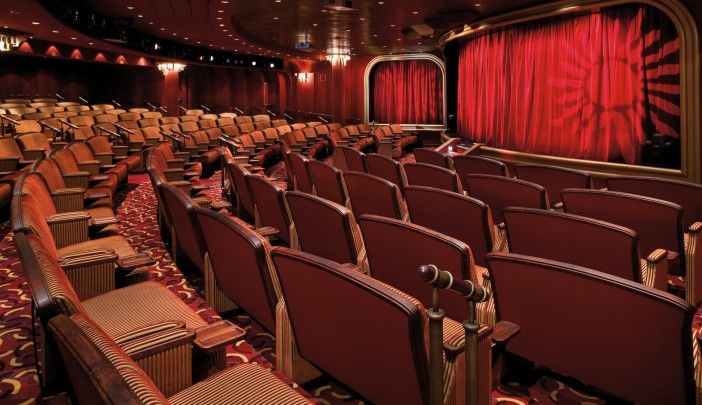
Applaud a broad spectrum of entertainment—from full-scale production shows and classical soloists to cultural entertainment and feature films. Throughout your voyage, this luxury cruise ship’s Venetian Lounge also presents port talks, enrichment lectures, and a variety of special events.
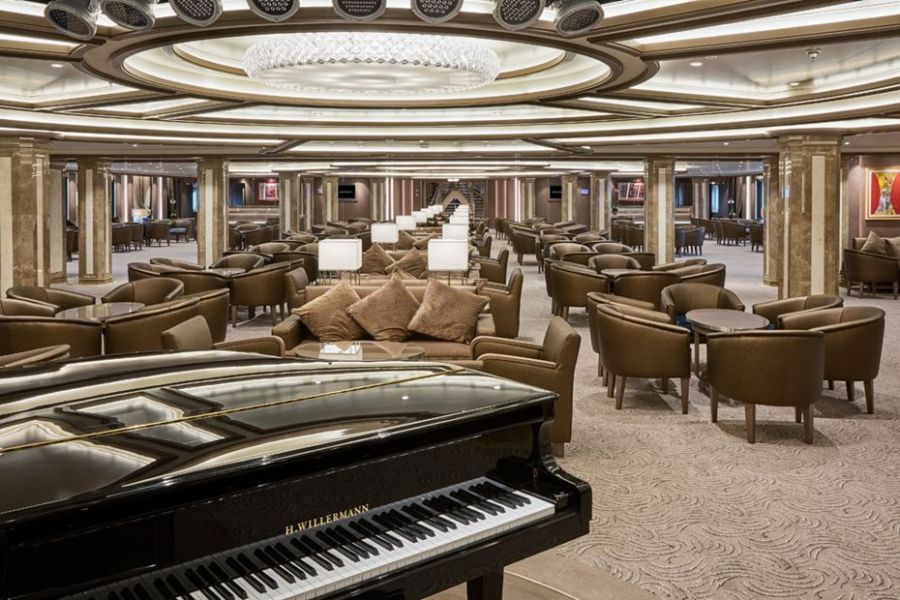
What could be a more fitting name for the very heart of Silver Spirit? Central to the soul and inspiration behind Silversea’s Italian heritage, Dolce Vita is the gathering place for our savvy travelers of the world, a place where guests mingle and exchange stories and where new faces become lifelong friends. Let us spoil you with an incredible array of flawless cocktails, wines, and spirits, as you relax, enjoy the evening sounds of a live pianist, and enjoy “the sweet life” aboard.
The images shown are for illustration purposes only and may not be an exact representation of what you find on the ship.
The images shown are for illustration purposes only and may not be an exact representation of what you find on the ship.


Our Fusion packages are all ABTA & ATOL protected ensuring that your booking is safe with us
| 12 nights aboard the Silver Spirit | |||
| Butler Service in Every Suite | |||
| Gratuities Always Included | |||
| Beverages In-Suite and Throughout the Ship | |||
| Gourmet Dining | |||
| In Suite Dining & 24-Hour Room Service | |||
| Intimate small size ships | |||
| Free Wifi Throughout the Ship | |||
| Free Zodiac, Land and Sea Tours & Activities & Complimentary Expedition gear | |||
| Port Taxes and Fees | |||
 | ABTA and ATOL Protection* | ||
Date 15th Sep 2027 |
Nts 12 |
Suite £6,000pp |
Date 15th Sep 2027 |
Nts 12 |
Suite £6,000pp |
| Suite staterooms from | £6,000pp | ||
| CV | Classic Veranda Suite | £7,100pp | |
| DX | Deluxe Veranda Suite | £7,550pp | |
| G1 | Grand Suite (1 Bedroom) | £19,150pp | |
| G2 | Grand Suite (2 Bedrooms) |  | |
| O1 | Owner's Suite (1 Bedroom) | | |
| O2 | Owner's Suite (2 Bedrooms) | | |
| ME | Medallion Suite | £10,750pp | |
| PA | Panorama Suite | £6,400pp | |
| R1 | Royal Suite (1 Bedroom) | | |
| R2 | Royal Suite (2 Bedrooms) | | |
| S2 | Silver Suite (2 Bedrooms) | | |
| SL | Silver Suite | | |
| SV | Superior Veranda Suite | £7,400pp | |
| VI | Vista Suite | £6,000pp | |
Fusion Holidays when selling travel arrangements is a trading name of Co-op Travel Services Limited, registration 08903986. Fusion Cruises is an Accredited Body Member of Co-op Travel Services Limited ATOL 12904.
Book with Confidence. We are a Member of ABTA which means you have the benefit of ABTA’s assistance and Code of Conduct.
Some of the flights and flight-inclusive holidays on this website are financially protected by the ATOL scheme but ATOL protection does not apply to all holiday and travel services offered on this website. This website will provide you with information on the protection that applies in the case of each holiday and travel service offered before you make your booking. If you do not receive an ATOL Certificate then the booking will not be ATOL protected. If you do receive an ATOL Certificate but all parts of your trip are not listed on it, those parts will not be ATOL protected. Please see our booking conditions for information, or for more information about financial protection and the ATOL Certificate go to: www.caa.co.uk