This site uses cookies as defined in our Cookie Policy, by continuing to use this site you agree to their use.
Continue

| Arrive | Depart | ||||||
| 5th05 | JanJan | 202929 | San Diego, California, United States, embark on the Silver Whisper | 16:00 | |||
San Diego is a vacationer's paradise, with year-round temperatures in the seventies and near-constant sunshine. One of America's most family-friendly cities, San Diego is home to LEGOLAND, the New Children's Museum, and the famous San Diego Zoo. Sunbathers and surfers are guaranteed to find their perfect beach, and foodies find delights in artisanal breweries, local bistros, and gourmet restaurants. From the Broadway excitement of La Jolla Playhouse to the European feel of Little Italy to the nouveau-chic of the Gaslamp Quarter, San Diego has something for everyone. Attention all sun, sea and surf lovers! Welcome to the place that considers those three words the only three little words worth saying. This is where the vibe is cool, the living is easy and weekends are spent worshiping the holy trinity, beachside. The southernmost city in California, San Diego borders Mexico which gives the place a slightly transient feel, although as America’s eighth largest city, it is anything but. Made up of little neighbourhoods, each has their own personality which gives a blended family feel. There’s Mission Beach, Little Italy, the Gaslamp Quarter, Downtown… all in all 17 neighbourhoods range from quirky to cool result in a city which is much more than a sum of its parts. European settlers arrived in the mid-18th century although Iberian explorer Juan Rodriguez Cabrillo claims to have discovered San Diego Bay in 1542, 200 years previously. Regardless of when the Europeans arrived, there is proof that Native Americans populated the land 12,000 years before, and a trip to the San Diego History Centre is both educational and inspirational. The town became part of the United States of America in 1848 (it had been under Mexican rule before that) and since then has carved out a niche for being “America’s finest city”, a moniker that you’ll see everywhere from t-shirts to bumper stickers. If it feels familiar, that’s because it is. Jack Lemmon, Tony Curtis and Marilyn Monroe filmed Some Like It Hot here and the city’s slightly worn around but ever so glamourous feel has remained. | |||||||
| 6th06 | JanJan | 202929 | At Sea | ||||
| 7th07 | JanJan | 202929 | At Sea | ||||
| 8th08 | JanJan | 202929 | At Sea | ||||
| 9th09 | JanJan | 202929 | At Sea | ||||
| 10th10 | JanJan | 202929 | At Sea | ||||
| 11th11 | JanJan | 202929 | Honolulu, Hawaii, United States | ||||
Capital of Hawaii, and a popular tourist destination, Honolulu is known for surfing and water sports. However, there's more to the city than surfing; with museums, the only royal palace in the country, and a mall, there's bound to be something of interest for any visitor. Here is Hawaii's only true metropolis, its seat of government, center of commerce and shipping, entertainment and recreation mecca, a historic site, and an evolving urban area—conflicting roles that engender endless debate and controversy. For the visitor, Honolulu is an everyman's delight: hipsters and scholars, sightseers and foodies, nature lovers and culture vultures all can find their bliss. Once there was the broad bay of Mamala and the narrow inlet of Kou, fronting a dusty plain occupied by a few thatched houses and the great Pakaka heiau (shrine). Nosing into the narrow passage in the early 1790s, British sea captain William Brown named the port Fair Haven. Later, Hawaiians would call it Honolulu, or "sheltered bay." As shipping traffic increased, the settlement grew into a Western-style town of streets and buildings, tightly clustered around the single freshwater source, Nuuanu Stream. Not until piped water became available in the early 1900s did Honolulu spread across the greening plain. Long before that, however, Honolulu gained importance when King Kamehameha I reluctantly abandoned his home on the Big Island to build a chiefly compound near the harbor in 1804 to better protect Hawaiian interests from the Western incursion. Two hundred years later, the entire island is, in a sense, Honolulu—the City and County of Honolulu. The city has no official boundaries, extending across the flatlands from Pearl Harbor to Waikiki and high into the hills behind. The main areas (Waikiki, Pearl Harbor, Downtown, Chinatown) have the lion's share of the sights, but greater Honolulu also has a lot to offer. One reason to venture farther afield is the chance to glimpse Honolulu's residential neighborhoods. Species of classic Hawaii homes include the tiny green-and-white plantation-era house with its corrugated tin roof, two windows flanking a central door and small porch; the breezy bungalow with its swooping Thai-style roofline and two wings flanking screened French doors through which breezes blow into the living room. Note the tangled "Grandma-style" gardens and many ohana houses—small homes in the backyard of a larger home or built as apartments perched over the garage, allowing extended families to live together. Carports, which rarely house cars, are the island's version of rec rooms, where parties are held and neighbors sit to "talk story." Sometimes you see gallon jars on the flat roofs of garages or carports: these are pickled lemons fermenting in the sun. Also in the neighborhoods, you find the folksy restaurants and takeout spots favored by the islanders. | |||||||
| 12th12 | JanJan | 202929 | Honolulu, Hawaii, United States | 19:00 | |||
Capital of Hawaii, and a popular tourist destination, Honolulu is known for surfing and water sports. However, there's more to the city than surfing; with museums, the only royal palace in the country, and a mall, there's bound to be something of interest for any visitor. Here is Hawaii's only true metropolis, its seat of government, center of commerce and shipping, entertainment and recreation mecca, a historic site, and an evolving urban area—conflicting roles that engender endless debate and controversy. For the visitor, Honolulu is an everyman's delight: hipsters and scholars, sightseers and foodies, nature lovers and culture vultures all can find their bliss. Once there was the broad bay of Mamala and the narrow inlet of Kou, fronting a dusty plain occupied by a few thatched houses and the great Pakaka heiau (shrine). Nosing into the narrow passage in the early 1790s, British sea captain William Brown named the port Fair Haven. Later, Hawaiians would call it Honolulu, or "sheltered bay." As shipping traffic increased, the settlement grew into a Western-style town of streets and buildings, tightly clustered around the single freshwater source, Nuuanu Stream. Not until piped water became available in the early 1900s did Honolulu spread across the greening plain. Long before that, however, Honolulu gained importance when King Kamehameha I reluctantly abandoned his home on the Big Island to build a chiefly compound near the harbor in 1804 to better protect Hawaiian interests from the Western incursion. Two hundred years later, the entire island is, in a sense, Honolulu—the City and County of Honolulu. The city has no official boundaries, extending across the flatlands from Pearl Harbor to Waikiki and high into the hills behind. The main areas (Waikiki, Pearl Harbor, Downtown, Chinatown) have the lion's share of the sights, but greater Honolulu also has a lot to offer. One reason to venture farther afield is the chance to glimpse Honolulu's residential neighborhoods. Species of classic Hawaii homes include the tiny green-and-white plantation-era house with its corrugated tin roof, two windows flanking a central door and small porch; the breezy bungalow with its swooping Thai-style roofline and two wings flanking screened French doors through which breezes blow into the living room. Note the tangled "Grandma-style" gardens and many ohana houses—small homes in the backyard of a larger home or built as apartments perched over the garage, allowing extended families to live together. Carports, which rarely house cars, are the island's version of rec rooms, where parties are held and neighbors sit to "talk story." Sometimes you see gallon jars on the flat roofs of garages or carports: these are pickled lemons fermenting in the sun. Also in the neighborhoods, you find the folksy restaurants and takeout spots favored by the islanders. | |||||||
| 13th13 | JanJan | 202929 | Kailua-Kona, Hawaii, United States | 08:30 | 20:00 | ||
Kailua-Kona is a town on the west coast of Hawaii Island (the Big Island). Hulihee Palace is a former royal vacation home dating from 1838. Mokuaikaua Church, from the 1800s, is Hawaii’s oldest Christian church. On Kailua Bay, reconstructed thatched houses at Kamakahonu National Historic Landmark mark King Kamehameha I’s residence. Colorful coral lies off Kamakahonu Beach. Kailua Pier has boat moorings. The Kona coast, on Hawaii’s western shore, divides into two distinct areas – the north with spectacular sandy beaches followed farther up by a long bleak slope of barren lava trails from dormant Mauna Kea all the way down to the sea. Southwards, the hillsides are more fertile and there is still a feel of the old Hawaii. The Big Island’s main resort is officially called Kailua, but mostly everyone simply refers to it as Kona, or Kailua-Kona. It is by far the island’s most developed area. Whilst the main road, Ali’i Drive, is lined with shops, hotels and condominiums, most of the shoreline vista remains intact thanks to low-rise buildings. To show just how fertile lava can be when tended, miles of multi-hued bougainvillea and poinsettias line Ali’i Drive like a colourful lei. East of town is the 8,271-foot (2,521-metre) Mount Hualalai, where local people still earn a living growing vegetables and taro on small farms spreading over the side of the mountain. In the centre of Kona stands the Hulihee Palace built as the governor’s residence in 1838. The relatively simple dwelling was heavily damaged during the last big storm and is now under restoration. The north end of downtown is home to Ahuena Heiau, where King Kamehameha spent the last years of his life. A dozen miles south of Kona at Kealakekua Bay is the site where Captain Cook was killed on his second voyage to Hawaii. South Kona is also the prime source of the famous Kona coffee. | |||||||
| 14th14 | JanJan | 202929 | At Sea | ||||
| 15th15 | JanJan | 202929 | At Sea | ||||
| 16th16 | JanJan | 202929 | At Sea | ||||
| 17th17 | JanJan | 202929 | At Sea | ||||
| 18th18 | JanJan | 202929 | At Sea | ||||
| 19th19 | JanJan | 202929 | Nuku Hiva Island, French Polynesia | 09:00 | 19:00 | ||
| Think of French Polynesia and you are automatically transported to the white sands of Tahiti, the blue seas of Bora Bora or, at the very least, the iconic statues of Easter Island. Now, imagine a place that is home to that majestic trinity, but has no crowds and is full of island authenticity that is rare in these global times. You have just imagined Nuku Hiva. The island is the second largest after Tahiti in the archipelago, but is yet to be discovered by tourism. As part of the Marquesas Islands, Nuku Hiva is technically French, but don’t expect to find any blue and white striped shirts here! In fact, even though French is the “official” language of the island, a sing-song dialect of Tahitian mixed with Marquesan is more widely spoken. The younger generations also speak English. Undeniably, Nuku Hiva has been blessed by the Gods. With towering mountains, eight magnificent harbours, and one of the world's highest waterfalls, Nuku Hiva is rich with Mother Nature’s jewels. The island could lay claim to a great many claims to fame, such as its deep, unpolluted waters, its lush forests bursting with vitality or its fascinating assortment of archaeological interests including tikis (sacred statues) and pae pae (stone platforms that formed the foundations of houses). Yet for those in the know, the island’s primary claim to fame is that author Herman Mellville deserted his ship in order to live among the natives of the island and his books Typee and Omoo were inspired by his experiences on Nuku Hiva. | |||||||
| 20th20 | JanJan | 202929 | At Sea | ||||
| 21st21 | JanJan | 202929 | Fakarava, French Polynesia | 08:00 | 19:00 | ||
| Fakarava is oblong shaped and has an almost continuous string of reef and motu stretching for 40 km (25 mi) on its eastern edge. It's the second largest of the Tuamotu atolls located 450 km (280 mi) northeast of Tahiti and 120 km (75 mi) southeast of Rangiroa. It's renowned for the drift diving in its two passes—Garuae (also spelled Ngarue) in the north near the main town of Rotoava (and the airport) and Tamakohua Pass 48 km (30 mi) across the lagoon in the south. The tiny village of Tetamanu situated by the southern pass was once the capital of the Tuamotus and houses the first church built in the archipelago in 1874. In 2006 the entire atoll was deemed an UNESCO biosphere reserve to preserve the lagoon no overwater bungalows have been built in it. Fakarava was "discovered" by Russian explorer Fabian Gottlieb Von Bellingshausen in 1820 some 20 years later missionaries arrived in the guise of fanatical Catholic priest Honore Laval and began building churches. | |||||||
| 22nd22 | JanJan | 202929 | Rangiroa, French Polynesia | 08:00 | 15:00 | ||
| Rangiroa is French Polynesia’s largest atoll. More than 400 motu (islets) enclose the lagoon, which is so wide and long that one cannot see the southern row of motu from the two main islets in the north –hence the local name Rangiroa meaning wide or long sky, sometimes taken as “immense sky”. There are several passes from the ocean into the lagoon and the two main villages of Avatoru and Tiputa are located next to the passes of the same names. Drift diving and snorkeling the incoming tides looking for sharks and manta rays at these passes is one of Rangiroa’s main touristic draws. Government jobs, ecotourism and pearl farming are the main sources of income on the atoll. The lagoon’s calm turquoise waters, rich marine underwater world and relaxed atmosphere attract visitors year-round to the many local guesthouses and a few hotels. Both Avatoru and Tiputa also feature schools for the other Tuamotu Islands which have no higher education possibilities. One of Rangiroa’s most unusual attractions is the white and rose wine produced on the islet immediately west of Avatoru –the wine has won several awards. | |||||||
| 23rd23 | JanJan | 202929 | Papeete, Tahiti, French Polynesia | ||||
Papeete will be your gateway to the tropical paradise of French Polynesia, where islands fringed with gorgeous beaches and turquoise ocean await to soothe the soul. This spirited city is the capital of French Polynesia, and serves as a superb base for onward exploration of Tahiti – an island of breathtaking landscapes and oceanic vistas. Wonderful lagoons of crisp, clear water beg to be snorkelled, stunning black beaches and blowholes pay tribute to the island's volcanic heritage, and lush green mountains beckon you inland on adventures, as you explore extraordinary Tahiti. Visit to relax inside picturesque stilted huts, which stand out over shimmering water, as you settle into the intoxicating rhythm of life, in this Polynesian paradise. Papeete is the center of the tropical paradise of French Polynesia where islands fringed with gorgeous beaches and turquoise ocean await to soothe the soul. This spirited city is the capital of French Polynesia and serves as a superb base for onward exploration of Tahiti – an island of breathtaking landscapes and oceanic vistas. A wonderful lagoon of crisp clear water begs to be snorkelled stunning black beaches and blowholes pay tribute to the island's volcanic heritage and lush green mountains beckon you inland on adventures as you explore extraordinary Tahiti. Visit to relax and settle into the intoxicating rhythm of life in this Polynesian paradise. | |||||||
| 23rd23 | JanJan | 202929 | Papeete, Tahiti, French Polynesia | ||||
Papeete will be your gateway to the tropical paradise of French Polynesia, where islands fringed with gorgeous beaches and turquoise ocean await to soothe the soul. This spirited city is the capital of French Polynesia, and serves as a superb base for onward exploration of Tahiti – an island of breathtaking landscapes and oceanic vistas. Wonderful lagoons of crisp, clear water beg to be snorkelled, stunning black beaches and blowholes pay tribute to the island's volcanic heritage, and lush green mountains beckon you inland on adventures, as you explore extraordinary Tahiti. Visit to relax inside picturesque stilted huts, which stand out over shimmering water, as you settle into the intoxicating rhythm of life, in this Polynesian paradise. Papeete is the center of the tropical paradise of French Polynesia where islands fringed with gorgeous beaches and turquoise ocean await to soothe the soul. This spirited city is the capital of French Polynesia and serves as a superb base for onward exploration of Tahiti – an island of breathtaking landscapes and oceanic vistas. A wonderful lagoon of crisp clear water begs to be snorkelled stunning black beaches and blowholes pay tribute to the island's volcanic heritage and lush green mountains beckon you inland on adventures as you explore extraordinary Tahiti. Visit to relax and settle into the intoxicating rhythm of life in this Polynesian paradise. | |||||||
| 24th24 | JanJan | 202929 | Papeete, Tahiti, French Polynesia | 05:00 | |||
Papeete will be your gateway to the tropical paradise of French Polynesia, where islands fringed with gorgeous beaches and turquoise ocean await to soothe the soul. This spirited city is the capital of French Polynesia, and serves as a superb base for onward exploration of Tahiti – an island of breathtaking landscapes and oceanic vistas. Wonderful lagoons of crisp, clear water beg to be snorkelled, stunning black beaches and blowholes pay tribute to the island's volcanic heritage, and lush green mountains beckon you inland on adventures, as you explore extraordinary Tahiti. Visit to relax inside picturesque stilted huts, which stand out over shimmering water, as you settle into the intoxicating rhythm of life, in this Polynesian paradise. Papeete is the center of the tropical paradise of French Polynesia where islands fringed with gorgeous beaches and turquoise ocean await to soothe the soul. This spirited city is the capital of French Polynesia and serves as a superb base for onward exploration of Tahiti – an island of breathtaking landscapes and oceanic vistas. A wonderful lagoon of crisp clear water begs to be snorkelled stunning black beaches and blowholes pay tribute to the island's volcanic heritage and lush green mountains beckon you inland on adventures as you explore extraordinary Tahiti. Visit to relax and settle into the intoxicating rhythm of life in this Polynesian paradise. | |||||||
| 24th24 | JanJan | 202929 | Moorea, French Polynesia | 08:15 | 18:00 | ||
Mo’orea is one of the Society Islands of the French Polynesia. Located in the South Pacific, it is considered a magical island thanks to its majestic volcanic mountains, set against warm lagoon waters and green meadows. It is an island that attracts visitors of all abilities wanting to explore both above and below the ocean waters. Moorea is a high mountainous island with two nearly symmetrical bays found on the north coast. The island’s triangular shape has been likened to a heart or a bat. Eight mountain peaks reaching a height of up to 1,207 meters give Moorea a very rugged silhouette. The reef surrounding the island encloses a narrow lagoon –a RAMSAR Wetland- and has barely any motu (reef islets). Sharks and rays are some of the lagoon’s attractions. The island is only one eighth the size of neighboring Tahiti and has a more relaxed life-style. A road leads around Moorea, passing small villages with their churches and the resorts and smaller hotels mainly found on the north coast. A detour into the interior will show large pineapple plantations, French Polynesia’s only agricultural school, ancient marae (stone platforms) and splendid views of the island from Belvedere above Cook’s Bay or the Magic Mountain above Papetoai, Opunohu Bay. Many of the 18,000 residents work in Tahiti, taking one of the ferries plying between Vaiare on the east coast and Papeete. This led to Papeete being one of France’s busiest ports in passenger volume. Foreign visitors either come into Temae airport, tucked in-between the Green Pearl golf course and Temae’s public beach, or by ship entering one of the two bays on the north coast. Both bays are connected to Captain Cook’s visit in 1777: he stayed in Opunohu Bay, but to honor him Pao Pao Bay has been named Cook’s Bay. | |||||||
| 25th25 | JanJan | 202929 | Bora-Bora, French Polynesia | ||||
Simply saying the name Bora Bora is usually enough to induce gasps of jealousy, as images of milky blue water, sparkling white beaches and casually leaning palm trees immediately spring to mind. The imagination doesn't lie, either, and if you visit, you’ll soon realise this island is every bit as gorgeous as you ever imagined. Thatched wooden huts stand out over shallow, sparkling seawater, with vivid fish swirling just below. Soak up the sun, scuba dive, or simply revel in the opulent luxury of one of the island's many magnificent resorts. If blissful inactivity doesn't appeal, then get active, and hike the greenery of the sharp Mount Pahia. If you have ever dreamt up your ideal island holiday, we suspect it goes something like this: Soapy blue seas? Check. Sparkling white beaches? Check. Thatched wooden huts, gently sloping palm trees and kaleidoscopic marine life? Check, check and check. And yet, even by ticking every box, first time viewing of Bora Bora still beggars belief. This tropical hideaway less than 12 m2 in the heart of the South Pacific has been toping travel wish lists for years. Long considered the realm of honeymooners – spectacularly romantic sunsets are a speciality – Bora Bora is not just for wandering with your love. If the prismatic shades of blue of the world’s most beautiful lagoon do not fill you up, then perhaps underwater scooters and aqua Safaris will charge your batteries. If exploring Bora Bora’s lush hinterland is more your glass of tequila sunrise, then trips around the island (often stopping off at the celebrity haunt Bloody Mary Restaurant & Bar) are a must. Bora Bora's peaceful ambience has not always been the case. The island was a US supply base, known as "Operation Bobcat" during WWII. During this time, Bora Bora was home to nine ships, 20,000 tons of equipment and nearly 7,000 men. Eight massive 7-inch naval cannons were installed around the island, all but one of which is still in place. Although little is known of the history of the island, it is known that Bora Bora was called Vava’u in ancient times. This supports belief that the island was colonised by Tongans prior to French annex in 1888. | |||||||
| 26th26 | JanJan | 202929 | Bora-Bora, French Polynesia | 16:00 | |||
Simply saying the name Bora Bora is usually enough to induce gasps of jealousy, as images of milky blue water, sparkling white beaches and casually leaning palm trees immediately spring to mind. The imagination doesn't lie, either, and if you visit, you’ll soon realise this island is every bit as gorgeous as you ever imagined. Thatched wooden huts stand out over shallow, sparkling seawater, with vivid fish swirling just below. Soak up the sun, scuba dive, or simply revel in the opulent luxury of one of the island's many magnificent resorts. If blissful inactivity doesn't appeal, then get active, and hike the greenery of the sharp Mount Pahia. If you have ever dreamt up your ideal island holiday, we suspect it goes something like this: Soapy blue seas? Check. Sparkling white beaches? Check. Thatched wooden huts, gently sloping palm trees and kaleidoscopic marine life? Check, check and check. And yet, even by ticking every box, first time viewing of Bora Bora still beggars belief. This tropical hideaway less than 12 m2 in the heart of the South Pacific has been toping travel wish lists for years. Long considered the realm of honeymooners – spectacularly romantic sunsets are a speciality – Bora Bora is not just for wandering with your love. If the prismatic shades of blue of the world’s most beautiful lagoon do not fill you up, then perhaps underwater scooters and aqua Safaris will charge your batteries. If exploring Bora Bora’s lush hinterland is more your glass of tequila sunrise, then trips around the island (often stopping off at the celebrity haunt Bloody Mary Restaurant & Bar) are a must. Bora Bora's peaceful ambience has not always been the case. The island was a US supply base, known as "Operation Bobcat" during WWII. During this time, Bora Bora was home to nine ships, 20,000 tons of equipment and nearly 7,000 men. Eight massive 7-inch naval cannons were installed around the island, all but one of which is still in place. Although little is known of the history of the island, it is known that Bora Bora was called Vava’u in ancient times. This supports belief that the island was colonised by Tongans prior to French annex in 1888. | |||||||
| 26th26 | JanJan | 202929 | Motu Tapu, French Polynesia | 16:01 | 23:00 | ||
| 27th27 | JanJan | 202929 | Raiatea, French Polynesia | 08:00 | 18:00 | ||
Known as the "Sacred Island," Raiatea is a fascinating haunt for archaeologists and historians as it's one of the islands in the Pacific where Polynesian culture can trace its roots. Visitors will find many of the older Polynesian structures still in place and are fascinating places to explore. In the 16th century, Raiatea developed a powerful cult dedicated to Oro the God of War and built a large meeting ground, the Taputaputea Marae, which is still intact. Human sacrifice was practiced until around the middle of the 18th century and visitors should look for the sacrificial stone. Several tour operators run visits to the marae (ancient temples) along with some degree of informed commentary—although in fairness Polynesian storytelling can embellish things a little. The Faaroa River is the only navigable waterway in French Polynesia and it can be traveled by powerboat or outrigger canoe. Running through the Faaroa Gorge it passes some spectacular scenery with steep-walled jungle foliage holding dozens of bird species and wild hibiscus. Trekking up Mount Temehani, a well-known landmark that's said to be Oro's birthplace, is relatively demanding. Keep a lookout for the rare, five-petal tiare apetahi. Said to be impossible to grow anywhere else, this white, indigenous flower can only be found above 1,300 feet (396 meters). Look, but don't touch. It's against the law to pick them. | |||||||
| 28th28 | JanJan | 202929 | At Sea | ||||
| 29th29 | JanJan | 202929 | At Sea | ||||
| 30th30 | JanJan | 202929 | At Sea | ||||
| 31st31 | JanJan | 202929 | Pago Pago, American Samoa | 08:00 | 19:00 | ||
American Samoa is a tropical paradise, located in the Pacific Ocean and home to some of the world's most unique flora and fauna. Pago Pago is the main harbour and village of Tutuila island. It is considered the capital of the territory and is the entry point for visitors exploring the picturesque volcanic islands. The high, volcanic islands of American Samoa sit along the Pacific Ring of Fire; their cone-shaped mountains rise with abrupt steepness. These islands are stunningly green, the windward hillsides carpeted thickly with coconut palms, breadfruit and mango, while the leeward side is punctuated by steep cliffs. Pago Pago (pronounced Pahngo Pahngo), on the island of Tutuila, boasts one of the world's most beautiful natural harbors that thrusts as a fjordlike arm deep into the land. The harbor was formed when the seaward wall of a volcano collapsed, allowing the sea to rush in. The bay and encircling mountain peaks present spectacular evidence of nature's force and astounding beauty. Introduced to the world in 1722 by a Dutchman, these islands were then visited by English missionaries in 1831; the islanders took to Christianity with enthusiasm. In 1900, in spite of the Germans who controlled Western Samoa, the United States took possession and the U.S. Navy ran American Samoa until 1951. Since then it has been administered by the U.S. Department of the Interior as an Incorporated Territory and thus is a unique part of the United States. Its 50,000 residents are U.S. citizens with equal rights, except for voting in national elections. Pago Pago, along with Fagatogo, is called the Bay Area. It is here where Somerset Maugham's story in his famous novel Rain was set. The story, which was made into a movie with Joan Crawford, was so popular that a hotel was named for the heroine, Sadie Thompson. Today, the former hotel houses a restaurant. The lookout over the harbor and out to sea is stunning, and you can hike up to Mount Alava on what is now National Park Trail. On a clear day, the Manu'a Group and Western Samoa are visible. Back in Pago Pago just below Solo Hill is Maugaoalii, the hill of chiefs, where Government House is located; you may walk around the beautiful grounds or visit the courthouse past the village green. There are a number of good things to do here in the combined town of Pago Pago-Fagatogo; as the island is compressed, it won't take long to accomplish them at a leisurely pace. Pier Information The ship is scheduled to dock at Pago Pago Harbor. The town center is within walking distance. Taxis are generally available at the pier. Shopping Shopping is not particularly exciting in American Samoa. There are small Korean, Samoan and American stores that carry items residents need on a daily basis. A limited selection of handicrafts and Samoan T-shirts are also available. The local currency is the U.S. dollar. Cuisine Stone hearth baked foods such as breadfruit, pork, chicken and bananas are available in most villages, while more international fare is available at restaurants in Pago Pago. Other Sites Fono Building Home of the territory's legislature, its architecture combines traditional "fale" construction with modern materials. Naval Guns Hill Located a short distance from the Rainmaker Hotel and requiring a short hike, two guns remain as relics from World War II. | |||||||
| 1st01 | FebFeb | 202929 | At Sea | ||||
| 2nd02 | FebFeb | 202929 | Apia, Samoa | 07:00 | 16:00 | ||
Samoa is a group of ten islands located in the South Pacific. The tropical climate and volcanic landscape create a picturesque location for visitors to explore, together with the experience of Fa'a Samoa, the three thousand year old way of life on Samoa. As the first independent state of Polynesia, Samoa is considered the cradle of the nation, a place where the Earth and the heart seamlessly fuse together. Incidentally, were one to translate the word "Samoa" into the traditional Polynesia dialect, they would find that the words "Sa" and "Moa" mean exactly that: earth and centre. Apia, Samoa's only town, is found central north coast of Upolu, Samoa’s second largest island. Originally a tiny village of just over 300 inhabitants (c. 1800), the town’s population has grown to be just shy of 40,000. While a population of such size might mean forgetting traditional roots in favour of modern life, this has not been the case (too much) in Apria. The Samoan way of life is still very much the order of the day; traditional open-sided houses with thatched roofs on platforms of coral or concrete, also known as 'fales', can be seen everywhere and nearly all of the population (including the policemen) wear the typical local dress; skirts, or ‘lavalavas’ for men, and long, mumu-style dresses for women. The markets are bursting with culture and colour, selling everything from handicrafts to cuisine and local produce. If the idyllic setting of aquamarine pools of bluey green water, framed by low fringed palms and huge umbrella trees seems familiar, that’s because it probably is. The island, and notably the southern resort of Lefaga, was used in the 1953 Gary Cooper classic Return to Paradise Beach. It is also the last place on Earth to see each day’s sunset. | |||||||
| 3rd03 | FebFeb | 202929 | At Sea | ||||
| 4th04 | FebFeb | 202929 | Lautoka, Fiji | ||||
North of Nadi through sugarcane plantations and past the Sabeto Mountains is Lautoka, nicknamed the Sugar City for the local agriculture and its big processing mill. With a population of around 50,000, it's the only city besides Suva and, like the capital, has a pleasant waterfront. It's the sailing point for Blue Lagoon and Beachcomber Cruises but is otherwise unremarkable for tourists, itself having few hotels and fewer good restaurants. Locals recommend the city as a less-expensive place to shop for clothing, but note that it can take as long as 45 minutes to drive here. Legend has it that Lautoka acquired its name when two chiefs engaged in combat and one hit the other with a spear. He proclaimed "lau toka" (spear hit) and thus the future town was named. It doesn’t get much sweeter than arriving on the sun-soaked shores of the Sugar City. Fiji’s second-biggest settlement opens up a world of blissful beaches and turquoise seascapes while its dense jungle lures the adventurous deep into its embrace. Experience rich Fijian life and see dramatic displays like warrior dances and remarkable local practices like firewalks which kick up burning embers into the night's sky. Legend says the city took its name after two chiefs faced each other in a duel. A spear pierced one of the chiefs leading to the shout of 'lau-toka!' or 'spear hit!' Sugar is Lautoka’s main trade but its botanical gardens are a sweet insight into the tropical plant life that thrives here - from pearl white lilies to tall fragrant orchids. Explore temples charming cafes and mills - or barter for some of the juiciest mangoes you’ll ever taste at the city’s lively market. You'll only be able to resist the beaches for so long and it doesn’t get much more stunning than the Blue Lagoon - a heavenly blend of woven together turquoise shades. Remote wild and unspoiled these are some of the best tropical beaches in the world. There's more rejuvenating relaxation at the mineral-rich mud pools and spas fuelled by the volcanic activity below. Savala Island is a teardrop of sand offshore and another beautiful place to wander with the soft powder between your toes - along sandy spits that peter out into the water. Or swim and snorkel among its envied reefs thronging with fish life. | |||||||
| 5th05 | FebFeb | 202929 | Lautoka, Fiji | 17:00 | |||
North of Nadi through sugarcane plantations and past the Sabeto Mountains is Lautoka, nicknamed the Sugar City for the local agriculture and its big processing mill. With a population of around 50,000, it's the only city besides Suva and, like the capital, has a pleasant waterfront. It's the sailing point for Blue Lagoon and Beachcomber Cruises but is otherwise unremarkable for tourists, itself having few hotels and fewer good restaurants. Locals recommend the city as a less-expensive place to shop for clothing, but note that it can take as long as 45 minutes to drive here. Legend has it that Lautoka acquired its name when two chiefs engaged in combat and one hit the other with a spear. He proclaimed "lau toka" (spear hit) and thus the future town was named. It doesn’t get much sweeter than arriving on the sun-soaked shores of the Sugar City. Fiji’s second-biggest settlement opens up a world of blissful beaches and turquoise seascapes while its dense jungle lures the adventurous deep into its embrace. Experience rich Fijian life and see dramatic displays like warrior dances and remarkable local practices like firewalks which kick up burning embers into the night's sky. Legend says the city took its name after two chiefs faced each other in a duel. A spear pierced one of the chiefs leading to the shout of 'lau-toka!' or 'spear hit!' Sugar is Lautoka’s main trade but its botanical gardens are a sweet insight into the tropical plant life that thrives here - from pearl white lilies to tall fragrant orchids. Explore temples charming cafes and mills - or barter for some of the juiciest mangoes you’ll ever taste at the city’s lively market. You'll only be able to resist the beaches for so long and it doesn’t get much more stunning than the Blue Lagoon - a heavenly blend of woven together turquoise shades. Remote wild and unspoiled these are some of the best tropical beaches in the world. There's more rejuvenating relaxation at the mineral-rich mud pools and spas fuelled by the volcanic activity below. Savala Island is a teardrop of sand offshore and another beautiful place to wander with the soft powder between your toes - along sandy spits that peter out into the water. Or swim and snorkel among its envied reefs thronging with fish life. | |||||||
| 6th06 | FebFeb | 202929 | At Sea | ||||
| 7th07 | FebFeb | 202929 | Nouméa, New Caledonia | 09:00 | 18:00 | ||
With its elegant urban infrastructure in a stunning natural setting, Noumea is a truly unique island and part of the New Caledonia archipelago. Noumea started as a penal colony, but has since evolved to a lovely metropolis and today has almost two thirds of New Caledonia’s population. While much of the archipelago of New Caledonia has a large percentage of Kanak people – the indigenous inhabitants who live in tribal areas across the country – Noumea is predominantly European with a strong French influence. The city’s center and Place de Cocotiers, the main park, are located close to the harbor and several churches date back to the late 19th century. Other attractions include a world-class aquarium at Anse Vata, several long beaches to the south, and a noteworthy collection of Kanak and South Pacific objects at the Museum of New Caledonia. The architectural gem of the city is the Tjibaou Cultural Center, the structure of which resembles sails, or the roofs of Kanak houses hidden behind mangroves. Catch some shade in the city’s centre below Coconut Palm Square and absorb the vibrant fusion of French and Kanak cultures. Or take a leisurely open-air stroll along the waterfront where white boats bob and jostle on the lapping waters. Noumea is a perfect jumping-off point for serene island adventures too. Enjoy a voyage to the island paradise of Amedee Isl - a tiny green land with a narrow historic lighthouse rocketing up from its centre. Climb 247 steps for the stunning view of the blotchy blue waters all around. Or explore the waters to swim among turtles and orange clownfish. Set among the New Caledonian barrier reef there are incredible diving opportunities and glass-bottom boats offer you a dry window into the underwater world. Kick back on some of the softest sands imaginable and enjoy glorious sea views from the inviting shade of coconut palms. More island jaunts like Illot Maitre - which translates as the Master Isle – tempt where you’ll find idyllic strings of stilted bungalows laced across the crystal-clear shallow waters. Swim in the sparkling sea and sprawl across the white sand beaches that are waiting. Back in the city try soft coconut crab following a starter of New Caledonian prawns. Bougna is the traditional Melanesian meal of choice and a social experience where locals share a mix of vegetables and chicken in coconut milk slow-cooked for hours in a bed of banana leaves. | |||||||
| 8th08 | FebFeb | 202929 | At Sea | ||||
| 9th09 | FebFeb | 202929 | At Sea | ||||
| 10th10 | FebFeb | 202929 | Bay of Islands, New Zealand | 09:00 | 18:30 | ||
The Tasman Sea on the west and the Pacific Ocean on the east meet at thetop of North Island at Cape Reinga. No matter what route you take, you'll passfarms and forests, marvellous beaches, and great open spaces. The East Coast,up to the Bay of Islands, is Northland's most densely populated, often withrefugees from bigger cities—looking for a more relaxed life—clustered aroundbreathtaking beaches. The first decision on the drive north comes at the footof the Brynderwyn Hills. Turning left will take you up the West Coast throughareas once covered with forests and now used for either agricultural orhorticulture. Driving over "the Brynderwyns," as they are known,takes you to Whangarei, the only city in Northland. If you're in the mood for adiversion, you can slip to the beautiful coastline and take in Waipu Cove, anarea settled by Scots, and Laings Beach, where million-dollar homes sit next tosmall Kiwi beach houses.An hour's drive farther north is the Bay of Islands, known all over theworld for its beauty. There you will find lush forests, splendid beaches, andshimmering harbors. The Treaty of Waitangi was signed here in 1840 betweenMāoriand the British Crown, establishing the basis for the modern New Zealandstate. Every year on February 6, the extremely beautiful Waitangi Treaty Ground(the name means weeping waters) is the sight of a celebration of the treaty andprotests by Māori unhappy with it. Continuing north on the East Coast, theagricultural backbone of the region is even more evident and a series ofwinding loop roads off the main highway will take you to beaches that are bothbeautiful and isolated where you can swim, dive, picnic, or just laze. .The West Coast is even less populated, and the coastline is rugged andwindswept. In the Waipoua Forest, you will find some of New Zealand's oldestand largest kauri trees; the winding road will also take you past mangroveswamps. Crowning the region is the spiritually significant Cape Reinga, theheadland at the top of the vast stretch of 90 Mile Beach, where it's believedMāori souls depart after death. Today Māori make up roughly a quarter of thearea's population (compared with the national average of about 15%). The legendaryMāori navigator Kupe was said to have landed on the shores of Hokianga Harbour,where the first arrivals made their home. Many different wi (tribes) livedthroughout Northland, including Ngapuhi (the largest), Te Roroa, Ngati Wai,Ngati Kuri, Te Aupouri, Ngaitakoto, Ngati Kahu, and Te Rarawa. Many Māoriherecan trace their ancestry to the earliest inhabitants The Tasman Sea on the west and the Pacific Ocean on the east meet at the top of North Island at Cape Reinga. No matter what route you take you'll pass farms and forests marvellous beaches and great open spaces. The East Coast up to the Bay of Islands is Northland's most densely populated often with refugees from bigger cities—looking for a more relaxed life—clustered around breathtaking beaches. The first decision on the drive north comes at the foot of the Brynderwyn Hills. Turning left will take you up the West Coast through areas once covered with forests and now used for either agricultural or horticulture. Driving over "the Brynderwyns " as they are known takes you to Whangarei the only city in Northland. If you're in the mood for a diversion you can slip to the beautiful coastline and take in Waipu Cove an area settled by Scots and Laings Beach where million-dollar homes sit next to small Kiwi beach houses. An hour's drive farther north is the Bay of Islands known all over the world for its beauty. There you will find lush forests splendid beaches and shimmering harbors. The Treaty of Waitangi was signed here in 1840 between Māoriand the British Crown establishing the basis for the modern New Zealand state. Continuing north on the East Coast the agricultural backbone of the region is even more evident and a series of winding loop roads off the main highway will take you to beaches that are both beautiful and isolated where you can swim dive picnic or just laze. | |||||||
| 11th11 | FebFeb | 202929 | Auckland, New Zealand | ||||
Known as the ‘City of Sails’, its two harbours will tempt you with waterfront walks and the chance to breathe fresh sea air deep into your lungs while absorbing spectacular views of Auckland’s grand harbour bridge’s span. Take in the true scale of Auckland’s magnificent cityscape by ascending 192 metres to the Sky Tower and looking out over the city’s gleaming silver towers which reflect on the abundant waters below. Views over the bay and adjacent islands await and you can share elegant cocktails at this dizzying height above the mingling yachts of Viaduct Harbour. Immerse yourself in the rich history and culture of the area at Auckland Art Gallery Toi o Tāmaki. Set beside tranquil fountains and handsomely landscaped flowerbeds of Albert Park, the French-Renaissance building houses, New Zealand’s most extensive art collection and exhibits works from Māori and Pacific artists. New Zealand is world-renowned for its captivating natural scenery and day trips across the sparkling bays to nearby islands like Waiheke Tiritiri Matangi and Rangitoto are always tempting. Discover lava caves grape-laden vineyards and flourishing wildlife in the Hauraki Gulf’s islands. You’ll also find an exceptional 360-degree panorama over the city to the horizon beyond from the heights of ancient Mount Eden. The spectacular dormant volcano rises improbably from a city suburb and also lends its name to Eden Park – the unusual translucent stadium of New Zealand’s mighty All Blacks. | |||||||
| 11th11 | FebFeb | 202929 | Auckland, New Zealand | 07:30 | |||
Known as the ‘City of Sails’, its two harbours will tempt you with waterfront walks and the chance to breathe fresh sea air deep into your lungs while absorbing spectacular views of Auckland’s grand harbour bridge’s span. Take in the true scale of Auckland’s magnificent cityscape by ascending 192 metres to the Sky Tower and looking out over the city’s gleaming silver towers which reflect on the abundant waters below. Views over the bay and adjacent islands await and you can share elegant cocktails at this dizzying height above the mingling yachts of Viaduct Harbour. Immerse yourself in the rich history and culture of the area at Auckland Art Gallery Toi o Tāmaki. Set beside tranquil fountains and handsomely landscaped flowerbeds of Albert Park, the French-Renaissance building houses, New Zealand’s most extensive art collection and exhibits works from Māori and Pacific artists. New Zealand is world-renowned for its captivating natural scenery and day trips across the sparkling bays to nearby islands like Waiheke Tiritiri Matangi and Rangitoto are always tempting. Discover lava caves grape-laden vineyards and flourishing wildlife in the Hauraki Gulf’s islands. You’ll also find an exceptional 360-degree panorama over the city to the horizon beyond from the heights of ancient Mount Eden. The spectacular dormant volcano rises improbably from a city suburb and also lends its name to Eden Park – the unusual translucent stadium of New Zealand’s mighty All Blacks. | |||||||
| 12th12 | FebFeb | 202929 | Auckland, New Zealand | 20:00 | |||
Known as the ‘City of Sails’, its two harbours will tempt you with waterfront walks and the chance to breathe fresh sea air deep into your lungs while absorbing spectacular views of Auckland’s grand harbour bridge’s span. Take in the true scale of Auckland’s magnificent cityscape by ascending 192 metres to the Sky Tower and looking out over the city’s gleaming silver towers which reflect on the abundant waters below. Views over the bay and adjacent islands await and you can share elegant cocktails at this dizzying height above the mingling yachts of Viaduct Harbour. Immerse yourself in the rich history and culture of the area at Auckland Art Gallery Toi o Tāmaki. Set beside tranquil fountains and handsomely landscaped flowerbeds of Albert Park, the French-Renaissance building houses, New Zealand’s most extensive art collection and exhibits works from Māori and Pacific artists. New Zealand is world-renowned for its captivating natural scenery and day trips across the sparkling bays to nearby islands like Waiheke Tiritiri Matangi and Rangitoto are always tempting. Discover lava caves grape-laden vineyards and flourishing wildlife in the Hauraki Gulf’s islands. You’ll also find an exceptional 360-degree panorama over the city to the horizon beyond from the heights of ancient Mount Eden. The spectacular dormant volcano rises improbably from a city suburb and also lends its name to Eden Park – the unusual translucent stadium of New Zealand’s mighty All Blacks. | |||||||
| 13th13 | FebFeb | 202929 | Tauranga, New Zealand | 08:00 | 18:00 | ||
The population center of the Bay of Plenty, Tauranga is one of New Zealand's fastest-growing cities. Along with its neighbor, Whakatane, this seaside city claims to be one of the country's sunniest towns. Unlike most local towns, Tauranga doesn't grind to a halt in the off-season, because it has one of the busiest ports in the country, and the excellent waves at the neighboring beach resort of Mount Maunganui—just across Tauranga's harbor bridge—always draw surfers and holiday folk. Tauranga is New Zealand’s sunny capital – with wide sweeping beaches and surfers curling across cresting waves. Climb to the top for spectacular views of the natural harbour or take winding coastal footpaths to explore the unfolding scenery. An entry point to the vast indent of the Bay of Plenty the volcanic peak of Mount Maunganui is a fittingly dramatic welcome. Brooding geothermal energy creates spectacular natural attractions across this region while plunging waterfalls and fascinating Maori culture ensures that the Bay of Plenty has a lot to offer visitors. Said to receive New Zealand’s highest amount of sunshine the hanging kiwi citrus fruit and avocados add an exotic touch to the area’s landscape - especially around Te Puke. Vibrant teal and orange colours await at the stunning geothermal area of Whakarewarewa Thermal Reserve where mud pools bubble and steam rises from the earth. There are more hot pools and some of the country’s best scenery at Lake Rotoiti - where you can kayak across the smooth surface and enter a cave that glows gentle blue with its darkened roof illuminated by glittering glow worms. Enter New Zealand’s fantasy world with a visit to some of the country's celebrated filming spots - which have featured as doubles for JRR Tolkien’s Middle Earth's fantasy settings. Offshore the wonderful White Island’s volcanic cone peeks from the waves and New Zealand's most active volcano certainly knows how to put on a show belching out smoke across the water. | |||||||
| 14th14 | FebFeb | 202929 | At Sea | ||||
| 15th15 | FebFeb | 202929 | Lyttelton, New Zealand | 09:00 | 18:00 | ||
Your initial impression of Christchurch will likely be one of a genteel, green city. Joggers loop through shady Hagley Park, and punters ply the narrow Avon River, which bubbles between banks lined with willows and oaks. With a population approaching 350,000, Christchurch is the largest South Island city, and the second-largest in the country. It is also the forward supply depot for the main U.S. Antarctic base at McMurdo Sound. The face of Christchurch is changing rapidly, fueled by both internal and international immigration. The Māori community, although still below the national average in size, is growing. Ngai Tahu, the main South Island Māori tribe, settled Treaty of Waitangi claims in 1997 and have been investing in tourism ventures. Old wooden bungalows are making way for town houses, the arts scene is flourishing, and the city's university attracts cutting-edge technology companies. In short, there's plenty of fresh energy percolating underneath the English veneer. New Zealand's ‘Garden City’ is a place of quiet streets leafy parks and beautiful tree-lined boulevards. Christchurch has an unmistakable English flavour to it and serves as the gateway to southern New Zealand’s natural wonders. The rebuild of the country's oldest city continues apace - following the earthquakes that devastated it in 2011 - and the South Island's biggest city is now blossoming having evolved into a confident and cultural powerhouse. Colourful street art adds an edge to the city while shiny new bars and restaurants contribute to the sense of revitalisation and renewal. Visit museums and take tours to learn more of the reconstruction which has made incredible progress in recent years. The old-time charm of a punt on the River Avon is still a quintessential Christchurch experience. Sail amid weeping willows drooping to the water as you drift through a blur of colours in the botanical gardens. Surrounded by extinct volcanoes soaring lakes and the rolling farmlands of the Canterbury Plains spectacular scenery sprawls around the city. Pay a visit to the Southern Alps’ snow-covered peaks the stunning hot pools and rushing streams of Hanmer Springs or the Hector’s dolphins who swim at Akaroa. A city that has faced immense challenges - both natural and manmade - over the last decade it's hard not to feel inspired by Christchurch's defiant character and friendly people who share an open and welcoming outlook that shines stronger than ever. | |||||||
| 16th16 | FebFeb | 202929 | Port Chalmers, New Zealand | 08:00 | 18:00 | ||
European whaling ships first called at Otago Province during the early decades of the 1800s, yielding a mixed response from the native Māori. In 1848 Dunedin was settled, and by the mid-1860s the city was the economic hub of the Otago gold rush. Dunedin's historical wealth endures in such institutions as the University of Otago, the oldest in the country. But if any region can bring out the bird-watcher in you, this is it; the area is home to the Royal Albatross and yellow-eyed penguins. The south-easterly coast of New Zealand's wild southern island is a haven for outdoor adventures with masses of raw scenic beauty and thrilling coastline. Heading the Otago Harbour Dunedin is a cosmopolitan city of culture and architectural splendour with a distinctly tartan flare.Searing bagpipes echo down the streets in the Edinburgh of the South which wears its Scottish origins proudly. Gothic revival architecture is scattered liberally including the magnificent university - with its glorious clocktower - and the city's grand cathedral. The railway station is perhaps the pick of this city's many artistic structures. Its glowing gardens and pretty mosaics add extra detail to the elegant gingerbread building. The melodramatic coastline of the Otago Peninsula boasts dramatic cliffs and sea-sprayed beaches as well as an abundance of animals. Explore cliffs laced with tunnels and hidden walkways to get you up close and personal with Yellow-eyed penguins. Sea lions and seals also sprawl out on windswept beaches drifting in and out of indulgent dozes. Not that Dunedin is lacking a distinctly quirky personality of its own as showcased by the event where locals race thousands of chocolate orbs down the world's steepest street - Baldwin Street. Museums in the city tell of Chinese influences as well as the stories of early Maori settlers. Round off an active day sampling a South Island institution - an icy beer from Speight's Brewery. | |||||||
| 17th17 | FebFeb | 202929 | Bluff, New Zealand | 08:00 | 18:00 | ||
The most southernmost town in New Zealand, Bluff (or The Bluff as it is locally known) is perhaps the most European of all the settlements in the country. Called Campbelltown until 1917, the city was officially renamed after the 265 meter conical hill that towers above it. One of the farthest corners of the British Empire, the inaugural Royal Tour of New Zealand by Queen Elizabeth II and Prince Philip, the Duke of Edinburgh, concluded at Bluff in January 1954. Nowadays however, it is the Bluff oysters that are the stars of the show. Reputed to be the best in the world, these local heroes are what have really put Bluff on the map and are celebrated every May with a lively festival honouring Ostrea chilensis (that’s Latin for Bluff oyster). But gastronomy aside (and it is mostly oyster related), Bluff offers the adventurous traveller much in the way activity. Gateway to Stewart Island, day trippers here might enjoy hopping on the ferry for the hour long trip to Stewart Island, or New Zealand’s third island. Unspoilt, tranquil and stunning, Stewart Island is a showcase for New Zealand’s undiscovered tourism spots due to its privileged (yet remote) position in the world. However, for those who wish to stay on the mainland, the Bluff Maritime Museum is a “must visit” for anyone travelling along the Southern Scenic Route, with fascinating historical information about the many early shipwrecks in these challenging southern waters and coastlines. The comprehensive network of walking tracks will delight the ornithologists amongst you – just don’t forget your binoculars! The most southernmost town in New Zealand, Bluff (or The Bluff as it is locally known) is perhaps the most European of all the settlements in the country. Called Campbelltown until 1917, the city was officially renamed after the 265 meter conical hill that towers above it. One of the farthest corners of the British Empire, the inaugural Royal Tour of New Zealand by Queen Elizabeth II and Prince Philip, the Duke of Edinburgh, concluded at Bluff in January 1954. Reputed to be the best in the world, these local heroes are what have really put Bluff on the map and are celebrated every May with a lively festival honouring Ostrea chilensis (that’s Latin for Bluff oyster).But gastronomy aside (and it is mostly oyster related), Bluff offers the adventurous traveller much in the way activity. Gateway to Stewart Island, day trippers here might enjoy hopping on the ferry for the hour long trip to Stewart Island, or New Zealand’s third island. Unspoilt, tranquil and stunning, Stewart Island is a showcase for New Zealand’s undiscovered tourism spots due to its privileged (yet remote) position in the world. However, for those who wish to stay on the mainland, the Bluff Maritime Museum is a “must visit” for anyone travelling along the Southern Scenic Route, with fascinating historical information about the many early shipwrecks in these challenging southern waters and coastlines. The comprehensive network of walking tracks will delight the ornithologists amongst you – just don’t forget your binoculars! | |||||||
| 18th18 | FebFeb | 202929 | At Sea | 07:00 | 10:00 | ||
| Located in the far southwest corner of New Zealand, Doubtful Sound was first named ͞Doubtful Harbor͟by Captain James Cook, who observed the inlet as he sailed past it and declined entering because it looked too tight for his ship. The place is often referred to as the ͞Sound of Silence͟ for its stillness and quiet visitors feel upon entering the fjord. Doubtful Sound is the deepest and second-longest fjord in the region (421 meters deep and 40 km long), second to nearby Milford Sound. Doubtful Sound contains two separate layers of water: fresh water on the surface fed by mountain run-off, and salt water from the sea beneath. These waters do not mix, resulting in two contrasting layers with differing refractive properties that make it difficult for light to penetrate. This phenomenon makes it possible for deep-sea species that are more light-sensitive, such as black coral, to flourish in relatively shallow waters. There are three distinguishable arms to Doubtful Sound all extending southward. The shortest is First Arm at 6km long, followed by the longest Crooked Arm at 14 km, and Hall Arm at 8 km long. Cruise these arms of Doubtful Sound to see its spectacular waterfalls, such as Helena Falls (220 meters high) and the impressive Browne Falls cascades (619 meters). Keep your eyes open for wildlife such as Fjordland crested penguins, bottlenose dolphins and New Zealand fur seals which may be spotted on the small islets that create the entry point to the fjord. | |||||||
| 18th18 | FebFeb | 202929 | Milford Sound, New Zealand | 15:00 | 18:00 | ||
New Zealand fiord country along with Fiordland National Park is one of New Zealand's premier attractions. Incredibly beautiful, wild and remote, the region is an intriguing combination of rugged mountain ranges, dense rainforest, solitary alpine lakes, sparkling rivers and splashing waterfalls. Much of Fiordland is virtually unexplored wilderness and still the habitat of rare birds. As the ship cruises the beautiful Doubtful, Dusky and Milford Sounds, experience the majestic fiordland of South Island's western coast. Captain James Cook sailed along this coast in 1770 and again in 1773, when he anchored at Dusky Sound for a rest and ship repair. Doubtful Sound is one of the region's most majestic fiords. It is ten times larger than Milford Sound. As the ship cruises into Hall Arm, gaze at vertical cliffs and mighty waterfalls plunging over sheer rock faces. In fine weather, mountains and greenery are reflected in the protected waters of the fiord. Farther north lies Milford Sound. Far from any populated area, Milford Sound is famous for its grandeur and spectacular beauty. It is perhaps the best example of New Zealand's renowned classic landscape of steep granite peaks framing glacier-carved inlets with mirrored reflections on dark waters. Dominating the scene is Milford's landmark, the triangular pinnacle of Mitre Peak. Along the sheer cliffs, several waterfalls tumble more than 500 feet (154 metres) into the sheltered Sound. Only a few moored boats and a scattering of buildings at the head of the Sound break the unity of mountains, forest and water. This spectacular beauty and unspoiled setting is yours to enjoy as the ship cruises Milford Sound. Named after Milford Haven in Wales, Milford Sound is not a sound but a fjord, yet the name has stuck. In 1998 the Maori name Piopiotahi has been added and officially it should be written as Milford Sound/Piopiotahi. The local name refers to the extinct New Zealand Thrush (the piopio). Milford Sound sits within South Island’s Fiordland National Park, one of the four national parks forming the UNESCO World Heritage site “Te Wahipounamu” –pounamu being the local greenstone highly estimated for carvings by the Maori. The fjord has a length of approximately 16 kilometers and a depth of more than 290 meters. Steep cliffs, several impressive waterfalls and dense rainforest characterize the fjord. Halfway down the fjord is Stirling Falls, the second tallest. Near the end of the sound the U-shaped Sinbad Gully and the famous Mitre Peak which rises to a height of 1,692 meters can be seen, while on the eastern side is Lady Bowen Falls, at 162 meters the tallest of the falls. The Piopiotahi Marine Reserve protects the flora and fauna in the water. Apart from bottlenose dolphins in the fjord, New Zealand fur seals can be seen resting on Seal Rock on the northern shore, while on the opposite side is a Fiordland Crested Penguin site. | |||||||
| 19th19 | FebFeb | 202929 | At Sea | ||||
| 20th20 | FebFeb | 202929 | At Sea | ||||
| 21st21 | FebFeb | 202929 | Sydney, New South Wales, Australia | ||||
Sydney, capital of New South Wales and one of Australia's largest cities, is best known for its harbourfront Sydney Opera House, with a distinctive sail-like design. Massive Darling Harbour and the smaller Circular Quay port are hubs of waterside life, with the arched Harbour Bridge and esteemed Royal Botanic Garden nearby. Sydney Tower’s outdoor platform, the Skywalk, offers 360-degree views of the city and suburbs. With its glorious harbour, lavish golden beaches and iconic landmarks, Sydney is Australia's showpiece city. Creative and curious, discover the world-class cuisine, indigenous culture, and irresistible beach life that make Sydney one of the world’s most dynamic, exciting destinations. Sydney’s sparkling harbour is the heart of a richly cultural city. Overlooked by the metallic curves of the masterpiece of an Opera House, and that grand arched harbour bridge. Take it all in from the water, and admire the iconic landmarks, which are set before the city’s gleaming skyline backdrop. If you’re feeling adventurous, take the legendary climb up the smooth curve of the bridge - nicknamed the Coathanger - to soak in the shining city’s spread from a unique perspective. Spread out to tan on one of the world’s most famous stretches of sand - Bondi Beach. Restaurants and bars burble away in the background, while the sun beams down, and surfers curl and leap over pure rollers. Swim in spectacular salty ocean pools, or wander the beautiful Bondi to Coogee coastal walk for more of this sun-gorged stretch of prime coastline. Leaving the thrills of Australia’s largest city behind is surprisingly simple - take to the skies to be flown above skyscrapers and rippling ribbons of waves, out to majestic peaks, sheer cliffs and iconic rock formations - like the Three Sisters of the Blue Mountains. Or, drop in on wildlife sanctuaries caring for the country’s animals - from hopping kangaroos to adorably cute, cuddly koalas. | |||||||
| 22nd22 | FebFeb | 202929 | Sydney, New South Wales, Australia | 13:00 | |||
Sydney, capital of New South Wales and one of Australia's largest cities, is best known for its harbourfront Sydney Opera House, with a distinctive sail-like design. Massive Darling Harbour and the smaller Circular Quay port are hubs of waterside life, with the arched Harbour Bridge and esteemed Royal Botanic Garden nearby. Sydney Tower’s outdoor platform, the Skywalk, offers 360-degree views of the city and suburbs. With its glorious harbour, lavish golden beaches and iconic landmarks, Sydney is Australia's showpiece city. Creative and curious, discover the world-class cuisine, indigenous culture, and irresistible beach life that make Sydney one of the world’s most dynamic, exciting destinations. Sydney’s sparkling harbour is the heart of a richly cultural city. Overlooked by the metallic curves of the masterpiece of an Opera House, and that grand arched harbour bridge. Take it all in from the water, and admire the iconic landmarks, which are set before the city’s gleaming skyline backdrop. If you’re feeling adventurous, take the legendary climb up the smooth curve of the bridge - nicknamed the Coathanger - to soak in the shining city’s spread from a unique perspective. Spread out to tan on one of the world’s most famous stretches of sand - Bondi Beach. Restaurants and bars burble away in the background, while the sun beams down, and surfers curl and leap over pure rollers. Swim in spectacular salty ocean pools, or wander the beautiful Bondi to Coogee coastal walk for more of this sun-gorged stretch of prime coastline. Leaving the thrills of Australia’s largest city behind is surprisingly simple - take to the skies to be flown above skyscrapers and rippling ribbons of waves, out to majestic peaks, sheer cliffs and iconic rock formations - like the Three Sisters of the Blue Mountains. Or, drop in on wildlife sanctuaries caring for the country’s animals - from hopping kangaroos to adorably cute, cuddly koalas. | |||||||
| 23rd23 | FebFeb | 202929 | At Sea | ||||
| 24th24 | FebFeb | 202929 | Hobart, Tasmania, Australia | ||||
Straddling the Derwent River at the foot of Mt. Wellington's forested slopes, Hobart was founded as a penal settlement in 1803. It's the second-oldest city in the country after Sydney, and it certainly rivals its mainland counterpart as Australia's most beautiful state capital. Close-set colonial brick-and-sandstone shops and homes line the narrow, quiet streets, creating a genteel setting for this historic city of 215,000. Life revolves around the broad Derwent River port, one of the deepest harbors in the world. Here warehouses that once stored Hobart's major exports of fruit, wool, and corn and products from the city's former whaling fleet still stand alongside the wharf today.Hobart sparkles between Christmas and New Year's—summer Down Under—during the annual Sydney-to-Hobart yacht race. The event dominates conversations among Hobart's citizens, who descend on Constitution Dock to welcome the yachts and join in the boisterous festivities of the crews. The New Year also coincides with the Tastes of Tasmania Festival, when the dockside area comes alive with the best of Tasmanian food and wine on offer in numerous cafés, bars, and waterfront stalls. Otherwise, Hobart is a placid city whose nightlife is largely confined to excellent restaurants, jazz clubs, and the action at the Wrest Point Casino in Sandy Bay.The Hobart Tasmanian Travel and Information Centre hours are weekdays 8:30–5:30 and Saturday 9–5. Mount Wellington's looming cloud-wisped form is an ever-present sight as you explore booming Hobart the cosmopolitan capital of Australia's most southerly state. A former British penal colony nowadays Australia’s second-oldest city is a place to live the free and easy life. Encircled by dramatic cliffs landscaped gardens and rolling vineyards Hobart is also well stacked with cultural pursuits including museums and respected - if controversial - galleries plastering new and old art to their walls. With fresh sea breezes and a fabulous location Hobart is a creative place where you can browse the produce of local artisans in Saturday's massive Salamanca Market - which draws visitors from all across Tasmania and beyond. Eat at waterfront restaurants or rise up Mount Wellington's slopes to appreciate the remoteness of Hobart's location. From this elevated platform you can look down across views of flowing forests undulating mountains and endless ocean swallowing up the city. Further away animal sanctuaries introduce you to the island's famous inhabitants including the famous Tasmanian devil. Thirsty? Hobart has a long brewing tradition - so enjoy a refreshing ale poured from the country's oldest brewery. The climate's blend of generous sunshine and cool Antarctic breezes helps Hobart to produce its acclaimed wines and thick clumps of pinot noir grapes hang from vineyards dotted along the valleys nearby. Taste the wines accompanied by a platter of artisan cheese and sausage. | |||||||
| 25th25 | FebFeb | 202929 | Hobart, Tasmania, Australia | 18:00 | |||
Straddling the Derwent River at the foot of Mt. Wellington's forested slopes, Hobart was founded as a penal settlement in 1803. It's the second-oldest city in the country after Sydney, and it certainly rivals its mainland counterpart as Australia's most beautiful state capital. Close-set colonial brick-and-sandstone shops and homes line the narrow, quiet streets, creating a genteel setting for this historic city of 215,000. Life revolves around the broad Derwent River port, one of the deepest harbors in the world. Here warehouses that once stored Hobart's major exports of fruit, wool, and corn and products from the city's former whaling fleet still stand alongside the wharf today.Hobart sparkles between Christmas and New Year's—summer Down Under—during the annual Sydney-to-Hobart yacht race. The event dominates conversations among Hobart's citizens, who descend on Constitution Dock to welcome the yachts and join in the boisterous festivities of the crews. The New Year also coincides with the Tastes of Tasmania Festival, when the dockside area comes alive with the best of Tasmanian food and wine on offer in numerous cafés, bars, and waterfront stalls. Otherwise, Hobart is a placid city whose nightlife is largely confined to excellent restaurants, jazz clubs, and the action at the Wrest Point Casino in Sandy Bay.The Hobart Tasmanian Travel and Information Centre hours are weekdays 8:30–5:30 and Saturday 9–5. Mount Wellington's looming cloud-wisped form is an ever-present sight as you explore booming Hobart the cosmopolitan capital of Australia's most southerly state. A former British penal colony nowadays Australia’s second-oldest city is a place to live the free and easy life. Encircled by dramatic cliffs landscaped gardens and rolling vineyards Hobart is also well stacked with cultural pursuits including museums and respected - if controversial - galleries plastering new and old art to their walls. With fresh sea breezes and a fabulous location Hobart is a creative place where you can browse the produce of local artisans in Saturday's massive Salamanca Market - which draws visitors from all across Tasmania and beyond. Eat at waterfront restaurants or rise up Mount Wellington's slopes to appreciate the remoteness of Hobart's location. From this elevated platform you can look down across views of flowing forests undulating mountains and endless ocean swallowing up the city. Further away animal sanctuaries introduce you to the island's famous inhabitants including the famous Tasmanian devil. Thirsty? Hobart has a long brewing tradition - so enjoy a refreshing ale poured from the country's oldest brewery. The climate's blend of generous sunshine and cool Antarctic breezes helps Hobart to produce its acclaimed wines and thick clumps of pinot noir grapes hang from vineyards dotted along the valleys nearby. Taste the wines accompanied by a platter of artisan cheese and sausage. | |||||||
| 26th26 | FebFeb | 202929 | At Sea | ||||
| 27th27 | FebFeb | 202929 | Melbourne, Victoria, Australia | ||||
Consistently rated among the "world's most livable cities" in quality-of-life surveys, Melbourne is built on a coastal plain at the top of the giant horseshoe of Port Phillip Bay. The city center is an orderly grid of streets where the state parliament, banks, multinational corporations, and splendid Victorian buildings that sprang up in the wake of the gold rush now stand. This is Melbourne's heart, which you can explore at a leisurely pace in a couple of days.In Southbank, one of the newer precincts south of the city center, the Southgate development of bars, restaurants, and shops has refocused Melbourne's vision on the Yarra River. Once a blighted stretch of factories and run-down warehouses, the southern bank of the river is now a vibrant, exciting part of the city, and the river itself is finally taking its rightful place in Melbourne's psyche.Just a hop away, Federation Square—with its host of galleries—has become a civic landmark for Melburnians. Stroll along the Esplanade in the suburb of St. Kilda, amble past the elegant houses of East Melbourne, enjoy the shops and cafés in Fitzroy or Carlton, rub shoulders with locals at the Victoria Market, nip into the Windsor for afternoon tea, or rent a canoe at Studley Park to paddle along one of the prettiest stretches of the Yarra—and you may discover Melbourne's soul as well as its heart. The smells of freshly ground artisan coffees fill the streets of this hip youthful city which is generously sprinkled with fine dining establishments art galleries and absorbing museums. With an airy outdoor lifestyle Melbourne is a vibrant global hub of fashion fun and festivities. Multicultural and diverse Victoria’s capital is crisscrossed by narrow alleys and splashed with street art. It’s fair to say Melbourne’s bearded baristas take their coffees seriously. Settle in to sample the unique coffee culture that is an essential part of Melbourne life. Looking for something a little stronger? The city’s rooftop bars come alive with clinking cocktails as the sun sets. A world leader in culinary arts take your seat at award-winning restaurants and sample world foods alongside delicious wines cultivated in the vineyards of the surrounding valleys. Savour a glass while cruising the arching Yarra River for an unbeatable introduction to Melbourne. An outdoor city it’s no surprise that Melbourne is one of Australia’s sporting giants. The vast bowl of Melbourne Cricket Ground serves as the city’s sporting cathedral – squeezing in over 100 000 fans and hosting various sports on its hallowed oval turf. Whether it’s the rumble of hoofs during the Melbourne Cup revs of engines during the Formula One or thwacks of tennis balls during the Australian Open - few places can boast such a comprehensive list of high-profile sporting appeals. | |||||||
| 27th27 | FebFeb | 202929 | Melbourne, Victoria, Australia | 21:00 | |||
Consistently rated among the "world's most livable cities" in quality-of-life surveys, Melbourne is built on a coastal plain at the top of the giant horseshoe of Port Phillip Bay. The city center is an orderly grid of streets where the state parliament, banks, multinational corporations, and splendid Victorian buildings that sprang up in the wake of the gold rush now stand. This is Melbourne's heart, which you can explore at a leisurely pace in a couple of days.In Southbank, one of the newer precincts south of the city center, the Southgate development of bars, restaurants, and shops has refocused Melbourne's vision on the Yarra River. Once a blighted stretch of factories and run-down warehouses, the southern bank of the river is now a vibrant, exciting part of the city, and the river itself is finally taking its rightful place in Melbourne's psyche.Just a hop away, Federation Square—with its host of galleries—has become a civic landmark for Melburnians. Stroll along the Esplanade in the suburb of St. Kilda, amble past the elegant houses of East Melbourne, enjoy the shops and cafés in Fitzroy or Carlton, rub shoulders with locals at the Victoria Market, nip into the Windsor for afternoon tea, or rent a canoe at Studley Park to paddle along one of the prettiest stretches of the Yarra—and you may discover Melbourne's soul as well as its heart. The smells of freshly ground artisan coffees fill the streets of this hip youthful city which is generously sprinkled with fine dining establishments art galleries and absorbing museums. With an airy outdoor lifestyle Melbourne is a vibrant global hub of fashion fun and festivities. Multicultural and diverse Victoria’s capital is crisscrossed by narrow alleys and splashed with street art. It’s fair to say Melbourne’s bearded baristas take their coffees seriously. Settle in to sample the unique coffee culture that is an essential part of Melbourne life. Looking for something a little stronger? The city’s rooftop bars come alive with clinking cocktails as the sun sets. A world leader in culinary arts take your seat at award-winning restaurants and sample world foods alongside delicious wines cultivated in the vineyards of the surrounding valleys. Savour a glass while cruising the arching Yarra River for an unbeatable introduction to Melbourne. An outdoor city it’s no surprise that Melbourne is one of Australia’s sporting giants. The vast bowl of Melbourne Cricket Ground serves as the city’s sporting cathedral – squeezing in over 100 000 fans and hosting various sports on its hallowed oval turf. Whether it’s the rumble of hoofs during the Melbourne Cup revs of engines during the Formula One or thwacks of tennis balls during the Australian Open - few places can boast such a comprehensive list of high-profile sporting appeals. | |||||||
| 28th28 | FebFeb | 202929 | Phillip Island, Victoria, Australia | 09:00 | 23:00 | ||
Your first sight of Phillip Island's prize asset - its parade of adorable penguins skipping across the sand - will be just one of many unforgettable experiences from your time on this stunning island. Located just to the south of cultured Melbourne, the southern ocean’s rollers have hewn a rugged, dramatic shoreline here, and you’ll be itching to explore as soon as you lay eyes upon it. Your first sight of Phillip Island's prize asset - its parade of adorable penguins skipping across the sand - will be just one of many unforgettable experiences from your time on this stunning island. Located just to the south of cultured Melbourne, the southern ocean’s rollers have hewn a rugged, dramatic shoreline here, and you’ll be itching to explore as soon as you lay eyes upon it. | |||||||
| 1st01 | MarMar | 202929 | At Sea | ||||
| 2nd02 | MarMar | 202929 | Adelaide, South Australia, Australia | 09:00 | 19:00 | ||
Australians think of Adelaide as a city of churches, but Adelaide has outgrown its reputation as a sleepy country town dotted with cathedrals and spires. The Adelaide of this millennium is infinitely more complex, with a large, multiethnic population and thriving urban art and music scenes supported by a "space activation program" that encourages pop-up shops, markets, performances, street food, mini festivals, art exhibitions, and other "off-the-cuff" experiences in the cities underutilized streets and public spaces.Bright and clean, leafy and beautiful Adelaide is a breeze to explore, with a grid pattern of streets encircled by parkland. The heart of the greenbelt is divided by the meandering River Torrens, which passes the Festival Centre in its prettiest stretch. For those of you that might think thatAdelaide lacks behind its coastal counterparts in terms of culture and creativity, think again. Adelaide is a thriving urban city with bright, leafy alleys that beg to be explored. The city’s labyrinthine lanes and alleys are bursting with bars and eateries, serving everything from local craft beer to a modern Australian cuisine. Uber aware of their carbon footprint, Adeladians like to keep things close to home, so expect lots of local produce which is abundant, fresh and delicious. Unsurprisingly, Barossa wine from the neighbouring valley features prominently on wine lists everywhere. Naturally, a lot of life centres around the lovely beaches, which are home to surfers, sheltered waters and wide boulevards. The coast is blessed with acres of parkland, perfect for lazing the afternoon away. Many of Australia’s most beautiful (and historic) buildings can be found within the boundaries of the city including the handsomely-restored former Railway Building, numerous stately Colonial buildings, St. Peter's Cathedral, the grand old Parliament Buildings and nearby Government House, which all make a worthy addition to any visit. Adelaide is of course known for its wide diversity of faiths, and as such carries its nickname “the city of churches” with pride. Contrary to other Australian penal settlements, Adelaide was a free settlement. This meant that it was also a state free from religious persecution, leading rise to the construction of many churches. | |||||||
| 3rd03 | MarMar | 202929 | Port Lincoln, South Australia, Australia | 08:00 | 18:00 | ||
Port Lincoln is the second-largest city on the lower Eyre Peninsula in the Australian state of South Australia. Nestled on the shore of Boston Bay, Australia's largest natural harbour, Port Lincoln opens eastward into Spencer Gulf. Port Lincoln is the largest city in the west coast region, and located approximately 174 miles (280 kilometres) from the capital city of Adelaide. Port Lincoln has a contrasting coastal landscape, ranging from sheltered waters and beaches to surf beaches and rugged oceanic coastline. The Great South Australian Coastal Upwelling System brings cold, nutrient-rich water into nearby waters of the Great Australian Bight and Spencer Gulf. This phenomenon supports lucrative fisheries, including that of the southern bluefin tuna and sardine, making Port Lincoln locally-renowned as the 'Seafood Capital of Australia'. The Eyre Peninsula has been home to Aboriginal people for thousands of years. The Nauo (south-western Eyre), Barngarla (eastern Eyre), Wirangu (north-western Eyre) and Mirning (far-western Eyre) being the predominant original cultural groups present at the time of the arrival of Europeans. Port Lincoln was discovered by Matthew Flinders under his commission by the British Admiralty to chart Australia's unexplored coastline. Flinders dropped anchor in Boston Bay in February 1802, and named the spot Port Lincoln after his native Lincolnshire in England. Port Lincoln was initially considered as the alternative site for the State's capital, but was subsequently rejected by Colonel Light in 1836 in favour of Adelaide; a lack of fresh water supplies was a major determining factor. The first settlers arrived in Port Lincoln in March 1839 aboard the Abeona, the Dorset and the Porter. There is an historic plaque at the First Landing site to commemorate the event. In the years since, Port Lincoln has evolved into one of the nation's biggest combined agricultural, fishing and aquaculture industries, with tourism becoming a major contributor towards the local economy. Port Lincoln offers ample opportunities to explore its unique blend of cultures and storied past. The local culture, traditions and storied past can be experienced during visits to any of Port Lincoln's scenic and informative museums. The Axel Stenross Museum is filled with maritime history, relics and artefacts from windjammer days. The Koppio Smithy National Trust Museum is a vast, Heritage-listed, open-air museum nestled amidst the rolling hills of Koppio, and replete with buildings and artefacts representing the early pioneer heritage of Eyre Peninsula. The Mt. Dutton Bay Woolshed Museum is a Heritage-listed 'working' museum consisting of hundreds of local artefacts depicting the history of Port Lincoln's historic shearing, farming and fishing era. The National Trust 'Mill Cottage' offers visitors a unique opportunity to explore the pioneering life of the Bishop family, one of Port Lincoln's first settlement families, during a visit to their 1866 home. The Railway Museum provides an authentic setting for many of the museum displays, with many internal features still intact from the days when it was an active railway station. Port Lincoln is home to 148,263 acres (60,000 hectares) of national parks, with abundant beaches, local wildlife, flora and fauna, 250 bird species, and breath-taking panoramic vistas of Boston Bay, Spencer Gulf and beyond. Port Lincoln National Park, Coffin Bay National Park and Kellidie Bay Conservation Park are all located nearby, and represent a unique opportunity to explore Port Lincoln's exquisite natural and coastal beauty. Land-based outdoor excursions include bird-watching, scenic walking tours, off-road 4WD excursions and wildlife tours at the Glen-Forest Tourist Park and Wilderness Wanders Adventure Tours, or a relaxing round of golf at the Port Lincoln Golf Club, located 6.2 miles (10 kilometres) from Port Lincoln. The abundant blue waters off Port Lincoln, Boston Bay, Spencer Gulf and the ocean beyond are ideally-suited for aquaculture tours, windsurfing, surfing, snorkelling, scuba-diving, fishing, boating, sailing, swimming with bluefin tuna at Swim with the Tuna, and shark cage-diving and swimming with sea lions, seals, rays, and grouper at Calypso Star Charters and Rodney Fox Shark Expeditions. Due to its compact size, Port Lincoln can be easily explored in just a single day. Known as the seafood capital of Australia, Port Lincoln is a foodie paradise. Home to Australia's largest fishing fleet, numerous seafood restaurants and a prized local wine region, this is one destination where it pays to travel with your taste buds. The city’s traditional name in Barngala is ‘Kallinyalla’ (pronounced Galinyalla), literally translating as ‘sweet waters’. That should give you some indication of how seriously the ocean is taken in these parts – it provides employment, entertainment and experiences that are just unseen in other parts of the country. Add in contrasting coastal landscape that ranges from quiet coves to surf happy beaches to rugged oceanic coastline, and you’ll soon see why Port Lincoln is fast becoming one of Australia’s favourite places. The city is located on the lower Eyre Peninsula, on the shore of Boston Bay. Discovered by Matthew Flinders in 1802, Port Lincoln was once under consideration to become the state’s capital. However, a lack of freshwater mired that idea, forcing settlers to look 280 kilometres east, to Adelaide. While European discovery is fairly recent, historians should note that the region had been inhabited by Aboriginal groups including the Nauo (south-western Eyre), Barngarla (eastern Eyre), Wirangu (north-western Eyre) and Mirning (far-western Eyre) for over 40,000 years. For those who want to look beyond the city boundaries, Port Lincoln is home to some extremely diverse and abundant nature, and a trip to the National Park is well worth it. | |||||||
| 4th04 | MarMar | 202929 | At Sea | ||||
| 5th05 | MarMar | 202929 | At Sea | ||||
| 6th06 | MarMar | 202929 | Esperance, Western Australia, Australia | 08:00 | 17:00 | ||
| Esperance and the Recherche Archipelago sheltering Esperance Bay received their name in 1792, when a French expedition under d’Entrecasteaux looked for shelter from a storm. Ten years later Matthew Flinders took refuge at Lucky Bay, some 30 kilometers southeast of Esperance near Cape Le Grand, another feature named during the French visit. It was not until the 1860s that settlement began and by the 1890s Esperance was known as the “Gateway to the Goldfields” further inland. Today some 12,000 residents live in Esperance. The town is southeast Western Australia’s only port and as such quite important for grain and mineral exports. Tourism is a major factor as Esperance and its surrounding area have such unusual attractions as a museum featuring debris from Skylab’s 1979 return to earth, a full-size replica of Stonehenge, the Pink Lake –which formerly used to be pink- an IBA for Hooded Plovers and Banded Stilts, several national parks and some of the whitest beaches in Australia. Lucky Bay is one of the iconic places, as kangaroos are regularly seen on the beach sunbathing. | |||||||
| 7th07 | MarMar | 202929 | Albany, Western Australia, Australia | 08:00 | 17:00 | ||
Proclaimed a city on July 1, 1998, Albany with a population of 28,000 is rapidly expanding. It is the commercial center of Western Australia's southern region and the oldest settlement in the state, established in 1826. Boasting an excellent harbor on King George Sound led to Albany becoming a thriving whaling port. Later, when steam ships started traveling between England and Australia, Albany was an important coaling station and served as a penal and a military outpost. The coastline offers some of Australia's most rugged and spectacular scenery. At certain times of the year, whales can be spotted off the coast. Among the city's attractions are some fine old colonial buildings that reflect Albany's Victorian heritage. Various lookout points offer stunning vistas. At 400 kilometres southeast of Perth, Albany is often overlooked in favour of the bigger city. This is of course a mistake as Albany and its gorgeous surrounding region have much to offer. The city is the oldest settlement in Western Australia, beating Perth and Freemantle by over two years (Albany was founded in late 1826, the others in June 1829). At the time of its foundation, the city was used as a military outpost as part of a plan to a prevent invasion, particularly by the French who had taken a shine to the region. With its excellent – and unusually deep – harbour, Albany was seen as the jewel of Western Australia and there are reminders of the city’s colonial past all over the city. The arrival of Europeans in the region led to Albany becoming a major player in the whaling industry. This only ceased in 1978 and the Historic Whaling Station, a museum dedicated to the city’s industrious past, now honours the good, the bad and the ugly aspects of a business that once supported an entire community. If that does not sound like your cup of tea, then do not miss a trip to the Princess Royal Fortress Military Museum for a glimpse of Albany’s ANZAC History at the excellent National ANZAC Centre. However, like much of Australia’s west coast, the real beauty of Albany lies in Mother Nature. Walk to the top of Mount Clarence and view the magnificent Kinge George Sound from above or take a stroll along the coastal path and enjoy vistas of some of Australia's most rugged and spectacular scenery. | |||||||
| 8th08 | MarMar | 202929 | Busselton, Western Australia, Australia | 10:45 | 18:00 | ||
| Bordering the Indian Ocean Geographe Bay’s Busselton has a Mediterranean style climate. The region features national parks towering forests caves historic lighthouses and some of the best surfing beaches in the country. Other attractions include wineries and micro-breweries in the Margaret River wine region to the south. Busselton’s iconic jetty –at over 1.8 km the longest wooden jetty in the southern hemisphere- has an ‘Underwater Observatory’ that descends 8 meters to the ocean floor via a spiral staircase to see tropical and sub-tropical corals sponges fish and invertebrates. | |||||||
| 9th09 | MarMar | 202929 | Fremantle, Western Australia, Australia | 07:00 | 14:30 | ||
The port city of Fremantle is a jewel in Western Australia's crown, largely because of its colonial architectural heritage and hippy vibe. Freo (as the locals call it) is a city of largely friendly, interesting, and sometimes eccentric residents supportive of busking, street art, and alfresco dining. Like all great port cities, Freo is cosmopolitan, with mariners from all parts of the world strolling the streets—including thousands of U.S. Navy personnel on rest and recreation throughout the year. It's also a good jumping-off point for a day trip to Rottnest Island, where lovely beaches, rocky coves, and unique wallaby-like inhabitants called quokkas set the scene.Modern Fremantle is a far cry from the barren, sandy plain that greeted the first wave of English settlers back in 1829 at the newly constituted Swan River Colony. Most were city dwellers, and after five months at sea in sailing ships they landed on salt-marsh flats that sorely tested their fortitude. Living in tents with packing cases for chairs, they found no edible crops, and the nearest freshwater was a distant 51 km (32 miles)—and a tortuous trip up the waters of the Swan. As a result they soon moved the settlement upriver to the vicinity of present-day Perth.Fremantle remained the principal port, and many attractive limestone buildings were built to service the port traders. Australia's 1987 defense of the America's Cup—held in waters off Fremantle—triggered a major restoration of the colonial streetscapes. In the leafy suburbs nearly every other house is a restored 19th-century gem. Coming in at number seven on Lonely Planet’s list of best places to live, Fremantle has finally begun to shake off the shadow of neighbouring big brother Perth. With just 20 kilometres separating the two cities, Perth, with its happy hippie vibe has long been the big pull for visitors to the region. But Fremantle’s colourful past and bright future gives Perth as good as it gets. The coastal city has undergone a complete revamp since the America’s Cup thrust Fremantle into the spotlight in 1987. Over AUS$1.3 billion has been poured into revamping the city, and the fruits of the city’s labour are ripe for picking. Investment in the arts has brought Fremantle to the fore of thriving urban culture, while generous grants for small businesses has led to groovy live-music rooms, hipster bars, boutique hotels, left-field bookshops, craft-beer breweries, Indian Ocean seafood shacks amid the buskers and beaches. If that doesn’t not sound like your glass of beer, we guarantee a stroll along the wooden riverside walkway will change your mind. The city also enjoys another, rather different status. Fremantle was one of Australia’s penal cities, vestiges of which can still be found in Fremantle Prison. Almost 10,000 convicts were condemned to life imprisonment here between 1850 and 1868, but the prison remained in use until 1991. Today, the memorable sandstone building is a UNESCO World Heritage Site and at just 15 minutes from port is well worth a visit. Just don’t forget your get out of jail free card. | |||||||
| 10th10 | MarMar | 202929 | At Sea | ||||
| 11th11 | MarMar | 202929 | At Sea | ||||
| 12th12 | MarMar | 202929 | At Sea | ||||
| 13th13 | MarMar | 202929 | Benoa, Bali, Indonesia | ||||
Bali really is as alluring as everyone says. This island, slightly bigger than Delaware, has it all: beaches, volcanoes, terraced rice fields, forests, renowned resorts, surfing, golf, and world-class dive sites. But what sets Bali apart from other nearby tropical destinations is Balinese tradition, and villagers dedicated to celebrating it. The hundreds of temples, dances, rituals, and crafts linked to their ancient Hindu faith aren't a show for tourists, but a living, breathing culture in which visitors are warmly received by the Balinese, who cherish their own identities. Bali. A.k.a. Island of the Gods, Land of a thousand temples or the World’s last paradise. As superlative as these monikers may sound, they do not do justice to the actual reality of the island. Bali is as good as everyone says – verdant mountains with terraced rice fields in one direction, black sand beaches in another and captivating people that will leave even the most seasoned traveller humbled. If you’re looking for a Garden of Eden that really does have it everything, Bali ticks all the boxes. The rich and diverse culture of the island is what sets Bali apart from Indonesia’s (many) other tropical paradises. The country’s estimated 10,000 Buddhist-Hindu temples, with their daily offerings of lotus flowers and fruit are testament to the gentleness of the islander’s belief. Then there is the vibrant arts and crafts scene, notably in Ubud in the centre of the island, but prolific everywhere. Ideal souvenirs to bring back range from gorgeous silver jewellery to intricate wood carvings. Additionally, do try to see a traditional dance if possible, particularly if accompanied to local gamelan music. No one could mention Bali without mentioning the food. Dishes range from elaborate meals to street food bites, but all are without exception ambrosia. Do not miss out on tasting a succulent chicken satay, betutu (apparently the King’s favourite meal) and sambal matah. But whatever you decide to discover, you can be assured of a taste sensation that will remain with you long after you have returned home. | |||||||
| 13th13 | MarMar | 202929 | Benoa, Bali, Indonesia | 23:00 | |||
Bali really is as alluring as everyone says. This island, slightly bigger than Delaware, has it all: beaches, volcanoes, terraced rice fields, forests, renowned resorts, surfing, golf, and world-class dive sites. But what sets Bali apart from other nearby tropical destinations is Balinese tradition, and villagers dedicated to celebrating it. The hundreds of temples, dances, rituals, and crafts linked to their ancient Hindu faith aren't a show for tourists, but a living, breathing culture in which visitors are warmly received by the Balinese, who cherish their own identities. Bali. A.k.a. Island of the Gods, Land of a thousand temples or the World’s last paradise. As superlative as these monikers may sound, they do not do justice to the actual reality of the island. Bali is as good as everyone says – verdant mountains with terraced rice fields in one direction, black sand beaches in another and captivating people that will leave even the most seasoned traveller humbled. If you’re looking for a Garden of Eden that really does have it everything, Bali ticks all the boxes. The rich and diverse culture of the island is what sets Bali apart from Indonesia’s (many) other tropical paradises. The country’s estimated 10,000 Buddhist-Hindu temples, with their daily offerings of lotus flowers and fruit are testament to the gentleness of the islander’s belief. Then there is the vibrant arts and crafts scene, notably in Ubud in the centre of the island, but prolific everywhere. Ideal souvenirs to bring back range from gorgeous silver jewellery to intricate wood carvings. Additionally, do try to see a traditional dance if possible, particularly if accompanied to local gamelan music. No one could mention Bali without mentioning the food. Dishes range from elaborate meals to street food bites, but all are without exception ambrosia. Do not miss out on tasting a succulent chicken satay, betutu (apparently the King’s favourite meal) and sambal matah. But whatever you decide to discover, you can be assured of a taste sensation that will remain with you long after you have returned home. | |||||||
| 14th14 | MarMar | 202929 | At Sea | ||||
| 15th15 | MarMar | 202929 | Makassar, Indonesia | 07:00 | 19:00 | ||
| Once the gateway to Indonesia, Makassar is teeming with vestiges of its Dutch colonial past. The port, also known by its one-time name Ujung Pandang, was part of the Dutch East India Company from 1699 the early 1800s, and then as a part of the Netherlands Indies (or Dutch East Indies) until its liberation after WWII. Street signs follow the traditional European alphabet, so any visitor not versed in the city’s official language of Makassarese needn’t worry about getting lost! Fort Rotterdam on the western coast of the city is perhaps Makassar’s most iconic landmark. It was from here that trades between Holland and Indonesia was struck and the fort has played a large role in Makassar’s development. Originally named Benteng or Fort Jumpandang, the fort was built in 1545, but has been expanded many times over its long history. Because of the fort’s enormity, it became Indonesia’s centre for stockpiling spices prior to their dispatch to Europe. The building is unmissable – one stroll down the (very pleasant) boulevard will take you right to its gates. If you feel the call of the wild while in Makassar, fear not, as the Bantimurung Bulusaraung National Park is just 50 kilometres away. The limestone hills, steep karts walls and tropical heat have made the park an ideal breeding ground for butterflies. The park is also home to an immense 15 x 20 metre waterfall that is said to “lift the spirits of all who see it”. Next to the waterfall is Goa Mimpi or The Dream Cave, which has millennia old cave art. | |||||||
| 16th16 | MarMar | 202929 | At Sea | ||||
| 17th17 | MarMar | 202929 | At Sea | ||||
| 18th18 | MarMar | 202929 | Sandakan, Sabah, Malaysia | ||||
Borneo's forbidding interior made it less attractive to early traders and explorers than neighboring areas, so what is now the state of Sabah remained unexploited by the British until the late 19th century, although traders long visited for exotic items such as bird's nests (for the celebrated Chinese soup). In 1963, Sabah joined Sarawak, Malaya, and Singapore (which later seceded) in forming the Federation of Malaysia. Known as the "Land Below the Wind" because it's south of the typhoon belt, Sabah occupies Borneo's northern tip. It shares its southwestern border with Sarawak and the rest of its southern border with the Indonesian province of East Kalimantan. Today vast tracts of forest have been replaced by oil-palm plantations, and a sizable portion of remaining forest land is protected in national parks or conservation areas.On the shore of a deep bay, Sandakan was the capital of British North Borneo and one of the most important towns in Southeast Asia from the 1880s through the 1930s. But Japanese occupation during World War II and allied bombing virtually destroyed the town, and the capital was transferred to Jesselton (now Kota Kinabalu) in 1946. Sandakan enjoyed a revival in the 1970s as the center of the region's logging industry. Logging has since declined, but Sandakan is still worth visiting for its rich history and proximity to some of Borneo's most accessible wildlife attractions. Sandakan's downtown, much of it built on landfill, is squeezed between a steep promontory and Sandakan Bay. In recent years, this city of 450,000 (counting its extensive suburbs) has begun redeveloping its downtown waterfront into a shopping and nightlife hub. Its working harbor area for passengers and cargo is 6 km (4 miles) west of downtown. Meet the extraordinary wildlife of Sabah a place where orange orangutans move through the rainforest and elusive sun bears hide out in the safety of dense canopy. Join the extraordinary animals in rehabilitation centres where they are lovingly cared for before often being released back into the jungle's interior. You'll also have the chance to encounter one of nature’s more unusual creatures the bizarre proboscis monkey named after the bulbous swinging noses they sport. Sandakan stretches along a scenic bay looking out over the Sulu Sea. A former trading hub ships voyaged here seeking riches from the thick jungle especially sought after bird nests. Nowadays the city has found its niche as a major palm-oil and cacao exporter. Bridges creaking planks and wooden walkways form an elaborate floating maze over the waves at Sim-Sim Water Village. Visit this fishing hotspot to sample some of the succulent local fare tasting freshly prepared meals like butter prawns seafood broths and fried squid snacks. Having served as the British capital of North Borneo there’s always time for an afternoon tea to keep you refreshed during your explorations. World War II history hangs heavy around the city’s neck and Sandakan was heavily shelled during the hostilities when it was occupied by the Japanese. Visit the Memorial Park to learn of the horrifying Sandakan Death Marches which killed thousands of Allied prisoners of war. | |||||||
| 19th19 | MarMar | 202929 | Sandakan, Sabah, Malaysia | 00:15 | |||
Borneo's forbidding interior made it less attractive to early traders and explorers than neighboring areas, so what is now the state of Sabah remained unexploited by the British until the late 19th century, although traders long visited for exotic items such as bird's nests (for the celebrated Chinese soup). In 1963, Sabah joined Sarawak, Malaya, and Singapore (which later seceded) in forming the Federation of Malaysia. Known as the "Land Below the Wind" because it's south of the typhoon belt, Sabah occupies Borneo's northern tip. It shares its southwestern border with Sarawak and the rest of its southern border with the Indonesian province of East Kalimantan. Today vast tracts of forest have been replaced by oil-palm plantations, and a sizable portion of remaining forest land is protected in national parks or conservation areas.On the shore of a deep bay, Sandakan was the capital of British North Borneo and one of the most important towns in Southeast Asia from the 1880s through the 1930s. But Japanese occupation during World War II and allied bombing virtually destroyed the town, and the capital was transferred to Jesselton (now Kota Kinabalu) in 1946. Sandakan enjoyed a revival in the 1970s as the center of the region's logging industry. Logging has since declined, but Sandakan is still worth visiting for its rich history and proximity to some of Borneo's most accessible wildlife attractions. Sandakan's downtown, much of it built on landfill, is squeezed between a steep promontory and Sandakan Bay. In recent years, this city of 450,000 (counting its extensive suburbs) has begun redeveloping its downtown waterfront into a shopping and nightlife hub. Its working harbor area for passengers and cargo is 6 km (4 miles) west of downtown. Meet the extraordinary wildlife of Sabah a place where orange orangutans move through the rainforest and elusive sun bears hide out in the safety of dense canopy. Join the extraordinary animals in rehabilitation centres where they are lovingly cared for before often being released back into the jungle's interior. You'll also have the chance to encounter one of nature’s more unusual creatures the bizarre proboscis monkey named after the bulbous swinging noses they sport. Sandakan stretches along a scenic bay looking out over the Sulu Sea. A former trading hub ships voyaged here seeking riches from the thick jungle especially sought after bird nests. Nowadays the city has found its niche as a major palm-oil and cacao exporter. Bridges creaking planks and wooden walkways form an elaborate floating maze over the waves at Sim-Sim Water Village. Visit this fishing hotspot to sample some of the succulent local fare tasting freshly prepared meals like butter prawns seafood broths and fried squid snacks. Having served as the British capital of North Borneo there’s always time for an afternoon tea to keep you refreshed during your explorations. World War II history hangs heavy around the city’s neck and Sandakan was heavily shelled during the hostilities when it was occupied by the Japanese. Visit the Memorial Park to learn of the horrifying Sandakan Death Marches which killed thousands of Allied prisoners of war. | |||||||
| 20th20 | MarMar | 202929 | Muara, Brunei Darussalam | 07:00 | 16:00 | ||
The microscopic Sultanate of Brunei lays claim to one of the most dramatic rags-to-riches stories. Thanks to oil, the Sultan of Brunei is one of the richest men in the world, and the Sultanate is often dubbed a Shell-fare-state. Brunei's citizens do not pay income tax; they enjoy free education, medical care and old-age pensions. The government employs a third of the workforce, who are probably the best-paid bureaucrats in the world. Brunei Darussalam, as the country is officially called, is the rump of what was once a sprawling empire that occupied a land area of about twice the size of Luxembourg. On January 1, 1984, after nearly 100 years as a British Protectorate, Brunei became a fully independent sovereign nation. In August of 1967, Hassanal Bolkiah was crowned the 29th Sultan of Brunei. He succeeded his father, Sir Omar Ali Saifuddien III, who started to modernize the capital and is known as the architect of modern Brunei. Bandar Seri Begawan is the capital and the only town of any size in the country. It is a neat, modern city, split into three main areas. The "old" sector, built in the 1950s, is being redeveloped with new buildings around the Omar Ali Saifuddien Mosque; the Seri Complex, a commercial area dates from the 1970s, and Gadong boasts a recently shopping center and numerous restaurants: Bandar or, simply BSB, as the capital is commonly called, still features a sprawling maze of wooden houses built on stilts along the Brunei River. The only sea gateway to Brunei, Muara welcomes you to a tiny country of amazing animals, dense rainforests, and soaring religious monuments. Head for the immense mosques, famed beaches and dive sites, or visit villages teetering above the water on stilts - as you explore a city and country of immense cultural interest and religious heritage. Brunei’s mosques are richly diverse and incredibly ambitious artistic achievements. Jame'Asr Hassanil Bolkiah Mosque is the larger of the two national mosques, and a vast, spectacular accomplishment that fits 5,000 worshipers inside. Adorned with 29 golden domes, the craftmanship is dazzling – inside you’ll see intricately decorated tiles and mosaic patterns. Outside pretty gardens and fountains glow majestically among a sea of lights. The other highlight is Omar Ali Saifuddien Mosque, which is perhaps the most magnificent. Enter to see sparkling English chandeliers hanging from the roof, and beautiful Arabic carpets spreading across its floors. The porcelain-white facade and shining domes reflect strikingly on the man-made lagoon it towers above. The floating village of Kampong Ayer teeters on stilts over the Brunei Rivera. Enter a friendly and welcoming community, as you explore along wooden bridges and pathways. Elsewhere, embark on mangrove cruises and venture to dense, ancient rainforests that are home to wonderful wildlife like proboscis monkeys. For beaches, try gorgeous Meragang Beach to watch as the glowing sun dips into the sea’s waves each evening. | |||||||
| 21st21 | MarMar | 202929 | At Sea | ||||
| 22nd22 | MarMar | 202929 | Bohol, Philippines | 11:30 | 20:00 | ||
| Bohol is an island province consisting of Bohol Island and 75 minor surrounding islands. Its capital is Tagbilaran City. With a land area of 1,589.7 sq mi and a coastline 162 mi, Bohol is the tenth largest island of the Philippines. In the 1600’s, the Jesuits introduced Christianity to the region. They built huge churches, which were declared heritage sites in the early 2000’s. Unfortunately most of these churches were heavily damaged by the 7.2 magnitude earthquake of 2013. Today, some of these churches are being restored. The province is a popular tourist destination for its beaches, historical sites, natural beauty & geological features, such as the Chocolate Hills that consist of over 1600 hills of limestone formation. The island of Panglao, located just southwest of Tagbilaran City, is famous for its diving and routinely listed as one of the top ten diving locations in the world. The Philippine Tarsier, considered the second-smallest primate in the world, is indigenous to the island. | |||||||
| 23rd23 | MarMar | 202929 | Kalanggaman Island, Philippines | 08:00 | 23:00 | ||
| The Philippines is an archipelago of over 7600 islands and tiny Kalanggamman Island, set between Cebu and Leyte is widely considered to be the most beautiful of all, a slice of paradise on earth. The approach to the island offers a first glimpse of abundant picturesque palm trees sprouting from whiter than white sand, seemingly floating in the middle of the clearest blue sea. The island was named “langgam”, a local word meaning bird and is indeed a rare bird. Just 750 metres long, you can walk round the bird shaped island in little under an hour. At low tide a stroll along the long sandbar of powdery sand and tiny seashells is the perfect place for a sublime photo opportunity. The blue and green crystal waters are enticing and swimming, snorkeling and diving opportunities are not to be missed. Once under the water, a colourful new world opens up, coral gardens teeming with shoals of exotic fish, sea turtles swimming lazily past, A peaceful and relaxing vibe predominates the island as visitors relish the outstanding beauty of this simple and secluded spot. The northern part of the island is quieter still, the only sounds being the sea breeze rustling the palm leaves and crashing waves. A barbeque of grilled fish on the beach, as the evening brings spectacular sunsets in buttery colou | |||||||
| 24th24 | MarMar | 202929 | At Sea | ||||
| 25th25 | MarMar | 202929 | Manila, Philippines | ||||
MANILA, the capital city of the Philippines, was founded in, 1571 by Spanish conquistador Miguel López de Legazpi. It is one of the oldest cities in the country and was the seat of power for most of the colonial rules of the Philippines. It is situated on the eastern shore of Manila Bay and contains a multitude of landmarks, some of which date back to the 16th century. It is home to the baroque 16th-century San Agustin Church as well as Fort Santiago, a storied citadel and military prison. In the 19th century Manila became one of the most modern cities in Asia. Before the Spanish–American War, Manila saw the rise of the Philippine Revolution. Under the American rule following the Spanish-American War, the United States changed the official language from Spanish to English. Towards the end of World War II, during the Battle of Manila, most of the city was flattened by intensive aerial bombardment. Today, tourism is a vital industry in Manila. Major shopping malls and bazaars thrive around Manila. Known as the Pearl of the Orient, Manila is the Philippine's sprawling capital city and a chaotic scramble of intoxicating urban energy. A megacity of culture and creativity, there's a lot to discover amid these chockablock streets. The delicious food wins many fans, but it’s the friendly Filipinos - always eager to help - who ensure that Manila takes a special place in the hearts of many visitors. The Baywalk is one of the city's best places for catching a legendarily intense sunset - or wandering among joggers and leisurely strollers. The city's Intramuros area is its cobbled historic core - and was the centre of power when the Spanish ruled these lands. Decorated with colonial architecture and citadels, the district is known for its rumbling horsedrawn carriages and storied history. Head to Fort Santiago, which aims canons out across the water from its chunky stone walls. The UNESCO World Heritage Site stands against the odds, despite World War II bombardments, fires and earthquakes - a true testament to Manila's incredible resilience. As one of the most densely populated places in the world, Manilla can be manically busy at times, but you can always escape to Rizal Park. With Chinese and Japanese gardens and plenty of room for open-air events, it's a beautiful oasis within the city. It's also an incredibly important national symbol, as the location where the hero of independence, Jose Rizal, was executed. A large statue now memorialises him here, and the park was renamed in his honour. | |||||||
| 25th25 | MarMar | 202929 | Manila, Philippines | 18:00 | |||
MANILA, the capital city of the Philippines, was founded in, 1571 by Spanish conquistador Miguel López de Legazpi. It is one of the oldest cities in the country and was the seat of power for most of the colonial rules of the Philippines. It is situated on the eastern shore of Manila Bay and contains a multitude of landmarks, some of which date back to the 16th century. It is home to the baroque 16th-century San Agustin Church as well as Fort Santiago, a storied citadel and military prison. In the 19th century Manila became one of the most modern cities in Asia. Before the Spanish–American War, Manila saw the rise of the Philippine Revolution. Under the American rule following the Spanish-American War, the United States changed the official language from Spanish to English. Towards the end of World War II, during the Battle of Manila, most of the city was flattened by intensive aerial bombardment. Today, tourism is a vital industry in Manila. Major shopping malls and bazaars thrive around Manila. Known as the Pearl of the Orient, Manila is the Philippine's sprawling capital city and a chaotic scramble of intoxicating urban energy. A megacity of culture and creativity, there's a lot to discover amid these chockablock streets. The delicious food wins many fans, but it’s the friendly Filipinos - always eager to help - who ensure that Manila takes a special place in the hearts of many visitors. The Baywalk is one of the city's best places for catching a legendarily intense sunset - or wandering among joggers and leisurely strollers. The city's Intramuros area is its cobbled historic core - and was the centre of power when the Spanish ruled these lands. Decorated with colonial architecture and citadels, the district is known for its rumbling horsedrawn carriages and storied history. Head to Fort Santiago, which aims canons out across the water from its chunky stone walls. The UNESCO World Heritage Site stands against the odds, despite World War II bombardments, fires and earthquakes - a true testament to Manila's incredible resilience. As one of the most densely populated places in the world, Manilla can be manically busy at times, but you can always escape to Rizal Park. With Chinese and Japanese gardens and plenty of room for open-air events, it's a beautiful oasis within the city. It's also an incredibly important national symbol, as the location where the hero of independence, Jose Rizal, was executed. A large statue now memorialises him here, and the park was renamed in his honour. | |||||||
| 26th26 | MarMar | 202929 | Romblon, Philippines | 08:00 | 18:00 | ||
The scattering of islands that make up Romblon Province are some of the Philippines’ most heavenly – and even better, the secret’s not yet out. White is a common theme here, whether it’s the polished sheen of pure white marble, sculpted by the region’s master craftsmen, or the sugar-white sands of the deserted, idyllic beaches that lie hidden on the province’s islands. Rent a habal-habal scooter to putter through jungle, discovering your own slices of idyllic sand, or take moonlit walks through forests that glitter with fireflies at night. Mesmerising, paradisical sands and sparkling waters create a truly stirring vision of Philippine beauty - dazzling visitors who head for Romblon Island's charmed shores. With transient, natural bridges linking together pristine islands, and fine, jungle-clad beaches offering unspoiled tropical relaxation, Romblon Island is part of a staggeringly picturesque archipelago. Occupied by the Japanese in World War II, you can also dig into military history and local heritage while absorbing these precious vistas of visceral beauty. There is high competition around here, but Bon Bon Beach is one of the island’s most celebrated stretches of sand - and a post-card perfect vision of pearly-white bliss. Crystal-clear water and soft, glowing sands await. A sandbar connects the beach with the small Bang-og Island, and as the tides recede, it's possible to stroll out across to the lush, vegetation-cloaked island. Close by, other peaceful beaches like Tiamban Beach roll out lazily, providing sublime sanctuary for swimming, and lounging before layers of thick palms. The tempting water is transparent, and you can spot colourful fish dashing back and forth, just below the surface. The Fort San Andre is a link back through time to Romblon Island’s Spanish colonial heritage. Built by the Spaniards in the 17th century, climb its set of steep stairs to enjoy views over this heavenly island realm. Wait until later if you want to catch a violent sunset bursting across the skies from its chunky stone walls. | |||||||
| 27th27 | MarMar | 202929 | Coron Island, Philippines | 08:00 | 20:00 | ||
Spoken of with awed reverence in scuba-diving circles, Coron's dramatic rock protrusions, which jut from emerald seas and glorious sweeps of sand, make it a destination that you can't help but dive into. The perfect base for an adventure holiday, Coron's exquisite setting means you'll face taxing choices on a daily basis - to spend the day relaxing on the soft sand, or to pound through the jungle on horseback? Whether you choose relaxation or all-out-action, you're sure to fall head over heels for Coron's beauty. Dramatic rock protrusions rear from turquoise sea - while endless sweeps of golden sand, and underwater worlds of colourful life – make Coron a place that you can’t help but dive into. A snorkeler and scuba diver’s paradise, ghostly shipwrecks lie below the glorious waters here, swirling with life and stories. With complex coral reefs, towering cliffs, and turquoise waters blotched with emerald greens, Coron is a vibrant and revitalising escape of spectacular islands and pristine beaches. With limestone cliffs jutting into the air, Kayangan Lake is already beautiful enough from the surface - but it’s a whole other world in the depths of the freshwater lake. Dive in to see the underlying world in all of its colourful glory, or sail across the surface and observe the beauty through the glass-like water. Elsewhere, Lake Barracuda is a unique diving experience, where you can swim among a swirl of intertwining fresh and saltwater and feel the sudden shifts in temperature as you move. Experienced divers should head out to the dozens of ghostly Japanese wrecks that have lain still on these sea-beds ever since they were sunken by a US air assault, as the Pacific War raged. All of that swimming, diving and beachside relaxation is hard work - so visit Maquinit Hot Springs to dissolve any stresses in the thermally heated waters, which will poach any sore muscles back to health. A Buko Shake’s blend of coconut, milk and ice is always refreshing – especially when sipped on your choice of Coron’s isolated beach paradises. | |||||||
| 28th28 | MarMar | 202929 | At Sea | ||||
| 29th29 | MarMar | 202929 | Vigan, Philippines | 08:00 | 18:00 | ||
| Vigan, the capital of the Province of Ilocos Sur, is located on the west coast of Luzon Island. It has the most intact examples of a planned Spanish colonial town in Asia, which was established in the 16th century. Vigan’s location at the river delta of the Abra River along the north-western coastline of the main island of Luzon, made this an important trading post before the colonial era. The city’s architecture reflects the melding of cultural elements from within the Philippines and China region with those of Europe and Mexico. This combination has created a unique culture and townscape unique within East and South-East Asia. The City is unique for having preserved much of its Hispanic colonial character and historic urban lay out. | |||||||
| 30th30 | MarMar | 202929 | At Sea | ||||
| 31st31 | MarMar | 202929 | At Sea | ||||
| 1st01 | AprApr | 202929 | At Sea | ||||
| 2nd02 | AprApr | 202929 | Osaka, Japan | ||||
From Minami's neon-lighted Dotombori and historic Tenno-ji to the high-rise class and underground shopping labyrinths of Kita, Osaka is a city that pulses with its own unique rhythm. Though Osaka has no shortage of tourist sites, it is the city itself that is the greatest attraction. Home to some of Japan's best food, most unique fashions, and warmest locals, Osaka does not beg to be explored—it demands it. More than anywhere else in Japan, it rewards the impulsive turn down an interesting side street or the chat with a random stranger. People do not come here to see the city, they come to experience it.Excluded from the formal circles of power and aristocratic culture in 16th-century Edo (Tokyo), Osaka took advantage of its position as Japan's trading center, developing its own art forms such as Bunraku puppet theater and Rakugo comic storytelling. It was in Osaka that feudal Japan's famed Floating World—the dining, theater, and pleasure district—was at its strongest and most inventive. Wealthy merchants and common laborers alike squandered fortunes on culinary delights, turning Osaka into "Japan's Kitchen," a moniker the city still has today. Though the city suffered a blow when the Meiji government canceled all of the samurai class's outstanding debts to the merchants, it was quick to recover. At the turn of the 20th century, it had become Japan's largest and most prosperous city, a center of commerce and manufacturing.Today Osaka remains Japan's iconoclastic metropolis, refusing to fit Tokyo's norms and expectations. Unlike the hordes of Tokyo, Osakans are fiercely independent. As a contrast to the neon and concrete surroundings, the people of Osaka are known as Japan's friendliest and most outgoing. Ask someone on the street for directions in Tokyo and you are lucky to get so much as a glance. Ask someone in Osaka and you get a conversation.The main areas of the city, Kita (north) and Minami (south), are divided by two rivers: the Dojima-gawa and the Tosabori-gawa. Between Kita and Minami is Naka-no-shima, an island and the municipal center of Osaka. Kita (north of Chuo Dori) is Osaka's economic hub and contains Osaka's largest stations: JR Osaka and Hankyu Umeda. The area is crammed with shops, department stores, and restaurants. Nearby are a nightlife district, Kita-shinchi; Naka-no-shima and the Museum of Oriental Ceramics; Osaka-jo (Osaka Castle); and Osaka Koen (Osaka Park). Restaurants, bars, department stores, and boutiques attract Osaka's youth to Minami (south Chuo Dori); theatergoers head to the National Bunraku Theatre and electronics-lovers to Den Den Town. For a glimpse of old Osaka, visit Tenno-ji Temple and Shin Sekai. The main stations are Namba, Shin-sai-bashi, Namba Nankai, and Tenno-ji. There's easy access to the Municipal Museum of Fine Art and Sumiyoshi Taisha (Sumiyoshi Grand Shrine).The bay area, to the west of the city center, is home to the Osaka Aquarium and Universal Studios Japan. The Shinkansen stops at Shin-Osaka, three stops (about five minutes) north of Osaka Station on the Mido-suji subway line. To the north of Shin-Osaka is Senri Expo Park. Japan’s third-biggest city has thrown off its shackles and stepped out of the shadows to light up the sky with glaring neon signs and a larger than life outlook. Giant octopuses cling to buildings and bustling restaurants pack in the crowds in this great and garish place, which is Japan at its most friendly, extroverted and flavourful. So dive in headfirst to experience an all-out sensory assault of delicious food, shopping cathedrals and glittering temples. Dotombori Bridge bathes in the multicoloured, jewel-like lights of signage-plastered buildings, and the neon lights dance on the canal's waters below. Osaka is known as the nation's kitchen, and the Kuromon Ichiba Market has served as the city's spot to tuck in for almost 200 years. Full of street food stalls - try pufferfish, savoury Okonomiyaki pancakes, or ginger and onion flavoured octopus, among the endless feast of exotic flavours. Osaka Castle is another of the city’s landmarks, built in the 16th century by Toyotomi Hideyoshi. A modern museum now waits inside, where you can learn about the country's history, and why this castle is a symbol of Japanese unity. Be sure to take the elevator up to the observation deck for a panoramic view of Osaka's spread. A colourful park encloses the castle and blooms with an ocean of pale pink cherry blossom during the season - the elegant black tiers rising from the pink haze below is one of Osaka's most alluring visions. Kyoto’s peaceful cultural treasures and temples are also just a short jaunt away on Japan’s sleek trains, should you wish to explore further afield. | |||||||
| 3rd03 | AprApr | 202929 | Osaka, Japan | 23:00 | |||
From Minami's neon-lighted Dotombori and historic Tenno-ji to the high-rise class and underground shopping labyrinths of Kita, Osaka is a city that pulses with its own unique rhythm. Though Osaka has no shortage of tourist sites, it is the city itself that is the greatest attraction. Home to some of Japan's best food, most unique fashions, and warmest locals, Osaka does not beg to be explored—it demands it. More than anywhere else in Japan, it rewards the impulsive turn down an interesting side street or the chat with a random stranger. People do not come here to see the city, they come to experience it.Excluded from the formal circles of power and aristocratic culture in 16th-century Edo (Tokyo), Osaka took advantage of its position as Japan's trading center, developing its own art forms such as Bunraku puppet theater and Rakugo comic storytelling. It was in Osaka that feudal Japan's famed Floating World—the dining, theater, and pleasure district—was at its strongest and most inventive. Wealthy merchants and common laborers alike squandered fortunes on culinary delights, turning Osaka into "Japan's Kitchen," a moniker the city still has today. Though the city suffered a blow when the Meiji government canceled all of the samurai class's outstanding debts to the merchants, it was quick to recover. At the turn of the 20th century, it had become Japan's largest and most prosperous city, a center of commerce and manufacturing.Today Osaka remains Japan's iconoclastic metropolis, refusing to fit Tokyo's norms and expectations. Unlike the hordes of Tokyo, Osakans are fiercely independent. As a contrast to the neon and concrete surroundings, the people of Osaka are known as Japan's friendliest and most outgoing. Ask someone on the street for directions in Tokyo and you are lucky to get so much as a glance. Ask someone in Osaka and you get a conversation.The main areas of the city, Kita (north) and Minami (south), are divided by two rivers: the Dojima-gawa and the Tosabori-gawa. Between Kita and Minami is Naka-no-shima, an island and the municipal center of Osaka. Kita (north of Chuo Dori) is Osaka's economic hub and contains Osaka's largest stations: JR Osaka and Hankyu Umeda. The area is crammed with shops, department stores, and restaurants. Nearby are a nightlife district, Kita-shinchi; Naka-no-shima and the Museum of Oriental Ceramics; Osaka-jo (Osaka Castle); and Osaka Koen (Osaka Park). Restaurants, bars, department stores, and boutiques attract Osaka's youth to Minami (south Chuo Dori); theatergoers head to the National Bunraku Theatre and electronics-lovers to Den Den Town. For a glimpse of old Osaka, visit Tenno-ji Temple and Shin Sekai. The main stations are Namba, Shin-sai-bashi, Namba Nankai, and Tenno-ji. There's easy access to the Municipal Museum of Fine Art and Sumiyoshi Taisha (Sumiyoshi Grand Shrine).The bay area, to the west of the city center, is home to the Osaka Aquarium and Universal Studios Japan. The Shinkansen stops at Shin-Osaka, three stops (about five minutes) north of Osaka Station on the Mido-suji subway line. To the north of Shin-Osaka is Senri Expo Park. Japan’s third-biggest city has thrown off its shackles and stepped out of the shadows to light up the sky with glaring neon signs and a larger than life outlook. Giant octopuses cling to buildings and bustling restaurants pack in the crowds in this great and garish place, which is Japan at its most friendly, extroverted and flavourful. So dive in headfirst to experience an all-out sensory assault of delicious food, shopping cathedrals and glittering temples. Dotombori Bridge bathes in the multicoloured, jewel-like lights of signage-plastered buildings, and the neon lights dance on the canal's waters below. Osaka is known as the nation's kitchen, and the Kuromon Ichiba Market has served as the city's spot to tuck in for almost 200 years. Full of street food stalls - try pufferfish, savoury Okonomiyaki pancakes, or ginger and onion flavoured octopus, among the endless feast of exotic flavours. Osaka Castle is another of the city’s landmarks, built in the 16th century by Toyotomi Hideyoshi. A modern museum now waits inside, where you can learn about the country's history, and why this castle is a symbol of Japanese unity. Be sure to take the elevator up to the observation deck for a panoramic view of Osaka's spread. A colourful park encloses the castle and blooms with an ocean of pale pink cherry blossom during the season - the elegant black tiers rising from the pink haze below is one of Osaka's most alluring visions. Kyoto’s peaceful cultural treasures and temples are also just a short jaunt away on Japan’s sleek trains, should you wish to explore further afield. | |||||||
| 4th04 | AprApr | 202929 | At Sea | ||||
| 5th05 | AprApr | 202929 | Tokyo, Japan | ||||
Lights, sushi, manga! Sprawling, frenetic, and endlessly fascinating, Japan’s capital is a city of contrasts. Shrines and gardens are pockets of calm between famously crowded streets and soaring office buildings. Mom-and-pop noodle houses share street space with Western-style chain restaurants and exquisite fine dining. Shopping yields lovely folk arts as well as the newest electronics. And nightlife kicks off with karaoke or sake and continues with techno clubs and more. Whether you seek the traditional or the cutting edge, Tokyo will provide it. Dense and delightful, there’s nowhere else like Japan’s kinetic capital - a city where ancient traditions blend seamlessly with a relentless pursuit for the future’s sharpest edge. See the city from above, as elevators rocket you up to towering viewing platforms, from which you can survey a vast urban ocean, interspersed with sky-scraping needles. Look out as far as the distant loom of Mount Fuji’s cone on clear days. Futuristic – second-accurate - transport seamlessly links Tokyo’s 14 districts, while the glow of flashing advertisement boards, clanks of arcade machines, and waves of humanity flowing along its streets, adds to the sense of mesmerising, dizzying and glorious sensory overload. One of Tokyo’s most iconic sights, don’t miss the flood of people scrambling to cross Shibuya’s famous intersection. Join the choreographed dance, as crowds of briefcase-carrying commuters are given the green light to cross at the same time – bathed in the light of massive neon advertisements. The culture is immensely rich and deep, with 7th-century, lantern-decorated temples, stunning palaces and tranquil scarlet shrines waiting below cloaks of incense and nestling between soaring skyscrapers. Restaurants serve up precisely prepared sushi, and wafer-thin seafood slivers, offering a unique taste of the country’s refined cuisine. Settle into traditional teahouses, to witness intricate ceremonies, or join the locals as they fill out karaoke bars to sing the night away. In the spring, cherry blossom paints a delicate pink sheen over the city’s innumerable parks and gardens. | |||||||
| 6th06 | AprApr | 202929 | Tokyo, Japan | ||||
Lights, sushi, manga! Sprawling, frenetic, and endlessly fascinating, Japan’s capital is a city of contrasts. Shrines and gardens are pockets of calm between famously crowded streets and soaring office buildings. Mom-and-pop noodle houses share street space with Western-style chain restaurants and exquisite fine dining. Shopping yields lovely folk arts as well as the newest electronics. And nightlife kicks off with karaoke or sake and continues with techno clubs and more. Whether you seek the traditional or the cutting edge, Tokyo will provide it. Dense and delightful, there’s nowhere else like Japan’s kinetic capital - a city where ancient traditions blend seamlessly with a relentless pursuit for the future’s sharpest edge. See the city from above, as elevators rocket you up to towering viewing platforms, from which you can survey a vast urban ocean, interspersed with sky-scraping needles. Look out as far as the distant loom of Mount Fuji’s cone on clear days. Futuristic – second-accurate - transport seamlessly links Tokyo’s 14 districts, while the glow of flashing advertisement boards, clanks of arcade machines, and waves of humanity flowing along its streets, adds to the sense of mesmerising, dizzying and glorious sensory overload. One of Tokyo’s most iconic sights, don’t miss the flood of people scrambling to cross Shibuya’s famous intersection. Join the choreographed dance, as crowds of briefcase-carrying commuters are given the green light to cross at the same time – bathed in the light of massive neon advertisements. The culture is immensely rich and deep, with 7th-century, lantern-decorated temples, stunning palaces and tranquil scarlet shrines waiting below cloaks of incense and nestling between soaring skyscrapers. Restaurants serve up precisely prepared sushi, and wafer-thin seafood slivers, offering a unique taste of the country’s refined cuisine. Settle into traditional teahouses, to witness intricate ceremonies, or join the locals as they fill out karaoke bars to sing the night away. In the spring, cherry blossom paints a delicate pink sheen over the city’s innumerable parks and gardens. | |||||||
| 6th06 | AprApr | 202929 | Tokyo, Japan | 19:00 | |||
Lights, sushi, manga! Sprawling, frenetic, and endlessly fascinating, Japan’s capital is a city of contrasts. Shrines and gardens are pockets of calm between famously crowded streets and soaring office buildings. Mom-and-pop noodle houses share street space with Western-style chain restaurants and exquisite fine dining. Shopping yields lovely folk arts as well as the newest electronics. And nightlife kicks off with karaoke or sake and continues with techno clubs and more. Whether you seek the traditional or the cutting edge, Tokyo will provide it. Dense and delightful, there’s nowhere else like Japan’s kinetic capital - a city where ancient traditions blend seamlessly with a relentless pursuit for the future’s sharpest edge. See the city from above, as elevators rocket you up to towering viewing platforms, from which you can survey a vast urban ocean, interspersed with sky-scraping needles. Look out as far as the distant loom of Mount Fuji’s cone on clear days. Futuristic – second-accurate - transport seamlessly links Tokyo’s 14 districts, while the glow of flashing advertisement boards, clanks of arcade machines, and waves of humanity flowing along its streets, adds to the sense of mesmerising, dizzying and glorious sensory overload. One of Tokyo’s most iconic sights, don’t miss the flood of people scrambling to cross Shibuya’s famous intersection. Join the choreographed dance, as crowds of briefcase-carrying commuters are given the green light to cross at the same time – bathed in the light of massive neon advertisements. The culture is immensely rich and deep, with 7th-century, lantern-decorated temples, stunning palaces and tranquil scarlet shrines waiting below cloaks of incense and nestling between soaring skyscrapers. Restaurants serve up precisely prepared sushi, and wafer-thin seafood slivers, offering a unique taste of the country’s refined cuisine. Settle into traditional teahouses, to witness intricate ceremonies, or join the locals as they fill out karaoke bars to sing the night away. In the spring, cherry blossom paints a delicate pink sheen over the city’s innumerable parks and gardens. | |||||||
| 7th07 | AprApr | 202929 | At Sea | ||||
| 8th08 | AprApr | 202929 | Miyako, Iwate, Japan | 07:00 | 16:00 | ||
| Set on the eastern coast in Japan’s Iwate prefecture, Miyako promises stunning scenery and Jorman history in equimeasure. The coastal city of around 50,000 inhabitants is around 600 km from Tokyo, but boasts one of the finest beaches in Japan, as well as a treasure trove of succulently fresh seafood restaurants. While travellers to Miyako might arrive expecting the usual amalgam of cultural attractions and high tech wizardry, they will leave with memories of one of the greatest garden cities they have ever experienced. During the Edo period (1603-1868) the town was considered as Japan’s main seaport. Today this is no longer the case, perhaps due to Miyako’s precarious placement and underwater seismic activity; four tsunamis have engulfed the city since 1700, with waves reaching almost 40 metres in some cases. Thus, local attractions tend to be of the natural kind, as historical buildings have been all but wiped out. Luckily, Mother Nature really does come into her own in Miyako. The city is bordered by the Sanriku Fukkō National Park, one of the National Parks of Japan. Sanriku Fukkō stretches for 180 km along the coast and homes a wonderful variety of flora and fauna, including groves of Japanese red pine, rhododendrons and Rosa rugosa. Numerous bird species, including the black-tailed gull and shearwater call the park home. What’s more, bird lovers will undoubted love that the nearby Hidejima Island and Sanganjima Island are the only breeding grounds in Japan for the band-rumped storm-petrel. | |||||||
| 9th09 | AprApr | 202929 | Aomori, Japan | 07:00 | 18:00 | ||
Aomori's main event is its Nebuta Matsuri Festival,held August 2 to 7. People come to see illuminated floats of gigantic samurai figures paraded through the streets at night. Aomori's festival is one of Japan's largest, and is said to celebrate the euphoria of post-battle victory, and is thus encouraged to be noisier and livelier than you may have been exposed to in other Japanese festivals. Dancers, called heneto, run alongside the floats, dancing crazily, and you're encouraged to join in. Throughout the year you can enjoy delicious seafood from Aomori Bay, including Oma no Maguro (tuna of Oma), as well as delicious fruits and vegetables (particularly garlic). And come every summer, the town cuts loose to throw the decidedly wild Nebuta Matsuri festival, a frenzied, utterly unaccountable period when normal gets thrown to the wind. From fiery festivals to spectacular mountain scenery soaring temples to castles surrounded by cherry blossom blooms Aomori is one of Japan’s most enchanting destinations. While there are gorgeous pink tinted parks tiered castles and towering Buddha statues to explore the Aomori Prefecture’s capital is perhaps best known for the summer festival of fire that lights it up each year. Lavish illuminated floats fill the streets during Nebuta Matsuri festival as dancing locals wave flickering lanterns through the night sky - and drummers pound out pulsating rhythms. Nebuta Matsuri has a euphoric and energetic atmosphere which makes it stand out as an unmissable experience compared with some of Japan’s more restrained festivals. At other times of the year places like the stunning Hirosaki Castle bloom with rose-pink cherry blossom as spring’s sunshine clears away winter’s plentiful snowfall. Extraordinary prehistoric Jomon period history is waiting to be unearthed at the living archaeological site Sannai-Maruyama Ruins. Or the untouched wilderness of UNESCO World Heritage Site Shirakami Sanchi is within reach. This sprawling mass of beech trees covers a third of the Shirakami mountain range and the dense forestry once blanketed the majority of northern Japan’s land. Visit to scratch the surface of this untamed landscape’s beauty and see sprawling waterfalls cascading down mountainsides in a beautiful off-bounds landscape where black bears roam freely. | |||||||
| 10th10 | AprApr | 202929 | Hakodate, Japan | 07:00 | 18:00 | ||
Facing out on two bays, Hakodate is a 19th-century port town, with clapboard buildings on sloping streets, a dockside tourist zone, streetcars, and fresh fish on every menu. In the downtown historic quarter, a mountain rises 1,100 feet above the city on the southern point of the narrow peninsula. Russians, Americans, Chinese, and Europeans have all left their mark; this was one of the first three Japanese ports the Meiji government opened up to international trade in 1859. The main sights around the foot of Mt. Hakodate can be done in a day, but the city is best appreciated with an overnight stay for the illumination in the historic area, the night views from either the mountain or the fort tower, and the fish market at dawn. City transport is easy to navigate and English information is readily available. Evening departure trains from Tokyo arrive here at dawn—perfect for fish-market breakfasts. Gaze down over Hakodate, from the heights of its namesake peak - Mount Hakodate - to see the city stretching out spectacularly, with back-to-back twin bays splitting the ocean. Hakodate port was one of the first to open Japan up to the world, and to international trade in 1859 - a fact reflected in the architecture, with its influences from the West and beyond. The port area is a redbrick wash of warehouses turned shopping malls, all observed by the onion domes of the city's Russian Orthodox church. Elsewhere, the star-shaped Goryokaku fortress glows with natural colours and a beautiful haze of cherry blossom during the season. Goryokaku Tower, which rises up beside it, offers a sweeping bird's eye view of the green fortress and mountain backdrop. Buses trundle up the 335-metre incline to the top of Mount Hakodate, but the best way to reach the views is to jump on the ropeway, which swings high above downtown's buildings, over a carpet of pine trees. Head up to the mountain's heights as sunset approaches. With darkness sweeping in, and the lights flickering to life, the panorama is one of Japan's most spectacular. Soak it all in, and look out to the horizon, dotted with the shimmering lights of ships hauling in harvests of the city's renowned squid. The plankton-rich waters attract a delicious variety of feasting sea life to Hakodate's coast, which is then plated up in the city's numerous, skilled restaurants. For an eye-opening, whirring morning, see the freshest produce being doled out at Hakodate Morning Market – amid a cacophony of noise and activity. | |||||||
| 11th11 | AprApr | 202929 | At Sea | ||||
| 12th12 | AprApr | 202929 | Kanazawa, Japan | 07:00 | 18:00 | ||
The capital of the Ishikawa Prefecture, Kanazawa once rivalled Kyoto and Edo (Tokyo) as a town rich in cultural achievements. Kanazawa escaped destruction during World War II and accordingly has been able to preserve many of the old districts in good shape. The city is famous because of Kenrokuen. Located next to Kanazawa Castle, Kenrokuen is classified as “One of the Three Gardens of Japan”. The garden has an artificial pond, and hills and houses are dotted within the 11.4 hectares. It has Japan’s oldest fountain using natural water pressure and a tea-house dating back to 1774. Close by is the Higashi Chaya Gai Geisha District, designated a National Cultural Asset and the biggest of the Geisha districts of Kanazawa. Some of the houses not only retain the original structure, but still are used as Geisha houses. Some of the streets have traditional shops creating a nostalgic atmosphere. Kanazawa is also known for its lacquer ware, Kutani-style pottery, gold-leaf workmanship and delicately painted silk kimonos. The capital of the Ishikawa Prefecture, Kanazawa once rivalled Kyoto and Edo (Tokyo) as a town rich in cultural achievements. Kanazawa escaped destruction during World War II and accordingly has been able to preserve many of the old districts in good shape. The city is famous because of Kenrokuen. Located next to Kanazawa Castle, Kenrokuen is classified as “One of the Three Gardens of Japan”. The garden has an artificial pond, and hills and houses are dotted within the 11.4 hectares. It has Japan’s oldest fountain using natural water pressure and a tea-house dating back to 1774. Close by is the Higashi Chaya Gai Geisha District, designated a National Cultural Asset and the biggest of the Geisha districts of Kanazawa. Some of the houses not only retain the original structure, but still are used as Geisha houses. Some of the streets have traditional shops creating a nostalgic atmosphere. Kanazawa is also known for its lacquer ware, Kutani-style pottery, gold-leaf workmanship and delicately painted silk kimonos. | |||||||
| 13th13 | AprApr | 202929 | Maizuru, Japan | 07:00 | 18:00 | ||
Maizuru port is considered as the gateway to the Japanese most popular historic city, Kyoto. Why don’t you relax on the coach to save your energy for your exciting day in Kyoto? Kyoto used to be the capital of Japan in the 8th century, and it was the centre for politics, economy and culture for more than 1,000 years. After capital functions were transferred to Tokyo in the middle of 19th century, luckily Kyoto did not lose its lustre. As soon as you step into the city, you will see how hard the local people tried to keep the atmosphere of the heyday. Nowadays, Kyoto is not the centre of attention within Japan anymore; nonetheless it is indeed the centre of tourism industry. There are seventeen historic sites such as Nijo castle and Kinkakuji temple which were designated a World Heritage Site. There are also numerous sites which can be seen from your coach, so please keep your eyes wide open while you are in Kyoto! The red-brick city of Maizuru sits pretty on the coast of Kyoto prefecture, welcoming you to a Japanese region of grace and elegant beauty. Nature puts on a spectacular display each season, which rivals the city's esteemed neighbour Kyoto. Summer's parks bloom with bright reds and yellows, while winter’s snow adds a white fairytale highlight to the city. Spring's cherry blossom season is undoubtedly the most magical, however, spilling pale pink across the grounds of Tanabe Castle and beyond. Look over this city of colour, and the island sprinkled Maizuri Bay, by rising to the top of the Goro Sky Tower, which is nestled on the slopes of Gorogadake mountain. The huge fish market is a Maizuri institution, where you can watch locals bartering and bantering over the fresh morning’s catch and elusive snow crab. The sleek white sand beaches nearby tempt Japanese holidaymakers and visitors alike to Maizuru's pretty coastline. The ivy coated, red-brick warehouses and military barracks have a slightly eerie, Cold-War feel to them - and historic rumours of North Korean spies landing on these darkened coves are still whispered. Maizuru Brick Park is home to the most impressive red brick buildings, and you can tour the collection of museums and studios - including one dedicated to the humble brick itself. Sample some local cuisine by trying nikujaga - a stew of meat, potato and onion in a salty broth of soya sauce. If you’re feeling mischievous, try your luck by daring to suggest that the dish originated in nearby Kure – the two cities are locked in an endless dispute over its true origins. | |||||||
| 14th14 | AprApr | 202929 | Sakaiminato, Japan | 08:00 | 22:00 | ||
Sakaiminato is a small city almost totally surrounded by water: the Sea of Japan to the east, the Sakai Channel to the north and Lake Nakaumi to the west. Across the lake the towns of Matsue and Yasugi offer interesting experiences. Matsue is known as the “Town of Water” next to scenic Lake Shinji and Lake Nakaumi. It has one of the very few wooden castles that still remain in Japan. Touring the castle and boat rides on the Horikawa River and the castle’s moat are popular. Yasugi has the Adachi Museum of Art, a private museum that houses one of the finest collections of contemporary Japanese paintings, but also has a 165,000 square metres garden –with plants and rocks collected by the museum’s founder. Six different gardens show different scenarios depending on the season. These gardens have been selected as “Japan’s best garden” for several years. Sakaiminato is a small city almost totally surrounded by water: the Sea of Japan to the east the Sakai Channel to the north and Lake Nakaumi to the west. Across the lake the towns of Matsue and Yasugi offer interesting experiences. Matsue is known as the “Town of Water” next to scenic Lake Shinji and Lake Nakaumi. It has one of the very few wooden castles that still remain in Japan. Touring the castle and boat rides on the Horikawa River and the castle’s moat are popular. Yasugi has the Adachi Museum of Art a private museum that houses one of the finest collections of contemporary Japanese paintings but also has a 165 000 square metres garden –with plants and rocks collected by the museum’s founder. Six different gardens show different scenarios depending on the season. These gardens have been selected as “Japan’s best garden” for several years. | |||||||
| 15th15 | AprApr | 202929 | Busan, South Korea | ||||
White-sand city beaches and hot-spring resorts may not be everyone's first image of Korea, but these are what Koreans flock to Busan for all year. And there are plenty of opportunities for rest, relaxation, retail therapy, and even a touch of glamour every October with the Busan International Film Festival. Busan's beaches are the big summertime draw but there is plenty to be seen year round. Quintessential experiences include taking some rest and relaxation at a local spa and exploring the Beomeosa temple complex. "A tapestry of kaleidoscopic colours, intense seafood flavours, and urban beach bliss, Busan rolls across a glorious natural setting on the Korean Peninsula's south-east. One of the largest and busiest ports in the world, 3.5 million people call South Korea's second city home, and the amiable locals help to lend the city its quirky, offbeat outlook. A spacious, playful and cosmopolitan place, Busan is a lively, liveable city, cradled by lush mountains and endless ocean scenery. Haedong Yonggung Temple nestles on a dramatic cliffside, just above the crumbling rocks and crashing waves of the East Sea. Dating back to 1376, the temple's multi-storey pagoda is adorned with lions - each representing a different emotion. Elsewhere, lanterns glitter in the night sky around Mount Geumjeongsan, freshly released from the beautiful Beomeosa Temple, which was established in AD 678. The hillside shantytown of Gamcheon Culture Village has completed an improbable transformation, blossoming from a sea of makeshift homes for Korean war refugees, into a colourful explosion of creativity and curiosity. Local artists have been let loose to create interactive installations, and the entire area is now an expansive canvas for expression. Lose yourself among vibrant alleyways of flamingo-pink, lemon-yellow and baby-blue painted facades in this unique area. Sample bibimbap, fiery-hot beef and rice, from street food vendors, before relaxing on one of South Korea's best beaches - Haeundae's banana bend of sand. Metallic skyscrapers offer an unusual backdrop to this pristine expanse of golden powder and are mirrored by elaborate sandcastles and sculptures during the annual sand festival - when spontaneous water fights and firework displays also take place. Gwangalli beach is another urban option, laying out spectacular views of the reaching Gwangan Bridge - the country's second largest bridge. At night, 16,000 bulbs bathe this engineering marvel in colour." | |||||||
| 16th16 | AprApr | 202929 | Busan, South Korea | 18:00 | |||
White-sand city beaches and hot-spring resorts may not be everyone's first image of Korea, but these are what Koreans flock to Busan for all year. And there are plenty of opportunities for rest, relaxation, retail therapy, and even a touch of glamour every October with the Busan International Film Festival. Busan's beaches are the big summertime draw but there is plenty to be seen year round. Quintessential experiences include taking some rest and relaxation at a local spa and exploring the Beomeosa temple complex. "A tapestry of kaleidoscopic colours, intense seafood flavours, and urban beach bliss, Busan rolls across a glorious natural setting on the Korean Peninsula's south-east. One of the largest and busiest ports in the world, 3.5 million people call South Korea's second city home, and the amiable locals help to lend the city its quirky, offbeat outlook. A spacious, playful and cosmopolitan place, Busan is a lively, liveable city, cradled by lush mountains and endless ocean scenery. Haedong Yonggung Temple nestles on a dramatic cliffside, just above the crumbling rocks and crashing waves of the East Sea. Dating back to 1376, the temple's multi-storey pagoda is adorned with lions - each representing a different emotion. Elsewhere, lanterns glitter in the night sky around Mount Geumjeongsan, freshly released from the beautiful Beomeosa Temple, which was established in AD 678. The hillside shantytown of Gamcheon Culture Village has completed an improbable transformation, blossoming from a sea of makeshift homes for Korean war refugees, into a colourful explosion of creativity and curiosity. Local artists have been let loose to create interactive installations, and the entire area is now an expansive canvas for expression. Lose yourself among vibrant alleyways of flamingo-pink, lemon-yellow and baby-blue painted facades in this unique area. Sample bibimbap, fiery-hot beef and rice, from street food vendors, before relaxing on one of South Korea's best beaches - Haeundae's banana bend of sand. Metallic skyscrapers offer an unusual backdrop to this pristine expanse of golden powder and are mirrored by elaborate sandcastles and sculptures during the annual sand festival - when spontaneous water fights and firework displays also take place. Gwangalli beach is another urban option, laying out spectacular views of the reaching Gwangan Bridge - the country's second largest bridge. At night, 16,000 bulbs bathe this engineering marvel in colour." | |||||||
| 17th17 | AprApr | 202929 | At Sea | ||||
| 18th18 | AprApr | 202929 | Incheon, South Korea | 07:00 | 18:00 | ||
| The bright lights of neighbouring big city Seoul might burn brightly but Incheon, just 27 kilometres away, has nothing to be ashamed of. The coastal city was the first to open its borders to the world in 1883, and as such has always enjoyed a special relationship with the west. So much so that it was granted “English Status” in 2007, with many residents priding themselves on their command of the language. The city’s love of English has made it a business powerhouse so expect soaring skyscrapers and smart technology as part of the landscape. Incheon was also the first to welcome the Chinese and today the city’s Chinatown is one of the most vibrant and welcoming there is. A frenetic and exciting hybrid of Chinese and Korean heritage, it is said that Jjajangmyeon (black soy bean noodles), South Korea’s de facto national dish originates from here. Try a steaming bowl from one of the many vendors, then walk it off with the short 15-minute stroll from Chinatown to the traditional Sinpo Market for different kind of sensational feast. The city is steeped in history, notably in recent times during the Korean War. In 1950, the US general General MacArthur led UN forces behind enemy lines in freeing the city from North Korean pressure. MacArthur’s victory is commemorated by a statue in the Jaya (Freedom) Park. The city’s history of course goes back much further, with the first historical record dating as far back as 475 CE. At the time the city was called Michuhol, only changing its name to Incheon in 1413. | |||||||
| 19th19 | AprApr | 202929 | At Sea | ||||
| 20th20 | AprApr | 202929 | Shanghai, China | ||||
Shanghai is a city of two faces. It is home to some of the world’s tallest skyscrapers, miles of luxury goods shops, and scores of trendy bars and restaurants. But look just beyond the main streets and you’ll find narrow alleyways packed with traditional lane houses, where laundry billows from bamboo poles, and local communities are alive and well.Shanghai has always been China’s most Westernized city. In its heyday, Shanghai had the best nightlife, the greatest architecture, and the strongest business in Asia. Nearly a century later, after extreme tumult and political upheaval, it’s back on top.Shanghai’s charm lies not in a list of must-see sites, but in quiet, tree-lined streets, the Bund’s majestic colonial buildings, sweet boutiques, and a dizzying array of places to eat and drink, from literal hole-in-the-walls to celebrity chef restaurants.Today, Shanghai has nearly 24 million people, the skyscrapers keep getting taller, the metro keeps getting longer, and the historical buildings continue to evade the wrecking ball. For how much longer is anyone’s guess. China's showpiece city Shanghai is staggering in its scope and scale. A city of 24 million and growing Shanghai is a global centre of soaring skyscrapers that is bursting with modernity and energy. The past hasn't been totally engulfed however and leafy colonial streets and delicate temples linger below the skyward scramble. Wealthy and wild Shanghai is one of China's most welcoming cities and you'll find a hedonistic flair of excess and exuberance below the iconic jagged Lujiazui skyline. Shanghai's celebrated waterfront The Bund is adorned with grand European style buildings and Art Deco wonders. The glowing orb of the Pearl Tower meanwhile rockets above the bending Yangtze River providing a tall exclamation mark to China's futuristic vision. Just as the urban spread and claustrophobic towers begin to overwhelm you can discover the tranquillity of ancient temples and gardens. Then stumble upon the contorted twist of the Shanghai Tower a spectacular tube of glass and steel that dwarfs the city as the world's second-tallest building. Join Shanghai's high rollers to drink in swanky bars and restaurants or bite explosively flavourful street food below a flood of neon lights. More earthy delights keep the city grounded - head to an open park where locals flow through tai chi routines en masse or explore rich cultural treasures like the Jade Buddha Temple. A sensory assault Shanghai is China at its most extreme and intense yet perhaps most accessible and open-minded. | |||||||
| 21st21 | AprApr | 202929 | Shanghai, China | ||||
Shanghai is a city of two faces. It is home to some of the world’s tallest skyscrapers, miles of luxury goods shops, and scores of trendy bars and restaurants. But look just beyond the main streets and you’ll find narrow alleyways packed with traditional lane houses, where laundry billows from bamboo poles, and local communities are alive and well.Shanghai has always been China’s most Westernized city. In its heyday, Shanghai had the best nightlife, the greatest architecture, and the strongest business in Asia. Nearly a century later, after extreme tumult and political upheaval, it’s back on top.Shanghai’s charm lies not in a list of must-see sites, but in quiet, tree-lined streets, the Bund’s majestic colonial buildings, sweet boutiques, and a dizzying array of places to eat and drink, from literal hole-in-the-walls to celebrity chef restaurants.Today, Shanghai has nearly 24 million people, the skyscrapers keep getting taller, the metro keeps getting longer, and the historical buildings continue to evade the wrecking ball. For how much longer is anyone’s guess. China's showpiece city Shanghai is staggering in its scope and scale. A city of 24 million and growing Shanghai is a global centre of soaring skyscrapers that is bursting with modernity and energy. The past hasn't been totally engulfed however and leafy colonial streets and delicate temples linger below the skyward scramble. Wealthy and wild Shanghai is one of China's most welcoming cities and you'll find a hedonistic flair of excess and exuberance below the iconic jagged Lujiazui skyline. Shanghai's celebrated waterfront The Bund is adorned with grand European style buildings and Art Deco wonders. The glowing orb of the Pearl Tower meanwhile rockets above the bending Yangtze River providing a tall exclamation mark to China's futuristic vision. Just as the urban spread and claustrophobic towers begin to overwhelm you can discover the tranquillity of ancient temples and gardens. Then stumble upon the contorted twist of the Shanghai Tower a spectacular tube of glass and steel that dwarfs the city as the world's second-tallest building. Join Shanghai's high rollers to drink in swanky bars and restaurants or bite explosively flavourful street food below a flood of neon lights. More earthy delights keep the city grounded - head to an open park where locals flow through tai chi routines en masse or explore rich cultural treasures like the Jade Buddha Temple. A sensory assault Shanghai is China at its most extreme and intense yet perhaps most accessible and open-minded. | |||||||
| 22nd22 | AprApr | 202929 | Shanghai, China | 20:00 | |||
Shanghai is a city of two faces. It is home to some of the world’s tallest skyscrapers, miles of luxury goods shops, and scores of trendy bars and restaurants. But look just beyond the main streets and you’ll find narrow alleyways packed with traditional lane houses, where laundry billows from bamboo poles, and local communities are alive and well.Shanghai has always been China’s most Westernized city. In its heyday, Shanghai had the best nightlife, the greatest architecture, and the strongest business in Asia. Nearly a century later, after extreme tumult and political upheaval, it’s back on top.Shanghai’s charm lies not in a list of must-see sites, but in quiet, tree-lined streets, the Bund’s majestic colonial buildings, sweet boutiques, and a dizzying array of places to eat and drink, from literal hole-in-the-walls to celebrity chef restaurants.Today, Shanghai has nearly 24 million people, the skyscrapers keep getting taller, the metro keeps getting longer, and the historical buildings continue to evade the wrecking ball. For how much longer is anyone’s guess. China's showpiece city Shanghai is staggering in its scope and scale. A city of 24 million and growing Shanghai is a global centre of soaring skyscrapers that is bursting with modernity and energy. The past hasn't been totally engulfed however and leafy colonial streets and delicate temples linger below the skyward scramble. Wealthy and wild Shanghai is one of China's most welcoming cities and you'll find a hedonistic flair of excess and exuberance below the iconic jagged Lujiazui skyline. Shanghai's celebrated waterfront The Bund is adorned with grand European style buildings and Art Deco wonders. The glowing orb of the Pearl Tower meanwhile rockets above the bending Yangtze River providing a tall exclamation mark to China's futuristic vision. Just as the urban spread and claustrophobic towers begin to overwhelm you can discover the tranquillity of ancient temples and gardens. Then stumble upon the contorted twist of the Shanghai Tower a spectacular tube of glass and steel that dwarfs the city as the world's second-tallest building. Join Shanghai's high rollers to drink in swanky bars and restaurants or bite explosively flavourful street food below a flood of neon lights. More earthy delights keep the city grounded - head to an open park where locals flow through tai chi routines en masse or explore rich cultural treasures like the Jade Buddha Temple. A sensory assault Shanghai is China at its most extreme and intense yet perhaps most accessible and open-minded. | |||||||
| 23rd23 | AprApr | 202929 | At Sea | ||||
| 24th24 | AprApr | 202929 | At Sea | ||||
| 25th25 | AprApr | 202929 | Hong Kong, Hong Kong | ||||
The Hong Kong Island skyline, with its ever-growing number of skyscrapers, speaks to ambition and money. Paris, London, even New York were centuries in the making, while Hong Kong's towers, bright lights, and glitzy shopping emporia weren't yet part of the urban scene when many of the young investment bankers who fuel one of the world's leading financial centers were born. Commerce is concentrated in the glittering high-rises of Central, tucked between Victoria Harbor and forested peaks on Hong Kong Island's north shore. While it's easy to think all the bright lights are the sum of today's Hong Kong, you need only walk or board a tram for the short jaunt west into Western to discover a side of Hong Kong that is more traditionally Chinese but no less high-energy. You'll discover the real Hong Kong to the east of Central, too, in Wan Chai, Causeway Bay, and beyond. Amid the residential towers are restaurants, shopping malls, bars, convention centers, a nice smattering of museums, and—depending on fate and the horse you wager on—one of Hong Kong's luckiest or unluckiest spots, the Happy Valley Racecourse. Kowloon sprawls across a generous swath of the Chinese mainland across Victoria Harbour from Central. Tsim Sha Tsui, at the tip of Kowloon peninsula, is packed with glitzy shops, first-rate museums, and eye-popping views of the skyline across the water. Just to the north are the teeming market streets of Mong Kok and in the dense residential neighborhoods beyond, two of Hong Kong's most enchanting spiritual sights, Wong Tai Sin Temple and Chi Lin Nunnery. As you navigate this huge metropolis (easy to do on the excellent transportation network), keep in mind that streets are usually numbered odd on one side, even on the other. There's no baseline for street numbers and no block-based numbering system, but street signs indicate building numbers for any given block. A spectacular, serrated skyline of soaring towers and neon lights, Hong Kong is a vibrant, immersive metropolis and cultural hub. Dramatic harbour-front light shows transform the waterfront’s gleaming buildings into a colourful canvas – best seen from the Star Ferry, when the Symphony of Lights blares into life each evening. A city where future and tradition collides - perhaps best illustrated by the skyscrapers that feature gaping holes, designed to allow spirit dragons to soar from the hills to the waterfront unimpeded. Wander flowing shopping streets, wade through sprawling markets and soak up the neon glory of this one-of-a-kind city - which continues to reach for the sky. Hong Kong's dense jumble of activity is one of its main appeals, but once you've felt the thrill of rising to towering observation decks, to see the soaring city from above, it's surprisingly easy to find peace among Hong Kong's intense urban wonders. Victoria Peak is the highest point and it offers staggering views down over the city and harbour. The Peak Tram funicular can ferry you to the top, to the vantage point which was historically adored by the rich for the cooler air found here, away from the busy bustle of the city streets. Many elaborate temples add a tranquil element to Hong Kong’s whirr, and Tin Hau temple has a surprisingly urban location, considering its dedication to the Goddess of the Sea. It did once occupy the shorefront, but the city's growth saw land reclaimed from the sea around it, leaving the temple marooned inland. Having been leased to the British for 99 years, milky tea is a revered tradition here - enjoy your cup with a serving of local dim sum.While it's easy to think all the bright lights are the sum of today's Hong Kong, you need only walk or board a tram for the short jaunt west into Western to discover a side of Hong Kong that is more traditionally Chinese but no less high-energy. You'll discover the real Hong Kong to the east of Central, too, in Wan Chai, Causeway Bay, and beyond. Amid the residential towers are restaurants, shopping malls, bars, convention centers, a nice smattering of museums, and—depending on fate and the horse you wager on—one of Hong Kong's luckiest or unluckiest spots, the Happy Valley Racecourse. Kowloon sprawls across a generous swath of the Chinese mainland across Victoria Harbour from Central. Tsim Sha Tsui, at the tip of Kowloon peninsula, is packed with glitzy shops, first-rate museums, and eye-popping views of the skyline across the water. Just to the north are the teeming market streets of Mong Kok and in the dense residential neighborhoods beyond, two of Hong Kong's most enchanting spiritual sights, Wong Tai Sin Temple and Chi Lin Nunnery. As you navigate this huge metropolis (easy to do on the excellent transportation network), keep in mind that streets are usually numbered odd on one side, even on the other. There's no baseline for street numbers and no block-based numbering system, but street signs indicate building numbers for any given block. | |||||||
| 25th25 | AprApr | 202929 | Hong Kong, Hong Kong | ||||
The Hong Kong Island skyline, with its ever-growing number of skyscrapers, speaks to ambition and money. Paris, London, even New York were centuries in the making, while Hong Kong's towers, bright lights, and glitzy shopping emporia weren't yet part of the urban scene when many of the young investment bankers who fuel one of the world's leading financial centers were born. Commerce is concentrated in the glittering high-rises of Central, tucked between Victoria Harbor and forested peaks on Hong Kong Island's north shore. While it's easy to think all the bright lights are the sum of today's Hong Kong, you need only walk or board a tram for the short jaunt west into Western to discover a side of Hong Kong that is more traditionally Chinese but no less high-energy. You'll discover the real Hong Kong to the east of Central, too, in Wan Chai, Causeway Bay, and beyond. Amid the residential towers are restaurants, shopping malls, bars, convention centers, a nice smattering of museums, and—depending on fate and the horse you wager on—one of Hong Kong's luckiest or unluckiest spots, the Happy Valley Racecourse. Kowloon sprawls across a generous swath of the Chinese mainland across Victoria Harbour from Central. Tsim Sha Tsui, at the tip of Kowloon peninsula, is packed with glitzy shops, first-rate museums, and eye-popping views of the skyline across the water. Just to the north are the teeming market streets of Mong Kok and in the dense residential neighborhoods beyond, two of Hong Kong's most enchanting spiritual sights, Wong Tai Sin Temple and Chi Lin Nunnery. As you navigate this huge metropolis (easy to do on the excellent transportation network), keep in mind that streets are usually numbered odd on one side, even on the other. There's no baseline for street numbers and no block-based numbering system, but street signs indicate building numbers for any given block. A spectacular, serrated skyline of soaring towers and neon lights, Hong Kong is a vibrant, immersive metropolis and cultural hub. Dramatic harbour-front light shows transform the waterfront’s gleaming buildings into a colourful canvas – best seen from the Star Ferry, when the Symphony of Lights blares into life each evening. A city where future and tradition collides - perhaps best illustrated by the skyscrapers that feature gaping holes, designed to allow spirit dragons to soar from the hills to the waterfront unimpeded. Wander flowing shopping streets, wade through sprawling markets and soak up the neon glory of this one-of-a-kind city - which continues to reach for the sky. Hong Kong's dense jumble of activity is one of its main appeals, but once you've felt the thrill of rising to towering observation decks, to see the soaring city from above, it's surprisingly easy to find peace among Hong Kong's intense urban wonders. Victoria Peak is the highest point and it offers staggering views down over the city and harbour. The Peak Tram funicular can ferry you to the top, to the vantage point which was historically adored by the rich for the cooler air found here, away from the busy bustle of the city streets. Many elaborate temples add a tranquil element to Hong Kong’s whirr, and Tin Hau temple has a surprisingly urban location, considering its dedication to the Goddess of the Sea. It did once occupy the shorefront, but the city's growth saw land reclaimed from the sea around it, leaving the temple marooned inland. Having been leased to the British for 99 years, milky tea is a revered tradition here - enjoy your cup with a serving of local dim sum.While it's easy to think all the bright lights are the sum of today's Hong Kong, you need only walk or board a tram for the short jaunt west into Western to discover a side of Hong Kong that is more traditionally Chinese but no less high-energy. You'll discover the real Hong Kong to the east of Central, too, in Wan Chai, Causeway Bay, and beyond. Amid the residential towers are restaurants, shopping malls, bars, convention centers, a nice smattering of museums, and—depending on fate and the horse you wager on—one of Hong Kong's luckiest or unluckiest spots, the Happy Valley Racecourse. Kowloon sprawls across a generous swath of the Chinese mainland across Victoria Harbour from Central. Tsim Sha Tsui, at the tip of Kowloon peninsula, is packed with glitzy shops, first-rate museums, and eye-popping views of the skyline across the water. Just to the north are the teeming market streets of Mong Kok and in the dense residential neighborhoods beyond, two of Hong Kong's most enchanting spiritual sights, Wong Tai Sin Temple and Chi Lin Nunnery. As you navigate this huge metropolis (easy to do on the excellent transportation network), keep in mind that streets are usually numbered odd on one side, even on the other. There's no baseline for street numbers and no block-based numbering system, but street signs indicate building numbers for any given block. | |||||||
| 26th26 | AprApr | 202929 | Hong Kong, Hong Kong | 19:00 | |||
The Hong Kong Island skyline, with its ever-growing number of skyscrapers, speaks to ambition and money. Paris, London, even New York were centuries in the making, while Hong Kong's towers, bright lights, and glitzy shopping emporia weren't yet part of the urban scene when many of the young investment bankers who fuel one of the world's leading financial centers were born. Commerce is concentrated in the glittering high-rises of Central, tucked between Victoria Harbor and forested peaks on Hong Kong Island's north shore. While it's easy to think all the bright lights are the sum of today's Hong Kong, you need only walk or board a tram for the short jaunt west into Western to discover a side of Hong Kong that is more traditionally Chinese but no less high-energy. You'll discover the real Hong Kong to the east of Central, too, in Wan Chai, Causeway Bay, and beyond. Amid the residential towers are restaurants, shopping malls, bars, convention centers, a nice smattering of museums, and—depending on fate and the horse you wager on—one of Hong Kong's luckiest or unluckiest spots, the Happy Valley Racecourse. Kowloon sprawls across a generous swath of the Chinese mainland across Victoria Harbour from Central. Tsim Sha Tsui, at the tip of Kowloon peninsula, is packed with glitzy shops, first-rate museums, and eye-popping views of the skyline across the water. Just to the north are the teeming market streets of Mong Kok and in the dense residential neighborhoods beyond, two of Hong Kong's most enchanting spiritual sights, Wong Tai Sin Temple and Chi Lin Nunnery. As you navigate this huge metropolis (easy to do on the excellent transportation network), keep in mind that streets are usually numbered odd on one side, even on the other. There's no baseline for street numbers and no block-based numbering system, but street signs indicate building numbers for any given block. A spectacular, serrated skyline of soaring towers and neon lights, Hong Kong is a vibrant, immersive metropolis and cultural hub. Dramatic harbour-front light shows transform the waterfront’s gleaming buildings into a colourful canvas – best seen from the Star Ferry, when the Symphony of Lights blares into life each evening. A city where future and tradition collides - perhaps best illustrated by the skyscrapers that feature gaping holes, designed to allow spirit dragons to soar from the hills to the waterfront unimpeded. Wander flowing shopping streets, wade through sprawling markets and soak up the neon glory of this one-of-a-kind city - which continues to reach for the sky. Hong Kong's dense jumble of activity is one of its main appeals, but once you've felt the thrill of rising to towering observation decks, to see the soaring city from above, it's surprisingly easy to find peace among Hong Kong's intense urban wonders. Victoria Peak is the highest point and it offers staggering views down over the city and harbour. The Peak Tram funicular can ferry you to the top, to the vantage point which was historically adored by the rich for the cooler air found here, away from the busy bustle of the city streets. Many elaborate temples add a tranquil element to Hong Kong’s whirr, and Tin Hau temple has a surprisingly urban location, considering its dedication to the Goddess of the Sea. It did once occupy the shorefront, but the city's growth saw land reclaimed from the sea around it, leaving the temple marooned inland. Having been leased to the British for 99 years, milky tea is a revered tradition here - enjoy your cup with a serving of local dim sum.While it's easy to think all the bright lights are the sum of today's Hong Kong, you need only walk or board a tram for the short jaunt west into Western to discover a side of Hong Kong that is more traditionally Chinese but no less high-energy. You'll discover the real Hong Kong to the east of Central, too, in Wan Chai, Causeway Bay, and beyond. Amid the residential towers are restaurants, shopping malls, bars, convention centers, a nice smattering of museums, and—depending on fate and the horse you wager on—one of Hong Kong's luckiest or unluckiest spots, the Happy Valley Racecourse. Kowloon sprawls across a generous swath of the Chinese mainland across Victoria Harbour from Central. Tsim Sha Tsui, at the tip of Kowloon peninsula, is packed with glitzy shops, first-rate museums, and eye-popping views of the skyline across the water. Just to the north are the teeming market streets of Mong Kok and in the dense residential neighborhoods beyond, two of Hong Kong's most enchanting spiritual sights, Wong Tai Sin Temple and Chi Lin Nunnery. As you navigate this huge metropolis (easy to do on the excellent transportation network), keep in mind that streets are usually numbered odd on one side, even on the other. There's no baseline for street numbers and no block-based numbering system, but street signs indicate building numbers for any given block. | |||||||
| 27th27 | AprApr | 202929 | At Sea | ||||
| 28th28 | AprApr | 202929 | Ha Long Bay, Vietnam | ||||
A visit to the north is not complete without a trip to Halong Bay, where placid waters give way to more than 3,000 limestone karsts and wind-sculpted limestone formations that jut from foggy lagoons. Dotting the bay are tiny islands bordered by white sandy coves and hidden caves, adding to the majestic landscape of this UNESCO World Heritage Site. Adding to this naturalist’s dream is the biodiversity of islets, grottos, and Cat Ba Island National Park. The bay, however, shows tourism’s impact: the clearing of mangrove forests to make way for jetties and piers, marine life threatened by game fishing, and garbage from passenger boats and fishing villages washed up on the shores.Beyond its geological uniqueness are activities like hiking, kayaking, rock climbing, or exploring one of the many floating villages where fishermen bring in their daily catch. The downside to all this allure is the large number of unlicensed boats it draws to the bay each day.Boat trips out onto the bay are the main tourism stock in trade farther north, but a more multifaceted side of the area can be experienced at Cat Ba Island. The largest island in Halong Bay, Cat Ba is very much its own entity. Its national park offers incredible biodiversity, with more than a thousand species of plants having been recorded here. Animal life is slightly thinner on the ground, but alert visitors may spy inhabitants such as the endangered golden-headed langur, wild boar, deer, civets, and several species of squirrel. Trekking through the wilderness is a highlight with a number of fascinating trails to follow.Cat Ba Island has also become a firm favorite with the adventure sports set. Indeed, along with Railay Beach in Thailand, it is recognized as one of the top spots in the region for rock climbing. Other outdoor pursuits include sailing and kayaking around the karsts. Although Halong Bay has arguably been tainted by over-exposure, Bai Tu Long Bay farther east toward China, retains all the majesty of Vietnam’s premier bucket-list natural attraction but sees a fraction of the traffic of its immediate neighbor to the west. Here, visitors will find islands of substantial size with deserted beaches and untamed jungle. Halong Bay's 3,000 islands of dolomite and limestone cover a 1,500-square-km (580-square-mile) area, extending across the Gulf of Tonkin nearly to the Chinese border. According to legend, this breathtaking land- and seascape was formed by a giant dragon that came barreling out of the mountains toward the ocean—hence the name (Halong translates into "descent of the dragon"). Geologists are more likely to attribute the formations to sedimentary limestone that formed here between 300 and 500 million years ago, in the Paleozoic Era. Over millions of years water receded and exposed the limestone to wind, rain, and tidal erosion.Today the limestone formations are exposed to hordes of tourists—but don't let that discourage you. Hundreds of fishing trawlers and tour boats share space on these crystal waters, yet there seems to be room for everyone. Most people use the main population center, Halong City, as a base from which to venture into the bay. Although it's now officially one municipality, Halong City was, until 1996, two separate towns: Bai Chay is now Halong City West, where Halong Road winds its way around the coast and past the lifeless central beach; Hon Gai is the grimier Halong City East, where a coal transportation depot dominates the center of town and covers nearby roads and buildings with a sooty film. Locals still refer to the towns by their old names, but they are now inexorably lassoed together by a bridge. Boat trips through Halong Bay are the main attraction. Little of the majesty of this region can be found in the city, so head out onto the water and start exploring. Countless 10- and 30-foot fishing boats have been converted into Halong Bay's formidable tourist-boat fleet. Hotels or travel agencies in Halong City or Hanoi can arrange boat trips for you (often they are part of organized tours from Hanoi). It is still possible to go down to the wharf and bargain yourself onto a boat for the day, but you are likely to be charged (sometimes significantly) more than you would pay for a prebooked tour, so this is not advised. Self-sufficient travelers have fallen victim to the old bait-and-switch: they've arranged a next-day boat tour with local fishermen, only to be told in no uncertain terms the following morning that they could not board their chosen boat, but they could take a different one for quite a bit more money. You may have no choice in the end. Usually travel agencies, however, have their tried-and-true favorites. A visit to the north is not complete without a trip to Halong Bay, where placid waters give way to more than 3,000 limestone karsts and wind-sculpted limestone formations that jut from foggy lagoons. Dotting the bay are tiny islands bordered by white sandy coves and hidden caves, adding to the majestic landscape of this UNESCO World Heritage Site. Adding to this naturalist’s dream is the biodiversity of islets, grottos, and Cat Ba Island National Park. The bay, however, shows tourism’s impact: the clearing of mangrove forests to make way for jetties and piers, marine life threatened by game fishing, and garbage from passenger boats and fishing villages washed up on the shores. Beyond its geological uniqueness are activities like hiking, kayaking, rock climbing, or exploring one of the many floating villages where fishermen bring in their daily catch. The downside to all this allure is the large number of unlicensed boats it draws to the bay each day. Boat trips out onto the bay are the main tourism stock in trade farther north, but a more multifaceted side of the area can be experienced at Cat Ba Island. The largest island in Halong Bay, Cat Ba is very much its own entity. Its national park offers incredible biodiversity, with more than a thousand species of plants having been recorded here. Animal life is slightly thinner on the ground, but alert visitors may spy inhabitants such as the endangered golden-headed langur, wild boar, deer, civets, and several species of squirrel. Trekking through the wilderness is a highlight with a number of fascinating trails to follow. Cat Ba Island has also become a firm favorite with the adventure sports set. Indeed, along with Railay Beach in Thailand, it is recognized as one of the top spots in the region for rock climbing. Other outdoor pursuits include sailing and kayaking around the karsts. Although Halong Bay has arguably been tainted by over-exposure, Bai Tu Long Bay farther east toward China, retains all the majesty of Vietnam’s premier bucket-list natural attraction but sees a fraction of the traffic of its immediate neighbor to the west. Here, visitors will find islands of substantial size with deserted beaches and untamed jungle.
Halong Bay's 3,000 islands of dolomite and limestone cover a 1,500-square-km (580-square-mile) area, extending across the Gulf of Tonkin nearly to the Chinese border. According to legend, this breathtaking land- and seascape was formed by a giant dragon that came barreling out of the mountains toward the ocean—hence the name (Halong translates into "descent of the dragon"). Geologists are more likely to attribute the formations to sedimentary limestone that formed here between 300 and 500 million years ago, in the Paleozoic Era. Over millions of years water receded and exposed the limestone to wind, rain, and tidal erosion. Today the limestone formations are exposed to hordes of tourists—but don't let that discourage you. Hundreds of fishing trawlers and tour boats share space on these crystal waters, yet there seems to be room for everyone. Most people use the main population center, Halong City, as a base from which to venture into the bay. Although it's now officially one municipality, Halong City was, until 1996, two separate towns: Bai Chay is now Halong City West, where Halong Road winds its way around the coast and past the lifeless central beach; Hon Gai is the grimier Halong City East, where a coal transportation depot dominates the center of town and covers nearby roads and buildings with a sooty film. Locals still refer to the towns by their old names, but they are now inexorably lassoed together by a bridge. Boat trips through Halong Bay are the main attraction. Little of the majesty of this region can be found in the city, so head out onto the water and start exploring. Countless 10- and 30-foot fishing boats have been converted into Halong Bay's formidable tourist-boat fleet. Hotels or travel agencies in Halong City or Hanoi can arrange boat trips for you (often they are part of organized tours from Hanoi). It is still possible to go down to the wharf and bargain yourself onto a boat for the day, but you are likely to be charged (sometimes significantly) more than you would pay for a prebooked tour, so this is not advised. Self-sufficient travelers have fallen victim to the old bait-and-switch: they've arranged a next-day boat tour with local fishermen, only to be told in no uncertain terms the following morning that they could not board their chosen boat, but they could take a different one for quite a bit more money. You may have no choice in the end. Usually travel agencies, however, have their tried-and-true favorites. | |||||||
| 29th29 | AprApr | 202929 | Ha Long Bay, Vietnam | 13:00 | |||
A visit to the north is not complete without a trip to Halong Bay, where placid waters give way to more than 3,000 limestone karsts and wind-sculpted limestone formations that jut from foggy lagoons. Dotting the bay are tiny islands bordered by white sandy coves and hidden caves, adding to the majestic landscape of this UNESCO World Heritage Site. Adding to this naturalist’s dream is the biodiversity of islets, grottos, and Cat Ba Island National Park. The bay, however, shows tourism’s impact: the clearing of mangrove forests to make way for jetties and piers, marine life threatened by game fishing, and garbage from passenger boats and fishing villages washed up on the shores.Beyond its geological uniqueness are activities like hiking, kayaking, rock climbing, or exploring one of the many floating villages where fishermen bring in their daily catch. The downside to all this allure is the large number of unlicensed boats it draws to the bay each day.Boat trips out onto the bay are the main tourism stock in trade farther north, but a more multifaceted side of the area can be experienced at Cat Ba Island. The largest island in Halong Bay, Cat Ba is very much its own entity. Its national park offers incredible biodiversity, with more than a thousand species of plants having been recorded here. Animal life is slightly thinner on the ground, but alert visitors may spy inhabitants such as the endangered golden-headed langur, wild boar, deer, civets, and several species of squirrel. Trekking through the wilderness is a highlight with a number of fascinating trails to follow.Cat Ba Island has also become a firm favorite with the adventure sports set. Indeed, along with Railay Beach in Thailand, it is recognized as one of the top spots in the region for rock climbing. Other outdoor pursuits include sailing and kayaking around the karsts. Although Halong Bay has arguably been tainted by over-exposure, Bai Tu Long Bay farther east toward China, retains all the majesty of Vietnam’s premier bucket-list natural attraction but sees a fraction of the traffic of its immediate neighbor to the west. Here, visitors will find islands of substantial size with deserted beaches and untamed jungle. Halong Bay's 3,000 islands of dolomite and limestone cover a 1,500-square-km (580-square-mile) area, extending across the Gulf of Tonkin nearly to the Chinese border. According to legend, this breathtaking land- and seascape was formed by a giant dragon that came barreling out of the mountains toward the ocean—hence the name (Halong translates into "descent of the dragon"). Geologists are more likely to attribute the formations to sedimentary limestone that formed here between 300 and 500 million years ago, in the Paleozoic Era. Over millions of years water receded and exposed the limestone to wind, rain, and tidal erosion.Today the limestone formations are exposed to hordes of tourists—but don't let that discourage you. Hundreds of fishing trawlers and tour boats share space on these crystal waters, yet there seems to be room for everyone. Most people use the main population center, Halong City, as a base from which to venture into the bay. Although it's now officially one municipality, Halong City was, until 1996, two separate towns: Bai Chay is now Halong City West, where Halong Road winds its way around the coast and past the lifeless central beach; Hon Gai is the grimier Halong City East, where a coal transportation depot dominates the center of town and covers nearby roads and buildings with a sooty film. Locals still refer to the towns by their old names, but they are now inexorably lassoed together by a bridge. Boat trips through Halong Bay are the main attraction. Little of the majesty of this region can be found in the city, so head out onto the water and start exploring. Countless 10- and 30-foot fishing boats have been converted into Halong Bay's formidable tourist-boat fleet. Hotels or travel agencies in Halong City or Hanoi can arrange boat trips for you (often they are part of organized tours from Hanoi). It is still possible to go down to the wharf and bargain yourself onto a boat for the day, but you are likely to be charged (sometimes significantly) more than you would pay for a prebooked tour, so this is not advised. Self-sufficient travelers have fallen victim to the old bait-and-switch: they've arranged a next-day boat tour with local fishermen, only to be told in no uncertain terms the following morning that they could not board their chosen boat, but they could take a different one for quite a bit more money. You may have no choice in the end. Usually travel agencies, however, have their tried-and-true favorites. A visit to the north is not complete without a trip to Halong Bay, where placid waters give way to more than 3,000 limestone karsts and wind-sculpted limestone formations that jut from foggy lagoons. Dotting the bay are tiny islands bordered by white sandy coves and hidden caves, adding to the majestic landscape of this UNESCO World Heritage Site. Adding to this naturalist’s dream is the biodiversity of islets, grottos, and Cat Ba Island National Park. The bay, however, shows tourism’s impact: the clearing of mangrove forests to make way for jetties and piers, marine life threatened by game fishing, and garbage from passenger boats and fishing villages washed up on the shores. Beyond its geological uniqueness are activities like hiking, kayaking, rock climbing, or exploring one of the many floating villages where fishermen bring in their daily catch. The downside to all this allure is the large number of unlicensed boats it draws to the bay each day. Boat trips out onto the bay are the main tourism stock in trade farther north, but a more multifaceted side of the area can be experienced at Cat Ba Island. The largest island in Halong Bay, Cat Ba is very much its own entity. Its national park offers incredible biodiversity, with more than a thousand species of plants having been recorded here. Animal life is slightly thinner on the ground, but alert visitors may spy inhabitants such as the endangered golden-headed langur, wild boar, deer, civets, and several species of squirrel. Trekking through the wilderness is a highlight with a number of fascinating trails to follow. Cat Ba Island has also become a firm favorite with the adventure sports set. Indeed, along with Railay Beach in Thailand, it is recognized as one of the top spots in the region for rock climbing. Other outdoor pursuits include sailing and kayaking around the karsts. Although Halong Bay has arguably been tainted by over-exposure, Bai Tu Long Bay farther east toward China, retains all the majesty of Vietnam’s premier bucket-list natural attraction but sees a fraction of the traffic of its immediate neighbor to the west. Here, visitors will find islands of substantial size with deserted beaches and untamed jungle.
Halong Bay's 3,000 islands of dolomite and limestone cover a 1,500-square-km (580-square-mile) area, extending across the Gulf of Tonkin nearly to the Chinese border. According to legend, this breathtaking land- and seascape was formed by a giant dragon that came barreling out of the mountains toward the ocean—hence the name (Halong translates into "descent of the dragon"). Geologists are more likely to attribute the formations to sedimentary limestone that formed here between 300 and 500 million years ago, in the Paleozoic Era. Over millions of years water receded and exposed the limestone to wind, rain, and tidal erosion. Today the limestone formations are exposed to hordes of tourists—but don't let that discourage you. Hundreds of fishing trawlers and tour boats share space on these crystal waters, yet there seems to be room for everyone. Most people use the main population center, Halong City, as a base from which to venture into the bay. Although it's now officially one municipality, Halong City was, until 1996, two separate towns: Bai Chay is now Halong City West, where Halong Road winds its way around the coast and past the lifeless central beach; Hon Gai is the grimier Halong City East, where a coal transportation depot dominates the center of town and covers nearby roads and buildings with a sooty film. Locals still refer to the towns by their old names, but they are now inexorably lassoed together by a bridge. Boat trips through Halong Bay are the main attraction. Little of the majesty of this region can be found in the city, so head out onto the water and start exploring. Countless 10- and 30-foot fishing boats have been converted into Halong Bay's formidable tourist-boat fleet. Hotels or travel agencies in Halong City or Hanoi can arrange boat trips for you (often they are part of organized tours from Hanoi). It is still possible to go down to the wharf and bargain yourself onto a boat for the day, but you are likely to be charged (sometimes significantly) more than you would pay for a prebooked tour, so this is not advised. Self-sufficient travelers have fallen victim to the old bait-and-switch: they've arranged a next-day boat tour with local fishermen, only to be told in no uncertain terms the following morning that they could not board their chosen boat, but they could take a different one for quite a bit more money. You may have no choice in the end. Usually travel agencies, however, have their tried-and-true favorites. | |||||||
| 30th30 | AprApr | 202929 | Chan May, Vietnam | 08:30 | 19:00 | ||
Hue (pronounced hway), bisected by the Perfume River and 13 km (8 mi) inland from the South China Sea, in the foothills of the Annamite Mountains (Truong Son Mountains), stands as a reminder of Vietnam's imperial past. The seat of 13 Nguyen-dynasty emperors between 1802 and 1945, Hue was once Vietnam's splendid Imperial City. Although it was devastated by the French in the 19th century and again by fighting between the Vietnamese Communists and the Americans in the 20th, the monument-speckled former capital has a war-ravaged beauty. One can still imagine its former splendor, despite gaping holes in its silhouette. Hue is a UNESCO World Heritage Site, and the city's gems are slowly being restored. Experience the rich imperial past, stoic resilience, and blissful beaches of central Vietnam, as you delve deep into this fascinating country’s past and present. The sheer beauty and vitality of the scenery will amaze you, as you explore the stories this now tranquil land has to tell - all the while surrounded by rolling rice paddies, freely grazing water buffalo and soaring limestone scenery. Cut in half by the evocatively named Perfume River, and home to a spectacular sprawling citadel, Hue is a true experience for the senses. Vietnam's timeless beauty outshines the shadows of its past, but Hue still bears the heavy scars of war - whether it's from American bombs, or harrowing events like those of Hue Jungle Crevice - where the Viet Cong pushed 3,000 civilians to their deaths. Hue’s Old City was once the jewel of Vietnam, standing proudly as its Imperial Capital. Lotus flowers now twirl peacefully in the grand moat around its mighty walls, which encase a spectacular array of charred palaces, temples and regal residences. Danang’s Marble Mountains rise dramatically close by, and they are scattered with Buddhist shrines and plunging caves. While there is an endless treasure trove of rich cultural experiences waiting here, it’s hard to resist the call of Danang's idyllic beaches, where white sand gives way to a fringe of palm trees. The undulating humps of the city's Dragon Bridge soar across the wide River Han, and this ambitious structure comes alive at night, when strobing light shows illuminate its flowing form, and the bridge’s dragon head rasps fire into the dusk. | |||||||
| 1st01 | MayMay | 202929 | At Sea | ||||
| 2nd02 | MayMay | 202929 | Ho Chi Minh City, Vietnam | ||||
Romantically referred to by the French as the Pearl of the Orient, Ho Chi Minh City today is a super-charged city of sensory overload. Motorbikes zoom day and night along the wide boulevards, through the narrow back alleys and past vendors pushing handcarts hawking goods of all descriptions. Still called Saigon by most residents, this is Vietnam's largest city and the engine driving the country's current economic resurgence, but despite its frenetic pace, it's a friendlier place than Hanoi and locals will tell you the food—simple, tasty, and incorporating many fresh herbs—is infinitely better than in the capital.This is a city full of surprises. The madness of the city's traffic—witness the oddball things that are transported on the back of motorcycles—is countered by tranquil pagodas, peaceful parks, quirky coffee shops, and whole neighborhoods hidden down tiny alleyways, although some of these quiet spots can be difficult to track down. Life in Ho Chi Minh City is lived in public: on the back of motorcycles, on the sidewalks, and in the parks. Even when its residents are at home, they're still on display. With many living rooms opening onto the street, grandmothers napping, babies being rocked, and food being prepared, are all in full view of passersby.Icons of the past endure in the midst of the city’s headlong rush into capitalism. The Hotel Continental, immortalized in Graham Greene's The Quiet American, continues to stand on the corner of old Indochina's most famous thoroughfare, the rue Catinat, known to American G.I.s during the Vietnam War as Tu Do (Freedom) Street and renamed Dong Khoi (Uprising) Street by the Communists. The city still has its ornate opera house and its old French city hall, the Hôtel de Ville. The broad colonial boulevards leading to the Saigon River and the gracious stucco villas are other remnants of the French colonial presence. Grisly reminders of the more recent past can be seen at the city's war-related museums. Residents, however, prefer to look forward rather than back and are often perplexed by tourists' fascination with a war that ended 40 years ago.The Chinese influence on the country is still very much in evidence in the Cholon district, the city's Chinatown, but the modern office towers and international hotels that mark the skyline symbolize Vietnam's fixation on the future. A chaotic enchanting swirl of sensory stimulation - Ho Chi Minh City is a place of incense-infused temples colonial architecture warm people and delicious street food. Formerly known as Saigon the city was affectionately-labelled the Pearl of the Orient by the French. Afternoons here drift by lazily on the gentle chaos of the River Saigon as taxi boats and motor canoes flit up and down and parks fill out with locals playing jianzi kicking shuttlecocks back and forth. Just across the road you'll also find the celebrated Ho Chi Minh Post office which was erroneously credited as a Gustav Eifel creation. In reality the architect was another Frenchman Alfred Foulhoux. Taste the street food to get under Ho Chi Minh City's skin with humble restaurants serving up rich flavours - from the Vietnamese take on the baguette a banh mi sandwich - to the local staple of pho a delicious noodle soup. The Tortoise pagoda is a tranquil escape and a serene place of worship for Vietnamese who practice Buddhism and Taoism while the Vietnamese medical museum has a fascinating collection of remedies and potions - some dating back to Stone Age. Journey out to learn more of the Vietnam War at the Remnants Museum and Cu Chi tunnels. Offering a vivid glimpse of conditions and the ingenuity and resilience of the soldiers you'll learn of the guerrilla war campaign raged from within this claustrophobic 70-mile network of war tunnels. | |||||||
| 3rd03 | MayMay | 202929 | Ho Chi Minh City, Vietnam | 14:00 | |||
Romantically referred to by the French as the Pearl of the Orient, Ho Chi Minh City today is a super-charged city of sensory overload. Motorbikes zoom day and night along the wide boulevards, through the narrow back alleys and past vendors pushing handcarts hawking goods of all descriptions. Still called Saigon by most residents, this is Vietnam's largest city and the engine driving the country's current economic resurgence, but despite its frenetic pace, it's a friendlier place than Hanoi and locals will tell you the food—simple, tasty, and incorporating many fresh herbs—is infinitely better than in the capital.This is a city full of surprises. The madness of the city's traffic—witness the oddball things that are transported on the back of motorcycles—is countered by tranquil pagodas, peaceful parks, quirky coffee shops, and whole neighborhoods hidden down tiny alleyways, although some of these quiet spots can be difficult to track down. Life in Ho Chi Minh City is lived in public: on the back of motorcycles, on the sidewalks, and in the parks. Even when its residents are at home, they're still on display. With many living rooms opening onto the street, grandmothers napping, babies being rocked, and food being prepared, are all in full view of passersby.Icons of the past endure in the midst of the city’s headlong rush into capitalism. The Hotel Continental, immortalized in Graham Greene's The Quiet American, continues to stand on the corner of old Indochina's most famous thoroughfare, the rue Catinat, known to American G.I.s during the Vietnam War as Tu Do (Freedom) Street and renamed Dong Khoi (Uprising) Street by the Communists. The city still has its ornate opera house and its old French city hall, the Hôtel de Ville. The broad colonial boulevards leading to the Saigon River and the gracious stucco villas are other remnants of the French colonial presence. Grisly reminders of the more recent past can be seen at the city's war-related museums. Residents, however, prefer to look forward rather than back and are often perplexed by tourists' fascination with a war that ended 40 years ago.The Chinese influence on the country is still very much in evidence in the Cholon district, the city's Chinatown, but the modern office towers and international hotels that mark the skyline symbolize Vietnam's fixation on the future. A chaotic enchanting swirl of sensory stimulation - Ho Chi Minh City is a place of incense-infused temples colonial architecture warm people and delicious street food. Formerly known as Saigon the city was affectionately-labelled the Pearl of the Orient by the French. Afternoons here drift by lazily on the gentle chaos of the River Saigon as taxi boats and motor canoes flit up and down and parks fill out with locals playing jianzi kicking shuttlecocks back and forth. Just across the road you'll also find the celebrated Ho Chi Minh Post office which was erroneously credited as a Gustav Eifel creation. In reality the architect was another Frenchman Alfred Foulhoux. Taste the street food to get under Ho Chi Minh City's skin with humble restaurants serving up rich flavours - from the Vietnamese take on the baguette a banh mi sandwich - to the local staple of pho a delicious noodle soup. The Tortoise pagoda is a tranquil escape and a serene place of worship for Vietnamese who practice Buddhism and Taoism while the Vietnamese medical museum has a fascinating collection of remedies and potions - some dating back to Stone Age. Journey out to learn more of the Vietnam War at the Remnants Museum and Cu Chi tunnels. Offering a vivid glimpse of conditions and the ingenuity and resilience of the soldiers you'll learn of the guerrilla war campaign raged from within this claustrophobic 70-mile network of war tunnels. | |||||||
| 4th04 | MayMay | 202929 | At Sea | ||||
| 5th05 | MayMay | 202929 | Sihanoukville, Cambodia | 07:00 | 20:00 | ||
| Let Cambodia’s leading beach spot Sihanoukville draw you in with promises of relaxed white sand beaches and exotic island adventures. Formerly known as Kampong Som Sihanoukville bathes in the balmy waters of the Gulf of Thailand and is perfect for ventures out among the area's mangrove forests ornate temples and wild beaches. Local sands like Otres and Independence beaches offer easy access relaxation or you can head out across the bobbing waves to islands of palm trees and wooden fishing boats like Koh Rong and Koh Rong Sanloem. Or explore from Sihanoukville and hop on a tuk-tuk to visit the Kbal Chhay Waterfall which cascades close by. Surrounded by greenery and trees the waters thunder dramatically after being awoken by fresh rainfall. The Wat Leu Buddhist temple rises over the city with an intricately painted roof and triple-headed elephant statue. It’s a beautiful peaceful site with sweeping views down from the hill but it’s the lounging monkeys who often steal the show. Elsewhere the city’s war memorial hints at the dark events of Cambodia’s past. Walk among the dense web-like roots of mangrove forests in Ream National Park as you push a kayak through waterways and discover white sand beaches and stilted wooden huts. With 37 000 acres of park to explore and more than 150 different birds flocking to the area. All of that activity is sure to build an appetite – enjoy a local flavour of Khmer cuisine and try fish served up in coconut milk with a ginger kick in the local dish amok. | |||||||
| 6th06 | MayMay | 202929 | At Sea | ||||
| 7th07 | MayMay | 202929 | Laem Chabang, Thailand | ||||
There are two Bangkoks, the ancient soul of Thailand with its long and fascinating history and the frantic, modern metropolis that embraces the latest trends both Eastern and Western. The two blend together remarkably well—even the most jarring juxtapositions of old and new somehow make sense. Bangkok is not only the biggest city in Thailand, but also the most mesmerizing, with some of the country's most beautiful temples and shrines. The city's energy is palpable, especially at night, when traffic opens up a bit, its famous markets get going, and everything seems lit up—from its proudest monuments to its seediest streets. When Ayutthaya was besieged and pillaged by the Burmese in 1766, Thonburi became Thailand's capital. The Thais call Bangkok Krung Thep (City of Angels), and in 1782 King Rama I moved his capital here, just across the Chao Praya River. Laem Chabang is approximately 130 km (81 mi) from Bangkok. A voyage of flavour and an all-out sensory assault Bangkok is one of the world's most fascinating cities and a place to plunge right in at the deep end. Immense tradition and relentless modernity combines and it's these contrasts and collisions that make Bangkok the remarkable all-encompassing experience it is. Ornate towers and places of worship blend in alongside cathedral-like shopping malls and skyscrapers while the streets hum with bartering from the markets that spill out wherever you walk. Part of Bangkok's allure is that Iife is well and truly played out on its streets. Stalls of flowers spices and silk fabrics fill bustling alleyways with colour and exotic fragrances. You can find fine dining hidden away here - including Michellin-starred restaurants - but the real Bangkok is the feast of flavours on street level - where authentic Pad Thai is cooked up alongside spicy papaya salad. To truly know Bangkok you must sail the waters of the Chao Phraya river which provides a cooling thoroughfare through the city. You'll sail through Bangkok's soul with glorious temples leaning up against the river's banks filled with intricately decorated Buddha statues. One of the country's most sacred sites - the Temple of the Emerald Buddha - rises in a river bend while the beautiful Grand Palace and the skyscraper-like tower of the colourful Wat Arun temple also watch out over the water. | |||||||
| 8th08 | MayMay | 202929 | Laem Chabang, Thailand | 18:00 | |||
There are two Bangkoks, the ancient soul of Thailand with its long and fascinating history and the frantic, modern metropolis that embraces the latest trends both Eastern and Western. The two blend together remarkably well—even the most jarring juxtapositions of old and new somehow make sense. Bangkok is not only the biggest city in Thailand, but also the most mesmerizing, with some of the country's most beautiful temples and shrines. The city's energy is palpable, especially at night, when traffic opens up a bit, its famous markets get going, and everything seems lit up—from its proudest monuments to its seediest streets. When Ayutthaya was besieged and pillaged by the Burmese in 1766, Thonburi became Thailand's capital. The Thais call Bangkok Krung Thep (City of Angels), and in 1782 King Rama I moved his capital here, just across the Chao Praya River. Laem Chabang is approximately 130 km (81 mi) from Bangkok. A voyage of flavour and an all-out sensory assault Bangkok is one of the world's most fascinating cities and a place to plunge right in at the deep end. Immense tradition and relentless modernity combines and it's these contrasts and collisions that make Bangkok the remarkable all-encompassing experience it is. Ornate towers and places of worship blend in alongside cathedral-like shopping malls and skyscrapers while the streets hum with bartering from the markets that spill out wherever you walk. Part of Bangkok's allure is that Iife is well and truly played out on its streets. Stalls of flowers spices and silk fabrics fill bustling alleyways with colour and exotic fragrances. You can find fine dining hidden away here - including Michellin-starred restaurants - but the real Bangkok is the feast of flavours on street level - where authentic Pad Thai is cooked up alongside spicy papaya salad. To truly know Bangkok you must sail the waters of the Chao Phraya river which provides a cooling thoroughfare through the city. You'll sail through Bangkok's soul with glorious temples leaning up against the river's banks filled with intricately decorated Buddha statues. One of the country's most sacred sites - the Temple of the Emerald Buddha - rises in a river bend while the beautiful Grand Palace and the skyscraper-like tower of the colourful Wat Arun temple also watch out over the water. | |||||||
| 9th09 | MayMay | 202929 | At Sea | ||||
| 10th10 | MayMay | 202929 | At Sea | ||||
| 11th11 | MayMay | 202929 | Singapore, Singapore, disembark the Silver Whisper | ||||
The main island of Singapore is shaped like a flattened diamond, 42 km (26 miles) east to west and 23 km (14 miles) north to south. Near the northern peak is the causeway leading to West Malaysia—Kuala Lumpur is less than four hours away by car. It is at the southern foot where you will find most of the city-state’s action, with its gleaming office towers, working docks, and futuristic "supertrees," which are solar-powered and serve as vertical gardens. Offshore are Sentosa and over 60 smaller islands, most uninhabited, that serve as bases for oil refining or as playgrounds and beach escapes from the city. To the east is Changi International Airport, connected to the city by metro, bus, and a tree-lined parkway. Of the island's total land area, more than half is built up, with the balance made up of parkland, farmland, plantations, swamp areas, and rain forest. Well-paved roads connect all parts of the island, and Singapore city has an excellent, and constantly expanding, public transportation system. The heart of Singapore's history and its modern wealth are in and around the Central Business District. The area includes the skyscrapers in the Central Business District, the 19th-century Raffles Hotel, the convention centers of Marina Square, on up to the top of Ft. Canning. Although most of old Singapore has been knocked down to make way for the modern city, most colonial landmarks have been preserved in the CBD, including early-19th-century buildings designed by the Irish architect George Coleman. Advanced, airy and elevated, Singapore is a spectacular, futuristic vision of utopian city life. A healthy population of almost six million call it home, but this is a city designed with space to breathe, and gorgeous outdoor parks, massive indoor greenhouses and beautiful recreational spaces spread between the City of Gardens' skyscrapers and soaring structures. Once a quiet fishing village, now a glistening island city-state and an international beacon of science, education and technology. Singapore is almost intimidatingly clean - and the hyper-efficient public transport system whips residents and visitors across the city's neighbourhoods in a heartbeat. Glorious fountains and audacious skyscrapers loom up - nodding to traditional feng shui beliefs - and putting on dazzling illuminated displays after dark. The lush green botanical gardens are a spectacular UNESCO World Heritage Site, covering 52 hectares and decorated with impressive colourful orchids. Or breathe in more of the freshest air by heading up to wander the canopy strung bridges of MacRitchie Reservoir Park. Head for the iconic Marina Bay - a landmark of the city crowned by three interconnected towers, which watch out over island sprinkled waters. Jaunt between Little India and the atmospheric Chinatown in minutes, where beautiful temples - like the Chinese Thian Hock Keng Temple and Hindu Sri Mariamman Temple add rich cultural intrigue. Singapore's cuisine is a mouthwatering fusion of its Indian, Chinese, Indonesian, and Malay influences, taking and enhancing the best of each. Enjoy dishes in towering restaurants, or toast the glowing skyline with the city's eponymous gin-soaked cocktail - a Singapore Sling. | |||||||
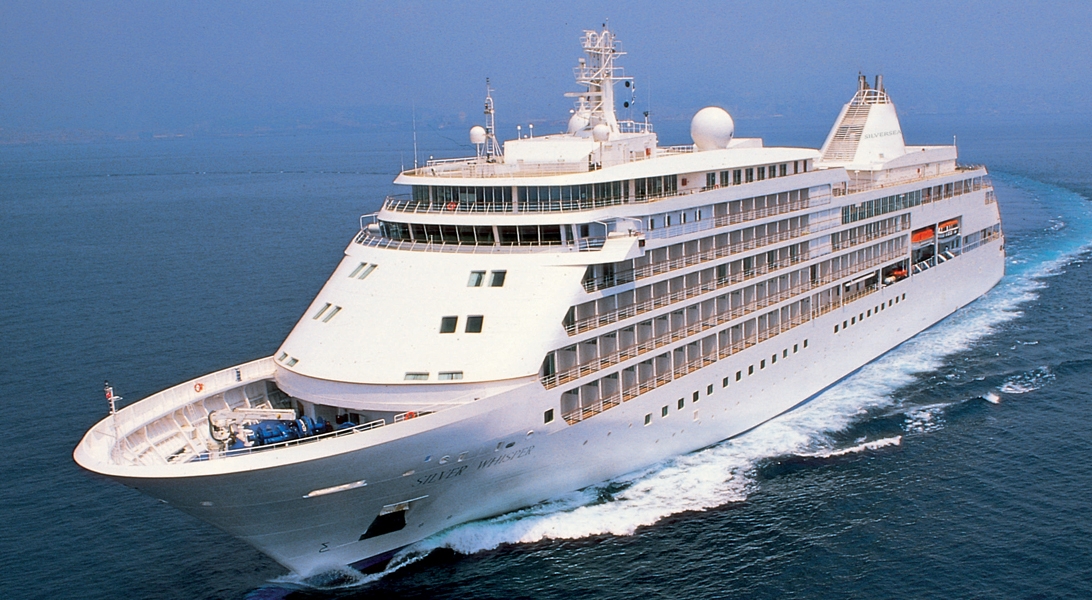
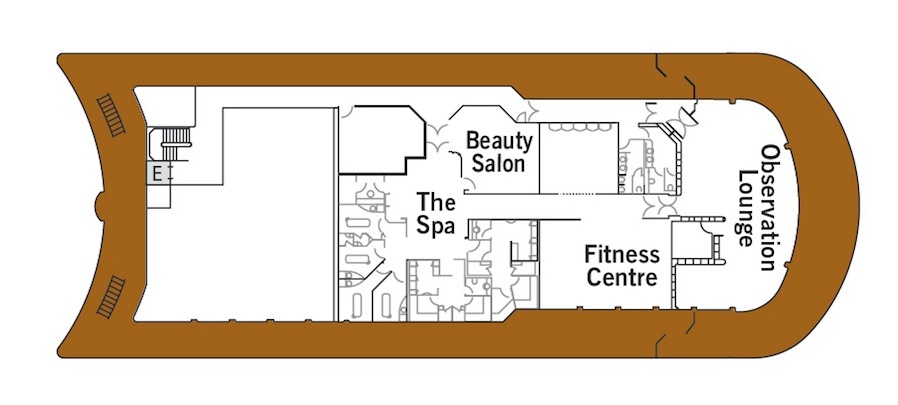

The images shown are for illustration purposes only and may not be an exact representation of what you find on the ship.
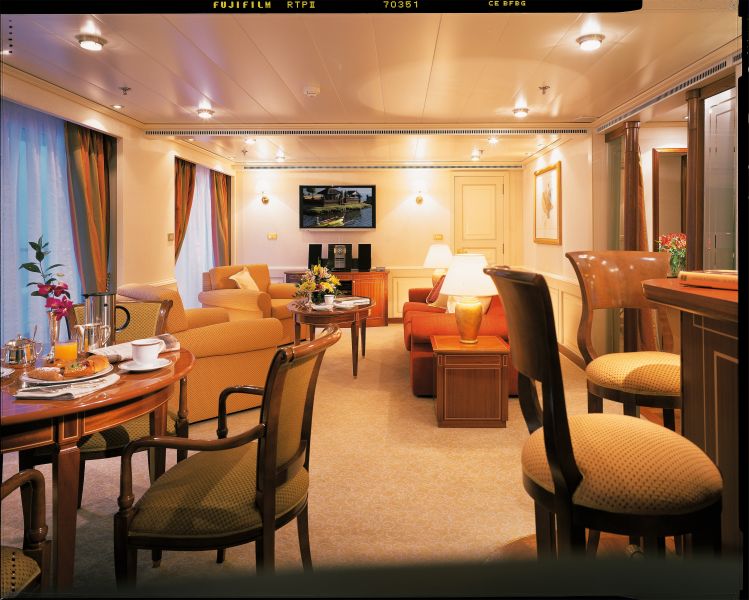
The name says it all. A stylish apartment. Prestigious and classic, as is the Silver Whisper itself. For those who seek the superlative level of space, comfort and service on board. Available as a one-bedroom configuration or as two-bedrooms (as illustrated) by adjoining with a Vista Suite.
One bedroom: 85 sq.m. including veranda
Two bedroom: 117 sq.m. including veranda
Please note that the 3rd guest will sleep on a comfortable sofa bed in the reception area of the suite.
Essentials
Characteristics
Furniture
Media & Communication
Onboard Services
Amenities
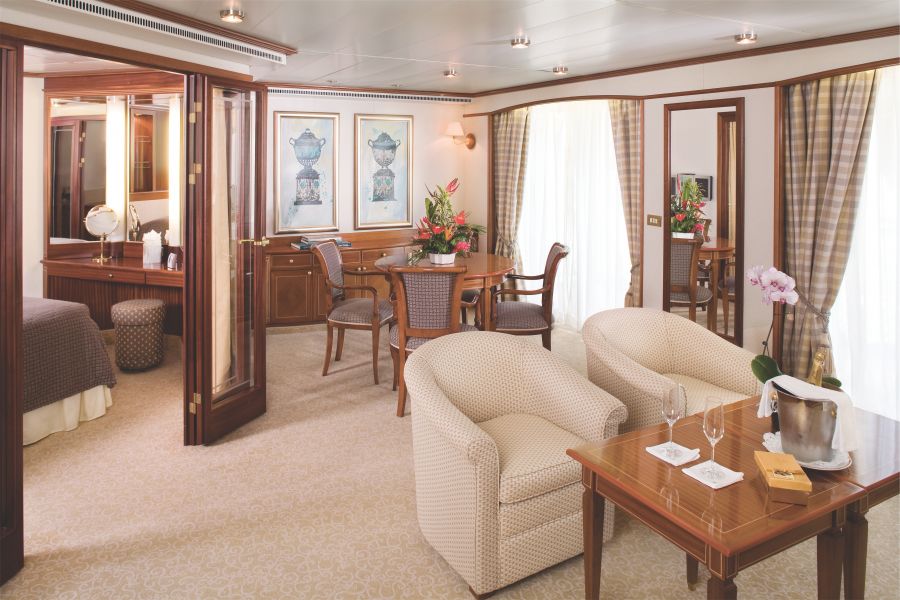
Stylish and sophisticated. Separate dining and living rooms. Larger verandas. Situated midship. Perfection in design for comfortable living. Silver Suites accommodate three guests.
One bedroom: 61-65 sq.m. including veranda
Please note that the 3rd guest will sleep on a comfortable sofa bed in the reception area of the suite.
Essentials
Characteristics
Furniture
Media & Communication
Onboard Services
Amenities
The images shown are for illustration purposes only and may not be an exact representation of what you find on the ship.
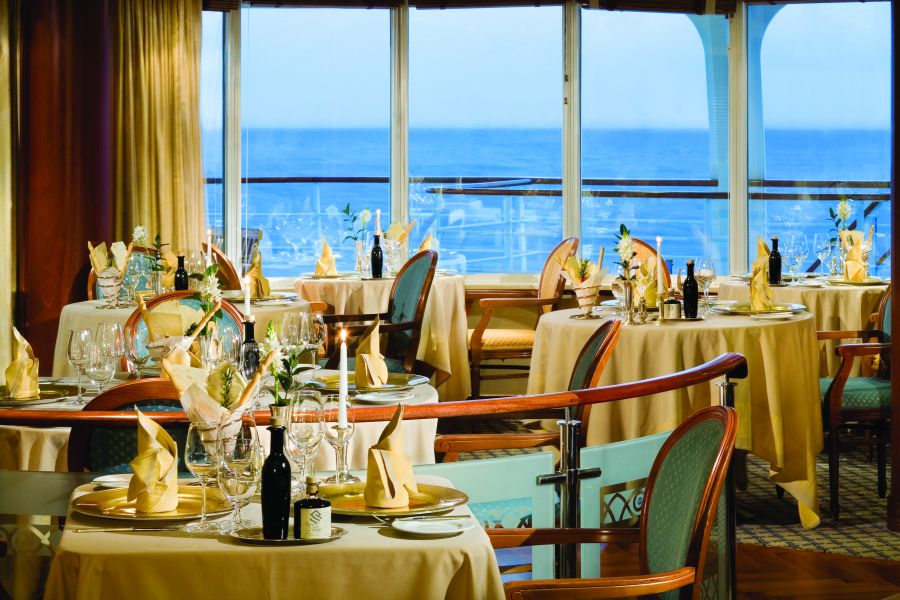
Authentic Italian recipes and the freshest, sustainable ingredients come together in this restaurant at sea.
On board this luxury cruise ship a divine selection of Italy’s best cuisine is served à la carte in La Terrazza. Authentic recipes and the freshest ingredients come together with flair and passion aboard this luxury cruise — a flavourful expression of Silversea’s distinctive Italian heritage. La Terrazza uses buffalo mozzarella from Naples, organic balsamic vinegar and olive oil from Umbria, and air-dried ham out of Parma. The Emilia-Romagna region also produces Silversea’s 24-month aged Parmigiano Reggiano, while the pasta is made daily right on board. La Terrazza is open for casual, buffet-style breakfast and lunch with indoor or al fresco dining on the outdoor terrace. During the evening, La Terrazza transforms into an à la carte traditional Italian restaurant.
Open-seating for breakfast and lunch.
Seating is limited for dinner and reservations are recommended.
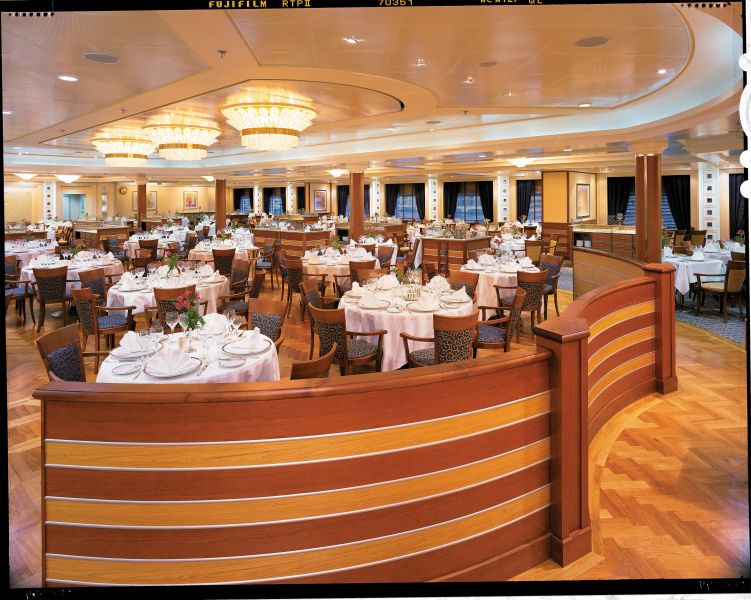
Enjoy Continental and regional specialities, as well as sweeping ocean views in our main dining room.
Sparkling with silver, crystal and candlelight, this luxury cruise ship’s main dining room serves contemporary, international cuisine with sophisticated elegance and impeccable service. Menus feature regional specialities unique to the voyage destination, for example, Roasted Chilean Sea Bass while cruising the Chilean fjords and Indian Chicken Korma en route to Mumbai. The Restaurant on board this luxury cruise ship offers open-seating dining, which means there are no assigned times, no assigned tables. You are free to dine when, where and with whom you please.
The images shown are for illustration purposes only and may not be an exact representation of what you find on the ship.
The images shown are for illustration purposes only and may not be an exact representation of what you find on the ship.
The images shown are for illustration purposes only and may not be an exact representation of what you find on the ship.


Our Fusion packages are all ABTA & ATOL protected ensuring that your booking is safe with us
| 126 nights aboard the Silver Whisper | |||
| Butler Service in Every Suite | |||
| Gratuities Always Included | |||
| Beverages In-Suite and Throughout the Ship | |||
| Gourmet Dining | |||
| In Suite Dining & 24-Hour Room Service | |||
| Intimate small size ships | |||
| Free Wifi Throughout the Ship | |||
| Free Zodiac, Land and Sea Tours & Activities & Complimentary Expedition gear | |||
| Port Taxes and Fees | |||
 | ABTA and ATOL Protection* | ||
Date 5th Jan 2029 |
Nts 126 |
Please Call for Availability |
Date 5th Jan 2029 |
Nts 126 |
Please Call for Availability |
Fusion Holidays when selling travel arrangements is a trading name of Co-op Travel Services Limited, registration 08903986. Fusion Cruises is an Accredited Body Member of Co-op Travel Services Limited ATOL 12904.
Book with Confidence. We are a Member of ABTA which means you have the benefit of ABTA’s assistance and Code of Conduct.
Some of the flights and flight-inclusive holidays on this website are financially protected by the ATOL scheme but ATOL protection does not apply to all holiday and travel services offered on this website. This website will provide you with information on the protection that applies in the case of each holiday and travel service offered before you make your booking. If you do not receive an ATOL Certificate then the booking will not be ATOL protected. If you do receive an ATOL Certificate but all parts of your trip are not listed on it, those parts will not be ATOL protected. Please see our booking conditions for information, or for more information about financial protection and the ATOL Certificate go to: www.caa.co.uk